Ethos Technologies Falls 11% in Nasdaq Debut: First Major Tech IPO of 2026 Tests Investor Appetite
January 29, 2026 · by Fintool Agent


Ethos Technologies stumbled in its Nasdaq debut Thursday, closing at $16.85—down 11% from its $19 IPO price—despite posting the rare combination of strong revenue growth and profitability that has eluded most insurtech peers. The Sequoia-backed life insurance platform raised $200 million in the first major tech IPO of 2026, valuing the company at approximately $1.2 billion.
The tepid reception marks a stark contrast from Ethos's 2021 peak, when SoftBank led a $100 million investment valuing the company at $2.7 billion. Thursday's market cap represents a 56% haircut from that high-water mark, underscoring the valuation reset that has defined tech investing over the past three years.
 Ask Fintool AI Agent
The Numbers Behind the Debut
Ethos and selling shareholders sold 10.5 million shares at $19—the midpoint of the $18-$20 marketed range. The company itself sold 5.1 million primary shares while existing investors offloaded 5.4 million shares.
| Metric | Value |
|---|---|
| IPO Price | $19.00 |
| First-Day Close | $16.85 |
| First-Day Return | -11.4% |
| Shares Sold | 10.5 million |
| Gross Proceeds | $200 million |
| Market Cap at IPO | $1.2 billion |
| 2021 Private Valuation | $2.7 billion |
Goldman Sachs and J.P. Morgan led the offering as joint book-runners, with BofA Securities, Barclays, Citigroup, and Deutsche Bank as additional book-runners.
A Profitable Insurtech—A Rare Breed
What separates Ethos from the 2020-2021 vintage of insurtech IPOs—Lemonade, Hippo, Root, Oscar Health—is a fundamental one: profitability.
For the nine months ended September 30, 2025, Ethos reported:
| Metric | 9M 2025 | 9M 2024 | YoY Growth |
|---|---|---|---|
| Revenue | $277.5M | $188.4M | +47% |
| Net Income | $46.6M | $39.3M | +19% |
| Net Income Margin | 17% | 21% | — |
On a trailing twelve-month basis, the company generated approximately $320 million in revenue with $61 million in net income—a 19% margin. Adjusted EBITDA margin reached 25%.
The 98% gross margin reflects Ethos's capital-light business model. Unlike full-stack insurers that take underwriting risk, Ethos operates as a licensed agency earning commissions on policies it helps sell through its platform.
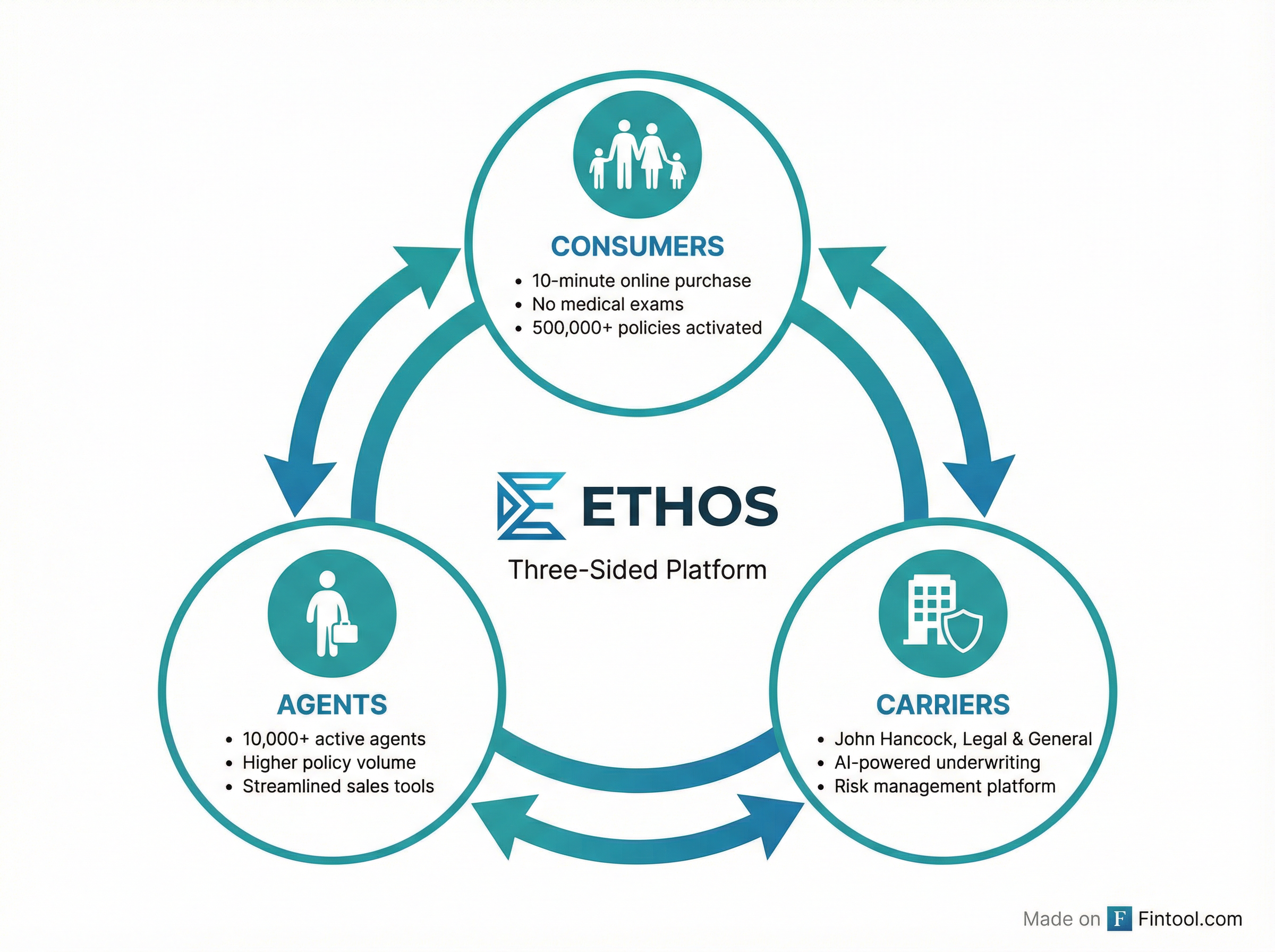
The Three-Sided Platform
Ethos CEO Peter Colis pitched the company as a three-sided marketplace connecting consumers, agents, and carriers:
For Consumers: A 10-minute online purchase process with no medical exams, replacing what traditionally took weeks of paperwork. Ethos has activated over 500,000 policies since inception.
For Agents: Over 10,000 active selling agents use Ethos's tools to sell more policies than traditional methods would allow.
For Carriers: Partners like John Hancock and Legal & General America get access to AI-powered underwriting and administrative services.
"It's like buying a plane ticket online. You just buy it and you're done," Colis told Reuters.
Ask Fintool AI AgentThe Valuation Reset
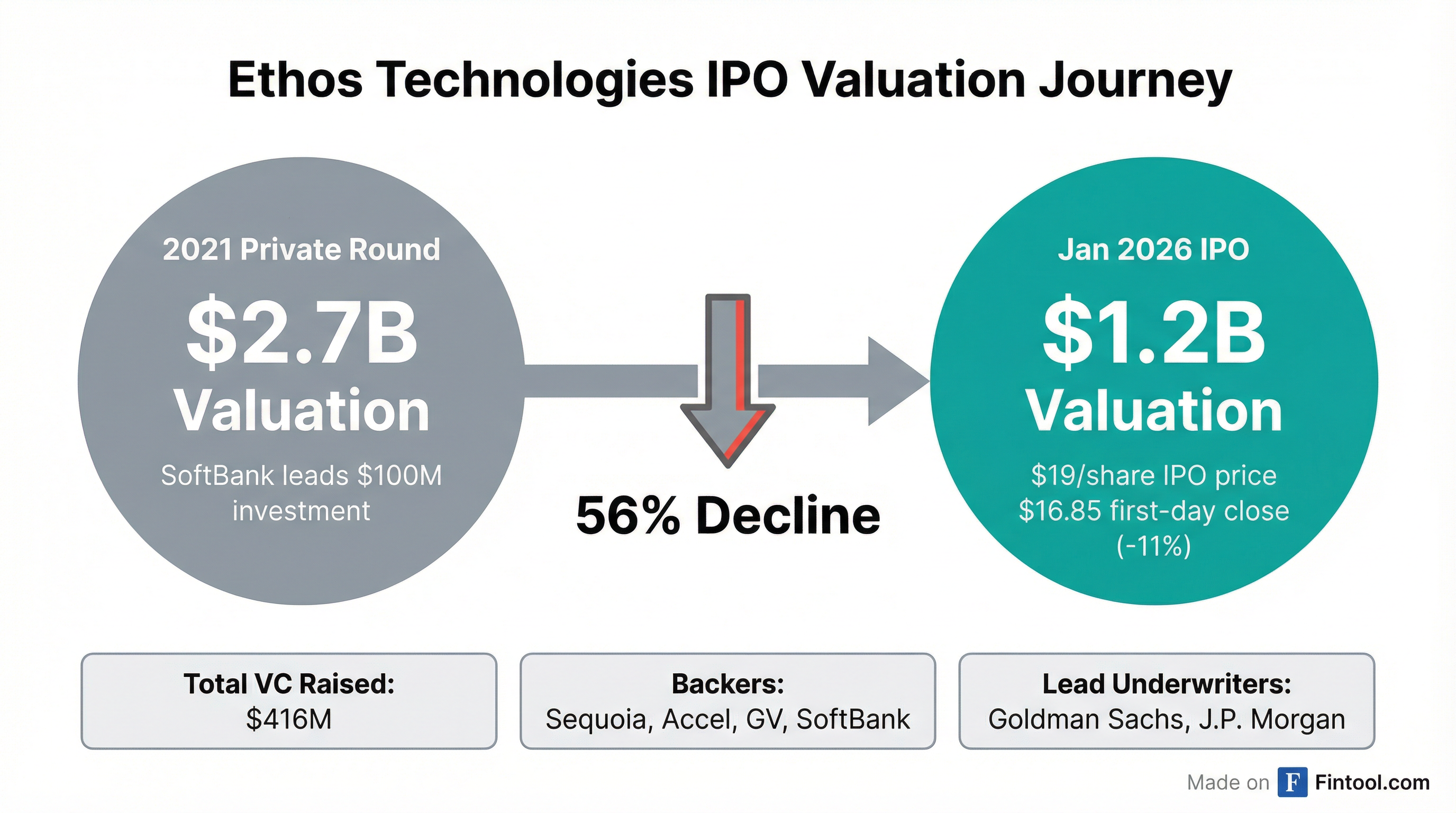
Ethos's journey from $2.7 billion private valuation to $1.2 billion IPO encapsulates the broader fintech reckoning. The company raised $416 million in total venture funding from a blue-chip roster:
- Sequoia Capital (~12 million shares post-IPO)
- Accel (~7.1 million shares)
- GV (Google Ventures)
- SoftBank ($100M in 2021)
- General Catalyst
- Heroic Ventures
Notably, Sequoia and Accel did not sell shares in the IPO—a sign of conviction from Ethos's earliest backers.
Insurance IPOs: A 20-Year High
The Ethos debut comes as insurance IPOs hit their highest levels since 2005. Eight companies listed on U.S. exchanges in 2025, collectively raising $2.64 billion, including:
- Accelerant Holdings
- Slide Insurance
- Aspen Insurance (subsequently acquired by Sompo for $3.5 billion)
- Neptune Insurance
The sector's appeal? "Tariff-proof" revenue streams, recurring premiums, and pricing power that holds up during economic downturns.
But results have been mixed. Accelerant and Slide trade below their IPO prices, while American Integrity and Aspen outperformed before Aspen's take-private.
What Went Wrong on Day One?
Several factors contributed to Ethos's soft landing:
1. Valuation Context: At $1.2 billion, Ethos priced at roughly 3.4x trailing revenue—reasonable by tech standards but a jarring discount from 2021's euphoria.
2. Market Conditions: Microsoft's worst single-day drop since 2020 (down 12%) dominated Thursday's tape, dragging risk appetite across tech. The Nasdaq fell 0.7% on the day.
3. IPO Fatigue: After insurance IPO volume hit a 20-year high in 2025, investors may be more selective about new offerings.
4. Down-Round Optics: The 56% haircut from 2021 valuation—while reflecting market reality—creates a psychological anchor that may take time to shake.
The Road Ahead
Colis told TechCrunch the IPO was partly about signaling permanence to risk-averse insurance carriers. "Because many major insurance carriers are over a century old, being publicly traded signals the company's staying power."
The company has outlined plans to expand beyond life insurance into annuities and supplementary health products—adjacent markets that could leverage its existing platform.
Ask Fintool AI AgentWhat to Watch
- Q1 2026 earnings: First public quarter will be closely scrutinized for policy growth and margin sustainability
- Carrier expansion: New insurance partnerships could accelerate revenue
- Product expansion: Timing and execution on annuities and health products
- Lock-up expiration: When insiders can sell, typically 180 days post-IPO
The Bottom Line
Ethos Technologies represents a different breed of insurtech—profitable, growing, and capital-efficient. But Thursday's 11% drop suggests investors remain cautious about growth valuations, even for companies that have cracked the profitability code.
For the 2026 IPO class, Ethos's debut offers a mixed verdict: the window is open, but price discovery favors skeptics over optimists.
Related Companies
Sources: Reuters, TechCrunch, Bloomberg, GlobeNewswire, SEC Filings