EU and India Seal 'Mother of All Deals': $27 Trillion Free Trade Zone Reshapes Global Trade
January 27, 2026 · by Fintool Agent

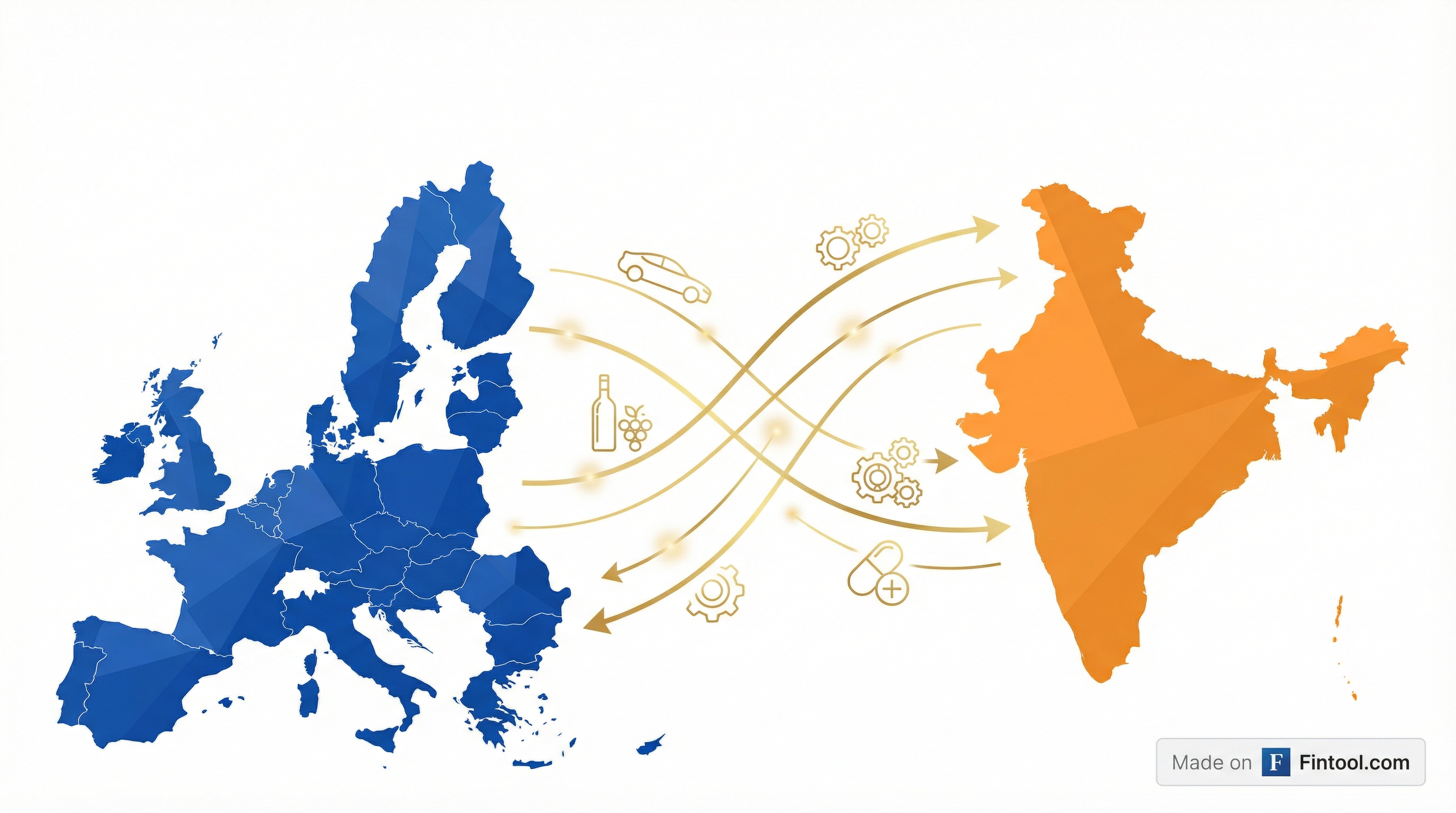
The European Union and India finalized the largest free trade agreement in either side's history on Tuesday, creating a market of 2 billion people worth $27 trillion in combined GDP—roughly 25% of the global economy. The deal, which Prime Minister Narendra Modi called "the mother of all deals," slashes tariffs on automobiles from 110% to 10%, eliminates duties on most pharmaceuticals and chemicals, and opens India's vast consumer market to European wines, machinery, and industrial goods.
The timing is no coincidence. After nearly two decades of on-and-off negotiations, the deal came together in months following President Trump's 50% tariff on Indian goods and escalating trade tensions with European allies. For investors, the agreement marks a fundamental shift in global trade architecture—middle powers are actively building alternative commercial networks to reduce dependence on an increasingly unpredictable United States.
 Ask Fintool AI Agent
What's in the Deal
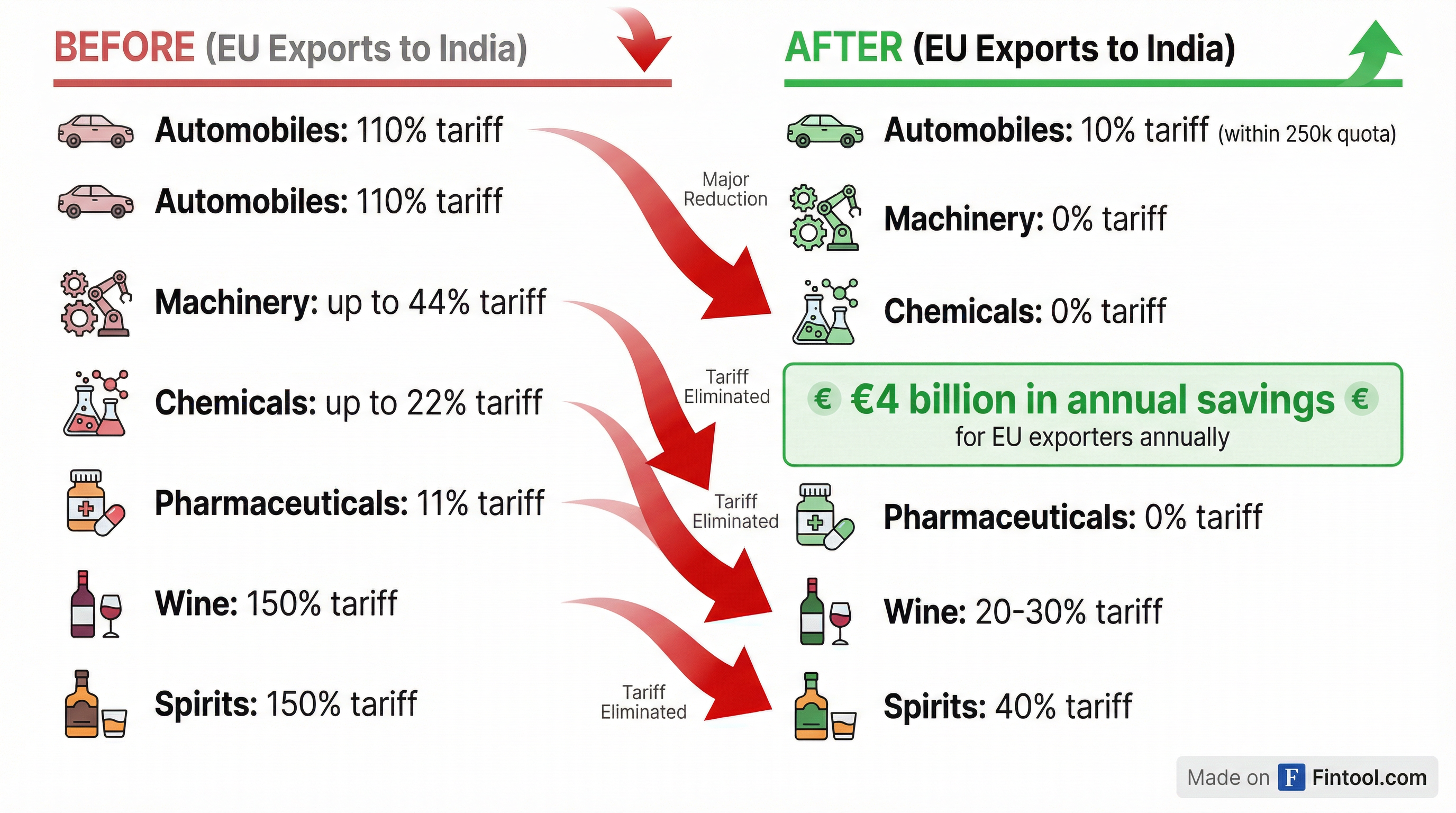
The agreement eliminates or reduces tariffs on 96.6% of EU goods exports to India and 99.5% of Indian goods entering the EU over seven years. For European companies, that translates to an estimated €4 billion in annual duty savings.
The most dramatic changes hit the automotive sector. India's tariffs on European cars will plunge from 110% to just 10% within a quota of 250,000 vehicles annually—by far the biggest opening India has ever granted to foreign automakers. Currently, the EU exports only about 3,000 cars per year to India because existing tariffs effectively price out European manufacturers.
"The Indian auto market is heavily dominated by domestic players, which will be difficult to disrupt, but this gives European auto manufacturers a fighting chance," said Michael Field, chief equity strategist at Morningstar.
Key tariff reductions for EU exports:
| Sector | 2024 EU Exports | Current Tariff | Future Tariff | Timeline |
|---|---|---|---|---|
| Machinery & Equipment | €16.3B | Up to 44% | 0% | Mostly immediate |
| Automobiles | €1.6B | 110% | 10% (250k quota) | 5 years |
| Chemicals | €3.2B | Up to 22% | 0% | Immediate |
| Pharmaceuticals | €1.1B | 11% | 0% | 5-7 years |
| Wine | - | 150% | 20-30% | Phased |
| Spirits | - | 150% | 40% | 7 years |
Source: European Commission
For Indian exporters, the deal removes barriers on textiles, leather goods, chemicals, marine products, gems, and jewelry. The EU will cut tariffs to zero on these goods, providing a critical outlet as Indian products face 50% US tariffs.
The Geopolitical Calculus
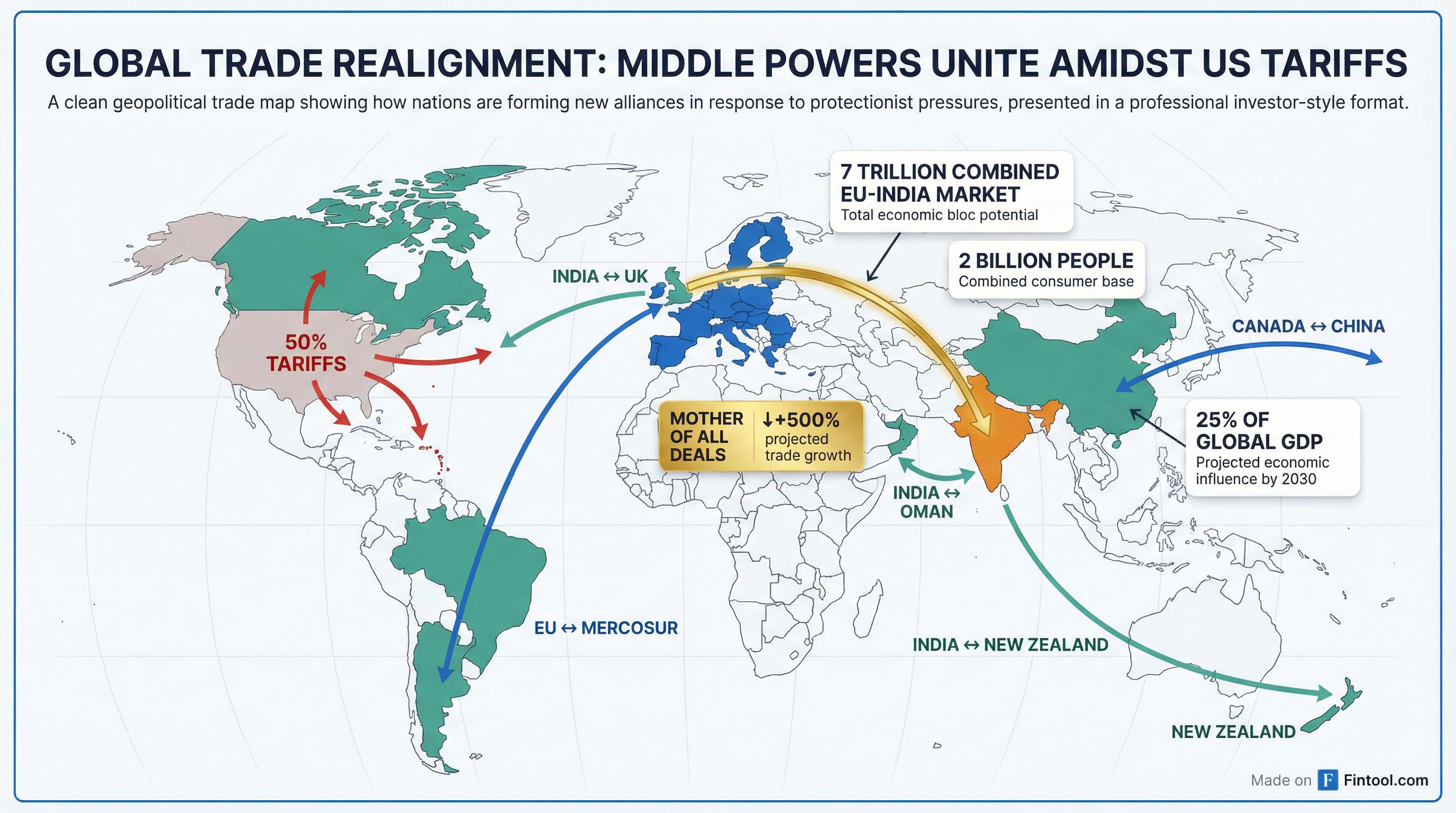
This isn't just a trade agreement—it's a geopolitical statement. Both the EU and India are explicitly positioning the deal as a response to Washington's aggressive trade tactics.
"The negotiations gained momentum after Washington imposed a 50% tariff on some Indian goods, and as U.S. allies pushed back against President Donald Trump's tariff threats and his bid to take over Greenland," Reuters reported.
The deal follows a flurry of trade activity by both parties:
- EU: Finalized agreements with Mercosur, Indonesia, Mexico, and Switzerland in recent months
- India: Signed deals with the UK, New Zealand, and Oman since May 2025
Canadian Prime Minister Mark Carney's Davos speech last week—in which he urged middle powers to unite against economic coercion—received a standing ovation. He's now planning to visit India to sign deals on uranium, energy, and minerals after recently striking a historic deal with China.
Ask Fintool AI AgentWinners and Losers
Clear Winners:
-
European automakers (Volkswagen, BMW, Mercedes-benz, Renault): Access to the world's fourth-largest and fastest-growing car market. India sold over 5 million vehicles in 2023.
-
European pharma: The €1.1B in annual pharmaceutical exports will see 11% tariffs eliminated over 5-7 years.
-
European spirits and wine producers: Access to India's rapidly growing middle class. Tariffs drop from 150% to 20-40%.
-
Indian textiles, gems, and leather: Zero EU tariffs provide a critical alternative market to the tariff-burdened US.
-
Infosys and Indian IT services: The deal includes the "most ambitious commitments on financial services by India in any trade agreement," opening opportunities for IT outsourcing to EU financial institutions.
Potential Losers:
-
Indian domestic automakers: Will face increased competition from European luxury brands, though the 250,000 vehicle quota limits exposure. Maruti Suzuki, Tata Motors, and Mahindra dominate domestically.
-
EU steel producers: India secured a 1.6 million metric ton duty-free steel quota, though this is about half of what India currently exports to the EU.
What's Not in the Deal
The agreement excludes several politically sensitive areas:
- Beef, rice, sugar, dairy, and poultry: Protected on both sides
- Carbon border tax exemption: India did not receive an exemption from the EU's Carbon Border Adjustment Mechanism (CBAM), though it secured a commitment that it will receive any flexibility granted to third countries
- Geographical Indications: Being negotiated separately
The EU committed €500 million over two years to help India reduce greenhouse gas emissions, partially addressing CBAM concerns.
Ask Fintool AI AgentMarket Reaction
European auto stocks initially dipped 1% on Tuesday as investors digested the details, though German engineering association VDMA called it "a day of celebration for export-oriented mechanical engineering."
"Export-oriented mechanical and plant engineering needs rule-based trade like it needs air to breathe. The free trade agreement between India and the EU brings much-needed oxygen to a world increasingly dominated by trade conflicts," said Thilo Brodtmann, VDMA executive director.
The muted initial reaction reflects investor caution—the deal still requires EU Parliament ratification, and the EU-Mercosur agreement faces legal challenges. Implementation is expected within a year following 5-6 months of legal vetting.
What to Watch
Near-term catalysts:
- EU Parliament ratification proceedings (potential political hurdles similar to Mercosur)
- Steel quota negotiations due by June 30 before new EU rules take effect July 1
- Geographic Indications side agreement
Medium-term implications:
- Whether the quota of 250,000 vehicles gets expanded as the Indian market grows
- How quickly European automakers can scale up Indian distribution
- Impact on India-US trade relations as New Delhi pivots toward Europe
The bigger picture:
- This deal is part of a broader realignment of global trade away from US-centric architecture
- Watch for similar moves by other middle powers feeling squeezed by Washington's tariff policies
- Modi is now pursuing deals with Mercosur, Chile, Peru, and the Gulf Cooperation Council
"This is the most comprehensive trade deal India has ever signed, which gives European companies a first mover advantage into this market and gives them a strategic upper hand that other players do not," said Garima Mohan, senior fellow at the German Marshall Fund.