Fidelity Enters Stablecoin Wars With FIDD, Joining Tether's US Push
January 28, 2026 · by Fintool Agent



Fidelity Investments is launching its own stablecoin, making the $5.9 trillion asset manager one of the first traditional financial giants to issue a digital dollar and intensifying competition in a market that's become Wall Street's newest battleground.
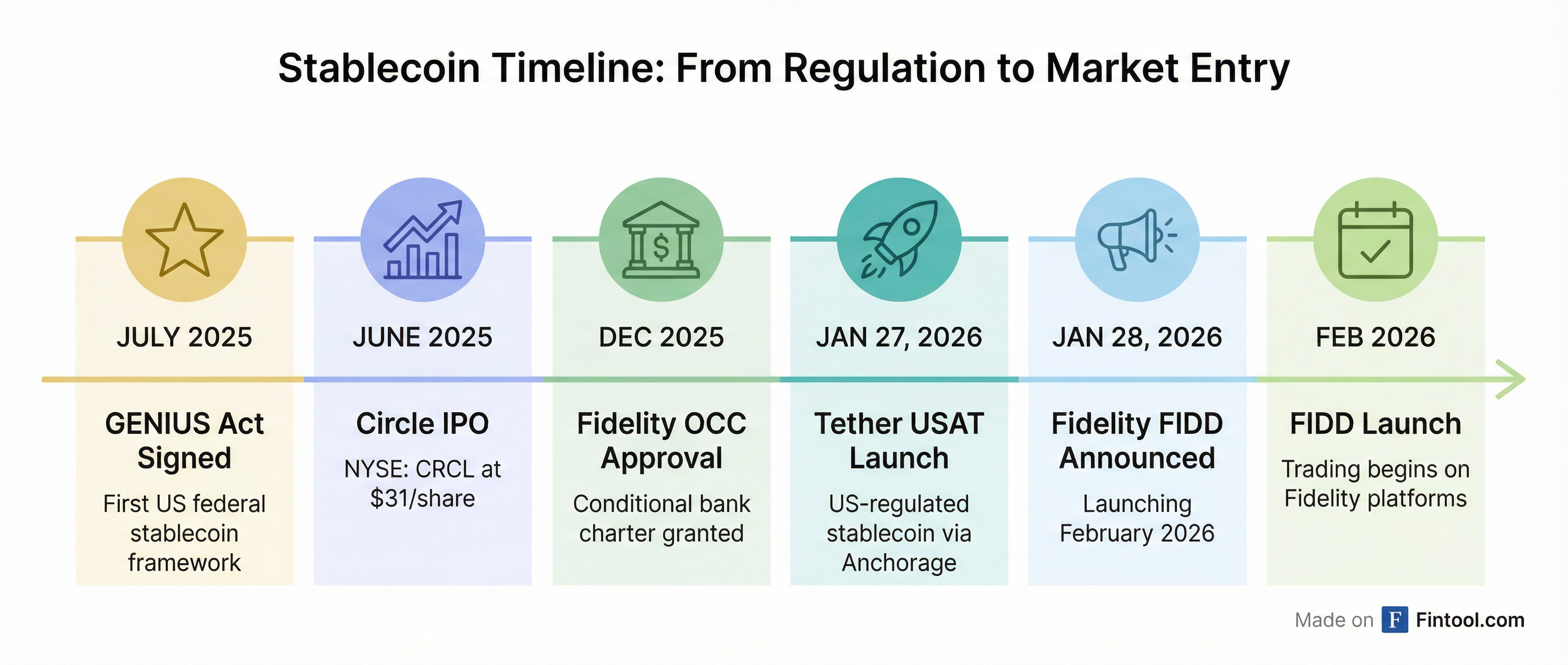
The Fidelity Digital Dollar, or FIDD, will launch in early February on the Ethereum blockchain, available to both retail and institutional clients through Fidelity's crypto platforms and major exchanges. The announcement comes just one day after Tether—the world's largest stablecoin issuer—launched its own U.S.-compliant token, USAT, signaling that the race for America's digital dollar market has officially begun.
"This is really just the next step in the evolution of our digital asset platform," said Mike O'Reilly, president of Fidelity Digital Assets. "The ability to offer a fiat-backed stablecoin fits naturally into what our clients are asking for—especially around low-cost payments and settlement."
 Ask Fintool AI Agent
The Structure: A Bank-Issued Digital Dollar
FIDD will be issued by Fidelity Digital Assets, National Association—a federally chartered national bank that received conditional approval from the Office of the Comptroller of the Currency (OCC) in December 2025. This regulatory status places FIDD squarely within the federal banking system, a key differentiator from offshore-issued competitors.
The stablecoin will be backed 1:1 by reserves consisting of:
- Cash and cash equivalents
- Short-term U.S. Treasury securities
- Reserves managed by Fidelity Management & Research Company LLC
This reserve structure aligns with the GENIUS Act's requirements for payment stablecoins, which mandate 100% backing with liquid assets and monthly public disclosures of reserve composition.
FIDD is designed for two primary use cases:
- 24/7 institutional settlement — enabling round-the-clock trading and settlement for institutional clients
- On-chain retail payments — allowing consumers to transact using a dollar-backed digital currency
The token can be transferred to any Ethereum mainnet address, enabling integration with decentralized finance (DeFi) protocols and blockchain-based platforms—a capability that could make FIDD a building block for broader financial infrastructure.
A Crowded Field Gets More Competitive
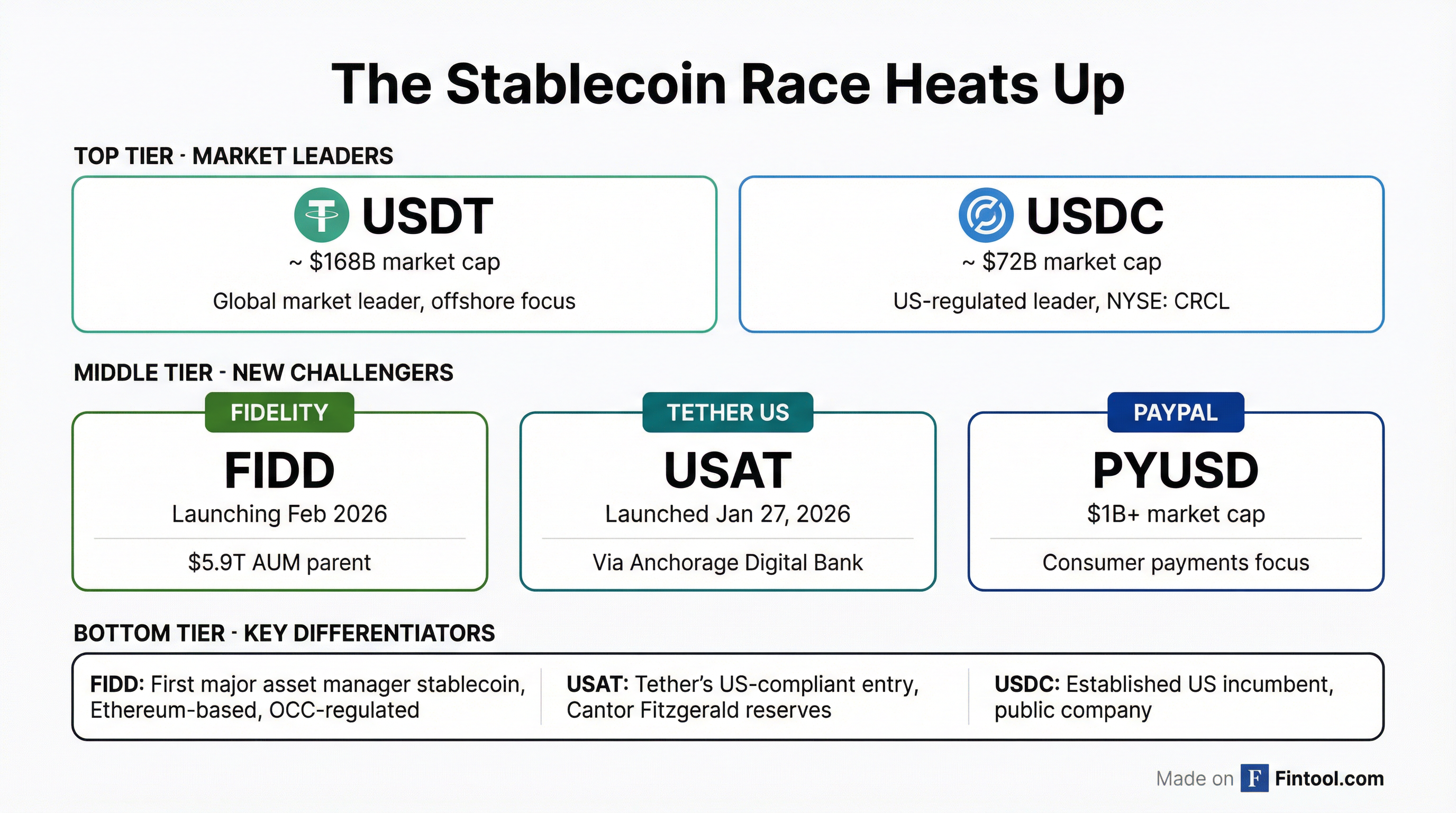
Fidelity's entrance puts it in direct competition with established players in a market now worth over $315 billion:
| Issuer | Stablecoin | Market Cap | Status |
|---|---|---|---|
| Tether | USDT | $168B | Global leader, offshore |
| Circle | USDC | $72B | U.S. incumbent, NYSE: CRCL |
| Tether | USAT | New | U.S.-regulated, via Anchorage |
| Fidelity | FIDD | New | Launching Feb 2026 |
| PayPal | PYUSD | $1B | Consumer payments |
The timing is notable. Tether launched USAT on January 27, 2026—just one day before Fidelity's announcement—issued through Anchorage Digital Bank with Cantor Fitzgerald serving as reserve custodian. Commerce Secretary Howard Lutnick, formerly Cantor Fitzgerald's CEO, has been one of Tether's most vocal supporters on Wall Street.
"USAT offers institutions an additional option: a dollar-backed token made in America," said Tether CEO Paolo Ardoino.
For Circle, which has dominated the U.S. regulated stablecoin market since its June 2025 IPO at $31 per share (the stock later soared to nearly $299 before retreating), the new entrants represent significant competitive pressure. Circle's USDC has been the go-to stablecoin for U.S. institutions due to its transparency and regulatory alignment.
Ask Fintool AI AgentWhy Fidelity, Why Now?
Fidelity's move into stablecoins builds on a decade-long crypto journey that began with Bitcoin mining at its offices in 2014 under CEO Abigail Johnson. The firm launched institutional Bitcoin custody in 2018—four years before the next major traditional player, BNY Mellon—and rolled out Bitcoin and Ethereum ETPs following SEC approvals.
The regulatory landscape has shifted decisively in Fidelity's favor. The GENIUS Act, signed by President Trump in July 2025, established the first comprehensive federal framework for stablecoins, requiring:
- 100% reserve backing with liquid assets like U.S. dollars or short-term Treasuries
- Monthly public disclosures of reserve composition
- Compliance with Bank Secrecy Act anti-money laundering requirements
- Technical capability to freeze or seize tokens when legally required
For issuers with over $10 billion in circulation, federal supervision is mandatory. Smaller issuers may operate under certified state regimes, but the law creates a clear path for banks like Fidelity Digital Assets to enter the market with federal backing.
O'Reilly framed FIDD as infrastructure for future innovation: "Having a stablecoin within our ecosystem opens the door for other financial services to be built on-chain, by us and others. It becomes a building block for more efficient infrastructure."
Competitive Advantages and Challenges
Fidelity brings unique strengths to the stablecoin race:
Advantages:
- Scale — $5.9 trillion in assets under management provides massive distribution and trust
- Ecosystem — Integration with Fidelity Digital Assets, Fidelity Crypto, and Fidelity Crypto for Wealth Managers
- Track record — A decade of digital asset experience and first-mover status in institutional crypto custody
- Private ownership — O'Reilly has highlighted Fidelity's private structure as enabling long-term strategic bets without quarterly earnings pressure
Challenges:
- Network effects — USDC and USDT have deep liquidity and integrations across DeFi
- First-mover disadvantage — PayPal and Ripple launched stablecoins but neither has captured even 10% of Circle's market cap
- Interest rate sensitivity — Lower rates reduce returns on reserve assets, compressing margins
What to Watch
FIDD's success will depend on several factors:
- Exchange adoption — Will major crypto exchanges list FIDD alongside USDC and USAT?
- DeFi integration — Can FIDD achieve meaningful adoption in decentralized protocols?
- Institutional uptake — Will hedge funds and asset managers prefer Fidelity's brand to Circle's?
- Layer 2 expansion — Fidelity said it may explore additional blockchains beyond Ethereum
For Circle shareholders, the competitive threat is real but perhaps overstated. Circle has projected 40% compound annual growth in USDC circulation, and CEO Jeremy Allaire has called the regulatory clarity from the GENIUS Act a "pivotal moment" for his company.
For the broader crypto ecosystem, Fidelity's entry validates stablecoins as core financial infrastructure. When one of the world's largest asset managers bets on blockchain-based digital dollars, it signals that the technology has graduated from experiment to essential.
Ask Fintool AI Agent