First Citizens, Flush From SVB Deal, Weighs KeyCorp for Next Mega-Merger
February 20, 2026 · by Fintool Agent


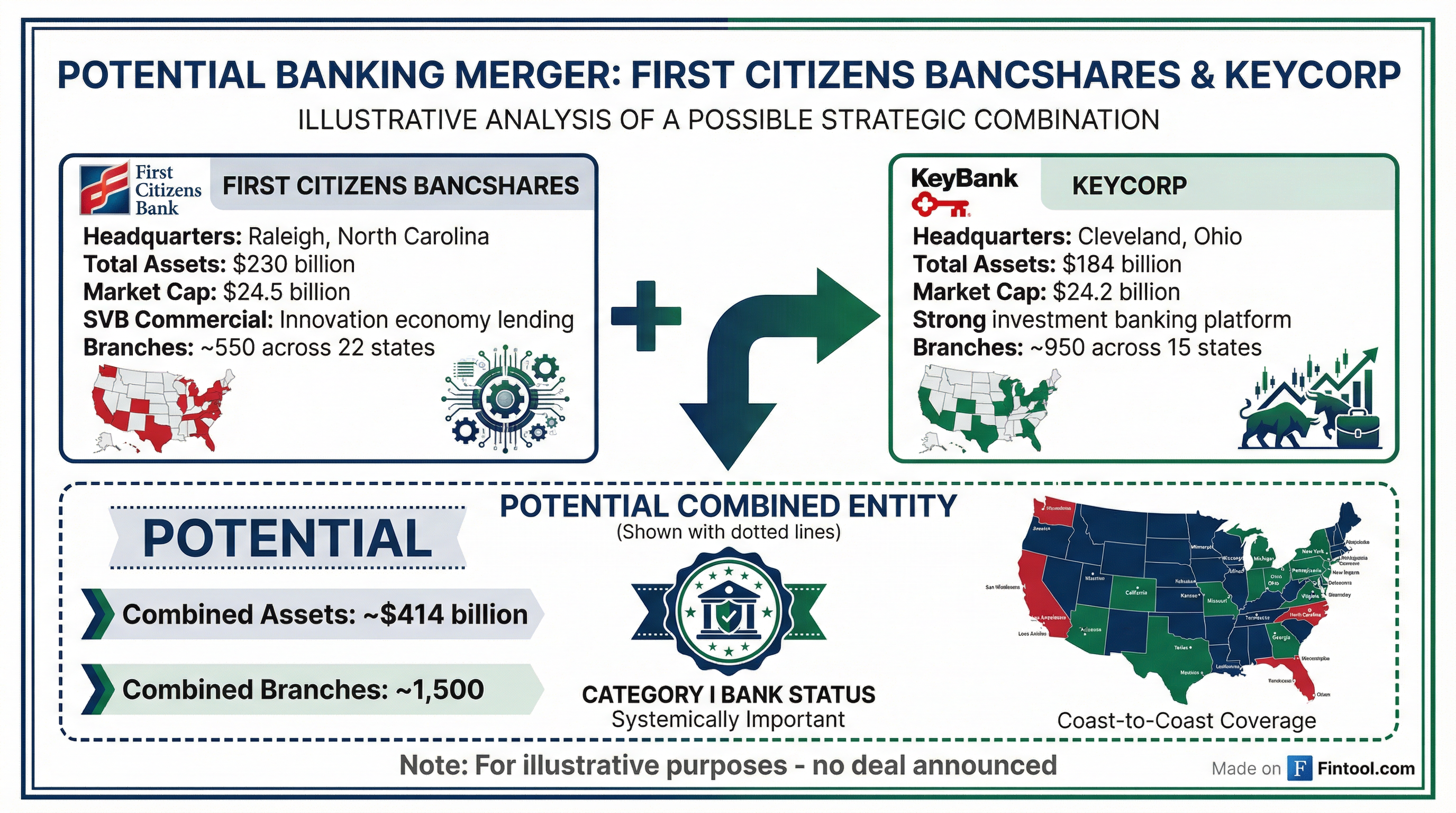
First Citizens Bancshares, the Raleigh-based regional bank that emerged as the surprise winner of Silicon Valley Bank's assets in 2023, is once again hunting for transformative M&A. The company has asked advisers to draw up a list of potential deal targets that would help it vault over the critical $250 billion asset threshold—and Cleveland's Keycorp has emerged as a leading candidate, according to people familiar with the discussions.
KeyCorp shares gained on the news, as investors weighed the possibility of a premium bid for the 200-year-old institution.
The Math: Creating a $400B+ Banking Giant
A combination of First Citizens and KeyCorp would create one of the largest regional banks in the United States, with combined assets exceeding $400 billion and a coast-to-coast branch footprint.
| Metric | First Citizens | KeyCorp | Pro Forma Combined |
|---|---|---|---|
| Total Assets (Q4 2025) | $230B | $184B | $414B |
| Total Equity | $22.2B | $20.4B | $42.6B |
| Market Cap | $24.5B | $24.2B | $48.7B |
| Net Income (Q4 2025) | $580M | $510M | $1.1B quarterly |
| Return on Equity | 10.5%* | 10.1% | TBD |
| Branch Network | 550 | 950 | 1,500 |
| Geographic Focus | Southeast + Tech Hubs | Midwest + Northeast | Coast-to-Coast |
*Values retrieved from S&P Global
The nearly identical market capitalizations suggest any deal would be structured as a merger of equals, though First Citizens' aggressive acquisition history and the Holding family's control of voting shares would likely position them as the acquirer.
 Ask Fintool AI Agent
Strategic Rationale: Scale and the $250 Billion Threshold

The primary driver behind First Citizens' M&A appetite is straightforward: regulatory economics. At $230 billion in assets, First Citizens sits just below the $250 billion threshold that triggers Category I bank status and the most stringent regulatory requirements under the Dodd-Frank Act.
"We're striving to meet Category III expectations," First Citizens CFO Craig Nix said on the company's January earnings call. "All of this is to meet regulatory requirements, improve our client experience."
The company has already made substantial investments in risk management infrastructure following the SVB acquisition. A larger asset base would spread these fixed compliance costs over more revenue, potentially improving efficiency ratios that currently sit in the "lower 60% range"—with a long-term goal of reaching the mid-50s.
KeyCorp would add several capabilities:
Investment Banking Platform: KeyBanc Capital Markets is one of the leading middle-market investment banks, with fee income growing 13% in 2025 despite muted M&A activity. The firm raised nearly $140 billion of capital for clients in 2025.
Commercial Payments: KeyCorp's payments business delivered 11% fee-equivalent revenue growth in 2025, with embedded banking capabilities that have been a strategic priority.
Wealth Management: Assets under management reached a record $70 billion at KeyCorp, with mass affluent being a particular growth focus.
The Scotiabank Complication
One factor investors are weighing: Bank of Nova Scotia already owns up to 14.99% of KeyCorp, with rights to increase its stake to 19.9% over the next five years following a 2024 investment.
However, analysts believe this minority stake doesn't preclude a full acquisition by another party. The Scotiabank agreement allows the Canadian bank to increase its holding gradually but doesn't appear to grant exclusivity or right of first refusal on a full acquisition.
"I don't believe this prevents another bank from buying KeyCorp if the bank were to be interested in selling," noted one analyst covering the regional banking sector.
KeyCorp's Stance: Focused on Organic Growth
KeyCorp has been explicit that bank acquisitions are not part of its strategy—at least as a buyer.
"That is not something we're focused on," CEO Chris Gorman said on the company's January earnings call, responding to questions about M&A appetite. "In spite of the fact that we have made some board changes, that doesn't change our philosophy of basically what our capital priorities are."
Those priorities center on organic growth: middle market lending, investment banking, wealth management, and commercial payments. KeyCorp has been hiring aggressively, adding nearly 10% to its frontline banker staff in 2025 and investing an additional $100 million in technology.
However, Gorman is 64 years old, and analysts have noted his change-in-control agreement would pay out approximately $35.7 million in the event of an acquisition. The board has also been in transition, with eight new directors added during Gorman's tenure as CEO and a new lead independent director (Todd Vassos of Dollar General) announced in January.
Ask Fintool AI AgentFirst Citizens' M&A Track Record
First Citizens has transformed itself through bold acquisitions. The family-controlled bank—led by Chairman and CEO Frank Holding—stunned the industry in March 2023 by outbidding larger rivals to acquire Silicon Valley Bank's $119 billion in assets from the FDIC at a steep discount.
That deal instantly transformed First Citizens from a $109 billion regional player into a major commercial banking force. The SVB Commercial unit has since been fully integrated into First Citizens' commercial bank segment, with Global Fund Banking loan production exceeding $5 billion in Q4 2025—"the highest since acquisition."
The company also acquired CIT Group in 2022, adding commercial lending and railcar leasing capabilities.
But the SVB deal came with obligations. First Citizens still owes the FDIC over $33 billion on the Purchase Money Note used to fund the acquisition. The company made its first $2.5 billion payment in December 2025 and expects to pay down $500 million to $1 billion monthly in 2026.
This debt servicing requirement is one reason First Citizens has been focused on deposit growth—including marketing its Direct Bank heavily—to fund both organic growth and note repayment.
What's Next
No formal discussions have been announced, and any deal would face significant regulatory scrutiny given the combined size. The process is still in the exploratory phase, with First Citizens working with advisers to identify the best strategic fit.
Key catalysts to watch:
- First Citizens Q1 2026 earnings (typically late April)
- KeyCorp Q1 2026 earnings
- Any Schedule 13D filings indicating stake accumulation
- Regulatory signals on large bank M&A appetite under current administration
For regional bank investors, the story represents the next phase of post-2023 banking crisis consolidation. First Citizens demonstrated during the SVB episode that it has both the appetite and capability to execute transformative deals. Whether KeyCorp's board and shareholders will find a premium compelling enough to abandon their organic growth path remains the central question.
Ask Fintool AI AgentRelated: