GlobalFoundries Acquires Synopsys ARC Processor IP, Uniting MIPS and ARC Under One Roof
January 14, 2026 · by Fintool Agent


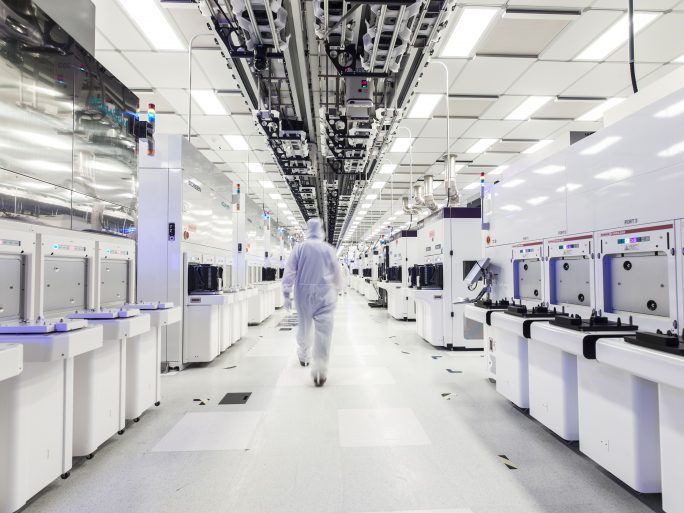
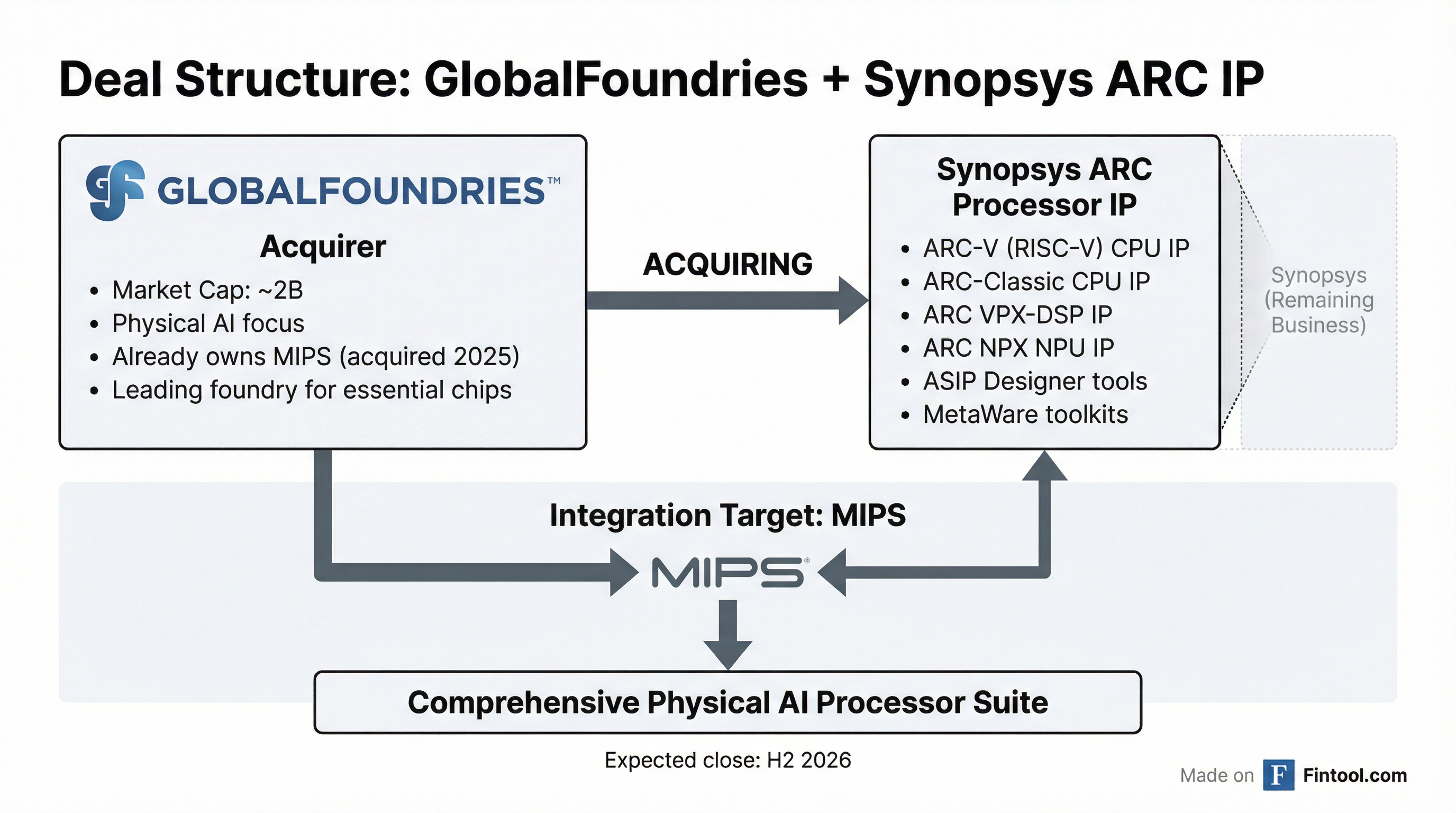
Globalfoundries is acquiring Synopsys' ARC Processor IP Solutions business, bringing two of the semiconductor industry's most storied processor architectures—MIPS and ARC—under the same roof for the first time. The deal, announced today, positions the foundry giant as a vertically integrated provider of Physical AI solutions from processor design through manufacturing.
GFS shares rose 1.2% to $41.35 on the news, extending a rally that has pushed the stock up 14% since announcing its MIPS acquisition in mid-2025.
What GlobalFoundries Is Getting
The acquisition encompasses Synopsys' complete processor IP portfolio:
| Product Line | Description |
|---|---|
| ARC-V | RISC-V compatible processor cores |
| ARC-Classic | Traditional 32-bit configurable cores |
| ARC VPX-DSP | Digital signal processor IP |
| ARC NPX NPU | Neural network processing unit IP |
| ASIP Designer | Application-specific processor design tools |
| MetaWare Toolkits | Software development environment |
The deal also includes Synopsys' teams of engineers and designers, who will join GlobalFoundries' MIPS organization upon close.
 Ask Fintool AI Agent
The Physical AI Strategy
GlobalFoundries CEO Tim Breen has been articulating a vision of "Physical AI"—the deployment of artificial intelligence into edge devices, autonomous vehicles, robotics, and IoT—since taking the helm. This acquisition accelerates that strategy by giving GFS control over critical processor IP.
"This acquisition doubles down on our commitment to advancing our leadership in Physical AI," Breen said in the announcement. "By combining Synopsys' ARC IP and MIPS technologies with GF's advanced manufacturing capabilities, we are lowering the barrier for customer adoption of the essential technologies that our customers need to innovate faster."
On the Q2 2025 earnings call, Breen explained the strategic rationale for processor IP ownership:
"MIPS has a long track record, a fantastic leadership team, really cutting edge IP in processes, really some strong advantages around multi-threaded cores, software and subsystems, particularly targeted at that physical AI space. And if you listen to industry pundits, people talk about things like everything that moves will be autonomous in the future. We strongly believe that."
The Revenue Model: IP Licensing Meets Foundry Services
GlobalFoundries CFO John Hollister quantified the opportunity during the MIPS acquisition discussion, providing a template for how ARC could contribute:
"We see this as a on a full year run rate basis in the neighborhood of a $50 million to $100 million addition of top line for GF... This will be IP-based high margin revenue stream for us, which over time can lead to greater hardware sales as well. And we see the revenue opportunity over the coming years getting into hundreds of millions of dollars of incremental revenue for GlobalFoundries, again which would be accretive to our gross margin."
The combined MIPS-ARC platform creates multiple revenue streams:
- IP Licensing Fees - Upfront and royalty payments for processor designs
- Development Tools - Recurring software subscriptions
- Wafer Revenue Pull-Through - Customers designing with GFS IP are more likely to manufacture at GFS fabs
Ask Fintool AI AgentWhy Synopsys Is Selling
For Synopsys, the divestiture reflects a strategic pivot toward higher-value opportunities. The EDA giant has been reshaping its portfolio since the Ansys acquisition, and CEO Sassine Ghazi has been explicit about focusing resources on interface and foundation IP rather than processor cores.
"We are focusing our IP resources and roadmap to further our leadership in essential interface and foundation IP while winning new, high-value opportunities that advance our position as the leading provider of engineering solutions from silicon to systems," Ghazi said in the announcement.
The company faced headwinds in its IP business throughout 2025, including China regulatory challenges and a key foundry customer that failed to deliver expected returns. Synopsys announced plans to reduce global headcount by roughly 10% by the end of fiscal 2026 as part of a broader efficiency initiative.
Historical Context: From ARC to GlobalFoundries
The ARC processor architecture has a storied history in the semiconductor industry:
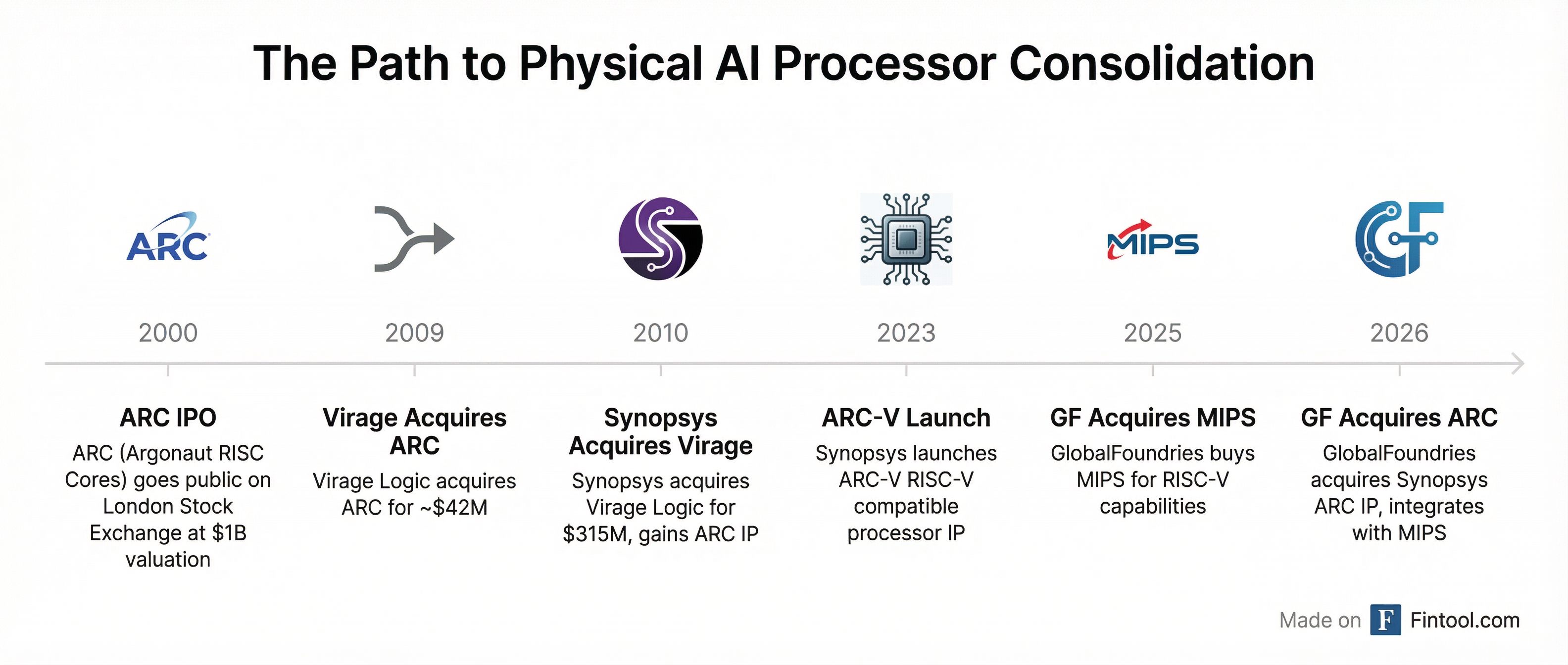
| Year | Event |
|---|---|
| 2000 | ARC (Argonaut RISC Cores) IPOs on London Stock Exchange at $1B valuation |
| 2009 | Virage Logic acquires ARC for $42M |
| 2010 | Synopsys acquires Virage Logic for $315M, gains ARC portfolio |
| 2023 | Synopsys launches ARC-V, a RISC-V compatible processor line |
| 2025 | GlobalFoundries acquires MIPS |
| 2026 | GlobalFoundries acquires ARC from Synopsys |
The trajectory tells a familiar story of semiconductor IP consolidation. What was once a $1 billion standalone company is now part of a foundry's vertical integration strategy—a path that reflects the industry's relentless drive toward efficiency and scale.
Financial Snapshot
| Metric | GlobalFoundries (GFS) | Synopsys (SNPS) |
|---|---|---|
| Market Cap | $23B | $102B |
| Latest Revenue | $1.69B (Q3 2025)* | $2.25B (Q4 2025) |
| Gross Margin | 24.8% (Q3 2025)* | 82.0% (Q4 2025) |
| TTM Net Income | $686M | $1.33B |
*Values retrieved from S&P Global
GlobalFoundries trades at a fraction of Synopsys' valuation, reflecting the capital-intensive nature of foundry operations versus high-margin software and IP businesses.
Ask Fintool AI AgentWhat to Watch
Near-term catalysts:
- Regulatory approval timeline (expected H2 2026)
- Customer retention during transition period
- Integration execution with MIPS organization
Strategic questions:
- Will GFS pursue additional processor IP acquisitions?
- How will combined MIPS-ARC compete against ARM and open-source RISC-V alternatives?
- Can GFS convert IP licensing relationships into fab utilization?
The deal underscores a broader trend: as AI proliferates from data centers to the edge, the companies that control the full stack—from processor design to manufacturing—may hold a decisive advantage.
Related: