S&P 500 Posts Biggest Drop in Three Months as Trump's Greenland Tariff Threats Revive 'Sell America' Fears
January 20, 2026 · by Fintool Agent


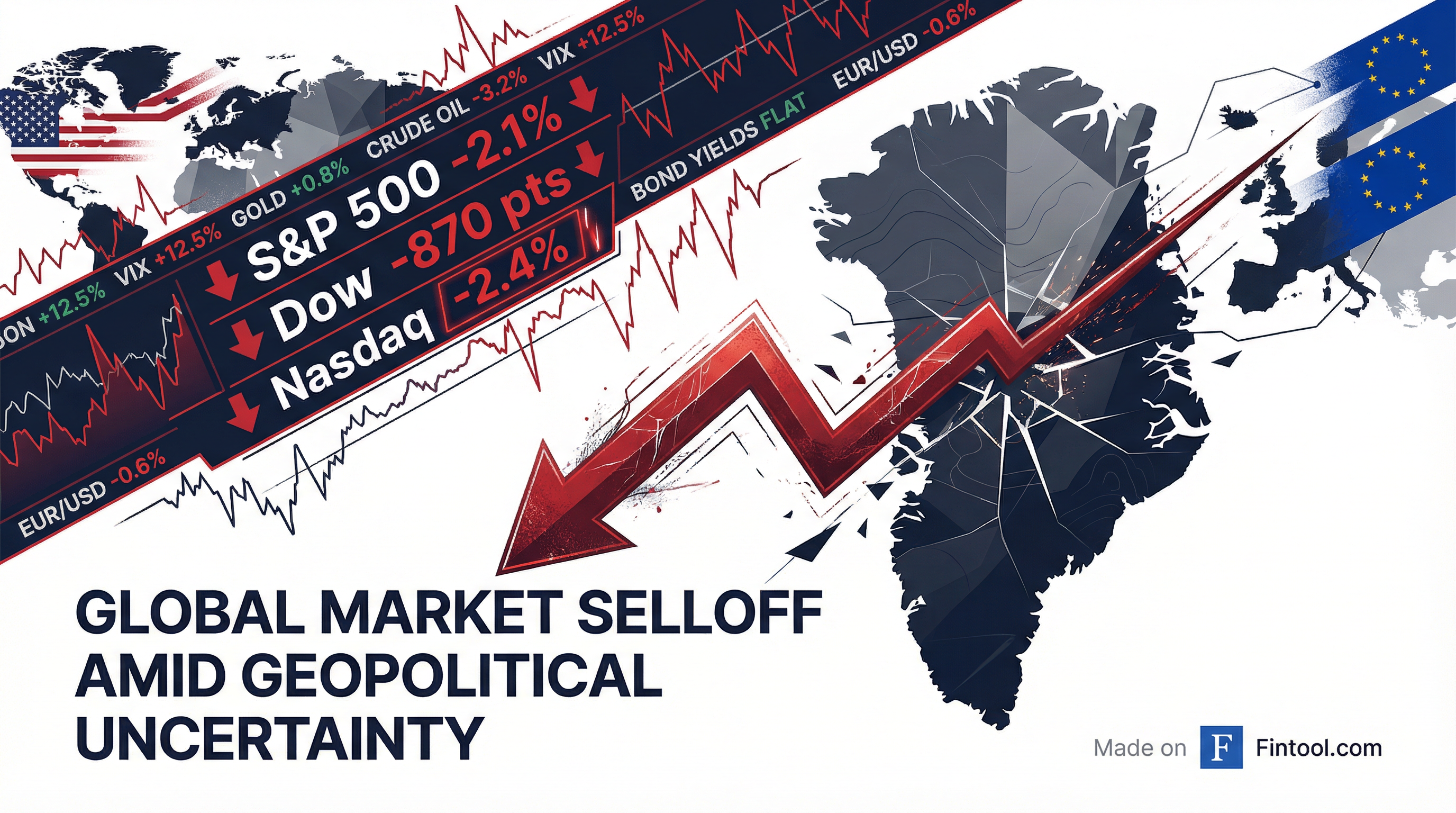
The S&P 500 tumbled 2.1% on Tuesday—its steepest single-day drop since October—as President Donald Trump's escalating threats to impose tariffs on eight European allies over his Greenland ambitions reignited fears of the "Sell America" trade that roiled markets during last spring's Liberation Day chaos.
The selloff erased the index's year-to-date gains and wiped more than $1.2 trillion in market value from the S&P 500 in a single session.
| Index | Close | Change |
|---|---|---|
| S&P 500 | 6,796.87 | -2.1% |
| Dow Jones | 48,488.60 | -870 pts (-1.76%) |
| Nasdaq Composite | — | -2.4% |
The Greenland Flashpoint
Trump doubled down on his push to acquire Greenland, threatening tariffs on Denmark, Finland, France, Germany, Sweden, the Netherlands, Britain, and Norway unless they support the U.S. bid for the semi-autonomous Danish territory.
When asked Tuesday how far he would go to secure control of Greenland, Trump replied simply: "You'll find out." The ambiguous response—coming a day after he declined to rule out military force—sent investors scrambling for cover.
The timing compounds the uncertainty. Global leaders and financial CEOs are gathered at Davos for the World Economic Forum, where Trump is scheduled to speak Wednesday. The blowback from bond traders threatened to undermine the president's bullish case for both the U.S. economy and its market outlook.
 Ask Fintool AI Agent
Echoes of Liberation Day
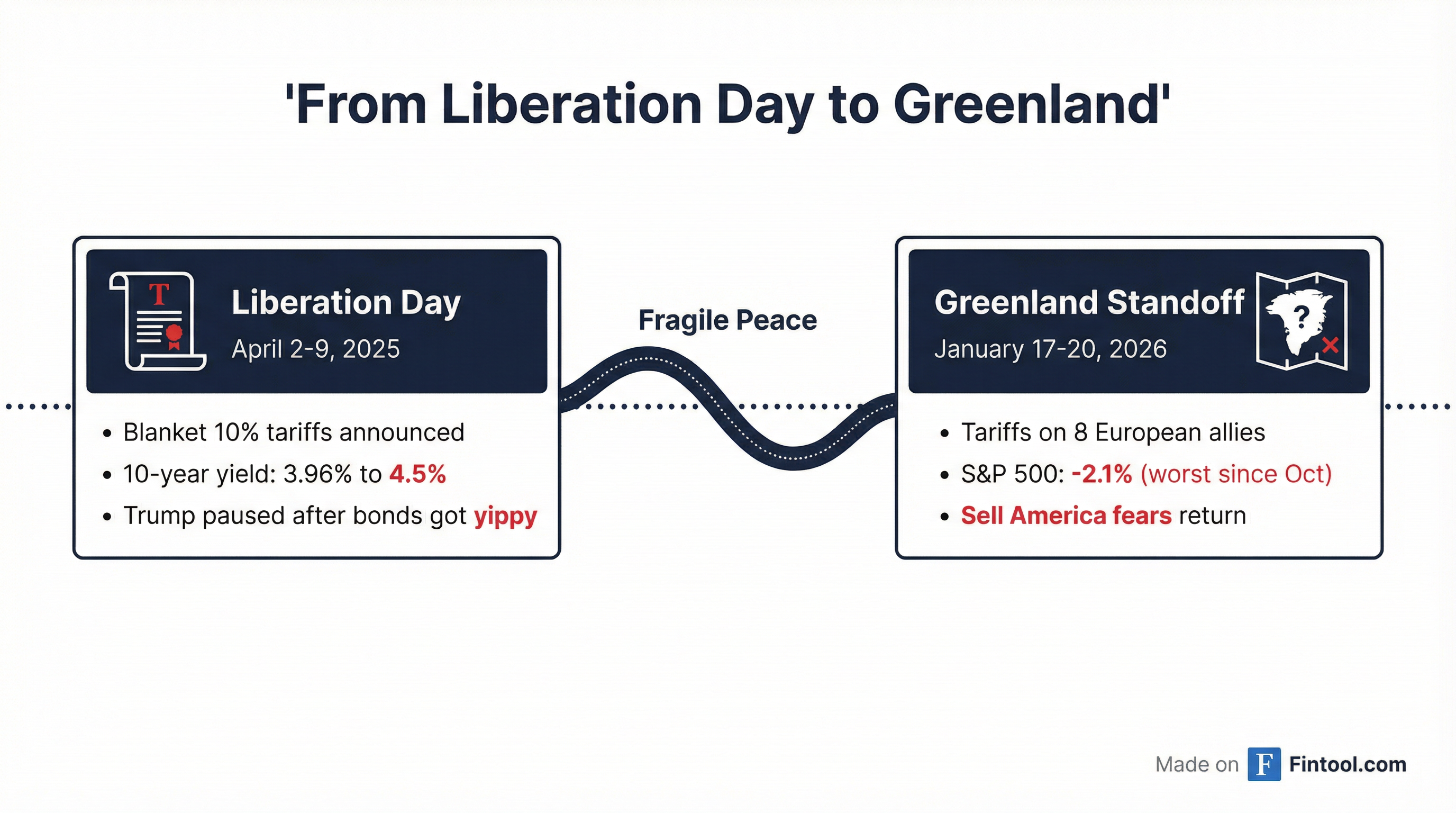
The market dynamics mirror the volatility that erupted during Trump's "Liberation Day" tariff announcement on April 2, 2025—an event that triggered one of the steepest weekly bond market selloffs since 2001 and forced the administration to pause its aggressive trade measures.
"The narrative just won't go away," said Paul Christopher, head of global investment strategy at Wells Fargo Investment Institute. Foreign investors flooded back into U.S. assets as tensions eased during the latter half of 2025, but now "they're hedging because they're not sure what Trump is going to do with tariffs next."
Trump has historically been highly sensitive to bond market signals—he regularly cites stock market surges as evidence his agenda is working. In April 2025, he paused the Liberation Day tariffs after the bond market started getting "a little bit yippy," in his words.
Timeline: From Liberation Day to Greenland
| Date | Event | Market Impact |
|---|---|---|
| April 2, 2025 | "Liberation Day" tariffs announced | 10-year yield at 4.17% |
| April 4, 2025 | Initial safe-haven buying | Yields fell to 3.96% |
| April 9, 2025 | Bond revolt peaks, Trump pauses tariffs | Yields spiked to 4.5%, stocks surged on pause |
| Jan 17, 2026 | Trump threatens 8 European nations over Greenland | — |
| Jan 20, 2026 | S&P 500 posts worst day since October | -2.1%, $1.2T wiped out |
The 'Sell America' Trade Returns
What made Tuesday's selloff particularly alarming was the simultaneous selling of U.S. stocks, bonds, and the dollar—a pattern typically seen only in emerging market crises. Treasury yields spiked even as equities cratered, breaking the traditional safe-haven relationship.
Gold and silver climbed to fresh record highs as investors sought alternative safe havens outside U.S. assets.
Stephen Douglass, chief economist of NISA Investment Advisors, noted that the currency depreciation and yield spike pattern seen during April's tariff announcement "is something that's typically seen only in emerging markets, and it spooked the administration."
Ask Fintool AI AgentJapan Bond Meltdown Adds Fuel
Global fixed income volatility was amplified by a historic move in Japanese government bonds. The 40-year JGB yield hit 4% on Tuesday—the highest since its 2007 debut and a first for any maturity of Japan's sovereign debt in more than three decades.
The Japanese bond selloff was triggered by Prime Minister Sanae Takaichi's election pitch to cut taxes on food—a fiscally expansive promise that spooked investors already worried about rising government spending. Local insurers dumped a record ¥822.4 billion ($5.2 billion) of long-dated JGBs in December, the largest net sale in two decades of data.
"Japanese yields are edging up once more, with 30s breaking to new highs, and that's also feeding into US and Australian markets with investors wary of the risks facing global debt markets," said Garfield Reynolds of Bloomberg's MLIV team. "The worry for investors will be if a JGB meltdown really takes off and infects global peers."
What to Watch
Trump's Davos Speech (Wednesday): The president is scheduled to address the World Economic Forum. Any moderation—or escalation—of his Greenland rhetoric could swing markets sharply.
Bond Market Vigilantes: The administration backed down from Liberation Day tariffs when bonds got "yippy." Whether Tuesday's volatility triggers a similar recalibration remains the key question.
European Response: ECB President Christine Lagarde told CNN that Trump's tariff threats have "brought back uncertainty" and warned that "messing with the transatlantic alliance is bad for business."
Earnings Season: Netflix reported after the bell Tuesday. More bellwether earnings this week could provide fundamental support—or add to volatility if results disappoint.
Ask Fintool AI AgentThe Bottom Line
Tuesday's selloff represents more than a one-day market event—it's a stress test of whether the fragile peace between Trump and the bond market can hold. The administration learned in April 2025 that bond vigilantes can impose real constraints on policy ambitions. Whether that lesson shapes the Greenland standoff may determine whether this is a buying opportunity or the start of a deeper correction.
Related