Indonesia Market Chiefs Resign After $80 Billion Meltdown as MSCI Threatens Frontier Downgrade
January 30, 2026 · by Fintool Agent


Indonesia's stock market leadership collapsed Friday as the heads of both the Indonesia Stock Exchange and the country's financial regulator resigned following an $80 billion market rout and mounting pressure from MSCI over governance failures.
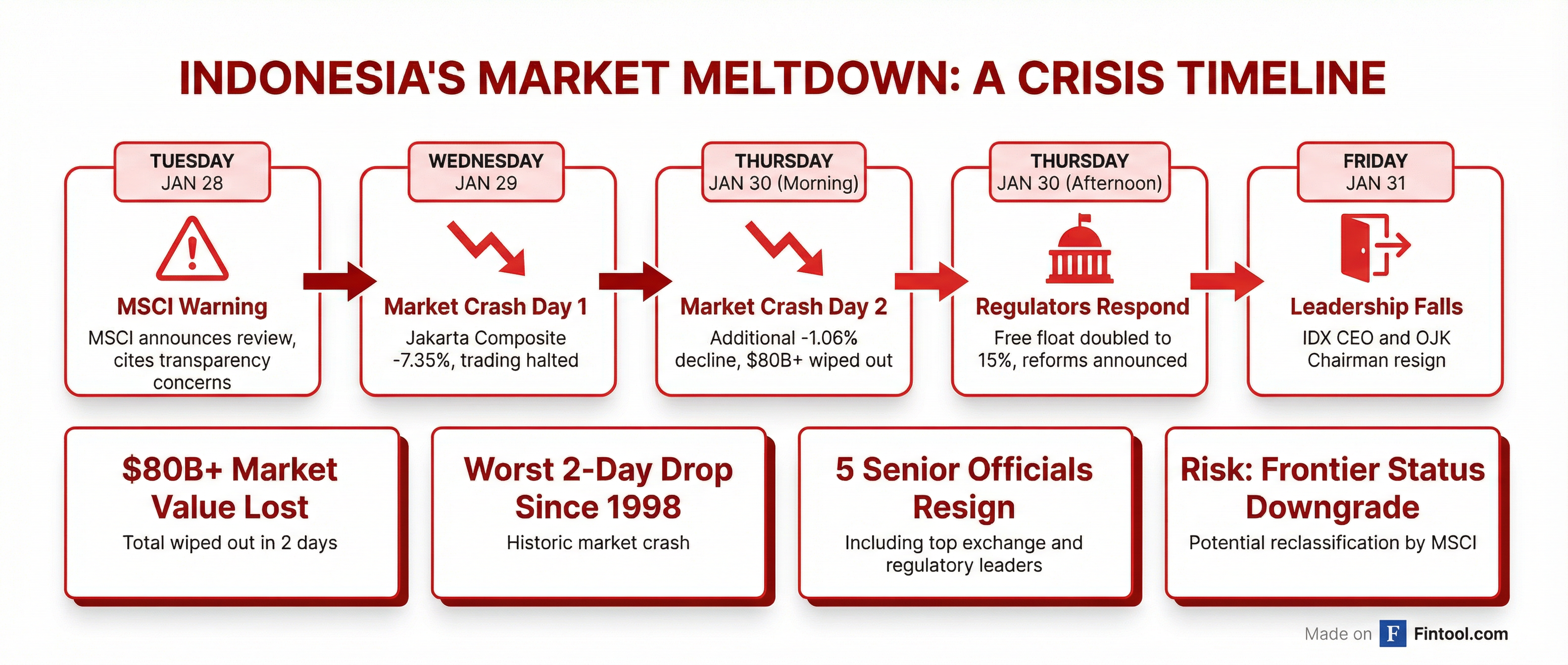
IDX President Director Iman Rachman stepped down Friday morning, taking responsibility for what he called "recent market conditions." Hours later, OJK Chairman Mahendra Siregar—the head of Indonesia's Financial Services Authority—followed, along with three other senior regulators including his deputy and the head of capital markets.
The departures cap a chaotic week that began with MSCI flagging "fundamental investability issues" at Southeast Asia's largest stock market—and ends with the most sweeping regulatory shake-up in the country's financial history.
The MSCI Warning That Started the Rout
On Tuesday, MSCI announced it had frozen any new Indonesian stock inclusions in its indexes and warned of a potential downgrade to "frontier" status—a designation that would remove Indonesia from major emerging market benchmarks and force billions in index fund outflows.
"Investors highlighted that fundamental investability issues persist due to ongoing opacity in shareholding structures and concerns about possible coordinated trading behavior that undermines proper price formation," MSCI said in its announcement.
The warning triggered immediate panic selling. The Jakarta Composite Index plunged 7.35% on Wednesday—its worst single-day drop since 1998—prompting a trading halt. Another 1.06% decline on Thursday brought the total two-day wipeout to more than $80 billion.
 Ask Fintool AI Agent
A Leadership Exodus
The resignations mark an unprecedented shake-up of Indonesia's financial infrastructure. In addition to Iman Rachman at the IDX, the following OJK officials stepped down Friday evening:
- Mahendra Siregar – OJK Chairman
- Mirza Adityaswara – OJK Deputy Chairman
- Inarno Djajadi – Chief Executive for Capital Markets, Financial Derivatives and Carbon Exchange Supervision
- I.B. Aditya Jayaantara – Deputy Commissioner for Issuer Oversight, Transaction Supervision and Special Investigations
"This should be seen less as blame and more as a reset," said Mohit Mirpuri, senior partner at SGMC Capital. "Periods of stress often accelerate change, and this opens the door for fresh leadership with a clear mandate to raise standards, improve market structure and reinforce investor confidence."
The Stakes: $13 Billion in Potential Outflows
The financial implications of an MSCI downgrade would be severe. Goldman Sachs estimates that under an "extreme scenario," more than $13 billion could flow out of Indonesian equities as passive funds tracking emerging market indexes are forced to rebalance.
Both Goldman and UBS have downgraded Indonesian equities this week, with HSBC joining Friday in cutting its outlook. Global funds offloaded a net $739 million through Thursday, on track for the largest weekly outflow since mid-April.
For context, Indonesia currently holds a meaningful weight in major emerging market ETFs. A downgrade to frontier status would effectively remove it from the investment universe for many institutional mandates that are benchmarked to MSCI Emerging Markets.
Ask Fintool AI AgentEmergency Reforms: Will They Be Enough?
Indonesian authorities moved quickly to announce reform measures aimed at addressing MSCI's concerns:
Immediate Changes:
- Double the minimum free float requirement to 15% from 7.5% starting in February
- Increase pension and insurance fund capital market allocation caps to 20% from 8%
- Enhanced disclosure requirements for shareholders with ownership below 5%
- Potential Danantara (sovereign wealth fund) involvement to boost market liquidity
Structural Reforms:
- Plans to make the Indonesia Stock Exchange a public entity to improve credibility
- Changes to the exchange's shareholding structure
- Commitment to resolve MSCI concerns by May
"The government guarantees protection for all investors by maintaining good governance and transparency," Chief Economic Minister Airlangga Hartarto said, stressing that economic fundamentals remain sound.
Market Reaction and What Comes Next
The Jakarta Composite closed 1.18% higher on Friday after authorities announced the proposed measures, a tentative sign that investor panic may be subsiding. But the rupiah remained near record lows at 16,790 to the dollar, and many investors remain skeptical that the reforms will satisfy MSCI's demands.
"The reforms outlined are directionally positive, but execution and the appointment of a credible successor will be key to determining whether these concerns fully dissipate," said Gary Tan, a portfolio manager at Allspring Global Investments.
Key dates to watch:
- February: New 15% free float requirement takes effect
- May: Indonesia's self-imposed deadline to address MSCI concerns
- MSCI Review Cycle: Semi-annual index reviews could confirm or reverse the downgrade threat
What It Means for EM Investors
For investors with emerging market exposure through ETFs like iShares MSCI Emerging Markets (EEM) or Vanguard FTSE Emerging Markets (VWO), the Indonesia situation underscores a persistent risk in EM investing: governance failures can erase years of gains in days.
The crisis also highlights the outsized influence of index providers like MSCI in determining capital flows. A single announcement about potential reclassification triggered $80 billion in value destruction and brought down the country's top financial regulators.
Pandu Sjahrir, chief investment officer at Indonesia's sovereign wealth fund Danantara, framed it bluntly: "What happened the last two days is almost like a good cold plunge...the market kind of panicked a bit. And what happens after a cold plunge? Usually, you fix yourself up and you become refreshed."
Whether Indonesia emerges "refreshed" or continues to spiral will depend on whether new leadership can deliver on transparency reforms quickly enough to satisfy MSCI—and restore confidence among global investors who just watched $80 billion evaporate in 48 hours.
Ask Fintool AI AgentRelated Companies: Ishares Msci Emerging Markets Etf-2.22% | Vanguard Ftse Emerging Markets Etf-2.03% | Ishares Msci Indonesia Etf+0.43%