IonQ Bets $1.8 Billion on SkyWater to Build America's First Vertically Integrated Quantum Powerhouse
January 26, 2026 · by Fintool Agent


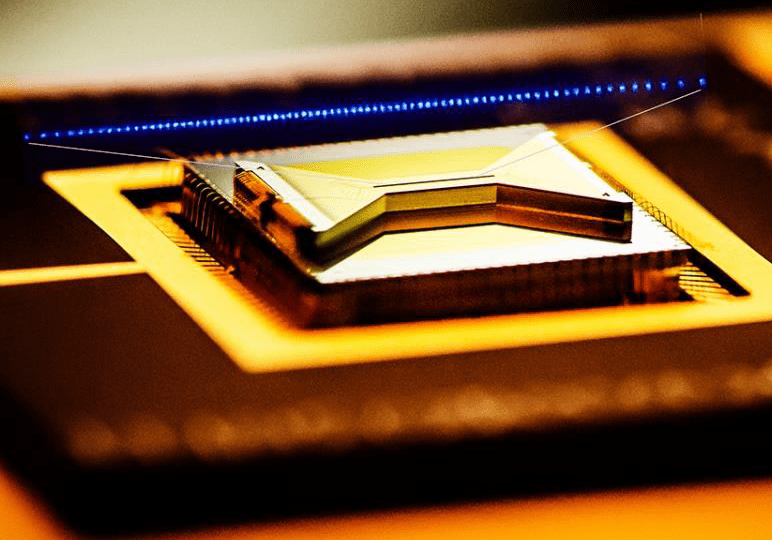
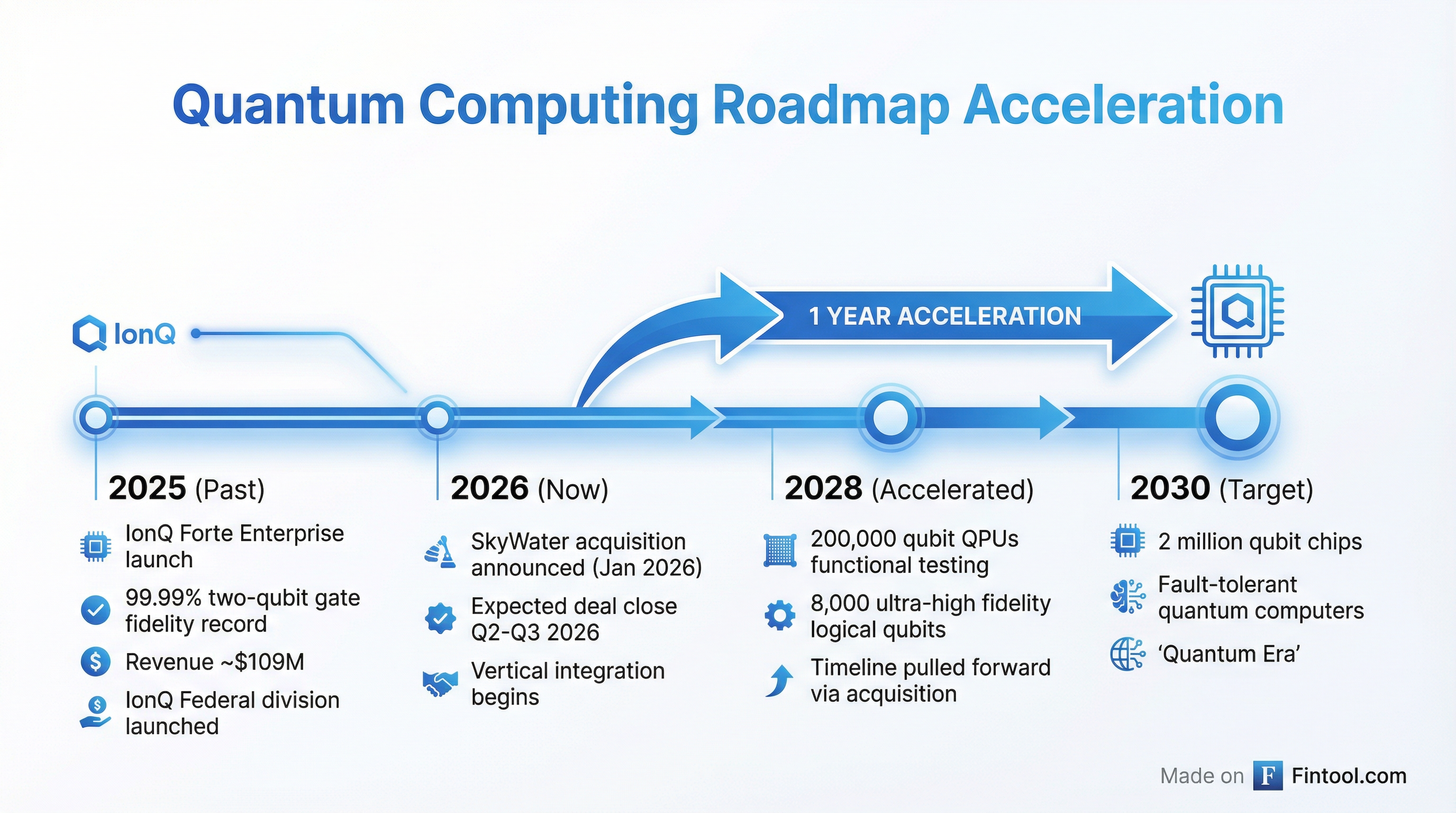
Ionq is acquiring Skywater Technology for $1.8 billion in cash and stock, creating what the companies call "the only vertically integrated full-stack quantum platform company" with a trusted US chip foundry.
The deal—$35 per share, consisting of $15 cash and $20 in IonQ stock—represents a 38% premium to SkyWater's 30-day volume-weighted average price and positions IonQ as the preeminent quantum supplier to the US government just as federal policy shifts toward securing domestic semiconductor capacity.
SkyWater shares jumped 5.4% to $33.03 on the news while IonQ fell 4.5% to $45.13, as investors weighed the strategic benefits against the dilution and execution risk of integrating two fundamentally different businesses.
 Ask Fintool AI Agent
The Strategic Logic: Vertical Integration Meets National Security
The acquisition reflects a calculated bet that quantum computing's commercialization will require tight integration between chip design and manufacturing—particularly for defense and government applications where supply chain security is non-negotiable.
SkyWater is the largest pure-play semiconductor foundry headquartered in the United States and holds DMEA Category 1A Trusted Accreditation from the Department of Defense, making it one of a handful of fabrication facilities cleared to produce chips for classified programs.
"This transformational acquisition enables IonQ to materially accelerate its quantum computing roadmap and secure its fully scalable supply chain domestically," said Niccolo de Masi, IonQ Chairman and CEO. "With secure, U.S.-based design, packaging and chip fabrication—IonQ will benefit from vertical integration across our increasingly interlinked quantum computing, quantum networking, quantum security, and quantum sensing applications for land, sea, air, and space."
Accelerating the Quantum Roadmap
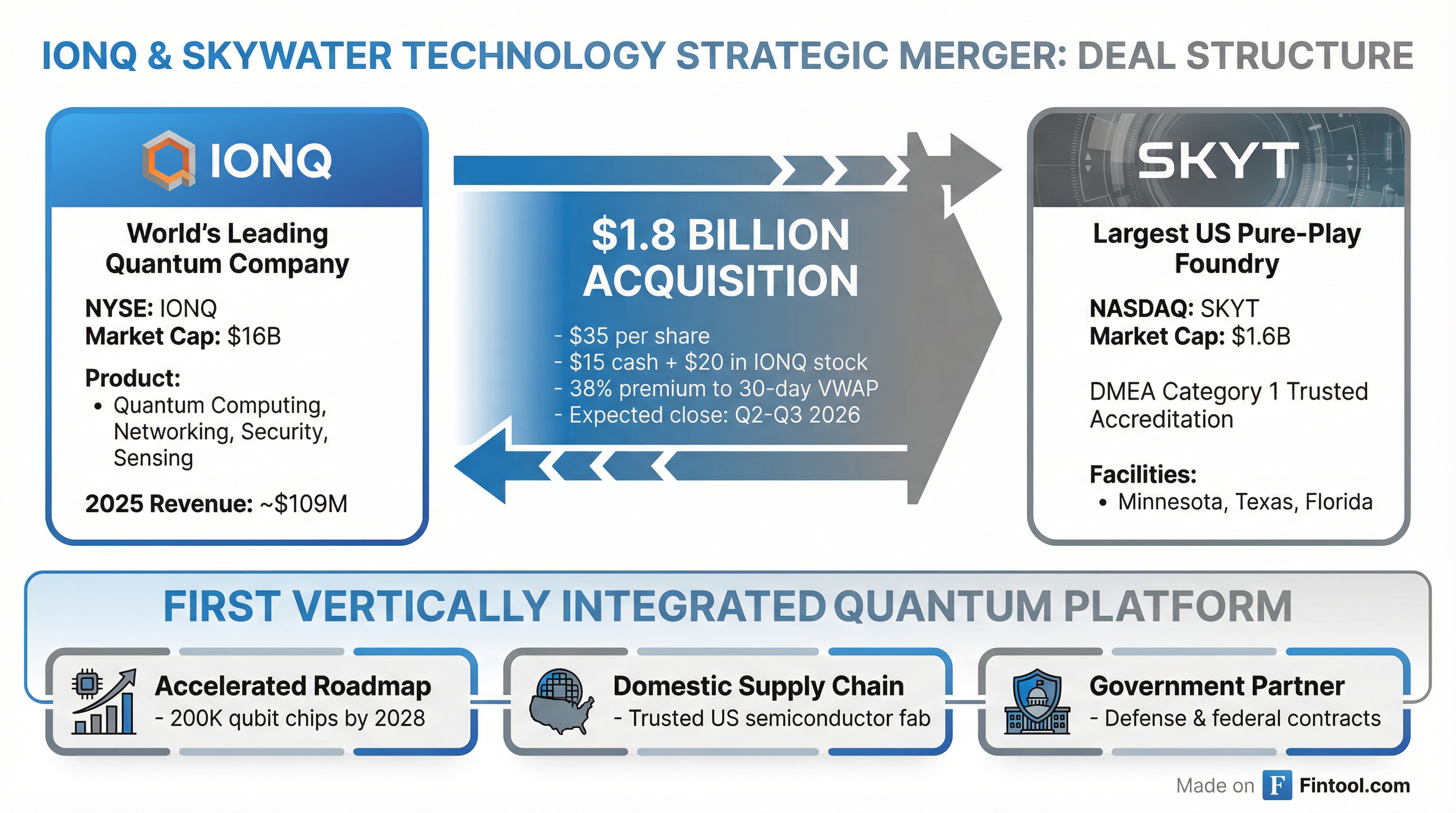
The deal's most concrete near-term benefit: IonQ now expects to begin functional testing of its 200,000-qubit quantum processing units by 2028, enabling over 8,000 ultra-high fidelity logical qubits—up to a year earlier than previously planned.
The acceleration comes from eliminating handoffs between design and fabrication. With embedded foundry access, IonQ can reduce wafer iteration times and run parallel prototypes—a significant advantage in a technology race where competitors are also racing toward fault-tolerant quantum computers.
IonQ's current flagship system, IonQ Forte Enterprise, achieved 99.99% two-qubit gate fidelity in 2025—a world record in quantum computing performance. The company's roadmap calls for 2 million qubit chips by 2030, a goal the SkyWater acquisition makes more achievable.
 Ask Fintool AI Agent
What IonQ Is Buying
SkyWater brings substantial assets beyond its trusted accreditation:
| Metric | SkyWater (SKYT) |
|---|---|
| Q3 2025 Revenue | $150.7M |
| FY 2025 Est. Revenue | $431M* |
| Facilities | Minnesota (HQ), Texas, Florida |
| Key Markets | Aerospace & Defense, Advanced Compute, Automotive |
| Special Status | DMEA Category 1A Trusted Accreditation |
*Values retrieved from S&P Global
The company's Texas fab—acquired in mid-2025 from Infineon—expanded SkyWater's 200mm wafer capacity by more than 4x, unlocking over $300 million in annual revenue potential. Its Florida facility provides advanced packaging capabilities, addressing one of the final integration gaps in US-based chip production.
Critically, SkyWater already has extensive quantum computing experience. "Quantum computing, our second largest end market, is expected to generate revenue growth exceeding 30% in 2025," CEO Thomas Sonderman said on the Q2 2025 earnings call.
SkyWater has partnerships with D-Wave and PsiQuantum, and produces superconducting ICs for quantum computing and sensing applications. The company plans to continue serving these customers post-acquisition—even direct IonQ competitors.
The Numbers: Premium Valuation for Strategic Control
The deal values SkyWater at roughly 4.2x trailing revenue and approximately 1.1x EV/Revenue on 2025 estimates—not cheap for a foundry business with mid-20s gross margins, but defensible given the strategic value of US-based trusted manufacturing.
| Metric | IonQ | SkyWater |
|---|---|---|
| Market Cap (Pre-Deal) | $16.0B | $1.6B |
| Q3 2025 Revenue | $39.9M | $150.7M |
| FY 2025 Est. Revenue | $109M* | $431M* |
| Gross Margin | 48% (Q3) | 24% (Q3) |
| Total Assets | $4.3B | $787M |
| Cash & Equivalents | $346M | $31M |
*Values retrieved from S&P Global
IonQ also disclosed that full-year 2025 revenue is expected at the high end or above its previously announced forecast of $106-110 million—a positive signal as it announces its largest-ever acquisition.
Execution Risks and Competitive Dynamics
The deal isn't without complications. Integrating a semiconductor foundry into a quantum computing company requires bridging vastly different operational cultures, margin profiles, and customer bases.
SkyWater's recent results show the challenges: aerospace and defense revenue fell $28.6 million year-over-year in the first nine months of 2025, driven by "U.S. government policy shifts and changes in defense spending priorities." Delayed contract awards have slowed program development, though this may reverse under the current administration's semiconductor reshoring agenda.
The cash-and-stock structure ($15 cash, $20 stock) is designed to preserve IonQ's balance sheet flexibility, but SkyWater shareholders will own between 4.4% and 6.7% of the combined company—introducing uncertainty if IonQ shares remain volatile.
An intriguing wrinkle: SkyWater will continue operating as a merchant foundry for other quantum companies. Whether competitors remain comfortable having IonQ control their chip production—and whether IonQ can resist the temptation to prioritize internal demand—remains an open question.
Ask Fintool AI AgentThe Bigger Picture: Quantum Meets Industrial Policy
The deal arrives at a pivotal moment for US semiconductor policy. Over $5 billion of semiconductors used annually in US defense applications are sourced from China and Taiwan, according to SkyWater management—a vulnerability that Washington is increasingly determined to address.
"The market needs more U.S.-based foundry options for mature node production. SkyWater is answering that need," Sonderman said. "There's growing consensus that the U.S. needs a stronger, more resilient semiconductor base—not just at the leading edge, but at foundational nodes that power everything from defense systems to vehicles to industrial infrastructure."
For IonQ, the acquisition positions the company as a potential cornerstone of America's quantum ambitions—a full-stack supplier capable of delivering quantum computing, networking, security, and sensing solutions with an entirely domestic supply chain.
The deal is expected to close in Q2 or Q3 2026, pending SkyWater shareholder approval, regulatory clearance, and customary closing conditions. SkyWater will operate as a wholly owned subsidiary, with Sonderman continuing as CEO and reporting to de Masi.
What to Watch
Near-term:
- SkyWater shareholder vote
- Regulatory review timeline
- IonQ Q4 2025 earnings for updated guidance
Long-term:
- Integration execution and customer retention
- Progress toward 200,000 qubit chips
- Government contract wins following vertical integration
- Competitor responses from Rigetti, D-Wave, PsiQuantum