Finland's IQM Becomes First European Quantum Company to Go Public in $1.8B SPAC Deal
February 23, 2026 · by Fintool Agent


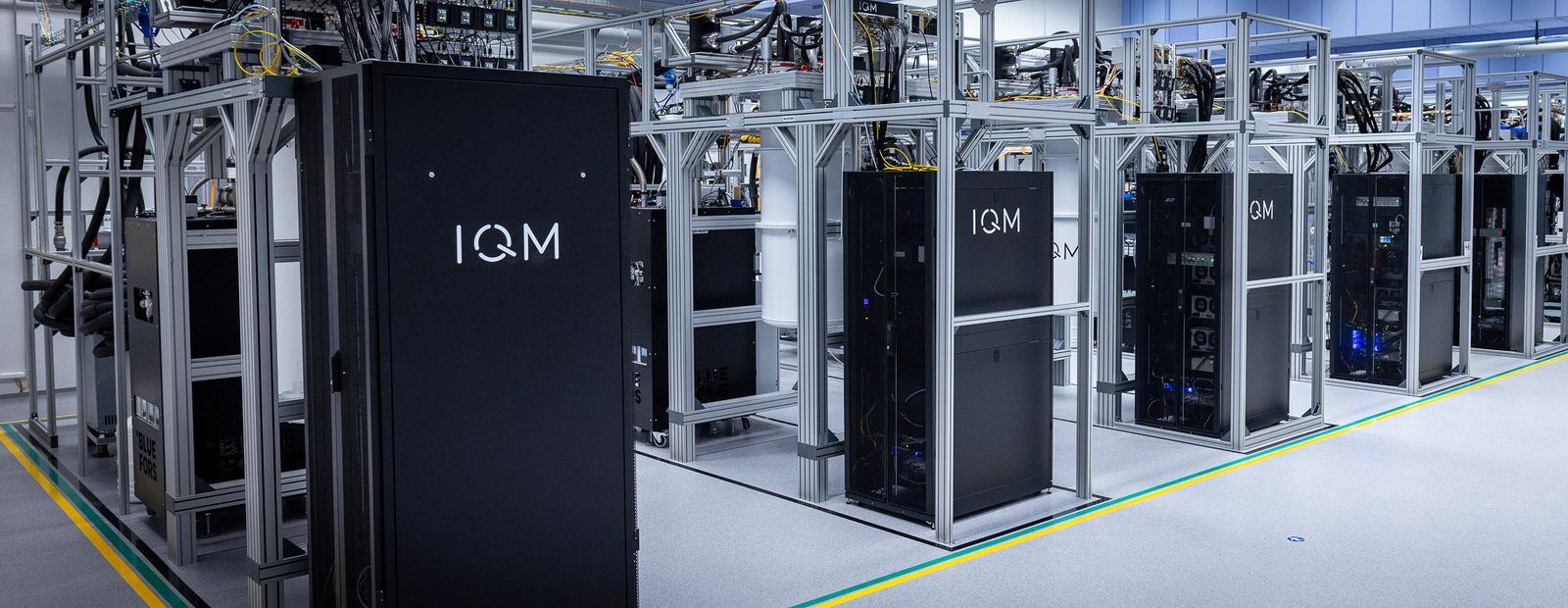
Finnish quantum computing unicorn IQM announced Monday it will go public through a merger with blank-check company Real Asset Acquisition Corp (RAAQ), valuing the company at approximately $1.8 billion. The deal marks a watershed moment for European deep tech: IQM will become the first quantum computing company from the continent to trade on U.S. public markets.
The transaction arrives amid a renewed quantum computing frenzy, with public quantum stocks surging on signals from governments and Big Tech that the long-promised "quantum advantage"—the point where quantum computers can outperform classical supercomputers on practical problems—may finally be within reach.
The Deal Structure
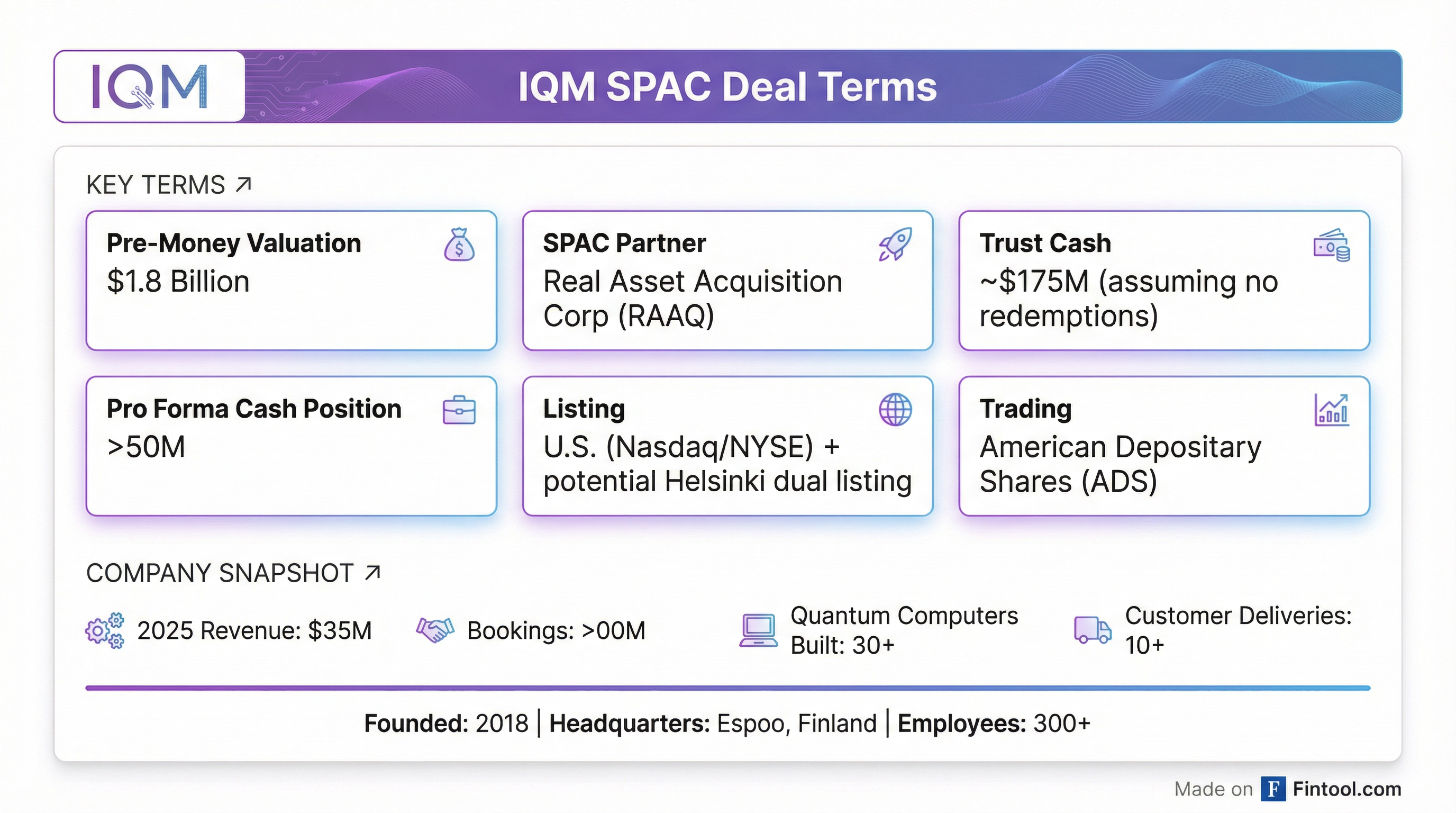
IQM will merge with RAAQ, a Nasdaq-listed SPAC. Existing IQM shareholders will convert their holdings into publicly traded shares without receiving cash. The SPAC's trust account holds approximately $175 million (assuming no redemptions), which will be available to IQM after the merger closes. Post-transaction, IQM expects its cash position to exceed $450 million—a substantial war chest for a company still in the commercialization phase.
American Depositary Shares will list on either the Nasdaq or NYSE, subject to regulatory approval. Notably, IQM is also considering a dual listing on the Helsinki Stock Exchange—a nod to its Finnish roots and the deep tech ecosystem that spawned it.
 Ask Fintool AI Agent
From Aalto Labs to Global Expansion
IQM's journey from academic spinoff to public company encapsulates the promise and patience required in quantum computing. Founded in 2018 as a spinout from Finland's Aalto University and VTT Technical Research Centre, the company built on decades of low-temperature physics research that traced back to the 1960s in the Otaniemi campus.
The founding team—led by CEO Jan Goetz, who joined Aalto's quantum computing labs after completing his PhD in low-temperature physics in 2017—raised €11.4 million in seed funding, then the largest seed round ever for a Finnish startup. They knew they were late to a race dominated by American and Chinese competitors, but bet on execution speed and a differentiated approach: building full-stack, on-premise quantum computers that customers could control directly.
The strategy has delivered tangible results. IQM has:
| Metric | Value |
|---|---|
| Quantum computers built | 30+ |
| Customer deliveries | 10+ |
| 2025 Revenue | $35 million |
| Bookings | >$100 million |
| Total funding raised | $569 million |
| Employees | 300+ |
| Global locations | 10+ |
| Patent applications | 300+ |
Data from IQM press releases and Crunchbase
The company's most recent funding—a $320 million Series B in September 2025 led by Ten Eleven Ventures—was the largest quantum funding round outside the United States, bringing total capital raised to approximately €600 million.
The Quantum SPAC Wave
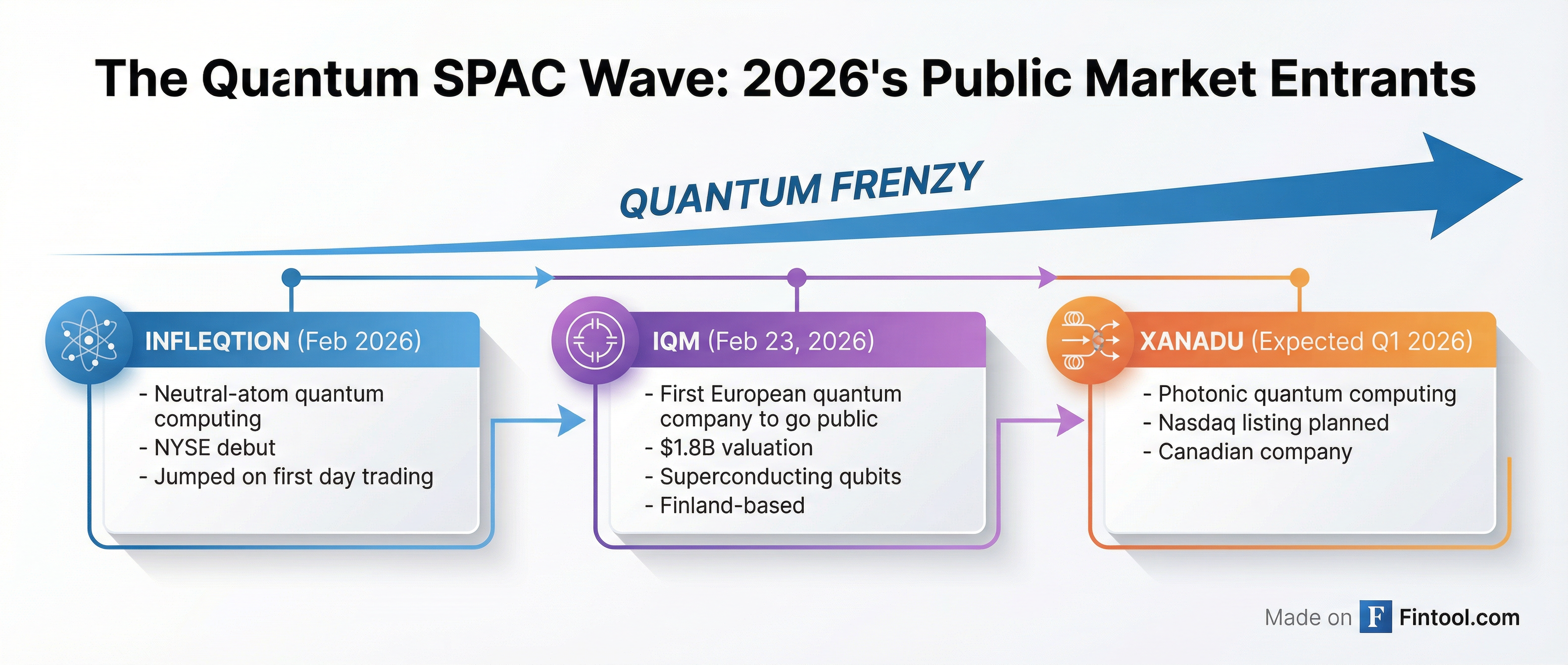
IQM's announcement follows a pattern. Earlier this month, neutral-atom quantum company Infleqtion jumped on its first day of NYSE trading after completing a SPAC merger. Canadian photonic quantum company Xanadu Quantum Technologies plans to list via SPAC on Nasdaq by the end of March.
The SPAC route offers speed and certainty over traditional IPOs—critical for companies whose primary currency is investor faith in long-term technological payoffs. But SPACs carry baggage: the 2021 SPAC boom left many investors nursing losses, and quantum computing stocks remain deeply loss-making enterprises with profitability years away.
Competitive Landscape: Where IQM Fits
At $1.8 billion, IQM's valuation sits well below the established public quantum players:
| Company | Market Cap | Technology | Notes |
|---|---|---|---|
| Ionq | $11.3B | Trapped ion | Recently acquired SkyWater for $1.8B |
| D-wave | $6.6B | Quantum annealing | Enterprise focus, Advantage2 system |
| Rigetti | $5.3B | Superconducting | Strong government ties |
| IQM | $1.8B | Superconducting | On-premise focus, European leader |
| Quantum Computing Inc. | $1.8B | Photonic/hybrid | Diversified approach |
Market cap data as of February 23, 2026
IQM's superconducting approach puts it in direct competition with Rigetti, though IQM differentiates through its on-premise delivery model. While competitors like IonQ and D-Wave emphasize cloud access, IQM has built a business around delivering physical quantum computers to customer sites—a model that appeals to government, defense, and research institutions with data sovereignty requirements.
The company claims to have delivered more on-premise quantum systems than any publicly-disclosed competitor, with customers spanning Europe, Asia-Pacific, and the United States.
Ask Fintool AI AgentThe Bull Case
Government Tailwinds: Quantum computing has become a strategic priority for major economies. The European Union, the United States, China, and Japan have all announced multi-billion-dollar quantum initiatives. IQM's European headquarters and NATO-friendly jurisdiction position it well for government contracts in the West.
On-Premise Differentiation: While cloud-based quantum access dominates headlines, many high-value customers—national labs, defense agencies, pharmaceutical companies—require on-site systems for security and data sovereignty. IQM has built operational expertise in delivering and supporting these installations.
Commercial Traction: $35 million in 2025 revenue and over $100 million in bookings suggest IQM has moved beyond pure R&D. The company has delivered 10+ systems to paying customers, providing real-world feedback loops that purely cloud-based competitors may lack.
Cash Runway: Post-SPAC, IQM will have over $450 million in cash. At current burn rates, this provides substantial runway to pursue its roadmap toward fault-tolerant quantum computing.
The Bear Case
Profitability Distant: Like all pure-play quantum computing companies, IQM is deeply loss-making. Quantum computers remain science projects as much as commercial products, with industrial applications likely years away. The company's technology roadmap extends to fault-tolerant quantum computing—a milestone no one has achieved commercially.
SPAC Overhang: SPACs have earned a reputation for overpromising. While quantum SPACs have rallied in early 2026, many 2021-vintage SPACs traded well below their deal prices. IQM faces execution risk in demonstrating that its valuation is justified by business fundamentals rather than quantum hype.
Competitive Intensity: Well-funded American competitors—IonQ, D-Wave, Rigetti—have head starts in public market access, commercial partnerships, and talent acquisition. IBM, Google, and Amazon are pursuing quantum computing internally, potentially as cloud offerings that could commoditize the hardware layer IQM builds.
Technical Risk: Superconducting quantum computers require extreme cooling (near absolute zero) and remain prone to errors. While IQM touts 99% fidelity rates on two-qubit gates, scaling to the thousands of qubits needed for transformative applications remains an unsolved engineering challenge.
What to Watch
Trading Debut: IQM's first-day performance will test whether the quantum frenzy has legs. Infleqtion's successful debut earlier this month set a positive precedent, but market conditions can shift rapidly.
Customer Announcements: With $100+ million in bookings, IQM's ability to convert pipeline to revenue—and potentially announce new marquee customers—will be scrutinized. Government and defense contracts would validate the on-premise thesis.
Cash Burn: Post-SPAC financial disclosures will reveal IQM's cost structure in detail. Investors will be watching for signs that the company can manage its runway while progressing toward technical milestones.
Dual Listing Decision: Whether IQM proceeds with a Helsinki Stock Exchange listing alongside its U.S. debut could signal confidence in European investor appetite for deep tech—and provide a model for other European quantum startups.
Ask Fintool AI AgentRelated Companies
- Ionq — Leading trapped-ion quantum computing company
- D-wave Quantum — Quantum annealing pioneer
- Rigetti Computing — Superconducting quantum computers
- Quantum Computing Inc. — Photonic and hybrid quantum systems