Jane Street Sued for Insider Trading That Allegedly Accelerated Terra's $40 Billion Collapse
February 23, 2026 · by Fintool Agent

Jane Street, Wall Street's most profitable trading firm, is facing allegations that it used insider information to profit from the catastrophic collapse of Terra-Luna—and may have helped accelerate it.
The lawsuit, filed Monday in Manhattan federal court by the administrator winding down Terraform Labs, accuses the high-frequency trading giant of deploying a former Terraform employee to establish back-channel communications with insiders, then using that non-public information to front-run trades as the $40 billion crypto ecosystem imploded in May 2022.
"Jane Street abused market relationships to rig the market in its favor during one of the most consequential events in crypto history," Todd Snyder, the court-appointed plan administrator, said in a statement.
The 10-Minute Trade
The complaint centers on the chaotic days of May 2022, when Terra's algorithmic stablecoin TerraUSD (UST) lost its $1 peg and spiraled into a "death spiral" that wiped out the entire ecosystem within days.
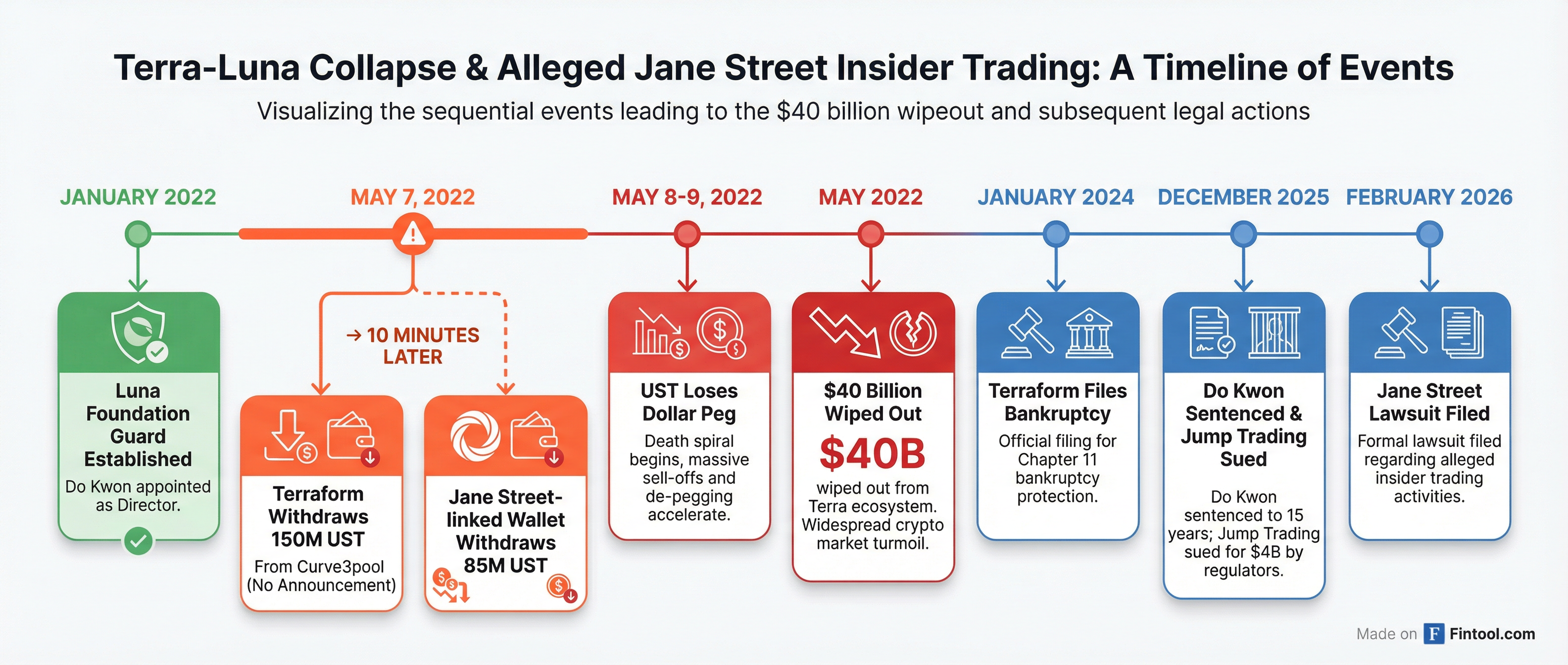
According to the lawsuit, on May 7, 2022, Terraform Labs withdrew 150 million UST from Curve3pool—a major decentralized exchange liquidity pool—without making any public announcement. Within 10 minutes, a wallet allegedly linked to Jane Street withdrew an additional 85 million UST from the same pool.
The timing and details of Terraform's withdrawal were not disclosed to the public, the complaint alleges, suggesting Jane Street had advance knowledge of the move.
The Inside Man
The lawsuit names four defendants: Jane Street Group LLC, co-founder Robert Granieri, and employees Bryce Pratt and Michael Huang.
Pratt, according to the complaint, was a former Terraform Labs employee whom Jane Street allegedly sent to form communication lines with his former colleagues at the crypto firm. These contacts reportedly included a software engineer and the head of business development. Their chat group was allegedly used as a channel to funnel Terraform-related information back to Jane Street.
On May 9, amid the UST depeg, Pratt allegedly initiated a group message with Do Kwon and Jane Street representatives to express interest in bidding on Luna or Bitcoin. Kwon replied that Jump co-founder Bill DiSomma should have already contacted them regarding a Terraform fundraise, according to the complaint.
 Ask Fintool AI Agent
Jane Street Pushes Back
Jane Street disputed the allegations, characterizing them as opportunistic. The firm argued that Terra-Luna's collapse was the result of a "multibillion-dollar fraud" perpetrated by Terraform's own management, and said it would vigorously defend against the claims.
The privately-held trading giant has emerged as one of the most powerful forces on Wall Street. In Q2 2025, Jane Street generated $10.1 billion in net trading revenue—surpassing JPMorgan ($8.9 billion), Goldman Sachs ($7.8 billion), and every other major bank. The firm manages approximately $662 billion in assets and paid out roughly $2 billion in compensation in Q3 2025 alone.
Jump Trading Also in the Crosshairs
The Jane Street lawsuit is the second major action Snyder has brought against prominent trading firms. In December 2025, he sued Jump Trading and its top executives for $4 billion, claiming Jump "actively exploited" the Terraform ecosystem by entering into a backdoor deal to inflate UST's value before it imploded.
Jump reportedly appears in the latest complaint as well, with Snyder alleging that some of the non-public information was leaked to Jane Street through Jump Trading.
The Terra Collapse: A Brief History
Terraform Labs, led by founder Do Kwon, collapsed spectacularly in May 2022 when UST lost its dollar peg. The algorithmic stablecoin relied on a complex mint-and-burn mechanism with its sister token Luna to maintain stability—a design critics had long warned was vulnerable to a "death spiral."
When confidence cracked, the mechanism worked in reverse: as UST fell below $1, the algorithm minted ever more Luna tokens to try to restore the peg. This hyperinflation crashed Luna's value to near zero within days, wiping out over $40 billion in market value and triggering a contagion that ultimately contributed to the collapse of Sam Bankman-Fried's FTX exchange.
Terraform filed for bankruptcy in January 2024 and agreed to pay $4.47 billion in SEC penalties. Kwon, who was extradited from Montenegro, pleaded guilty to two criminal counts in August 2025 and was sentenced to 15 years in federal prison in December 2025.
Ask Fintool AI AgentWhat's at Stake
The lawsuit does not specify a damages amount, but Snyder has signaled aggressive pursuit of recovery for creditors. The case raises fundamental questions about the boundaries of information-sharing in the opaque world of crypto market-making, where traditional securities law concepts like "insider trading" have uncertain application.
For Jane Street, the allegations represent a rare moment of public scrutiny for a firm that has largely operated below the radar despite its enormous market footprint. The company's dominance in ETF market-making and quantitative trading has made it systemically important, according to some analysts, yet it remains far less known than Goldman Sachs or Citadel.
The case also underscores the ongoing legal reckoning from crypto's 2022 meltdown. Four years on, courts continue to untangle the wreckage, and some of Wall Street's biggest players may yet be implicated.
Ask Fintool AI Agent