Jump Trading Takes Equity Stakes in Kalshi and Polymarket, Marking Wall Street's Biggest Bet on Prediction Markets
February 9, 2026 · by Fintool Agent


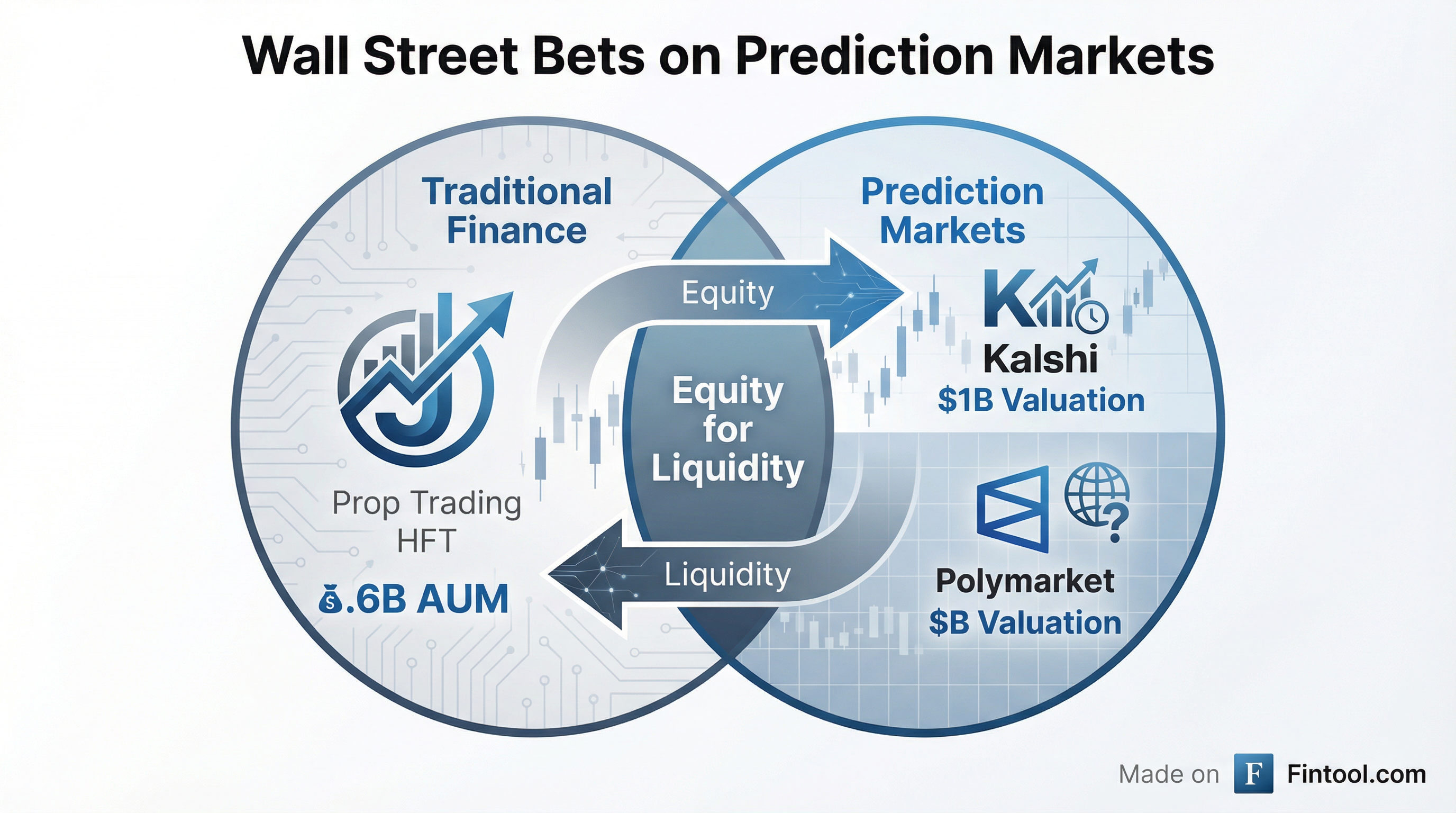
Jump Trading, one of the world's largest proprietary trading firms, is acquiring equity stakes in both Kalshi and Polymarket through liquidity-for-equity deals—the clearest signal yet that traditional finance views prediction markets as a mainstream asset class.
The Chicago-based high-frequency trading giant will earn ownership positions in the two leading prediction market platforms in exchange for providing market-making services, according to people familiar with the matter. The deals follow a venture-style structure where Jump receives stakes for its trading resources rather than direct cash investment.
With Kalshi valued at $11 billion and Polymarket at $9 billion, Jump is effectively gaining exposure to a combined $20 billion sector that barely existed in mainstream consciousness three years ago.
The Deal Structure: Equity for Liquidity
Unlike traditional venture investments, Jump's deals are structured around its core competency: trading. The firm will provide market-making services—putting up capital and taking the other side of trades—in exchange for equity allocations.
For prediction market platforms, this arrangement solves a critical challenge. Unlike traditional exchanges where institutional market makers provide deep liquidity, prediction markets have historically relied on retail traders and internal systems. Having a firm of Jump's caliber provide consistent liquidity could dramatically improve trading efficiency and attract more institutional participants.
 Ask Fintool AI Agent
Jump Trading's Prediction Market Buildout
Jump's move isn't opportunistic—it's the result of deliberate infrastructure investment. The firm has built out significant capabilities for trading CFTC-regulated event contracts:
| Metric | Detail |
|---|---|
| Dedicated Staff | 20+ employees trading prediction markets |
| Technology | Custom systems for event contract trading |
| Regulatory Focus | CFTC-regulated contracts |
| Asset Expansion | Beyond equities, Treasuries, and crypto |
The firm makes money by buying and selling securities and derivatives driven by AI models, and is already a significant player across asset classes including U.S. Treasury securities, futures, and cryptocurrency. Its pivot into prediction markets represents a natural extension of its algorithmic trading expertise.
A $20 Billion Sector Emerges
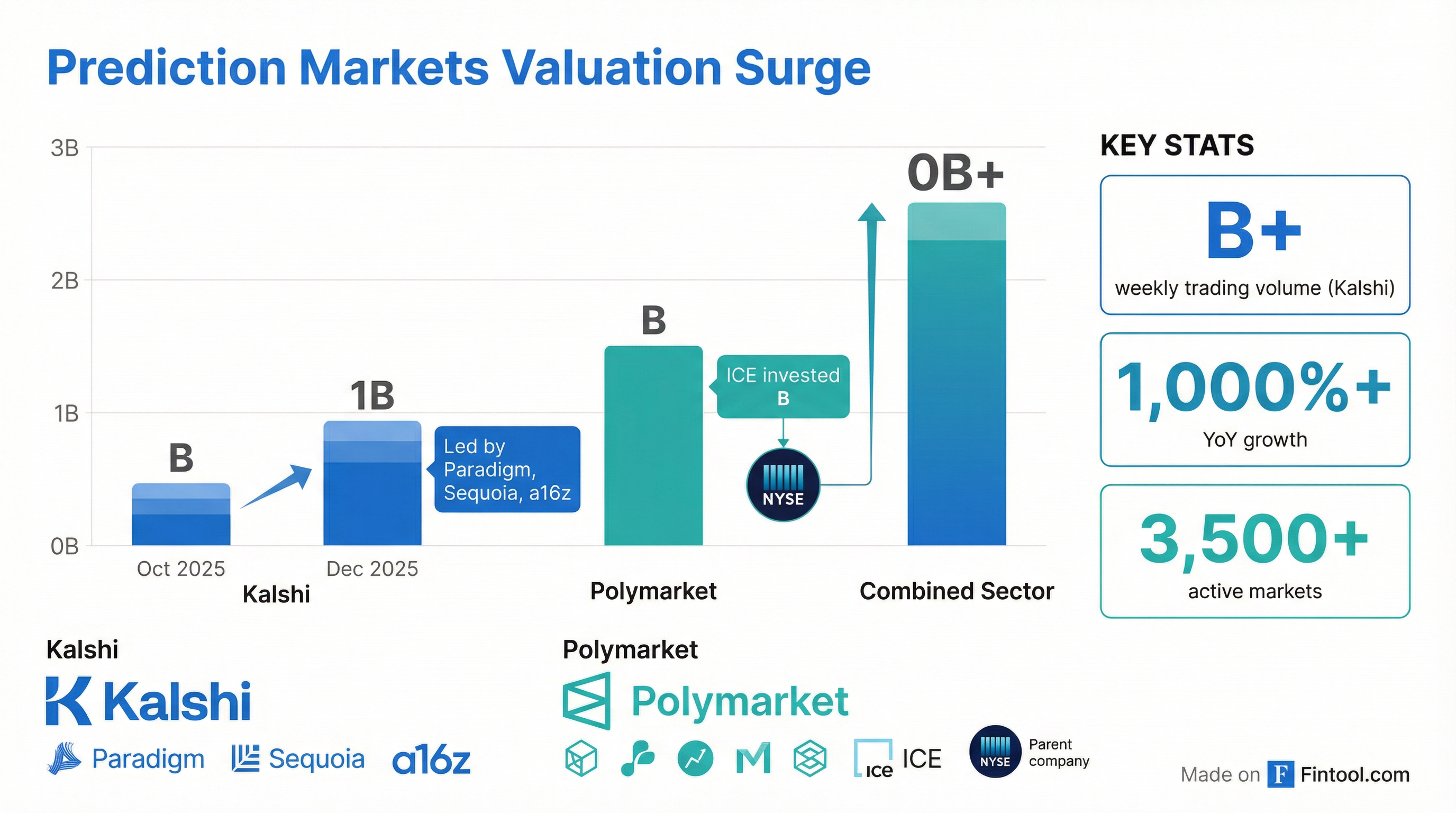
The combined valuations of Kalshi and Polymarket underscore just how rapidly prediction markets have grown:
Kalshi's Meteoric Rise
Kalshi raised $1 billion in its Series E round in December 2025, more than doubling its valuation from $5 billion to $11 billion in just two months. The round was led by Paradigm with participation from Sequoia, Andreessen Horowitz, ARK Invest, and others.
The platform's growth metrics are staggering:
- Weekly trading volume now exceeds $1 billion—up 1,000%+ from 2024
- Millions of weekly users trading across 3,500+ markets
- First platform to legalize prediction markets as a new financial asset class
Polymarket's Wall Street Backing
Polymarket secured a $2 billion investment from Intercontinental Exchange (ICE) in October 2025, valuing the platform at $9 billion. The deal gave the NYSE's parent company a roughly 20% stake and positioned ICE as a global distributor of Polymarket's event-driven data to financial institutions.
ICE's involvement signaled that prediction market data had crossed into mainstream finance—Bloomberg already incorporates Polymarket data into its Terminal service.
Ask Fintool AI AgentCompetitive Pressure on Traditional Sportsbooks
The institutional embrace of prediction markets is rattling traditional sports betting companies. Both Draftkings and Flutter Entertainment (owner of FanDuel) have seen shares decline on prediction market news and are now exploring their own event-betting platforms.
| Company | Market Cap | Response to Prediction Markets |
|---|---|---|
| DraftKings (DKNG) | $13.3B | Exploring prediction market products |
| Flutter (FLUT) | $26.7B | FanDuel facing competitive pressure |
| Robinhood (HOOD) | $74.5B | Launched prediction markets hub in app |
| Coinbase (COIN) | $44.5B | Crypto exchange watching space |
Market caps as of Feb 9, 2026. Source: S&P Global
Robinhood moved early, launching a prediction markets hub in its trading app that allows users to bet on events alongside stocks and crypto. The move reflects how prediction markets are increasingly viewed as just another asset class.
What Makes Jump Different
Jump Trading's entry carries particular weight given the firm's history and scale:
- Founded: 1999 by former CME pit traders Bill DiSomma and Paul Gurinas
- AUM: Over $7.6 billion in assets under management
- Employees: 1,600+ across Chicago, New York, London, Singapore, and other global offices
- Trading: One of the largest players in U.S. Treasury securities, futures, options, and crypto
- Infrastructure: Invested in microwave towers and low-latency systems for speed advantages
The firm's secretive nature—it rarely speaks publicly and protects its trading strategies zealously—makes its high-profile entry into prediction markets all the more notable. Jump reportedly reached out to platforms about market-making opportunities, suggesting the firm sees substantial opportunity in the space.
Ask Fintool AI AgentRegulatory Risks Remain
Despite the institutional validation, prediction markets face ongoing regulatory challenges:
State Gaming Laws: Kalshi suffered a legal setback in November 2025 when a federal judge ruled it was subject to Nevada gaming rules—a decision the company is appealing. State regulators argue they have jurisdiction over sports betting on prediction platforms and want a cut of the revenue.
CFTC Oversight: Both platforms operate under CFTC regulation for event contracts, but the boundary between prediction markets and gambling remains contested in some jurisdictions.
Political Sensitivity: Election betting drew scrutiny during the 2024 cycle, with some lawmakers questioning whether prediction markets should be allowed to operate on political outcomes.
What to Watch
For Jump Trading: Whether the firm expands its prediction market presence beyond market-making into direct investment or product development. Jump's crypto subsidiary has faced legal challenges, and the firm will want to avoid similar issues in this new space.
For Kalshi and Polymarket: Whether institutional liquidity translates to broader adoption. The platforms need to convert their current momentum into sustainable, regulated businesses that can weather political and legal headwinds.
For Traditional Sportsbooks: How quickly DraftKings and Flutter can launch competing products. The prediction market model—where users trade against each other rather than against a house—offers structural advantages that may be difficult for traditional sportsbooks to replicate.
For Investors: Ice remains the only public equity with direct prediction market exposure through its Polymarket stake. The exchange operator's shares could serve as a proxy for the sector's growth—or its risks.