KKR and PAG Win $3 Billion Battle for Sapporo Real Estate, Ending Years of Activist Pressure
December 24, 2025 · by Fintool Agent

Japanese brewer Sapporo Holdings will sell its entire real estate business to a consortium of KKR+4.06% and PAG for ¥477 billion ($3.05 billion), the companies announced Tuesday—a deal that ends years of activist pressure and cements Japan's status as private equity's hottest developed market.
The transaction, structured as a staged acquisition over three years, sees two of Asia's most active real estate investors take control of iconic Tokyo properties including the landmark Yebisu Garden Place mixed-use complex in Shibuya .
The KKR-PAG consortium beat out bids from Bain Capital, Lone Star, and Kenedix to win the deal , capping a bidding process that attracted unprecedented interest from global private equity.
The Deal at a Glance
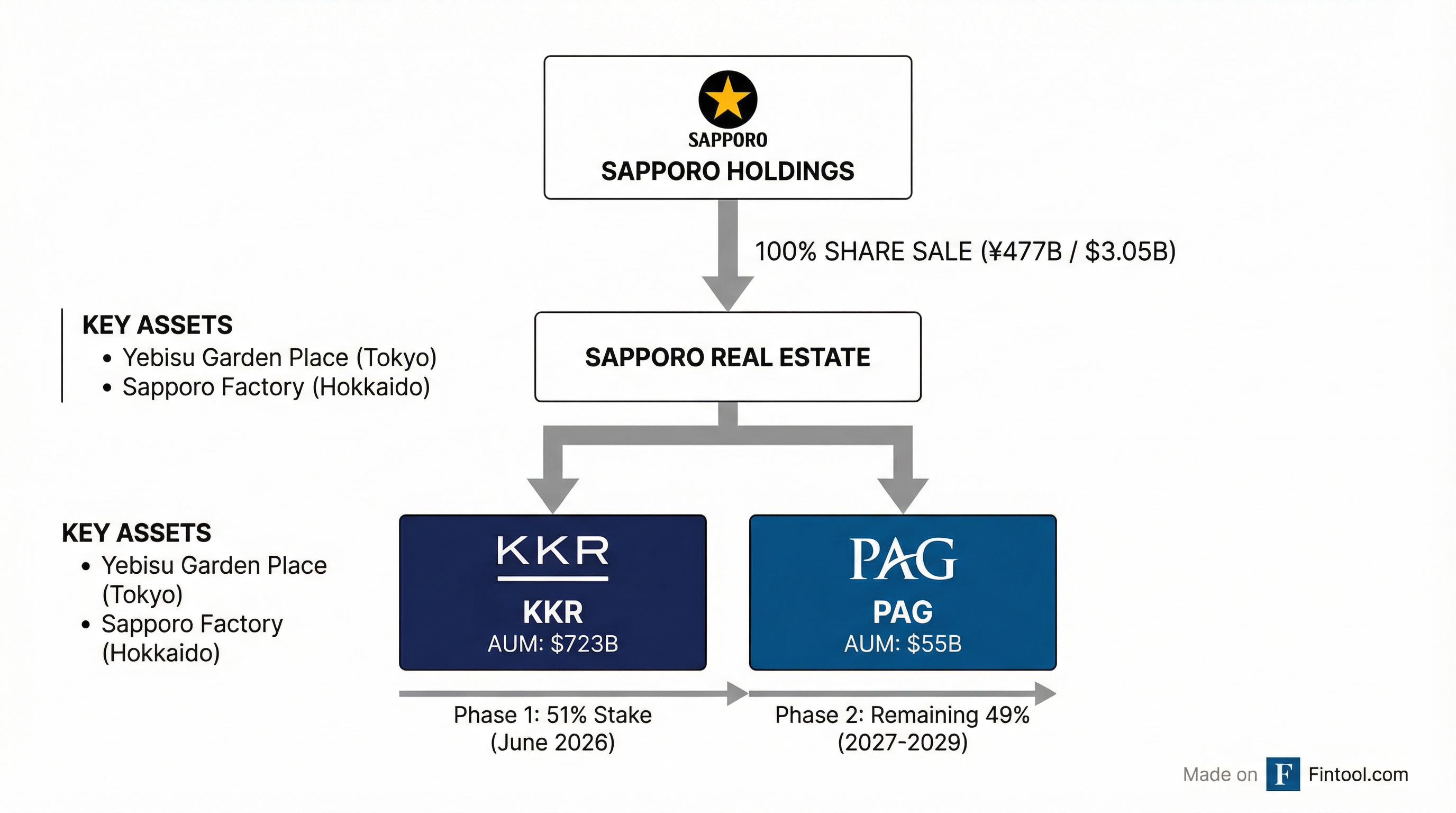
| Metric | Value |
|---|---|
| Enterprise Value | ¥477 billion ($3.05 billion) |
| First Tranche | 51% stake, closing June 2026 |
| Full Acquisition | Complete by June 2029 |
| Key Assets | Yebisu Garden Place (Tokyo), Sapporo Factory (Hokkaido) |
| Sellers | Sapporo Holdings (100% divestiture) |
| Buyers | KKR ($723B AUM) and PAG ($55B AUM) |
The staged structure—with the first 51% tranche closing in June 2026—is designed to facilitate a smooth handover across all locations .
 Ask Fintool AI Agent
Activist Victory: 3D Investment Partners Gets Its Wish
The sale represents a major victory for 3D Investment Partners, Sapporo's largest shareholder with approximately 19% of shares. The Singapore-based activist has waged a multi-year campaign to force the beer maker to divest its non-core real estate holdings .
3D first began pushing for change in 2022, criticizing Sapporo for what it called an "undue focus" on real estate at the expense of its core alcoholic beverages business. The activist argued that Sapporo's capital allocation had been suboptimal, leading to "significant impairment losses" and stunted growth in beer operations .
In a July 2024 presentation to shareholders, 3D outlined a detailed plan for a tax-qualified spin-off and property sales, arguing the strategy could increase Sapporo's market cap by approximately 65%—from ¥440 billion to ¥722 billion .
While Sapporo ultimately chose an outright sale rather than 3D's preferred spin-off structure, the outcome achieves the activist's core objective: unlocking trapped real estate value and refocusing management on beer.
Ask Fintool AI AgentSapporo's Strategic Pivot to Beer
Sapporo Holdings, whose origins date back more than 140 years to Hokkaido, has operated three main business verticals: alcoholic beverages, real estate, and food and soft drinks .
The company will now concentrate on its competitive advantage in alcoholic beverages, with proceeds from the real estate sale earmarked for:
- Growth investments in the core beer business, both domestically and internationally
- Debt reduction to strengthen the balance sheet
- Shareholder distributions
In a symbolic move underscoring the strategic shift, Sapporo Holdings will change its name to Sapporo Breweries Ltd. in July 2025 .
The decision reflects a broader trend among Japanese conglomerates shedding non-core assets under pressure from both activists and a regulatory environment that increasingly rewards capital efficiency.
The Trophy Assets: Yebisu Garden Place and Beyond
Sapporo Real Estate's crown jewel is the Yebisu Garden Place, a 31-year-old mixed-use development in Tokyo's prestigious Shibuya ward that combines offices, retail, restaurants, a museum, and the historic Yebisu Brewery that gives the complex its name .
The property portfolio also includes Sapporo Factory in Hokkaido, a shopping and entertainment complex that opened in 1993 on the site of the company's original brewery .
Under KKR and PAG ownership, Sapporo Real Estate will operate as an independent company focused on "sustainable enhancement of its real estate and corporate value over the medium-to-long term" .
The buyers bring deep real estate expertise:
- PAG Real Assets has invested more than $48 billion in Asia-Pacific, acquiring and managing over 7,800 properties since its founding in 1997
- KKR Real Estate is a leading global platform with extensive experience across commercial, residential, and hospitality sectors
Ask Fintool AI AgentJapan: Private Equity's New Frontier
The Sapporo deal is the latest example of Japan's emergence as the most active private equity market in developed Asia.
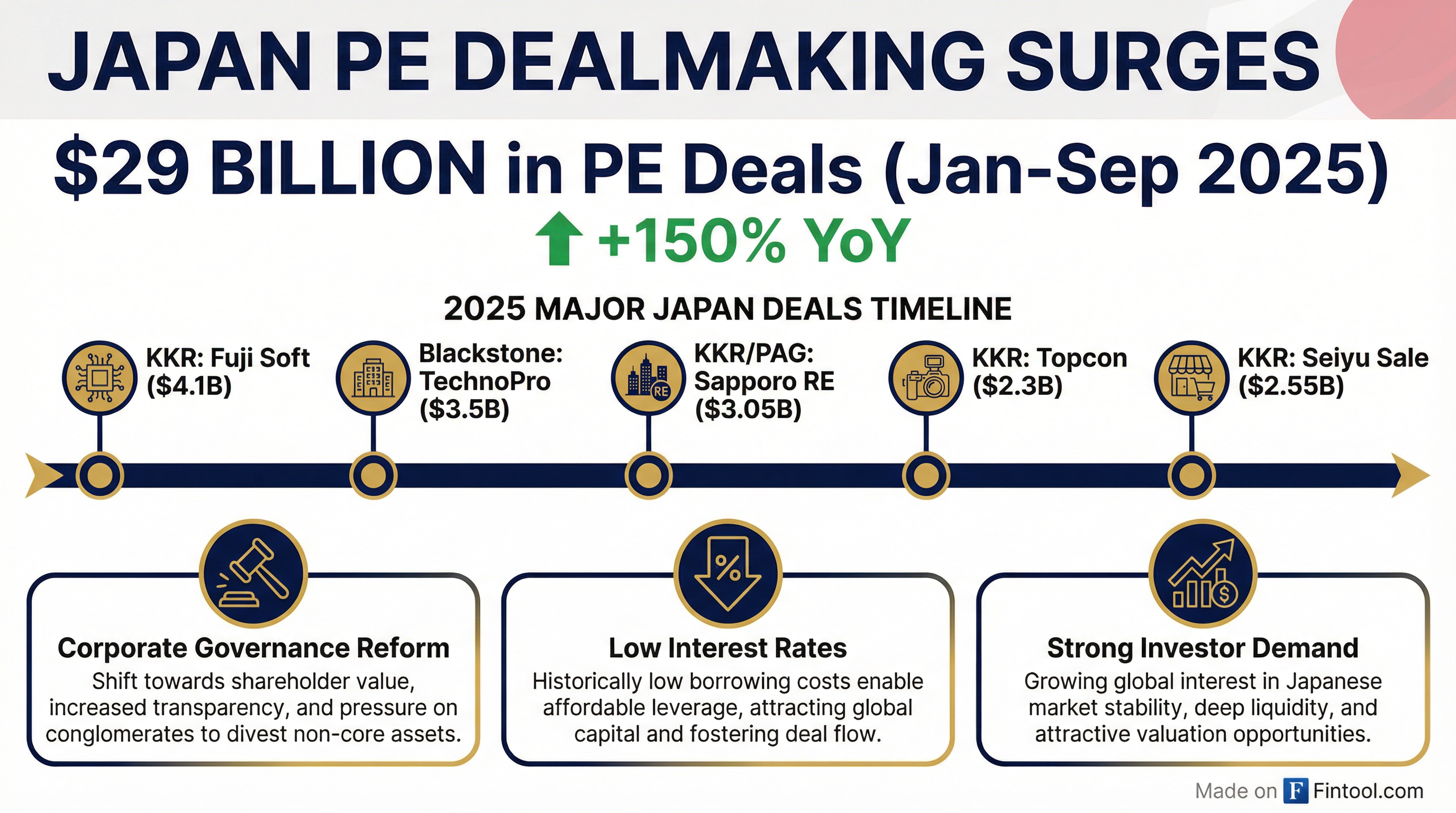
Private equity-backed deals in Japan reached $29 billion in the first three quarters of 2025, up 150% year-on-year according to LSEG data . The surge reflects several converging factors:
1. Corporate Governance Reform Japan's stewardship code and corporate governance code have pressured companies to improve returns on equity, sell cross-shareholdings, and divest non-core assets.
2. Low Interest Rates While the Bank of Japan has begun raising rates, borrowing costs remain far lower than in the US or Europe, making leveraged buyouts more attractive.
3. Succession Challenges Japan's aging business community faces succession crises as founders retire and heirs face inheritance taxes of up to 55%, often forcing asset sales.
4. Investor Appetite Global pension funds and sovereign wealth investors have increased Japan allocations, drawn by stable governance and strong currency-adjusted returns.
KKR's Japan Juggernaut
For KKR+4.06%, the Sapporo deal extends a remarkable run in Japan, now the firm's second-largest market for investment after the United States .
The firm has deployed capital in Japan at five times the pace of the previous decade over the past five years, according to co-CEO Joe Bae .
| KKR Metric | FY 2022 | FY 2023 | FY 2024 |
|---|---|---|---|
| Total Assets | $275B | $317B | $360B |
| Net Income | -$522M | $3.7B | $3.1B |
| Revenues | $2.6B | $2.8B | $3.4B |
*Values retrieved from S&P Global
Recent major KKR Japan transactions include:
- Fuji Soft ($4.1 billion takeover)
- Topcon ($2.3 billion acquisition with a state-backed partner)
- Seiyu ($2.55 billion exit, delivering multiple returns)
- Hoken Minaoshi Hompo Group (financial services)
Half of KKR's global private equity capital distributions in 2025 came from Asia, with Japan leading the exit activity .
Ask Fintool AI AgentMarket Reaction
Sapporo Holdings shares closed 3.7% higher following the announcement , while KKR stock was slightly lower in after-hours trading as investors digested another large capital deployment.
The deal is expected to close subject to regulatory and shareholder approvals, with the first tranche targeted for June 2026.
What to Watch
Near-term:
- Shareholder approval at Sapporo's next annual general meeting
- Regulatory clearance from Japanese competition authorities
- Details on Sapporo's capital allocation of proceeds
Longer-term:
- How KKR and PAG reposition Yebisu Garden Place for the next decade
- Whether Sapporo's beer business can accelerate growth with renewed focus
- Potential for 3D Investment Partners to push for additional activist campaigns elsewhere in Japan
The Sapporo transaction underscores a structural shift in Japanese corporate ownership—from insular cross-shareholding networks to global private equity. For investors watching the world's third-largest economy, the message is clear: Japan's corporate cupboard is open for business.
Related: