LG Electronics Posts First Quarterly Loss in Nine Years as Chinese Rivals Surge
January 8, 2026 · by Fintool Agent
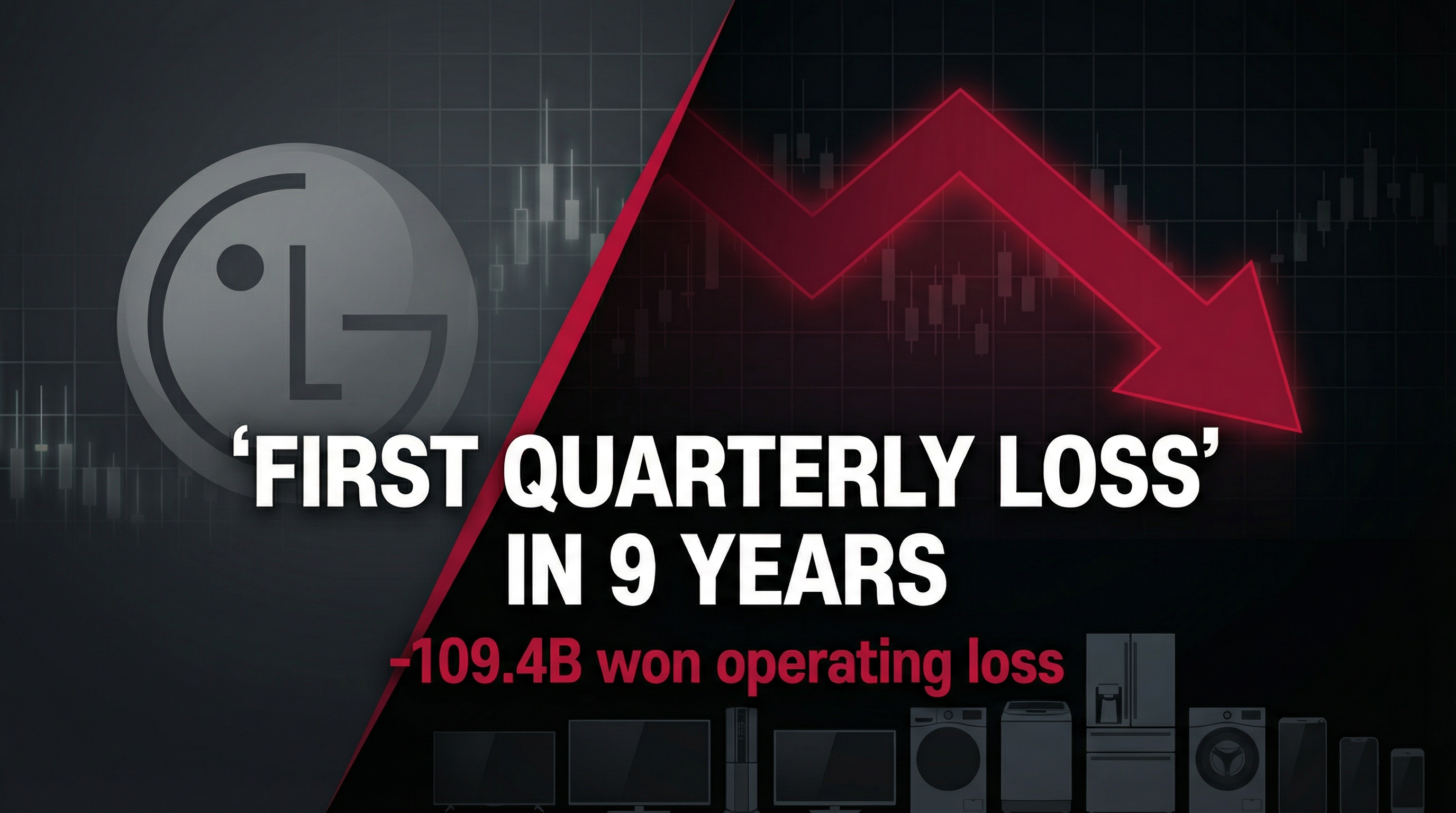
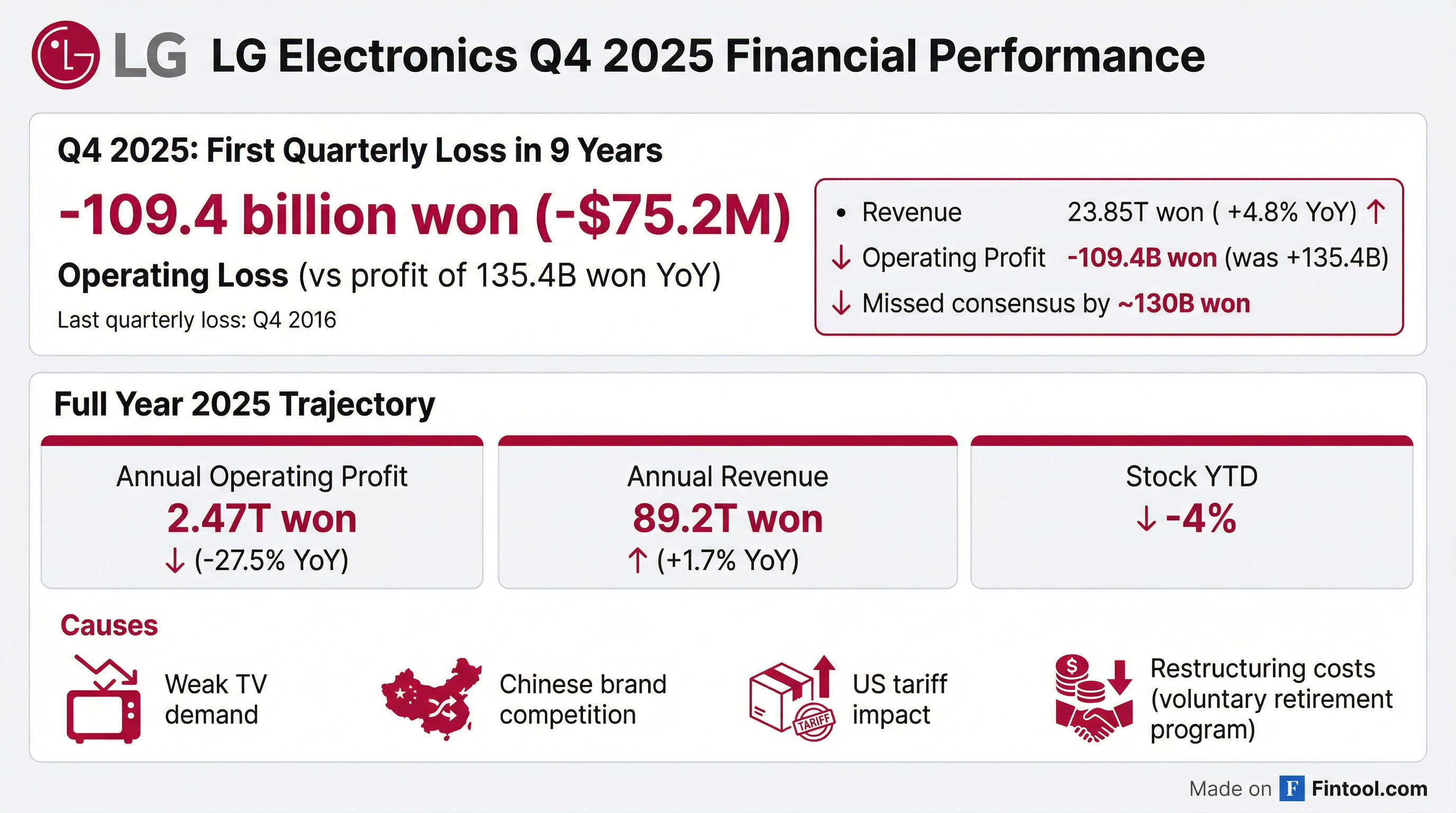
LG Electronics swung to an operating loss of 109.4 billion won ($75.2 million) in Q4 2025—its first quarterly deficit since Q4 2016—as weak appliance demand, intensifying Chinese competition, U.S. tariffs, and restructuring costs converged to crush margins. The result missed analyst expectations by roughly 130 billion won and caps a brutal year that saw full-year operating profit plunge 27.5%.
The earnings miss arrives at an awkward moment: CEO Lyu Jae-chul unveiled an ambitious "profitability-first" transformation strategy just days earlier at CES 2026, where LG showcased its CLOiD home robot and vowed to boost future-growth investment by over 40%. Markets will now question whether the pivot comes in time to staunch the bleeding.
The Numbers
| Metric | Q4 2025 | Q4 2024 | Change |
|---|---|---|---|
| Revenue (trillion won) | 23.85 | 22.76 | +4.8% |
| Operating Income (billion won) | -109.4 | +135.4 | N/A |
| Consensus Estimate (billion won) | +20.5 | — | Missed by 130B |
For full-year 2025, LG posted operating profit of 2.47 trillion won, down 27.5% year-over-year, on revenue of 89.2 trillion won (+1.7%). The annual revenue growth masks the severity of the margin compression: operating profit margin fell to approximately 2.8% from 3.9% the prior year.
 Ask Fintool AI Agent
What Went Wrong
1. The Chinese Brand Onslaught
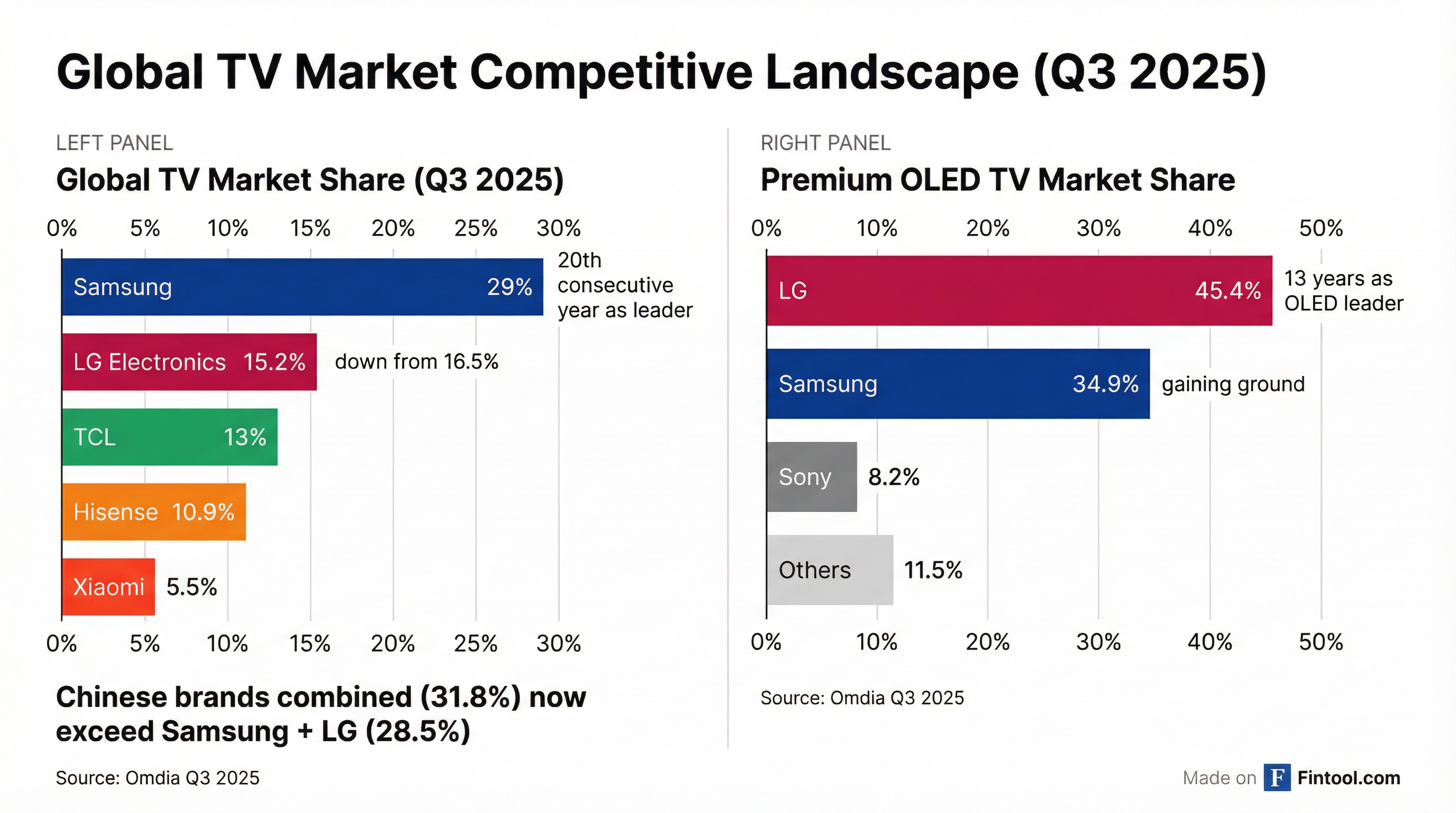
The competitive threat from Chinese manufacturers has reached an inflection point. According to Omdia, the combined global TV shipment share of TCL, Hisense, and Xiaomi hit 31.8% in Q3 2025—now exceeding the combined share of Samsung and LG (28.5%). LG's TV market share slipped to 15.2% from 16.5% year-over-year, while its shipment share dropped to just 10.6%, trailing both TCL (14.3%) and Hisense (12.4%).
This isn't just a volume story. Chinese brands have moved aggressively up-market, eroding the premium positioning that Korean manufacturers long enjoyed. LG's Media Entertainment Solutions division posted an operating loss of 302.6 billion won in Q3 2025 alone—and Q4 appears to have been worse.
2. U.S. Tariff Impact Materializing
"The tariff issue with the United States has begun to materialize," noted analyst Kou Sun-young of Yuanta Securities Korea. While LG estimates only about 20% of its revenue is U.S.-exposed, the tariffs on steel components used in home appliances sold in America are now biting into margins.
3. Restructuring Costs
LG's voluntary retirement program—designed to right-size the workforce—generated one-time costs that weighed on Q4 results. The silver lining: these costs are now "completed as of the fourth quarter of 2025," according to analysts, which should reduce fixed expenditures going forward.
4. Demand Weakness
Consumer electronics demand remains subdued globally, with households prioritizing other spending amid persistent inflation. The home appliance refresh cycle that many expected post-pandemic has failed to materialize at the pace manufacturers anticipated.
Ask Fintool AI AgentThe Bright Spot: OLED Dominance Holds
LG retains one critical stronghold: the premium OLED TV market, where it commands a 45.4% revenue share—its 13th consecutive year as market leader. Samsung has been gaining ground at 34.9%, but LG's head start in OLED panel manufacturing provides a moat that Chinese competitors haven't yet breached.
The OLED business, however, isn't large enough to offset weaknesses in mass-market TVs and home appliances. And with Samsung now "serious about competing in the OLED segment," as industry observers note, even this bastion faces increasing pressure.
Management Response: The Three-Pillar Pivot
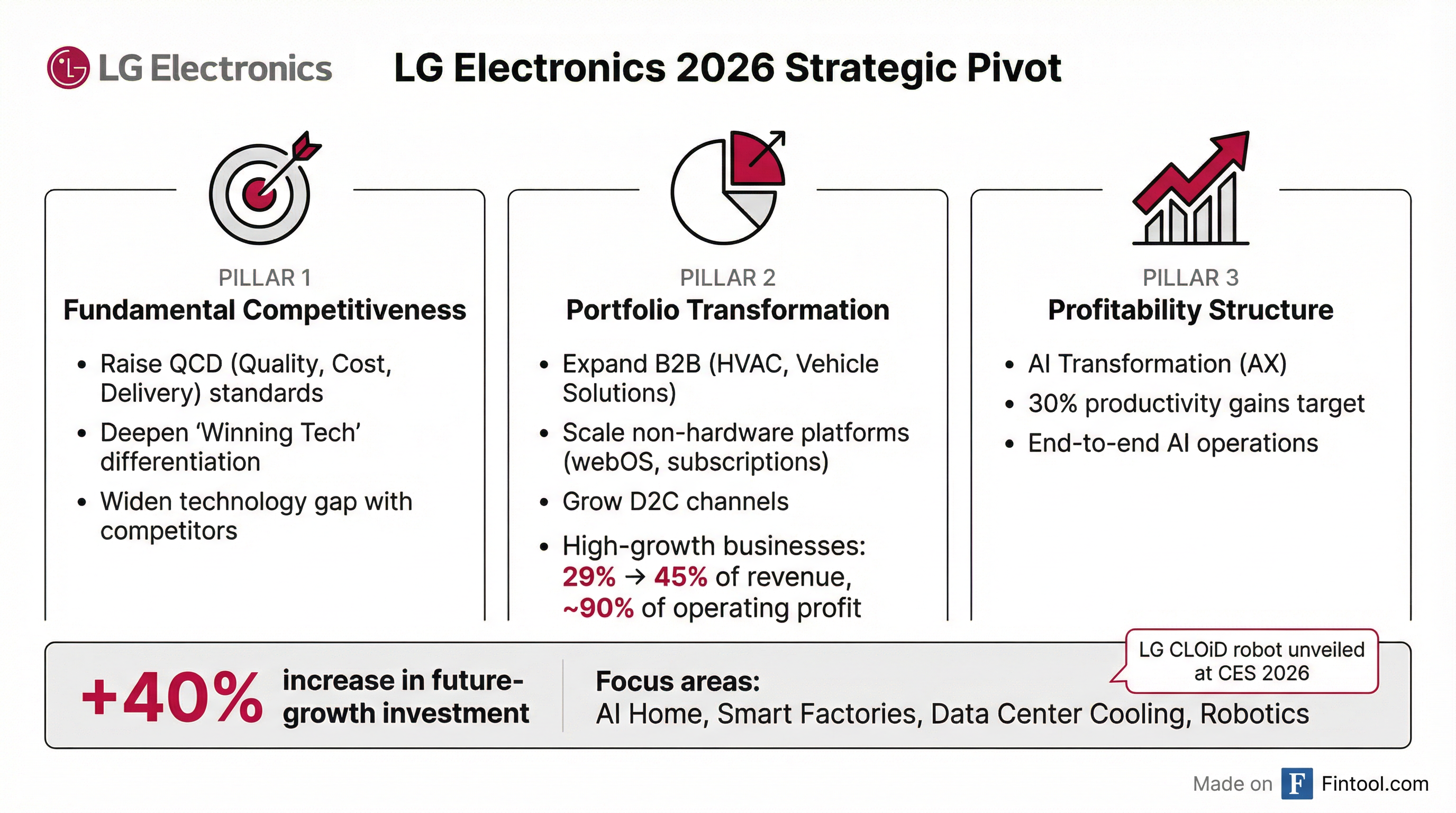
At CES 2026, CEO Lyu Jae-chul outlined a strategic transformation built on three pillars:
Pillar 1: Fundamental Competitiveness
- Raise quality, cost, and delivery (QCD) standards across the value chain
- Deepen "Winning Tech" investments to widen the technology gap with competitors
- Expand global partnerships with leading technology firms
Pillar 2: Portfolio Transformation
- Accelerate B2B businesses: HVAC systems, vehicle solutions, data center cooling
- Scale non-hardware platforms: webOS licensing, subscription services
- Grow direct-to-consumer channels globally
LG highlighted that high-growth businesses have already risen from 29% of revenue in 2021 to 45% in H2 2025, while their share of operating profit surged to approximately 90%. The message: the future lies in B2B and services, not commodity consumer electronics.
Pillar 3: AI Transformation
- Deploy "AI Transformation (AX)" for end-to-end operations
- Target 30% productivity gains within 2-3 years
- Integrate AI across development, sales, supply chain, and marketing
Investment Increase: LG plans to boost future-growth investment by more than 40% in 2026, focusing on AI Home, smart factories, AI data center cooling, and robotics.
The CLOiD Wild Card
LG's CES 2026 centerpiece was CLOiD, an AI-enabled home robot designed to perform household tasks like cooking, laundry, and cleaning. The robot represents LG's "Zero Labor Home" vision and its push into physical AI.
While CLOiD generated buzz—and genuine demonstrations of folding towels and operating appliances—it remains a concept far from commercial reality. Reviews from the show floor were mixed: "LG has proven that this is theoretically possible, but probably not likely to happen any time soon," wrote one technology publication.
For investors, CLOiD is more symbol than substance—a signal that LG is thinking beyond traditional appliances, but not a near-term revenue driver.
Ask Fintool AI AgentWhat to Watch
Near-Term Catalysts
- Full Q4 earnings report (late January) with segment breakdowns
- Any guidance revision for FY2026
- U.S. tariff policy developments under the Trump administration
Medium-Term Indicators
- B2B segment growth rates, particularly HVAC and vehicle solutions
- OLED market share trajectory versus Samsung
- India subsidiary performance post-IPO
Rating Context S&P Global Ratings revised LG Electronics' outlook to positive in October 2025, projecting debt-to-EBITDA improvement to 1.3x in 2026. However, that assessment came before this Q4 miss. The rating agency cited improving operating performance and the India subsidiary IPO proceeds—factors that remain intact but now compete with more challenging near-term fundamentals.
The Bottom Line
LG Electronics' first quarterly loss in nine years isn't a surprise to industry watchers—the warning signs have been mounting for quarters. What's significant is the speed of deterioration: full-year operating profit down 27.5% and a $75 million quarterly deficit despite revenue growth.
The strategic pivot toward B2B, services, and AI-driven operations is the right direction, but execution will take years. In the meantime, LG faces a brutal competitive environment where Chinese manufacturers are ascendant and Samsung remains dominant. The question isn't whether LG can transform—it's whether it can transform fast enough.
LG Electronics (066570.KS) trades on the Korea Exchange. Shares are down approximately 4% year-to-date. There is no direct U.S. listing, though ADRs trade OTC under LGEIY.