McGrath RentCorp Leadership Trio Makes First Public Appearance Since CEO Transition at Barclays Conference
February 17, 2026 · by Fintool Agent



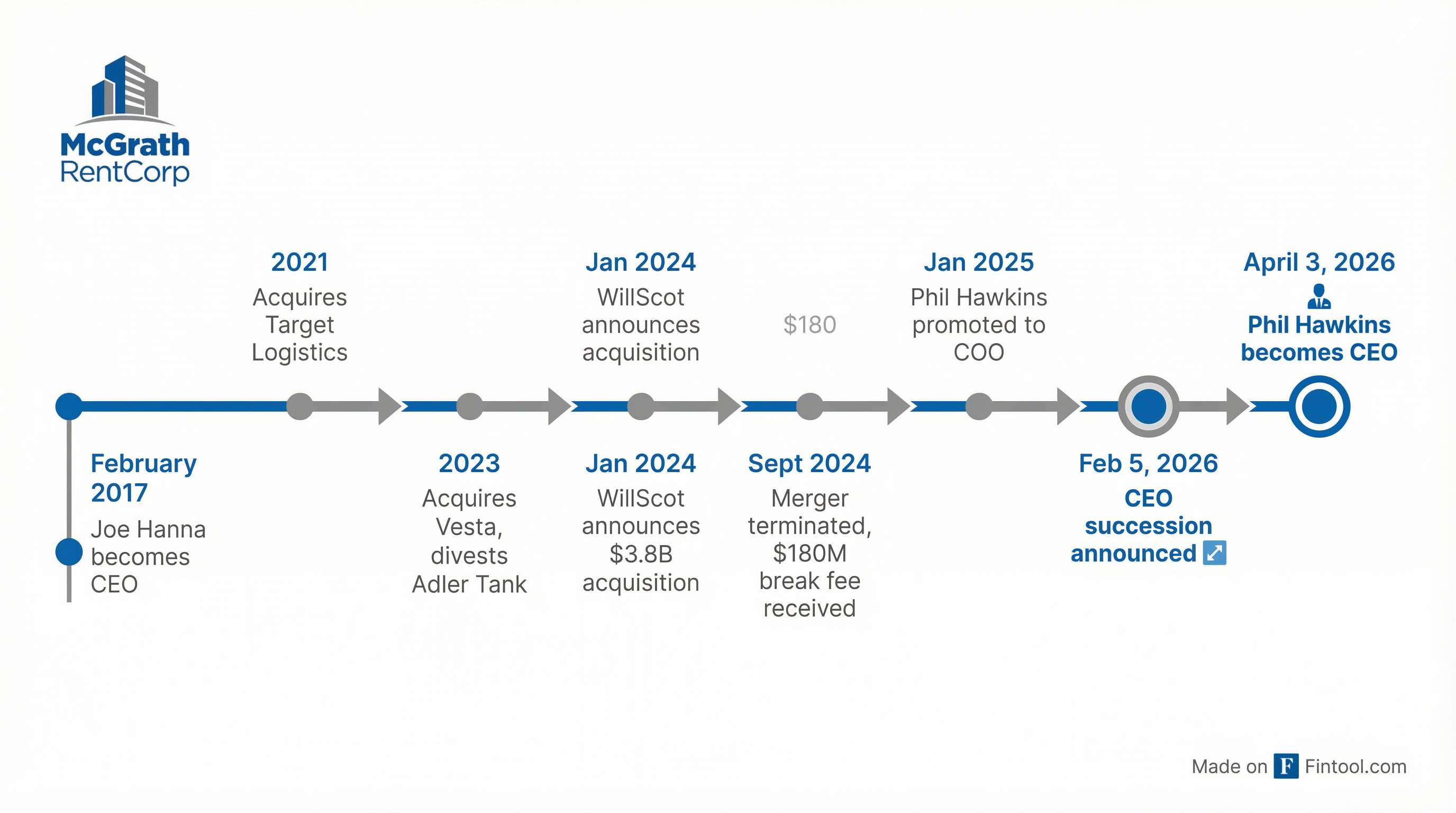
Mcgrath Rentcorp's leadership trio took the stage at Barclays' 43rd Industrial Select Conference today—their first major investor appearance since announcing the CEO succession twelve days ago.
Outgoing CEO Joe Hanna, incoming CEO Phil Hawkins, and CFO Keith Pratt presented a unified front at what amounts to a carefully orchestrated investor debut for the incoming chief executive. The message: expect continuity, not change.
Shares traded down 0.5% to $117.06 in a muted session, though the stock remains up 6% since the CEO transition announcement on February 5th.
The Transition: A 22-Year Company Man Takes the Helm
The conference gave investors their first chance to hear Hawkins articulate his vision alongside the CEO he's replacing. The optics were deliberate—Hanna deferred to Hawkins repeatedly throughout the session, letting him answer questions on operational strategy and market dynamics.
"While I'm a new CEO at McGrath, I'm not new to the company," Hawkins said. "Joe's been my boss for 18 of those [22 years]. Everything we've done, from the strategy to the way we run our business, we've done together."
Hanna emphasized the bench depth and cultural continuity: "Phil's gonna continue to execute the strategy that we've been very clear about over the last several years that's been producing results for us."
 Ask Fintool AI Agent
Barclays Initiates With Overweight: The Investment Case
The appearance comes as Barclays analyst Ronan Kennedy unveiled coverage with an Overweight rating—a notable endorsement for a $2.9 billion company often overlooked by Wall Street.
Kennedy framed McGrath as "a relatively safer way to have one foot in the door from a potential cyclical recovery" in non-residential construction, following the WillScot deal termination that left the company with a clean balance sheet and refocused standalone strategy.
The bull case rests on three pillars:
- Consistent results through a challenging macro environment
- Disciplined capital allocation with low leverage
- Attractive financial framework with pricing power
| Metric | Q3 2025 | Q3 2024 | YoY Change |
|---|---|---|---|
| Revenue | $254.2M* | $264.4M* | -3.9% |
| EBITDA | $71.8M* | $79.4M* | -9.5% |
| EBITDA Margin | 28.0%* | 29.8%* | -180 bps |
| Net Income | $42.3M* | $149.3M** | -71.7% |
| Total Debt | $551.8M* | $608.6M* | -9.3% |
*Values retrieved from S&P Global. *Q3 2024 included $180M WillScot termination fee.
The Bifurcated Market: Mega Projects vs. Local Construction
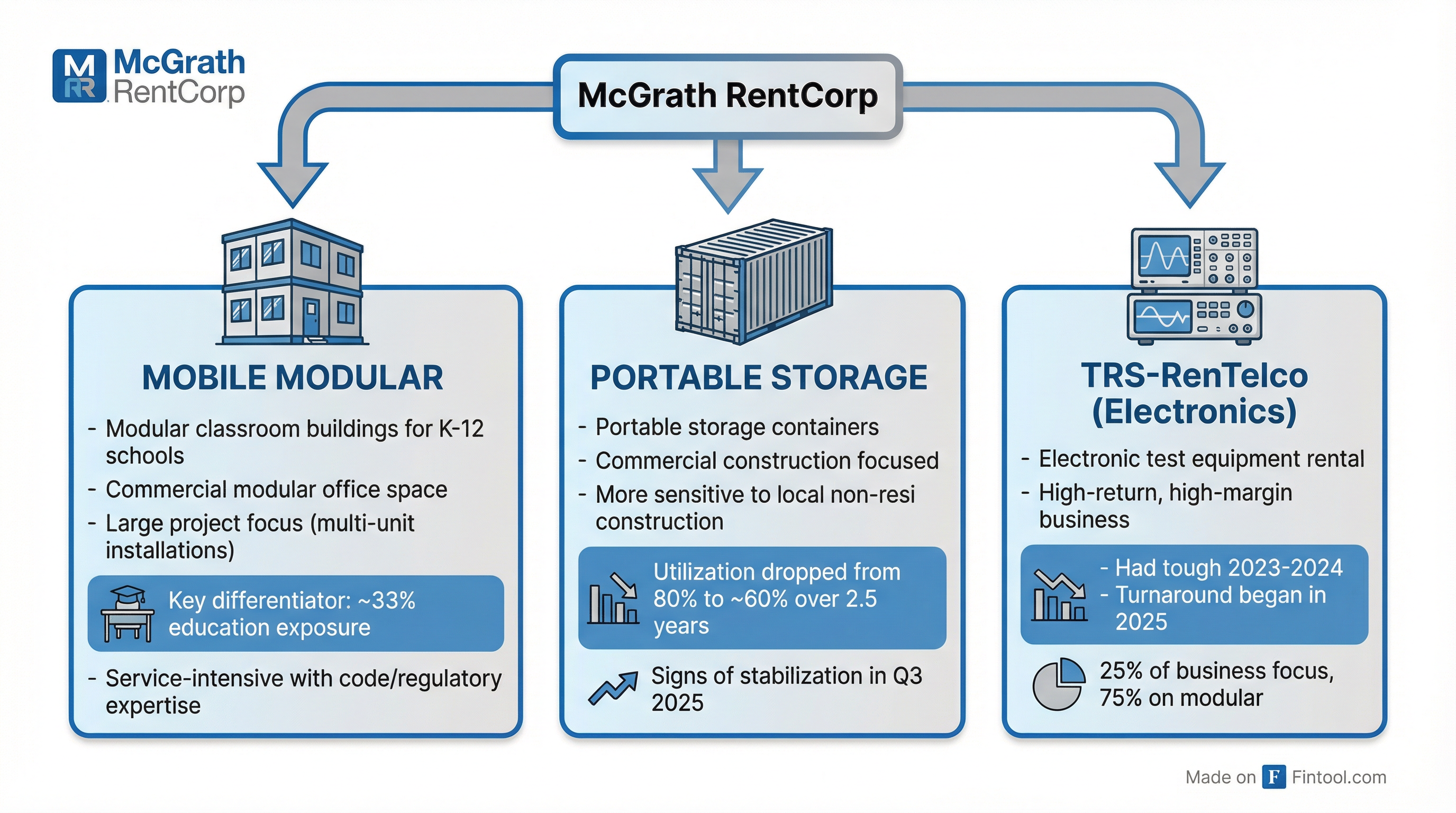
Management painted a picture of two very different demand environments. Large, complex projects—data centers, manufacturing reshoring, major school installations—remain robust. Smaller, rate-sensitive local construction has been weak for over two years.
"The largest GCs have backlogs that are still a year long," Hawkins explained. "For our business, the types of projects we play into and fit into, there's still a steady stream of work out there."
The contrast shows up starkly in their segments:
- Modular Solutions: Utilization pressure but pricing discipline driving revenue growth
- Portable Storage: Utilization collapsed from 80%+ to ~60% over 2.5 years, but showed first growth (1%) in Q3 after almost two years of decline
CFO Keith Pratt highlighted the Architectural Billing Index improving slightly to 48.5 in December—still contractionary but trending better.
 Ask Fintool AI Agent
The 40% Pricing Spread: Hidden Margin Tailwind
Perhaps the most compelling financial dynamic management discussed: the 40% spread between average revenue per unit on rent ($865) and revenue from units shipped in the last 12 months ($1,200).
This spread reflects two forces:
- Inflation pass-through: Building materials and maintenance costs rose significantly post-COVID, requiring higher pricing on new deployments
- Services attachment: Management is successfully bundling more services with new contracts than legacy installations carry
"For the installed base, seeing some progression in what is the revenue we realize per unit on rent, and that was up 6% in the third quarter compared to a year earlier," Pratt noted.
The dynamic creates a built-in tailwind: as older, lower-priced units churn off rent and return to new customers, they reset to current market rates. With average modular stay terms of 2-3 years (commercial) and 4-5+ years (education), this repricing wave will play out over multiple years.
WillScot Aftermath: Clean Balance Sheet, Full War Chest
The elephant in the room—or rather, the elephant that left the room—is the terminated Willscot Holdings merger. Management addressed it directly, framing the episode as strengthening rather than disrupting the company.
Hanna noted that during the nine months under merger agreement, "we did not deviate from the strategy... when the transaction actually was terminated, we did not have to pick up Humpty Dumpty off the floor."
The $180 million termination fee (netting ~$85-86 million after fees and taxes) bolstered an already conservative balance sheet. Total debt has declined from $608.6 million in Q3 2024 to $551.8 million in Q3 2025, while equity expanded from $1.09 billion to $1.20 billion over the same period.
The divergence is stark: McGrath shares are up modestly since the deal announcement while WillScot has cratered nearly 50% from its January 2024 levels, trading at $21.51 versus McGrath's $117.
Ask Fintool AI AgentQ4 Earnings Preview: What to Watch
Management signaled positive momentum heading into the upcoming February 25th earnings call, having raised guidance after Q3 results in October.
Key catalysts mentioned:
- Portable storage stabilization: Potential seasonal retail business in Q4
- Electronics turnaround: TRS-RenTelco showed "good momentum" after a tough 2023-2024
- Modular steady state: Pricing discipline offsetting volume headwinds
Wall Street consensus expects:
| Metric | Q4 2025E | Q1 2026E | Q2 2026E |
|---|---|---|---|
| Revenue | $254.3M | $199.3M | $244.8M |
| EPS | $1.71 | $1.15 | $1.62 |
| EBITDA | $95.2M | $75.1M | $93.0M |
Consensus estimates from S&P Global.
The Q1 dip reflects normal seasonality—education projects ramp in summer, not winter.
The Bottom Line
Today's conference accomplished exactly what McGrath's board intended: a seamless public introduction of the incoming CEO alongside his predecessor and finance chief, all singing from the same hymnal.
Hawkins inherits a company in solid financial shape with a clear strategy, facing cyclical headwinds in parts of the business but maintaining pricing power where it matters most. The education vertical (~33% of revenue) provides ballast; mega-projects provide growth; and that 40% pricing spread offers a multi-year tailwind as the fleet reprices.
The test for Hawkins won't be whether he can maintain the strategy—it's whether he can accelerate it. Management emphasized an active M&A pipeline and the capital to pursue it. In a fragmented industry still recovering from pandemic distortions, the next 12-18 months could prove defining.
"McGrath is an industry leader and is stronger than ever," Hawkins said. "We have a broad array of market opportunities ahead of us."
Q4 results drop February 25th—the first earnings call with the full leadership trio together on the line.