MicroVision Wins $33M Bankruptcy Auction for Luminar's Lidar Assets
January 27, 2026 · by Fintool Agent



Microvision emerged victorious from a bankruptcy auction Monday, securing Luminar Technologies' lidar assets for $33 million in cash — a fraction of the $3.4 billion valuation the autonomous vehicle sensor pioneer commanded when it went public via SPAC merger in 2020.
MVIS shares rose 6.5% to $0.91 on the news, giving the Redmond, Washington-based company a market cap of approximately $278 million.
The Deal
MicroVision outbid Quantum Computing Inc., which had entered as the stalking horse bidder at $22 million and later raised its offer to $28 million. The acquisition, subject to bankruptcy court approval at a hearing today, is expected to close on or shortly after February 2, 2026.
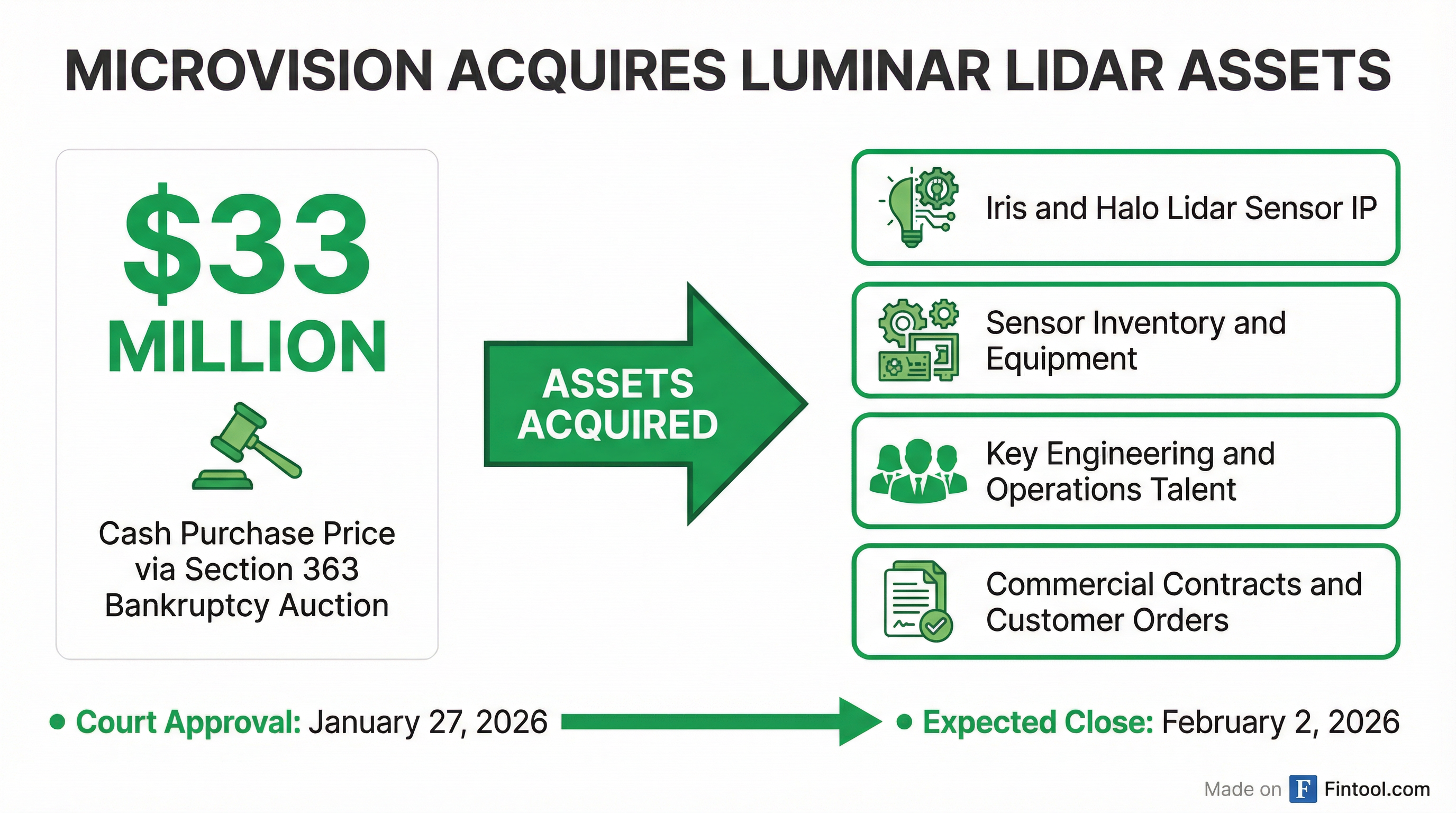
The assets include:
- Intellectual property for the Iris and Halo lidar sensors
- Inventory and equipment related to sensor production
- Key engineering and operations talent
- Commercial contracts and customer orders
"It's no secret that the lidar market has been ripe for disruption and in need of further consolidation," said MicroVision CEO Glen DeVos. "Building on our proven executive leadership in automotive, our history of developing and delivering products in defense, and now an even more expansive portfolio of technologically diverse lidar sensors and advanced perception solutions, we believe MicroVision is ready to upend the industry."
 Ask Fintool AI Agent
Luminar's Collapse: From Unicorn to Auction Block
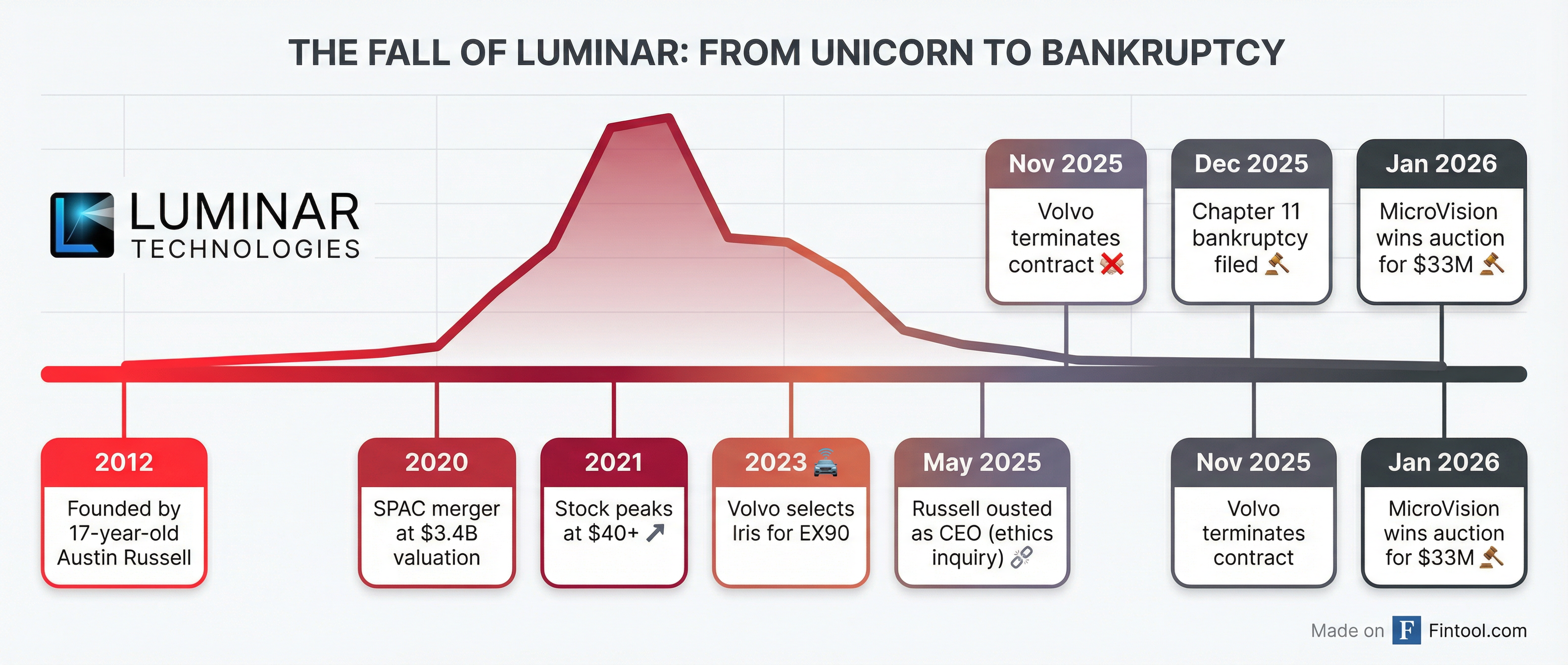
Luminar's fall represents one of the most dramatic implosions in the autonomous vehicle sector. Founded in 2012 by then-17-year-old Austin Russell, the company pioneered the use of 1550nm wavelength lidar technology that promised superior range and resolution for self-driving applications.
The company went public via SPAC merger in December 2020 at a $3.4 billion valuation. At its peak in early 2021, shares traded above $40. The stock has since lost more than 99% of its value.
Key milestones in Luminar's decline:
| Date | Event |
|---|---|
| December 2020 | SPAC merger at $3.4B valuation |
| 2021 | Stock peaks above $40/share |
| 2023 | Volvo selects Iris lidar for EX90 |
| May 2025 | Russell ousted as CEO following ethics inquiry |
| September 2025 | Enters forbearance proceedings |
| November 2025 | Volvo terminates contract |
| December 15, 2025 | Chapter 11 bankruptcy filed |
| January 27, 2026 | MicroVision wins auction for $33M |
The final blow came when Volvo terminated its supply agreement in November 2025, deciding against putting Luminar's sensors in its EX90 and ES90 electric vehicles because the lidar supplier allegedly did not meet its commitments. Luminar claimed significant damages against Volvo, but the loss of its flagship customer accelerated the path to bankruptcy.
At the time of filing, Luminar had approximately $505 million in debt against total assets of only $203 million.
The Semiconductor Split
In a parallel transaction, Quantum Computing Inc. has agreed to purchase Luminar's semiconductor subsidiary (Luminar Semiconductors Inc., or LSI) for $110 million in cash. This division includes photonics expertise gained through acquisitions of Freedom Photonics, Optogration, and Black Forest Engineering.
LSI was not included in Luminar's Chapter 11 filing and will continue operating normally. The semiconductor sale is also subject to court approval.
Ask Fintool AI AgentWhat This Means for MicroVision
MicroVision, which has been developing its own MEMS-based lidar sensors, gains a significantly expanded product portfolio and engineering talent from the acquisition. The company already has partnerships in place, including integration of its MOVIA lidar system on NVIDIA's DRIVE AGX platform.
MicroVision at a glance:
| Metric | Value |
|---|---|
| Stock Price | $0.91 |
| Market Cap | $278M |
| 52-Week Range | $0.81 - $1.93 |
| Today's Change | +6.5% |
The acquisition price of $33 million represents approximately 12% of MicroVision's current market capitalization — a meaningful but manageable deployment of capital for a company that has historically been cash-constrained.
CEO DeVos emphasized cost discipline: "Having already proven our ability to identify strategic opportunities to advance our business priorities and effectively integrate unique assets and talent into the MicroVision family, we intend to very efficiently integrate the acquired business with an intense focus on streamlining operations and managing costs."
The Austin Russell Question
The bankruptcy proceedings have been marked by ongoing legal tensions involving Luminar's founder. Austin Russell, who was ousted as CEO in May 2025 following an ethics inquiry by the board's audit committee, had attempted to buy back the company in October 2025 but failed to submit a formal bid before the Chapter 11 filing.
Russell recently agreed to accept an electronic subpoena for information on his phone as Luminar's lawyers assess whether to pursue legal action against the founder. He had initially turned away process servers at his Florida mansion before reaching an agreement on privacy protections for his personal information.
Representatives for Russell's new venture, Russell AI Labs, had indicated interest in bidding for Luminar's lidar assets, but no formal offer materialized before Monday's auction.
Industry Implications
Luminar's bankruptcy and fire sale mark a watershed moment for the autonomous vehicle lidar industry. Once heralded as a critical component of the self-driving revolution, pure-play lidar companies have struggled to achieve commercial scale as automakers delayed autonomous vehicle programs and Chinese competitors drove down prices.
Velodyne Lidar, another early lidar pioneer, merged with Ouster in 2023 after facing similar challenges. The combined entity continues to trade but at a fraction of its peak valuation.
The winners in this consolidation phase may be companies like MicroVision that can acquire valuable IP and talent at distressed prices while maintaining operational discipline. The losers are shareholders who believed the autonomous vehicle revolution would arrive faster than reality allowed.
Ask Fintool AI AgentWhat to Watch
- Court approval hearing scheduled for January 27, 2026
- Expected closing on or shortly after February 2, 2026
- MicroVision earnings call — additional details on integration plans
- Russell litigation — potential legal action against former CEO
- Customer retention — whether acquired commercial contracts remain viable