Mitsubishi Pays $7.5 Billion for Aethon's Haynesville Shale Assets in Japan's Largest U.S. Shale Deal
January 16, 2026 · by Fintool Agent
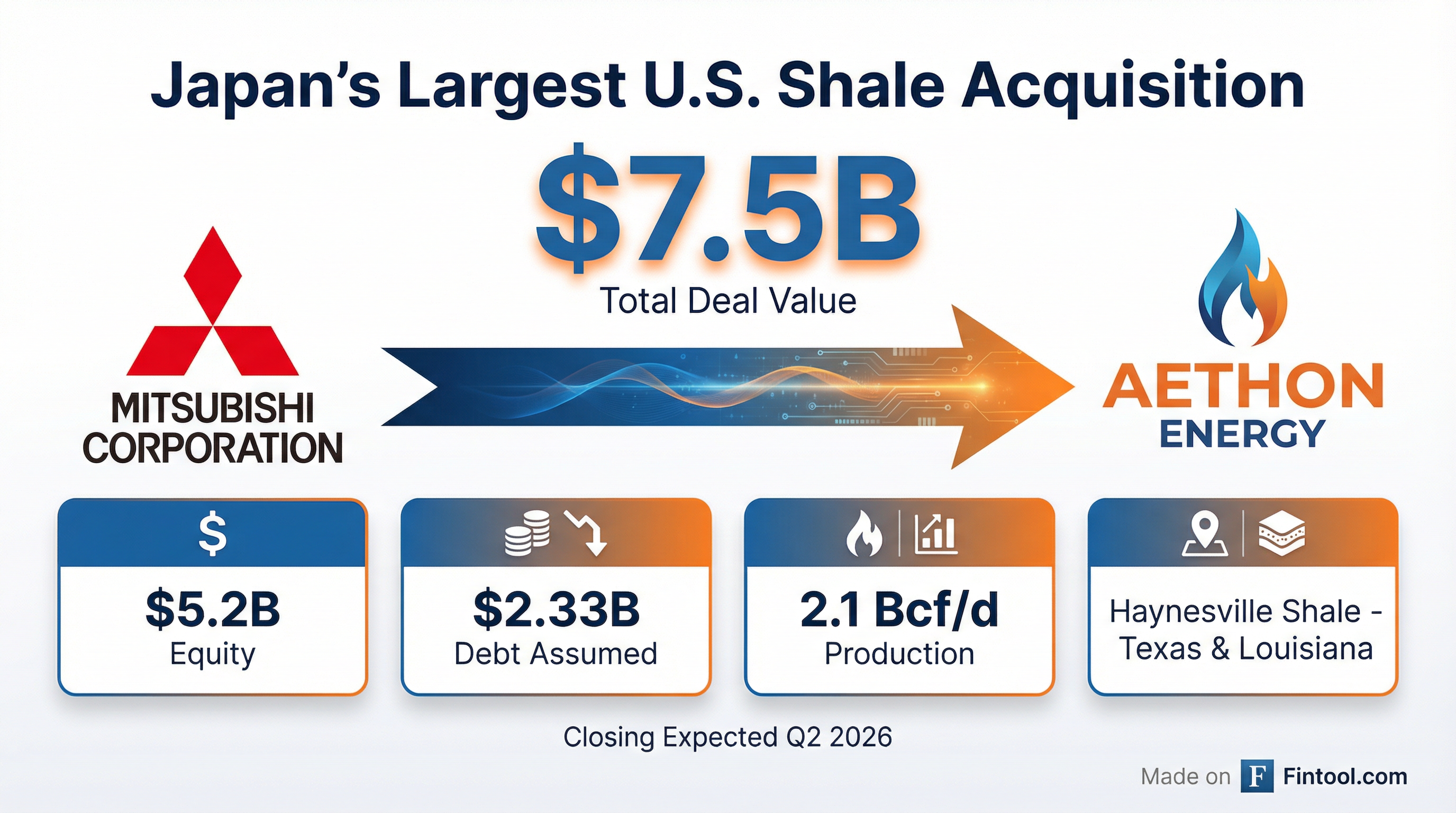
Mitsubishi Corporation is acquiring Aethon Energy Management's Haynesville shale gas assets in Texas and Louisiana for $7.53 billion, marking the largest acquisition by a Japanese company in the U.S. unconventional gas sector and the trading house's most significant deal ever.
The transaction, announced January 16, includes $5.2 billion in equity purchases and the assumption of $2.33 billion in net debt. Mitsubishi expects to close the deal in Q2 2026, subject to regulatory approvals.
Mitsubishi shares fell 2% following the announcement, underperforming the broader Nikkei 225 index which declined 0.3%.
 Ask Fintool AI Agent
The Deal
Aethon's assets are concentrated in the Haynesville Shale formation, spanning the Texas-Louisiana border, and currently produce approximately 2.1 billion cubic feet per day (Bcf/d) of natural gas—equivalent to about 15 million metric tons per year of LNG. This makes Aethon the second-largest producer in the Haynesville region, which accounts for roughly 15% of the area's total 14.3 Bcf/d output.
| Metric | Value |
|---|---|
| Total Transaction Value | $7.53 billion |
| Equity Purchase | $5.2 billion |
| Debt Assumed | $2.33 billion |
| Current Production | 2.1 Bcf/d (15 MTPA LNG) |
| Peak Production (2028) | 2.6 Bcf/d (18 MTPA LNG) |
| Expected Close | Q2 2026 (April-June) |
Mitsubishi CEO Katsuya Nakanishi emphasized the strategic importance of the assets: "While capturing the anticipated growth in U.S. domestic gas demand, we aim to ensure a stable energy supply to overseas consumers, including Japan, amid the expected prolongation of the energy transition."
The sellers include Ontario Teachers' Pension Plan, RedBird Capital Partners, and Aethon Energy Management's founders. Notably, Aethon is expected to repurchase up to 25% of the upstream and midstream assets within six months of closing, maintaining a strategic relationship with the Japanese buyer.
Strategic Rationale: Completing the Value Chain
The acquisition represents Mitsubishi's first direct entry into U.S. shale gas production, completing an integrated value chain from wellhead to export terminal.
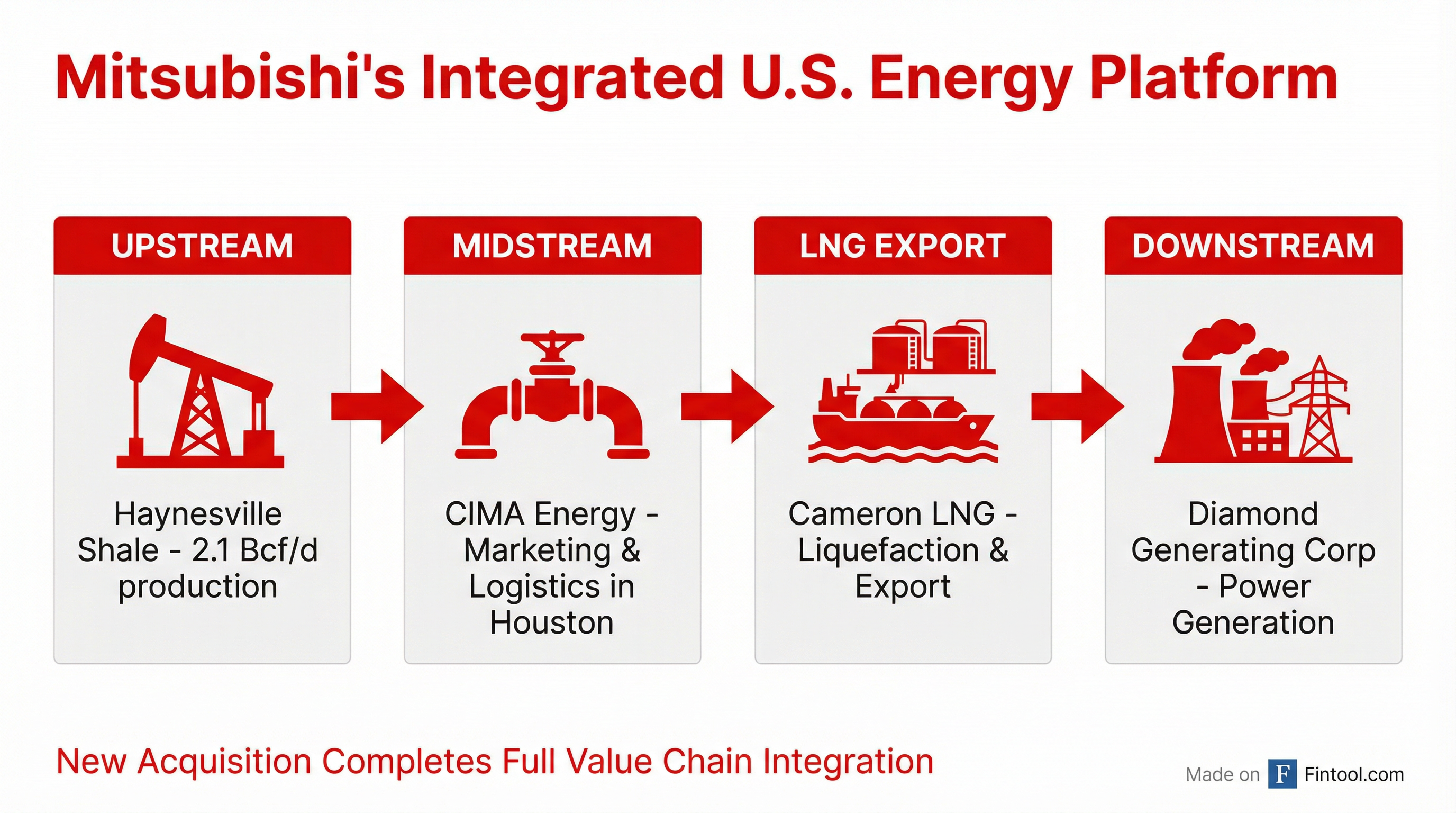
Mitsubishi's existing North American energy platform includes:
- Upstream: Shale gas development with Ovintiv in British Columbia
- Midstream: CIMA Energy marketing and logistics in Houston
- LNG Export: Stakes in Cameron LNG and LNG Canada
- Power Generation: Diamond Generating Corporation
The Haynesville's proximity to Gulf Coast LNG terminals is critical. Mitsubishi holds liquefaction capacity rights at Cameron LNG under a tolling agreement, providing a direct pathway to export Aethon's production to Asian markets, particularly Japan.
"This investment will not only strengthen the earnings base of Mitsubishi's natural gas and LNG businesses, but also accelerate efforts to build an integrated value chain in the United States—from upstream gas development to power generation, data center development, chemicals production, and related businesses," the company stated.
The companies have also formed a strategic alliance to evaluate potential investments in LNG, carbon capture and storage, geothermal energy, and data center infrastructure—though these arrangements remain non-binding and non-exclusive.
Ask Fintool AI AgentJapan's Haynesville Shale Push
Mitsubishi's acquisition is the largest in a wave of Japanese investments in U.S. shale, concentrated in the Haynesville due to its proximity to LNG export infrastructure.

| Company | Deal | Value | Date |
|---|---|---|---|
| Mitsubishi | Aethon Energy (Haynesville) | $7.5 billion | Jan 2026 |
| JERA | GEP Haynesville II | $1.7 billion | Oct 2025 |
| Tokyo Gas | TG Natural Resources (Exit) | $255 million sale | Nov 2025 |
In 2025 alone, Japanese companies announced over $8.5 billion in U.S. shale investments, heavily concentrated in the Haynesville.
These deals align with Japan's broader energy security strategy. In October 2025, President Trump and Japanese Prime Minister Sanae Takaichi signed an agreement calling for $550 billion in Japanese investments to revitalize the U.S. industrial base, with energy projects as key candidates.
Japan—which has few domestic energy resources—was the largest non-European importer of U.S.-sourced LNG last year, though a December IEEFA report noted that Japanese LNG imports have declined 20% since 2018 as the country revives nuclear power and expands renewables.
What to Watch
Regulatory Approval: The deal requires customary approvals and is expected to close by June 2026. Given the strategic U.S.-Japan relationship and energy security alignment, significant hurdles appear unlikely.
Aethon Buyback: Aethon's option to repurchase up to 25% of the assets within six months of closing will be closely watched. A partial buyback would reduce Mitsubishi's net investment while maintaining Aethon's operational involvement.
Production Ramp: Mitsubishi projects peak production of 2.6 Bcf/d by 2028—a 24% increase from current levels—which would boost LNG-equivalent output to approximately 18 MTPA.
LNG Arbitrage: The key value driver is Mitsubishi's ability to optimize volumes between domestic U.S. sales at Henry Hub pricing and Asian LNG exports, capturing price spreads based on market conditions.
Data Center Demand: Mitsubishi has flagged data center development as part of its strategic alliance with Aethon, reflecting the AI-driven surge in U.S. power demand that is reshaping domestic gas consumption patterns.
Ask Fintool AI Agent