NewLake CEO: Schedule III Filing 'By End of Year' as Cannabis REIT Delivers 11% Yield With Net Cash
February 5, 2026 · by Fintool Agent



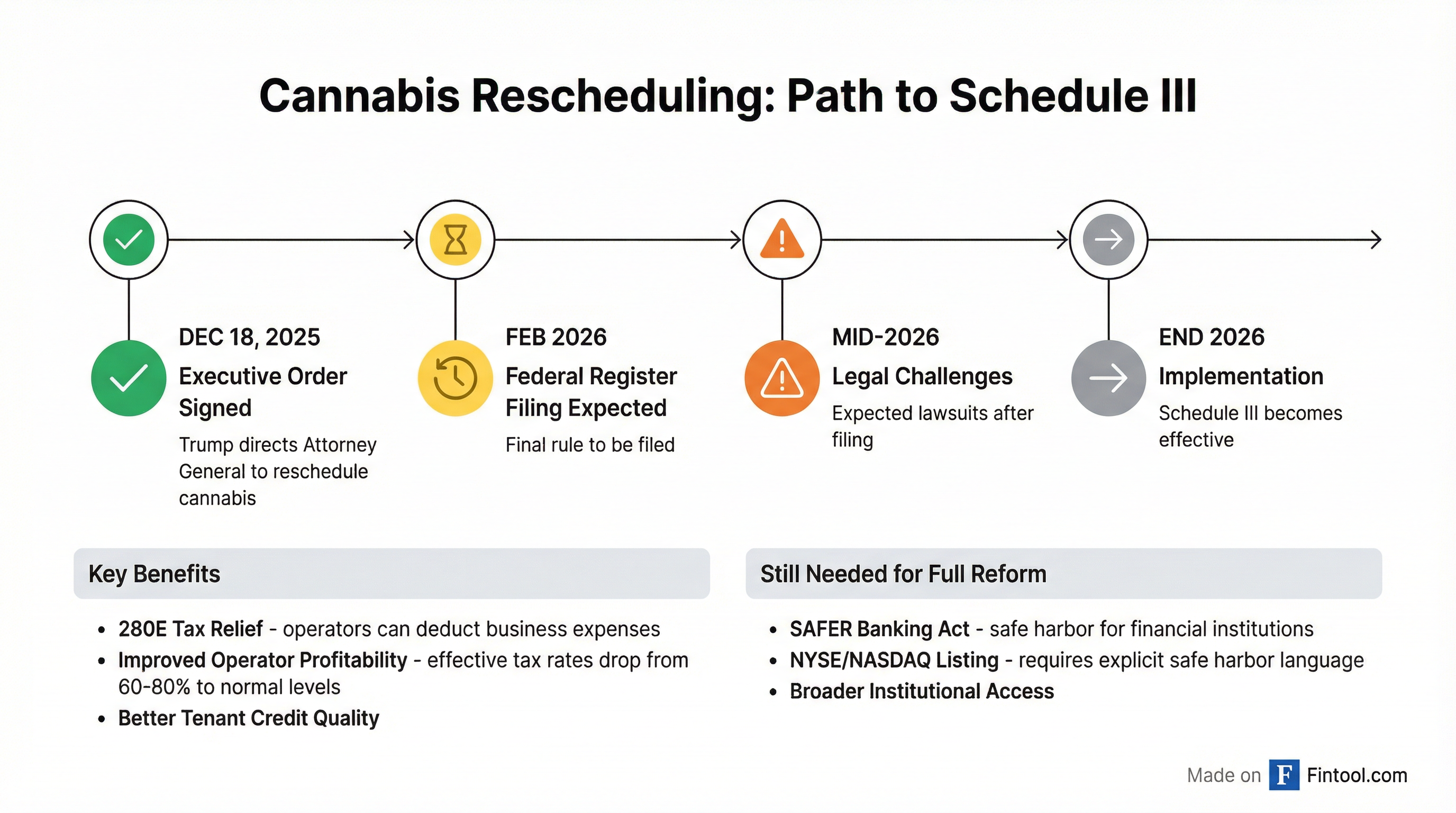
Newlake Capital Partners CEO Anthony Coniglio said he expects the final rule for cannabis rescheduling to Schedule III to be filed in the Federal Register "by the end of the year," calling the December 18 executive order an "undeniable positive" while tempering expectations for immediate exchange access in an interview with Zuanic & Associates analyst Pablo Zuanic.
The cannabis-focused REIT, which trades on the OTCQX at $15.35 and yields approximately 11%, sits in a unique position as the second-largest owner of cannabis real estate in the United States with 34 properties across 12 states—and a balance sheet that most REITs would envy: just $7.7 million in debt against over $23 million in cash.
The Schedule III Timeline
Coniglio outlined realistic expectations for when rescheduling will become effective. While the executive order was signed on December 18, 2025, the CEO acknowledged significant uncertainty remains around the filing timeline.
"We've got an executive order, but we need to see it filed," Coniglio said. "People certainly expect there will be lawsuits once the final rule is filed in the Federal Register. But people want to see the rule get filed in the Federal Register, so it's not just another politician saying, 'Hey, we're going to do this,' without getting that actual real reform."
On the question of when 280E tax relief—which currently prevents cannabis operators from deducting ordinary business expenses—would take effect, Coniglio deferred to tax professionals but noted most industry participants expect it would apply to the full taxable year once implemented.
 Ask Fintool AI Agent
The Exchange Listing Question
A key investor concern is whether Schedule III will enable NewLake to move from the OTC markets to the NYSE or NASDAQ. Coniglio was direct: it won't.
"Schedule III doesn't change that," he stated. "Unless they have a change in sentiment, unless they have a change in policy, unless they have a change in perspective—which is entirely possible—I don't see it."
The CEO explained that Innovative Industrial Properties (NYSE: IIPR), the largest cannabis REIT, was grandfathered onto the NYSE before the exchanges changed their rules. NewLake operates its business to qualify for NYSE and NASDAQ listing, but the exchanges won't accept companies focused on cannabis due to federal illegality and associated anti-money laundering concerns under the Bank Secrecy Act.
"We're gonna push hard for safer banking with the right safe harbor language, so that this industry can have regulatory access to the U.S. capital markets," Coniglio said.
Outperforming Despite OTC Status
Despite being confined to the OTC, NewLake has significantly outperformed its NYSE-listed peer since the executive order was signed:
NewLake shares are up 11.6% since December 17, while IIPR has declined 18.4% over the same period. The divergence highlights investor preference for NewLake's cleaner balance sheet and lower payout ratio as the industry awaits regulatory clarity.
The Business Model: 13% Cap Rates, 12-Year Leases
Coniglio explained NewLake's sale-leaseback model, which differs meaningfully from BDCs and mortgage REITs competing for cannabis operator capital.
"We acquire the property for that full price. We acquire the property, and then we lease it back on a long-term basis," Coniglio explained. "We have a 12-year remaining weighted average lease term... and we also have a yield on our leased portfolio of approximately 13%."
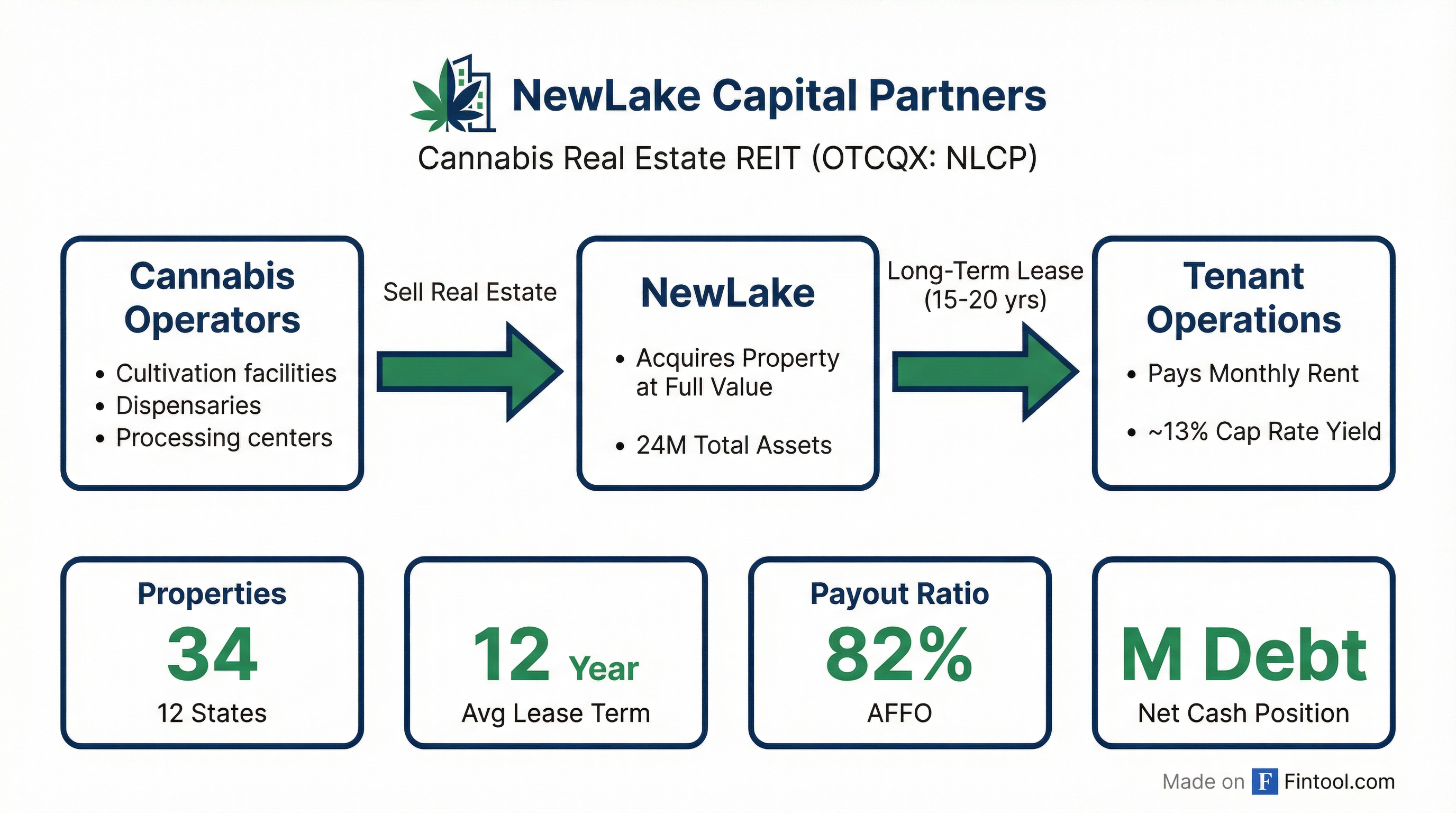
The CEO contrasted this with shorter-duration products: "If you're a BDC or a mortgage REIT, you tend to enter into 3-, 4-, or 5-year transactions, so it's shorter duration."
For operators, the trade-off is clear: sale-leaseback typically offers lower entry cap rates (around 12%) compared to 15%+ coupons on shorter-duration debt, but with longer commitments. Coniglio noted that in 2021-2022, many operators chose higher-rate short-term debt expecting their cost of capital to decline significantly—"but yet, that never materialized for the industry."
Ask Fintool AI AgentBalance Sheet: Net Cash in a Levered World
NewLake's financial position stands out in a sector where leverage concerns dominate.
"NewLake has a little over $7 million outstanding on over a $400 million balance sheet. In fact, we're in a net cash position, because if you take the over $20 million of cash we had on the balance sheet, we have net cash on the balance sheet," Coniglio said. "Very few REITs are in a net cash position."
| Metric | Q4 2024 | Q1 2025 | Q2 2025 | Q3 2025 |
|---|---|---|---|---|
| Revenue ($M) | $12.4* | $13.1 | $12.8* | $12.5* |
| Net Income ($M) | $6.0* | $6.3 | $7.3 | $6.7 |
| Total Assets ($M) | $432 | $428 | $426 | $424 |
| Total Debt ($M) | $7.7* | $7.7* | $7.7* | $7.7* |
| Cash ($M) | $20.2 | $19.9 | $21.9 | $23.6 |
*Values retrieved from S&P Global
The company has a $90 million credit facility with substantial capacity for acquisitions, though Coniglio emphasized selectivity: "We're only going to do deals that we think are quality deals. We're not going to try to put $20 million, $30 million, $40 million, $50 million of new deals out there if we're going to worry about collecting rent."
The Dividend: 82% Payout, Room to Spare
Addressing investor concerns about the high dividend yield, Coniglio was emphatic about coverage.
"An 82% payout ratio," he noted of Q3 results. "We target a payout of our free cash flow between 80% and 90%. So at 82% payout ratio in the third quarter... we could also absorb additional delinquencies, additional issues in the portfolio and still have room before we start to exceed our cash flow."
This compares favorably to IIPR's 90% payout ratio and contrasts sharply with some competitors whose payout ratios exceed 100%, meaning they're funding dividends from capital rather than operations.
Since the 2021 IPO, NewLake has grown its dividend approximately 80%.
Tenant Concentration and Credit Quality
NewLake's top three tenants—Curaleaf, Cresco Labs, and Trulieve—represent approximately half of annualized base rent, with Curaleaf alone at 24.1%.
Coniglio acknowledged the concentration risk but emphasized diversification across properties: "The 24% is across multiple properties. We have over 10 properties with them, and we look at each property from a cash flow perspective."
On recent tenant issues, the CEO provided updates:
- Ayr Wellness: Two properties recovered in Q3, actively being retenanted for cannabis use
- Rev Clinics: Massachusetts property recovered over the summer, broker engaged
- Calypso: "Really a non-event... that's not been really a discussion for at least a year or two"
Ask Fintool AI AgentState-Level Catalysts
Coniglio offered detailed commentary on NewLake's key state exposures:
Pennsylvania: "All of us would have expected that Pennsylvania would have moved to a recreational state, particularly given that 5 of the 6 states surrounding it already have adult use." He noted the governor is running for reelection and questioned whether he would "put his shoulder behind" legalization this year.
Florida: Described as a "coin toss" for adult-use legalization, with competing forces around ballot initiatives and public consumption legislation. "If it does get on and you don't have a DeSantis that's as powerful as he was two years ago, I think it's got a really good shot of passing."
Massachusetts: The CEO highlighted competing bills to raise the dispensary cap from 3 to either 4-6 stores per operator, which could drive consolidation and improve economics. "We've actually been seeing in the data and anecdotally... that it's stabilized in terms of pricing."
Illinois: "Another strong state" benefiting from dispensary growth and social equity licensee relationships.
Missouri: Characterized as having "volatile and inconsistent" regulatory approach, though consolidation is creating market leaders.
International Expansion: Watching, Not Acting
Asked about opportunities beyond the U.S., Coniglio confirmed NewLake is evaluating international deals, including a recent opportunity in Canada, but hasn't pulled the trigger.
"One of the reasons we haven't yet pulled the trigger internationally is because I think the sands are still shifting when it comes to a regulatory environment," he explained. "Even in Germany, where there's a lot of excitement and there's a lot of growth, I still think that you could see a regulatory structure that's different three years from now."
On hemp, the CEO was definitive: "There's an existential risk on the horizon. I think it's November twelfth. Maybe it's extended, maybe it doesn't. How do you underwrite that?"
CEO Bought Shares in December
Demonstrating insider confidence, Coniglio disclosed he purchased NewLake shares in December following the executive order. "I've never sold a share, and in fact, I bought some back in December," he said. Insiders including the board and management own roughly 5-6% of the company, with foundational institutional investors owning approximately one-third.
Outlook: Volatility Continues Until Federal Register Filing
Looking ahead, Coniglio declined to provide financial guidance but set clear expectations for the operating environment.
"I think the operating landscape in cannabis hasn't changed from where it was in 2025. It continues to be a difficult environment with a lack of access to regulatory capital markets," he said. "We all should expect continued volatility across the cannabis sector, and continued distress where there is distress until we get finalization of Schedule III, or at least the filing in the Federal Register."
For investors weighing cannabis exposure, Coniglio offered a clear framework: "Do I get paid current income to wait and potentially benefit from the catalysts? Or do I go with the higher volatility and potentially have greater upside, but not get paid anything while I wait for that?"
With Schedule III expected by year-end and an 11%+ yield covered at 82%, NewLake offers a lower-volatility way to bet on cannabis reform—though the exchange listing that would unlock institutional capital remains contingent on legislative action that isn't yet on the horizon.
Related Companies