NVIDIA and Dassault Systèmes Forge 'Largest Collaboration' in 25 Years to Build Industrial AI Platform
February 6, 2026 · by Fintool Agent

Nvidia+7.87% CEO Jensen Huang took the stage at 3DEXPERIENCE World 2026 in Houston on February 3 to announce what he called "the largest collaboration our two companies have ever had in over a quarter century"—a sweeping strategic partnership with French industrial software giant Dassault Systèmes (Euronext: DSY.PA) that fuses Virtual Twin technology with NVIDIA's accelerated computing platform.
NVDA shares rose 7.4% on Thursday to $184.67, extending a week of volatility as investors digest the implications of what Huang frames as "the largest infrastructure buildout in human history."
The Deal: What's Being Combined
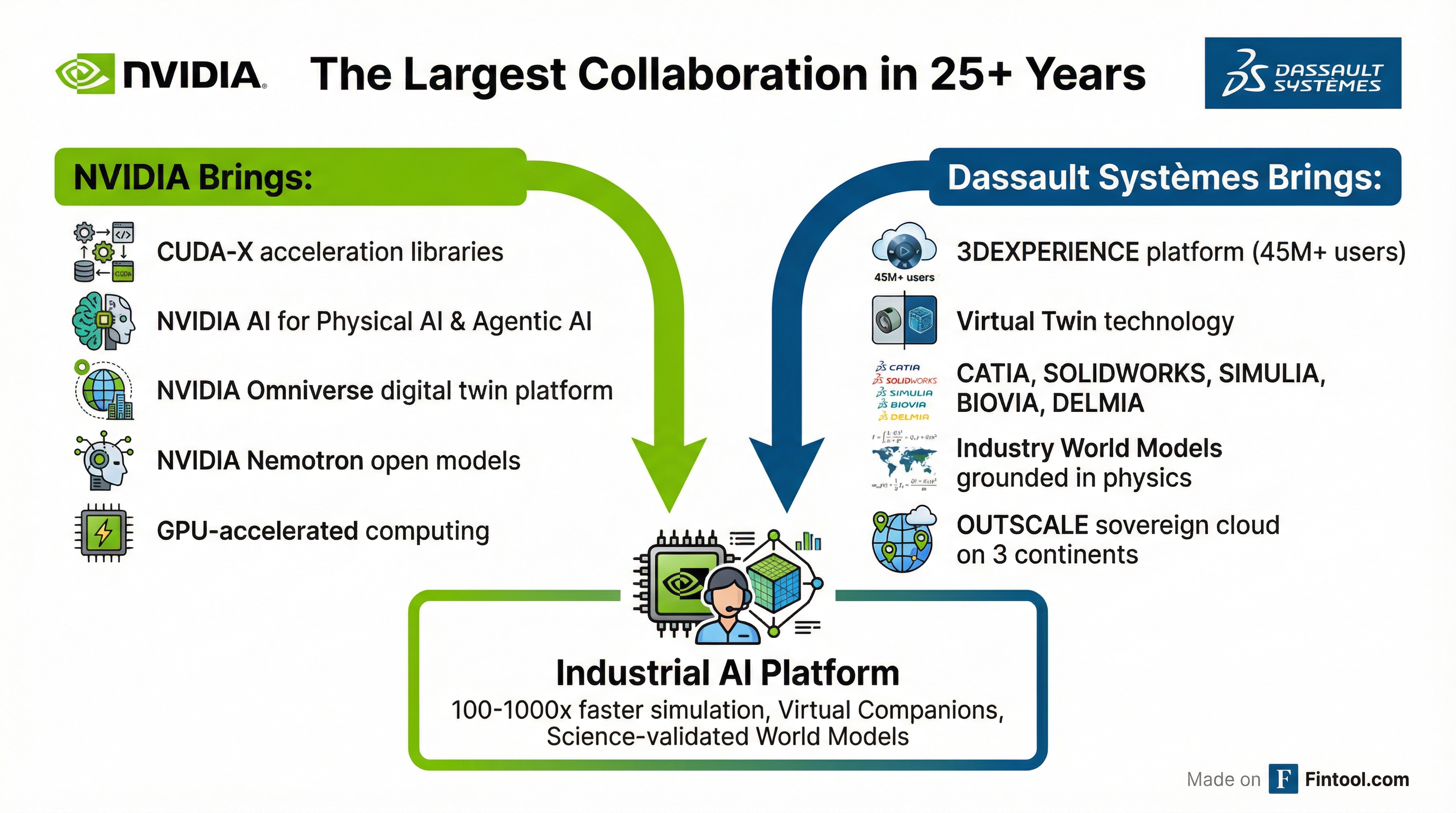
The partnership integrates three pillars of NVIDIA technology into Dassault's 3DEXPERIENCE platform, which serves over 45 million users and 400,000 customers globally:
- CUDA-X acceleration libraries for real-time simulation
- NVIDIA AI for physical AI and agentic AI applications
- NVIDIA Omniverse for digital twin visualization and collaboration
On the Dassault side, this means AI-accelerated capabilities across its entire product portfolio—CATIA, SOLIDWORKS, SIMULIA, BIOVIA, DELMIA, and ENOVIA.
"All of those VIAs are going to be built on top of NVIDIA," Huang quipped to the engineering crowd, playfully referencing Dassault's product naming convention. "Did we know that a quarter century ago?"
 Ask Fintool AI Agent
The Economics: $50 Billion AI Factories
Huang provided rare specificity on the economics of AI infrastructure. A single gigawatt-scale AI factory costs approximately $50 billion, he revealed, with "tens of gigawatts" currently being built globally.
The infrastructure challenge extends beyond just hardware. NVIDIA is itself using Dassault's Model-Based Systems Engineering (MBSE) tools to design, simulate, and validate these facilities before breaking ground:
"We design, we plan, we simulate everything in MBSE before we build it... We even run the network and run the supercomputers inside the virtual twin before we even break ground."
This positions Dassault as both a technology partner and a customer—a dual relationship that mirrors NVIDIA's approach with major cloud hyperscalers.
| Metric | Q4 2025 | Q1 2026 | Q2 2026 | Q3 2026 |
|---|---|---|---|---|
| Revenue ($B) | $39.3* | $44.1 | $46.7 | $57.0 |
| Net Income ($B) | $22.1* | $18.8 | $26.4 | $31.9 |
| EBITDA Margin % | 62.5%* | 50.5%* | 62.3%* | 64.5%* |
*Values retrieved from S&P Global
The Vision: From Digital Models to World Models
The technical core of the partnership centers on what both CEOs call "World Models"—AI systems grounded in physics that can simulate everything from molecular interactions to factory operations.
Huang described this as the fusion of traditional simulation with generative AI:
"8 years ago, I introduced the idea to scientific computing and simulations... Why don't we augment that with generative methods of predicting the future using artificial intelligence?"
The result is physics-aware AI that can predict 10,000x faster than traditional simulation while remaining grounded in physical laws. NVIDIA's PhysicsNeMo framework enables AI models trained by principled simulators—or that work alongside them—to emulate complex phenomena like material stress, aerodynamics, and crash behavior.
Customer Proof Points
The announcement came with endorsements from major industrial players:
Bel Group (food & beverage): Using the collaboration's computational power to model and optimize food products while delivering on sustainability commitments.
OMRON (industrial automation): Combining NVIDIA Physical AI frameworks with Dassault's Virtual Twin Factory to move manufacturers from design to deployment with greater confidence.
Lucid Motors: Embedding crash behavior, aerodynamics, and vehicle performance upstream in vehicle development—"designing behavior, not just shape."
Ask Fintool AI AgentThe Workforce Shift: Virtual Companions
Perhaps the most provocative element of Huang's remarks concerned the future of engineering work itself. The partnership introduces "Virtual Companions"—AI agents trained on individual users' preferences, domain expertise, and work habits:
"Every designer, every SOLIDWORKS designer, every designer in the future will have a team of companions. You've trained these companions, you've taught them different skills... The number of users of the SO tools is going to go from biological to biological as well as AI-based."
Huang emphasized this represents augmentation rather than replacement. The AI handles exploratory and repetitive tasks while humans retain purpose and direction. He used the example of setting companion teams to explore design alternatives during off-hours: "It's time for cocktail. Because it's solidly 4:30 P.M. somewhere... you kick off your team to go explore all these different areas."
Why It Matters for Investors
Revenue Expansion: NVIDIA's partnership with Dassault opens a direct channel to 45 million users across manufacturing, life sciences, and engineering—sectors that have historically lagged in AI adoption but represent massive TAM expansion.
Infrastructure Lock-In: By embedding CUDA-X and Omniverse into mission-critical design workflows, NVIDIA creates stickiness beyond its data center relationships. These become operational dependencies, not just hardware purchases.
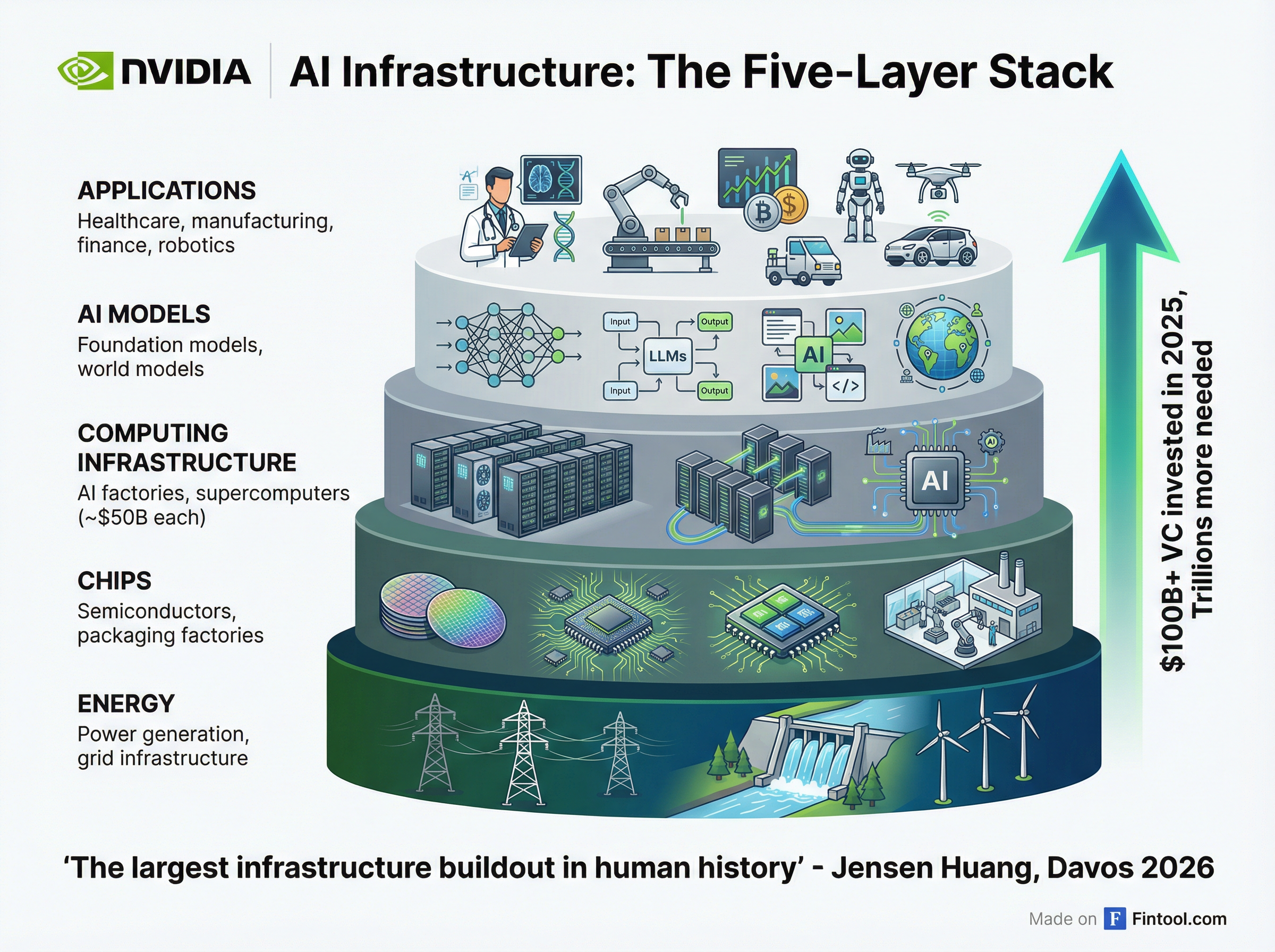
Physical AI Narrative: The Dassault deal reinforces NVIDIA's pivot toward Physical AI—AI that understands and interacts with the real world through robotics, simulation, and autonomous systems. This complements Huang's messaging on the "five-layer cake" of AI infrastructure.
Competitive Moat: The 25-year relationship with Dassault—dating to collaborative work on OpenGL and CgFX that became CUDA—represents institutional knowledge competitors cannot easily replicate.
| Current Quote | Day Change | 52-Week High | 52-Week Low | Market Cap |
|---|---|---|---|---|
| $184.67 | +7.4% | $212.19 | $86.62 | $4.5T |
NVIDIA shares have been on a roller coaster in 2026—falling sharply after the DeepSeek-related AI selloff in late January before recovering on enterprise AI momentum. The Dassault announcement came as the stock was rebounding from January lows, reinforcing the narrative that industrial and physical AI represent NVIDIA's next growth frontier beyond hyperscaler data centers.
What to Watch
GTC 2026 (March 16-19, San Jose): Expect deeper technical disclosure on Physical AI, Nemotron integration, and potentially more industrial partnerships.
Dassault Q4 Earnings: How management quantifies the NVIDIA collaboration's revenue and margin impact will signal partnership economics.
Virtual Companion Adoption: Early metrics on AI agent usage within SOLIDWORKS could validate or challenge the workforce augmentation thesis.
Sovereign Cloud Deployment: Dassault's OUTSCALE brand is deploying NVIDIA-powered AI factories on three continents—watch for data residency wins as EU AI Act implementation accelerates.
Ask Fintool AI AgentRelated
- Nvidia Corporation+7.87% — Company profile and financials