Congress Accuses Nvidia of Helping DeepSeek Build AI Now Used by China's Military
January 29, 2026 · by Fintool Agent


Internal Nvidia+7.87% documents reveal the chipmaker's engineers provided extensive technical support to China's DeepSeek, helping the AI startup achieve training efficiencies that later powered models linked to China's military, according to the chairman of a U.S. House of Representatives committee.
The disclosure, contained in a letter to Commerce Secretary Howard Lutnick, arrives weeks after the Trump administration approved sales of Nvidia's more powerful H200 chips to China—a decision now facing intensified scrutiny on Capitol Hill.
Nvidia shares fell 1.9% on the news, closing at $188.16—still well above the company's DeepSeek-shock low of $118.42 from exactly one year ago, but facing renewed regulatory clouds over its most valuable customer relationship.
What the Documents Show
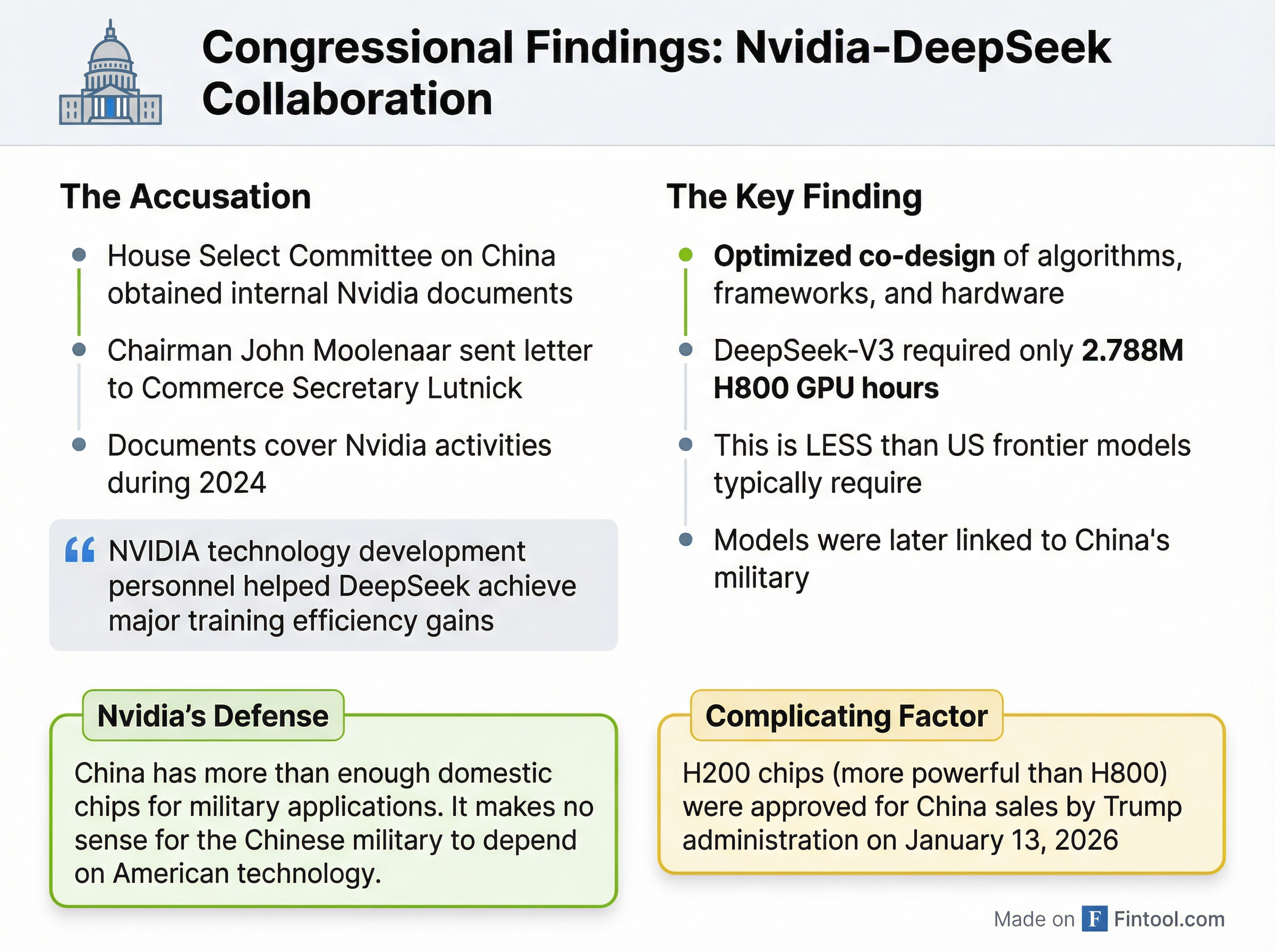
Representative John Moolenaar, a Michigan Republican who chairs the House Select Committee on China, said documents obtained from Nvidia revealed the extent of collaboration between the chipmaker and DeepSeek during 2024.
"According to NVIDIA records, NVIDIA technology development personnel helped DeepSeek achieve major training efficiency gains through an 'optimized co-design of algorithms, frameworks, and hardware,'" Moolenaar wrote. Internal Nvidia reporting boasted that "DeepSeek-V3 requires only 2.788M H800 GPU hours for its full training—less than what U.S. developers typically require for frontier-scale models."
GPU hours measure how long AI chips must run to train a model. Frontier-scale models are the most advanced offerings from U.S. firms like OpenAI, Anthropic, and Google. The implication: Nvidia's assistance helped DeepSeek achieve comparable results with significantly less compute.
 Ask Fintool AI Agent
The Military Connection
The collaboration occurred at a time when DeepSeek was viewed as "a legitimate commercial partner deserving of standard technical support," Moolenaar wrote. No public indication then connected DeepSeek to China's military.
That changed. Reuters reported last year that U.S. officials believe DeepSeek is aiding China's military. Procurement records show PLA entities referenced DeepSeek models in at least a dozen military tenders filed in 2025.
The uses range from autonomous drone swarm decision-making to battlefield target recognition. Chinese defense giant Norinco unveiled a military vehicle in February 2025 capable of autonomously conducting combat-support operations—powered by DeepSeek.
"If even the world's most valuable company cannot rule out the military use of its products when sold to (Chinese) entities, rigorous licensing restrictions and enforcement are essential to prevent such assurances from becoming superficial formalities," Moolenaar wrote.
Nvidia Pushes Back
Nvidia defended its actions forcefully, arguing that its technology isn't critical to China's military capabilities.
"China has more than enough domestic chips for all of its military applications, with millions to spare. Just like it would be nonsensical for the American military to use Chinese technology, it makes no sense for the Chinese military to depend on American technology," Nvidia said in a statement.
The company has previously documented its difficult position in SEC filings. In its most recent 10-Q, Nvidia stated it has been "effectively foreclosed from competing in China's data center computing/compute market" and warned that export controls "may disadvantage us against certain of our competitors that sell chips that are outside the scope of such control."
Notably, Nvidia's risk factors specifically reference DeepSeek by name: "Any regulatory control or other restriction that limits our ability to provide products and services that support third-party applications and models, including applications built on foundation models originating in China such as DeepSeek, Qwen, or KIMMI, could have a material impact on our business."
Ask Fintool AI AgentThe Export Control Timeline
The revelation adds another twist to the complex history of U.S.-China AI chip policy.
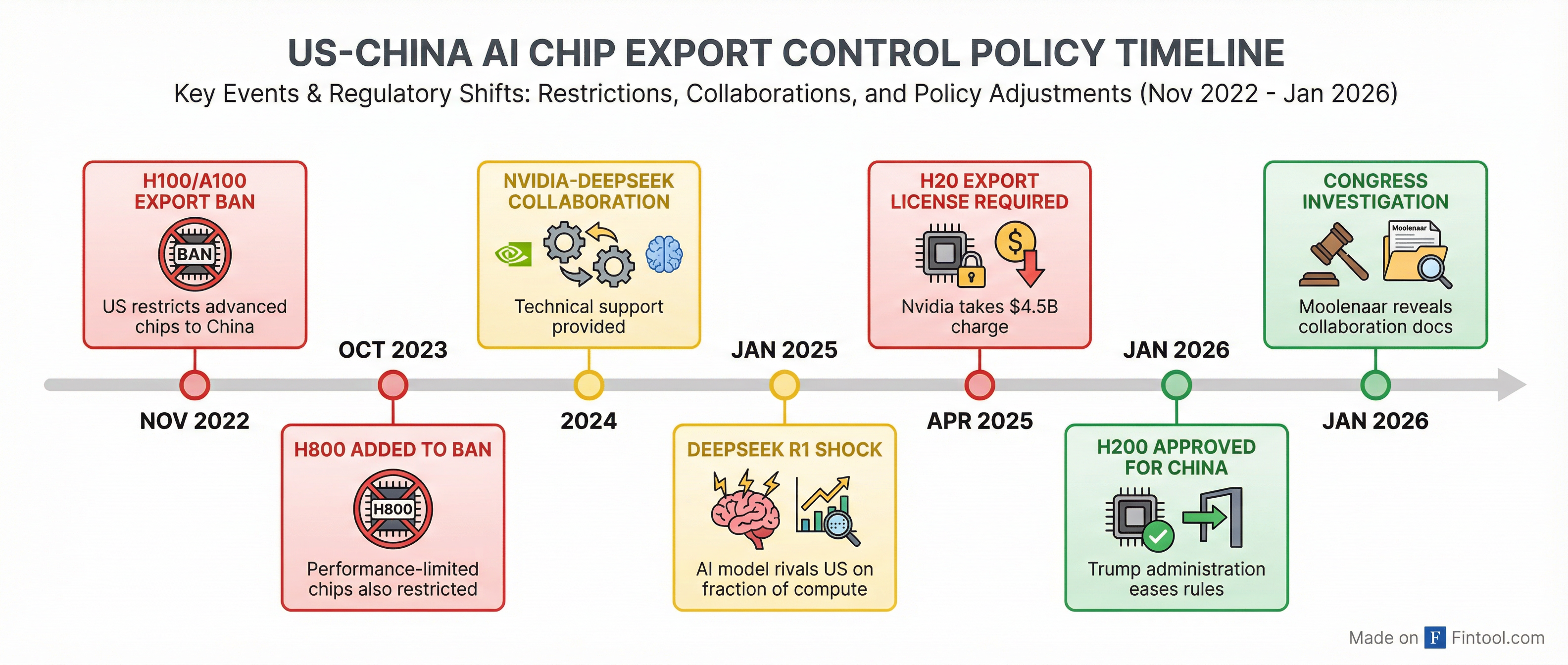
Nvidia's H800 chip—the model DeepSeek used—was specifically designed for the China market after the U.S. banned exports of the more powerful H100 in 2022. The H800 limited interconnect bandwidth to comply with export rules. Then in October 2023, the H800 itself was added to the export ban.
On January 27, 2025, DeepSeek's R1 model triggered a $593 billion single-day loss in Nvidia's market cap—the largest in stock market history—by demonstrating frontier AI capabilities with far less compute than expected.
In April 2025, the U.S. government required export licenses for Nvidia's H20 chip (the H800's successor), causing Nvidia to take a $4.5 billion charge on excess inventory.
Then on January 13, 2026, the Trump administration reversed course, approving sales of the H200—more powerful than both the H800 and H20—to China with conditions barring sales to entities assisting China's military.
| Chip | China Status | Performance |
|---|---|---|
| H100 | Banned (2022) | Highest |
| H800 | Banned (2023) | Reduced interconnect |
| H20 | License required (Apr 2025) | China-specific design |
| H200 | Approved with conditions (Jan 2026) | Higher than H800 |
Data: Bureau of Industry and Security
Investment Implications
For investors, the Congressional probe raises several concerns:
1. Regulatory Uncertainty Intensifies The revelation could provide ammunition for China hawks seeking to reverse the H200 approval or impose additional restrictions. Nvidia already faces complex export controls that the company says have "harmed" its competitive position.
2. China Revenue Remains Material Despite being "effectively foreclosed" from China's data center market, Nvidia generated $4.6 billion in H20 revenue in Q1 FY2026 before export license requirements took effect. The China AI market remains a "significant opportunity" per the company's own filings.
3. Political Exposure Heightened Nvidia finds itself caught between a Trump administration easing chip exports and a bipartisan Congress questioning those decisions. The Senate passed the "GAIN AI Act" in October 2025 that would restrict the administration's ability to adapt export control rules.
4. Reputation Risk Moolenaar's letter suggests Nvidia's standard business practices—providing technical support to commercial customers—can become national security liabilities when those customers later develop military applications.
Ask Fintool AI AgentWhat to Watch
Commerce Department Response: Secretary Lutnick has not commented on Moolenaar's letter. Any indication of policy review would pressure shares.
Congressional Hearings: The House Select Committee on China released a full investigative report on DeepSeek in April 2025. A follow-up hearing on Nvidia's role could amplify scrutiny.
Earnings Outlook: Nvidia reports Q4 FY2026 results in February. Management commentary on China policy and customer relationships will be closely watched.
H200 Shipments: The first licensed H200 exports to China could begin soon. Any diversion to military-linked entities would validate hawkish concerns.
The Bottom Line
One year after DeepSeek's R1 model triggered the largest single-day market cap loss in history, Congressional investigators have revealed that Nvidia's own engineers helped build it. The chipmaker treated DeepSeek as a "legitimate commercial partner"—a decision now complicated by the Chinese company's military connections.
For the world's most valuable company, the intersection of standard business practice and national security has never been more treacherous to navigate.
Related:
- Nvidia (nvda)+7.87% — World's leading AI chip company