Nvidia Scrambles for TSMC Capacity as Chinese H200 Orders Hit 2 Million
December 31, 2025 · by Fintool Agent



Nvidia is racing to meet an avalanche of Chinese demand for its H200 AI chips and has approached Taiwan Semiconductor Manufacturing Co. to ramp up production, sources told Reuters on Tuesday—a dramatic development that underscores just how quickly the chip war calculus has shifted since President Donald Trump greenlighted sales to China earlier this month.
Chinese technology giants have placed orders for more than 2 million H200 chips for 2026 delivery, but Nvidia currently holds just 700,000 units in inventory—a supply gap of nearly 2:1 that the company must somehow close while simultaneously meeting robust demand elsewhere in the world.
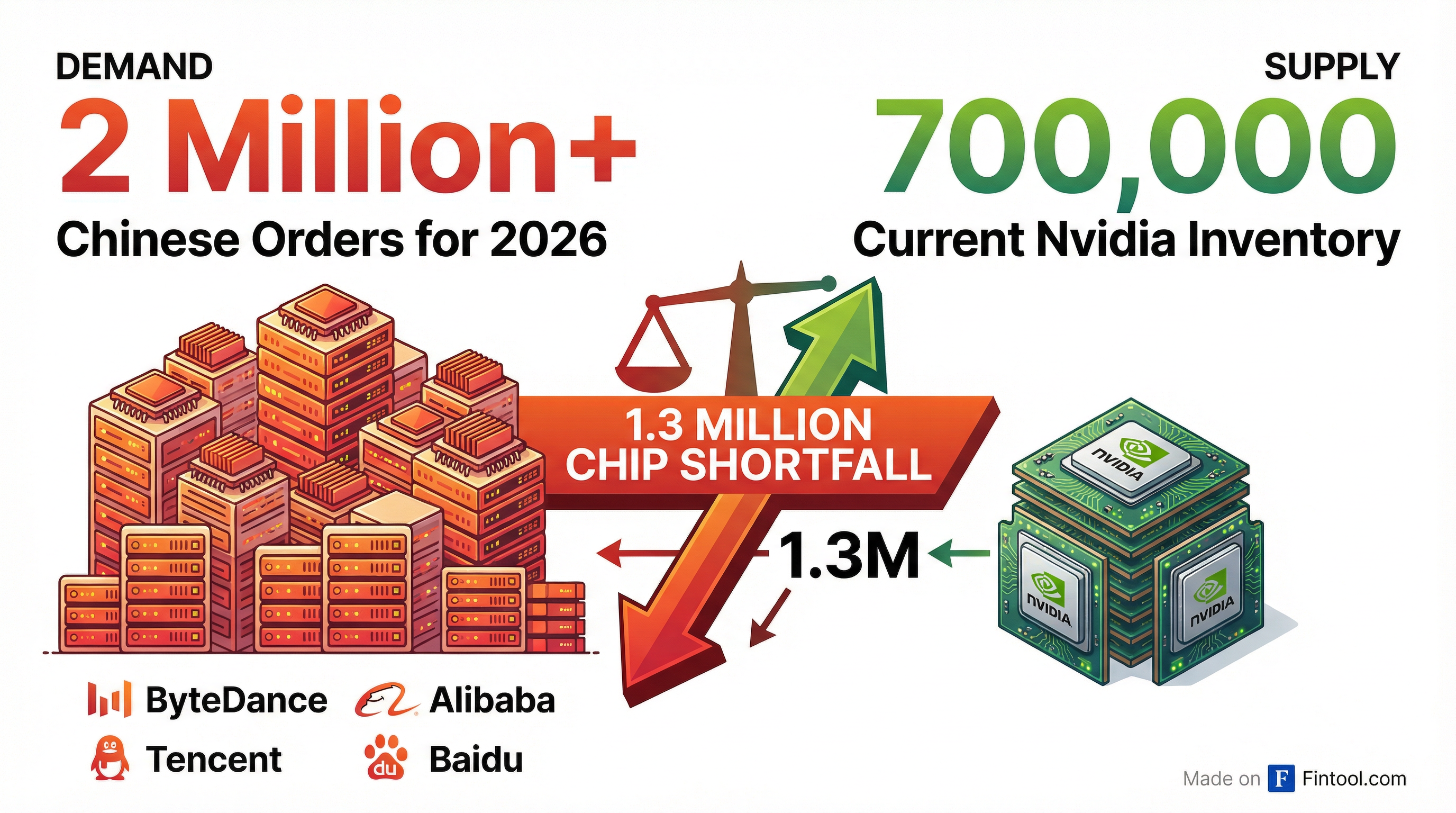
TSMC is expected to begin work on expanded H200 production in the second quarter of 2026, sources said, though the exact additional volume Nvidia intends to order remains unclear. The talks highlight the awkward position Nvidia finds itself in: managing a sudden resurgence in China demand while keeping pace with Blackwell and Rubin deliveries for U.S. hyperscalers.
 Ask Fintool AI Agent
The ByteDance Factor: $14 Billion on the Table
The single largest source of pent-up demand appears to be Bytedance, the TikTok parent company now valued at $500 billion. The South China Morning Post reported that ByteDance plans to spend approximately 100 billion yuan ($14 billion) on Nvidia chips in 2026, up from roughly 85 billion yuan in 2025—a 17% increase that hinges entirely on Beijing allowing H200 imports.
ByteDance isn't alone. Alibaba and Tencent have also signaled keen interest in H200 purchases, viewing the chip as a massive upgrade over the now-unavailable H20 that was specifically designed for the Chinese market.
| Company | Estimated 2026 AI Chip Spending | Key Use Cases |
|---|---|---|
| ByteDance | $14 billion (100B yuan) | TikTok/Douyin inference, Doubao chatbot training |
| Alibaba | Not disclosed | Cloud AI services, e-commerce |
| Tencent | Not disclosed | Gaming AI, enterprise cloud |
| Baidu | Not disclosed | Autonomous vehicles, Ernie LLM |
Estimates based on public reporting
Pricing: A 15% Grey Market Discount
Nvidia has set H200 pricing at approximately $27,000 per chip, with eight-chip modules expected to cost around 1.5 million yuan ($215,000). That represents a roughly 15% discount compared to grey-market alternatives, which currently retail at over 1.75 million yuan, making the official channel far more attractive to compliance-conscious Chinese enterprises.
The H200 delivers approximately six times the performance of the H20 for AI training workloads—a performance leap that Chinese internet firms view as transformative for their AI ambitions. While domestic Chinese chips have managed to rival the H20 in performance, no equivalent to the H200 yet exists in the local market.
Ask Fintool AI AgentTrump's December 8 Reversal
The sudden rush of orders follows Trump's December 8 announcement that the U.S. would allow H200 exports to China with a 25% fee collected by the government—a dramatic reversal of the Biden administration's ban on advanced AI chip exports.
"Offering H200 to approved commercial customers, vetted by the Department of Commerce, strikes a thoughtful balance that is great for America," Nvidia said in a statement following the announcement.
The policy shift came amid a flurry of competing pressures:
-
$160 million smuggling bust: On the same day Trump made his announcement, federal prosecutors unsealed documents revealing "Operation Gatekeeper," which shut down a China-linked network that had allegedly smuggled at least $160 million worth of Nvidia H100 and H200 GPUs to China between October 2024 and May 2025.
-
Huawei competitive threat: Administration officials reportedly viewed the H200 approval as a compromise to prevent Huawei from gaining ground in China's AI chip market.
-
Revenue opportunity: If Nvidia ships 3 million H200s to China at $27,000 each, the potential revenue would approach $81 billion—a figure that dwarfs prior China revenue estimates.
Beijing's Decision Still Pending
Despite Trump's green light, Chinese regulators have not yet formally approved H200 imports. Officials have gathered representatives from Alibaba, ByteDance, Tencent, and other major tech firms to assess demand, but concerns persist that access to advanced foreign chips could slow development of the domestic semiconductor industry.
Nvidia has told Chinese clients it aims to begin shipments before the Lunar New Year holiday in mid-February, starting with 5,000 to 10,000 chip modules—equivalent to 40,000 to 80,000 H200 chips—from existing inventory.
Ask Fintool AI AgentThe Supply Chain Squeeze
The talks with TSMC highlight a potential global supply squeeze for advanced AI chips. The Taiwanese foundry is already grappling with intense demand for Nvidia's newer Blackwell and upcoming Rubin chip lines, both of which compete for the same advanced packaging capacity.
The H200, part of Nvidia's previous-generation Hopper architecture, uses TSMC's 4-nanometer manufacturing process. Restarting or expanding H200 production means diverting resources that could otherwise support Blackwell Ultra or GB300 systems—Nvidia's current flagship products.
"Licensed sales of the H200 to authorized customers in China will have no impact on our ability to supply customers in the United States," an Nvidia spokesperson told Reuters. "China is a highly competitive market with rapidly growing local chip suppliers. Blocking all U.S. exports undercut our national and economic security and only benefited foreign competition."
Market Reaction
Both Nvidia and TSMC shares responded to the news. TSMC rose 1.6% on the day to $304.37, extending its 51% year-to-date gain. Nvidia edged lower amid broader market weakness but remains up approximately 36% year-to-date—a strong performance despite the export control turbulence that has defined its China strategy.
| Metric | NVDA | TSM |
|---|---|---|
| Current Price | $187.37 | $304.37 |
| YTD Change | +35.5% | +51.1% |
| Market Cap | $4.56T | $1.58T |
| 52-Week High | $212.19 | $313.98 |
Market data as of December 31, 2025
Nvidia's Q3 FY26 results showed Data Center revenue of $51.2 billion, up 66% year-over-year, driven by "three platform shifts—accelerated computing, powerful AI models, and agentic applications." The company noted that "H20 sales were insignificant in the third quarter" following the earlier export restrictions.
The Bigger Picture
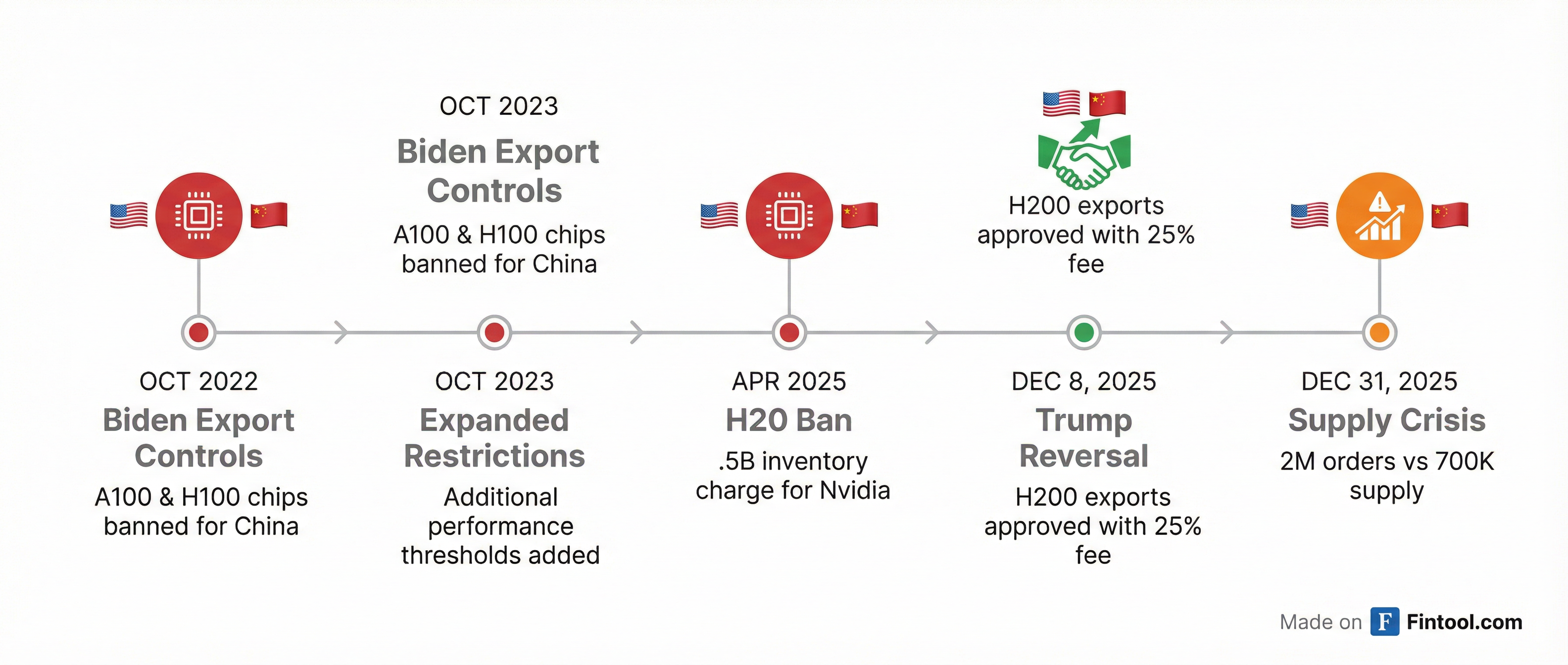
The H200 situation illustrates the whiplash that has defined U.S.-China chip policy over the past three years. Nvidia has navigated:
- October 2022: Initial Biden administration export controls on A100 and H100 chips
- October 2023: Expanded controls covering additional products and performance thresholds
- April 2025: H20 restrictions, leading to a $4.5 billion inventory charge
- December 2025: Trump reversal allowing H200 exports with 25% fee
"We have effectively been foreclosed from competing in China's data center computing/compute market," Nvidia warned in its most recent 10-Q filing, "and our effective foreclosure from the China market will help our competitors build larger developer and customer ecosystems to challenge us worldwide."
Whether the H200 reopening represents a permanent policy shift or another temporary chapter in the chip war remains to be seen. For now, Nvidia and TSMC are racing to meet demand that materialized almost overnight—while Chinese regulators weigh whether to let that demand be fulfilled.
Ask Fintool AI AgentAsk Fintool AI AgentRelated: Nvidia Company Profile · TSMC Company Profile · Alibaba Company Profile · Tencent Company Profile