Nvidia Demands 100% Upfront Payment for H200 Chips to China—No Refunds, No Cancellations
January 8, 2026 · by Fintool Agent


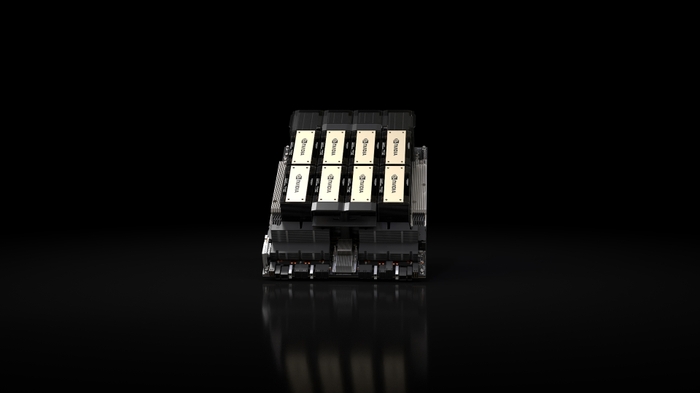
Nvidia+7.87% is requiring Chinese customers to pay 100% upfront for its H200 AI chips with no options to cancel, request refunds, or change configurations after placement—a dramatic shift in payment terms that transfers all financial risk from Nvidia to buyers still awaiting Beijing's approval for the imports.
The unusually stringent terms come as China appears poised to approve H200 sales as soon as this quarter, even while telling some technology companies to pause their orders to protect domestic chip manufacturers.
Nvidia shares fell 2.2% to $185.04 on Thursday, trimming the chipmaker's market capitalization to $4.5 trillion.
The New Payment Terms
The payment structure effectively makes Chinese buyers bear all the downside risk. If Beijing ultimately blocks H200 imports or changes policy, customers lose their prepayment. If Washington reverses course again—as it did with the H20—buyers are locked in.
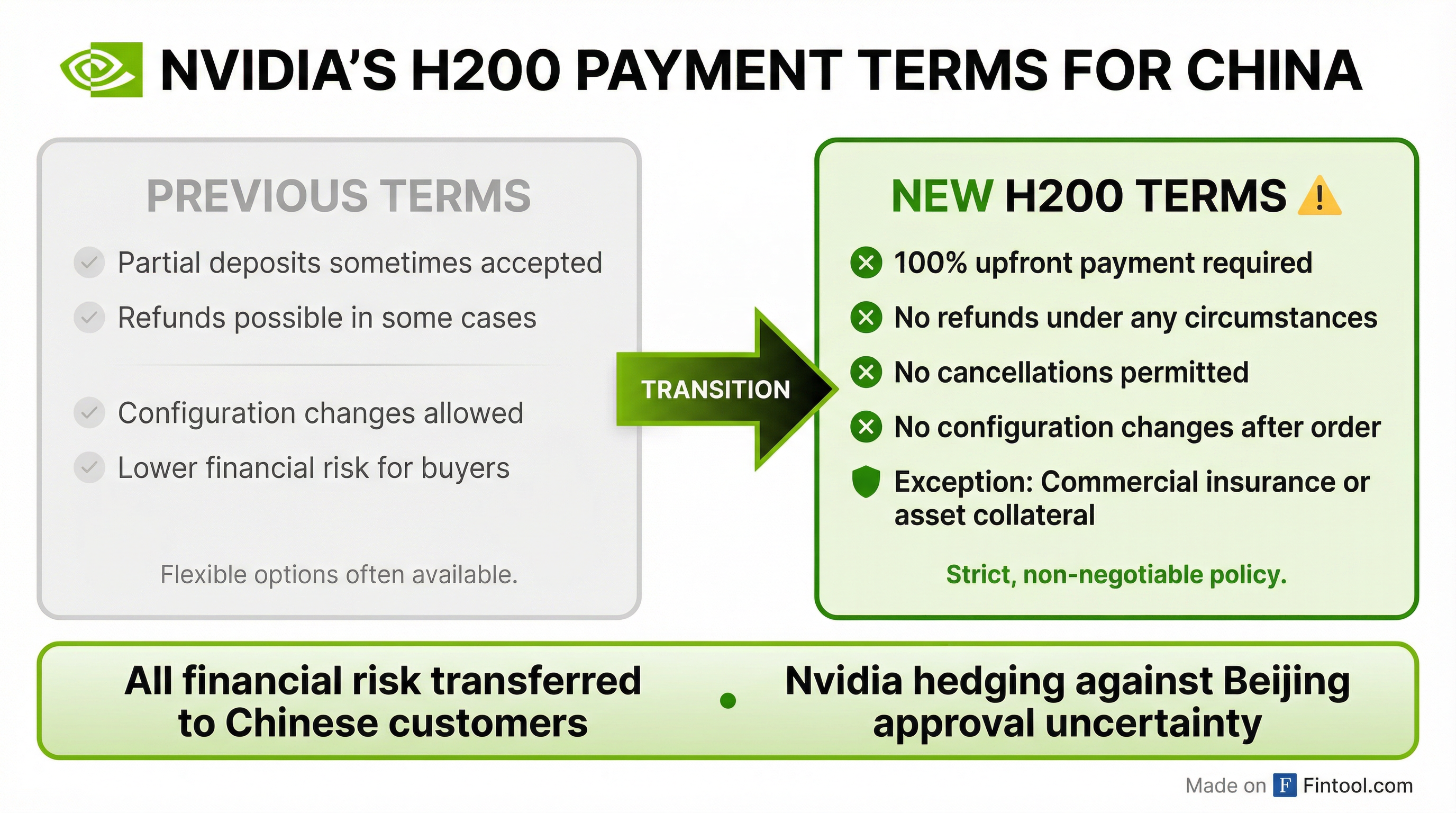
In limited cases, customers may substitute cash with commercial insurance or asset collateral, but the overall approach is far stricter than Nvidia's earlier policies, which sometimes permitted partial deposits.
The stringent terms reflect Nvidia's hard-won experience with the China market. In April 2025, the U.S. government banned H20 exports, resulting in a $4.5 billion charge in Nvidia's Q1 fiscal 2026 for excess inventory and purchase obligations.
 Ask Fintool AI Agent
Massive Demand Despite Uncertainty
Despite the payment demands and regulatory uncertainty, Chinese hyperscalers are rushing to secure H200 allocations. Orders for more than 2 million chips have reportedly been placed for 2026, far exceeding Nvidia's estimated 700,000 units in current inventory.
TikTok parent company ByteDance alone plans to spend approximately $14 billion on H200 chips in 2026, underscoring the desperate demand for high-performance AI accelerators in China.
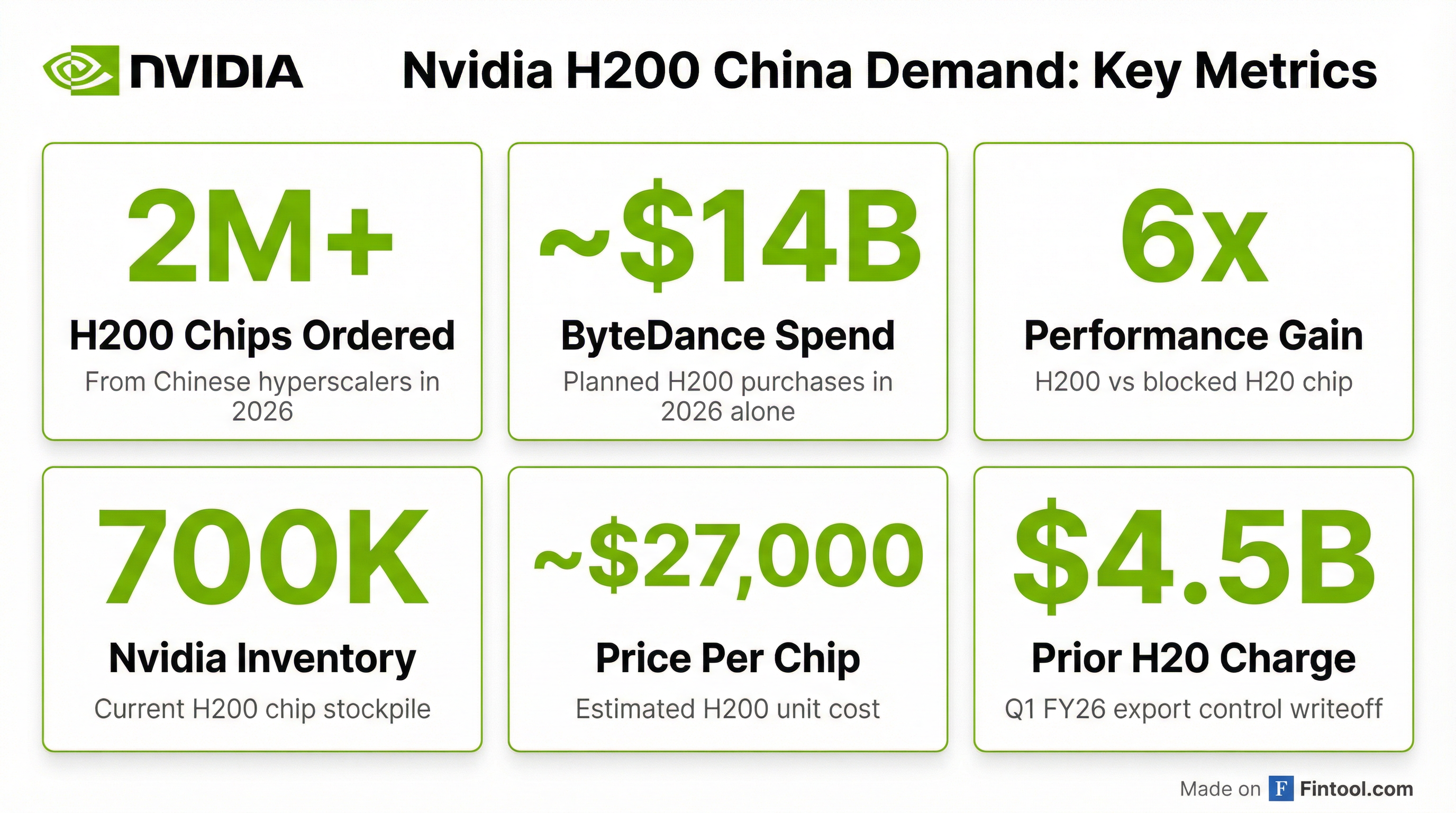
The H200 delivers roughly 6x the performance of the now-blocked H20 chip that Nvidia had designed specifically for the Chinese market—making it by far the most capable chip available to Chinese companies for large-scale AI model training.
The Geopolitical Squeeze
Nvidia finds itself navigating pressure from both Washington and Beijing. The Trump administration lifted Biden-era restrictions on H200 sales to China last month—but with a catch: the U.S. government expects to receive 25% of the resulting revenue.
At the same time, Chinese regulators have opened an antitrust investigation into whether Nvidia's compliance with U.S. export controls discriminates unfairly against Chinese customers. In September 2025, China's regulators issued a preliminary finding that Nvidia violated the terms of its Mellanox acquisition by offering degraded products to China.
| Regulatory Pressure | U.S. Government | Chinese Government |
|---|---|---|
| Current stance | 25% revenue fee on China sales | Pause orders directive |
| Ongoing concern | Potential tighter controls | Antitrust investigation |
| Past action | H20 ban (April 2025) | Domestic chip ratio requirements |
Beijing has also asked certain technology companies to temporarily halt H200 orders while regulators deliberate on approval terms, including whether to require firms to purchase a certain ratio of Chinese chips alongside any H200 purchases.
Ask Fintool AI AgentFinancial Context
Nvidia's China business has become a source of ongoing volatility. The company generated approximately $50 million in H20 revenue under limited licenses granted in August 2025—a fraction of what China would represent if the market were fully open.
In its most recent 10-Q, Nvidia warned that export controls have "effectively foreclosed" it from competing in China's data center market and that this foreclosure will help competitors "build larger developer and customer ecosystems to challenge us worldwide."
| Metric | Q3 2026 | Q2 2026 | Q1 2026 | Q4 2025 |
|---|---|---|---|---|
| Revenue | $57.0B | $46.7B | $44.1B | $39.3B |
| Net Income | $31.9B | $26.4B | $18.8B | $22.1B |
| Gross Margin | 73.4% | 72.4% | 60.5% | 73.0% |
The depressed Q1 FY2026 gross margin of 60.5% reflects the $4.5 billion H20 writeoff—a stark reminder of the financial consequences when export policy shifts suddenly.
TSMC Production Ramp
To meet the surge in Chinese demand, Nvidia has approached Taiwan Semiconductor Manufacturing Company+5.48% about ramping production of H200 chips, which use an older process technology than the company's newer Blackwell and Rubin generations.
The decision to restart production of a two-year-old chip architecture carries risk. If trade relations sour again, Nvidia could find itself with another glut of inventory that cannot be sold—repeating the $4.5 billion writeoff scenario from early 2025.
Ask Fintool AI AgentWhat to Watch
Beijing's final decision: Chinese regulators are expected to announce H200 import approval terms as soon as this quarter. The scope—which customers can purchase, any domestic chip ratio requirements, and restrictions on end uses—will determine how much of the pent-up demand actually converts to revenue.
Washington policy shifts: The GAIN AI Act, passed by the Senate in October 2025, would restrict the Trump Administration's ability to loosen Biden-era export controls. Any congressional action could upend Nvidia's China strategy overnight.
Inventory and writeoff risk: With demand exceeding supply and TSMC ramping production, Nvidia faces the same inventory risk that cost it $4.5 billion last year. If policy shifts before chips ship, the upfront payment structure may protect Nvidia—but customers will bear the loss.
Competitor positioning: Every month that Chinese companies cannot access Nvidia's best chips is an opportunity for domestic alternatives like Huawei's Ascend 910C to gain ground. Nvidia has acknowledged that its "lost opportunity" will benefit competitors and "have a material and adverse impact" on its business.
Related: Nvidia+7.87% · Taiwan Semiconductor+5.48%