OpenAI Bets $252M on Altman's Brain-Computer Startup, Challenging Musk's Neuralink
January 16, 2026 · by Fintool Agent
OpenAI has made its boldest bet yet on the future of human-AI convergence: a $252 million investment in Merge Labs, a brain-computer interface startup co-founded by CEO Sam Altman that aims to connect human brains to computers without surgery.
The seed round values Merge Labs at $850 million and marks OpenAI's first disclosed investment in brain-computer interface technology. It also adds another layer to Altman's expanding web of AI-adjacent ventures—and puts the company on a direct collision course with Elon Musk's Neuralink.
The Science of Reading Minds
Merge Labs emerged from stealth on Thursday with a fundamentally different approach to brain-computer interfaces than what's come before.
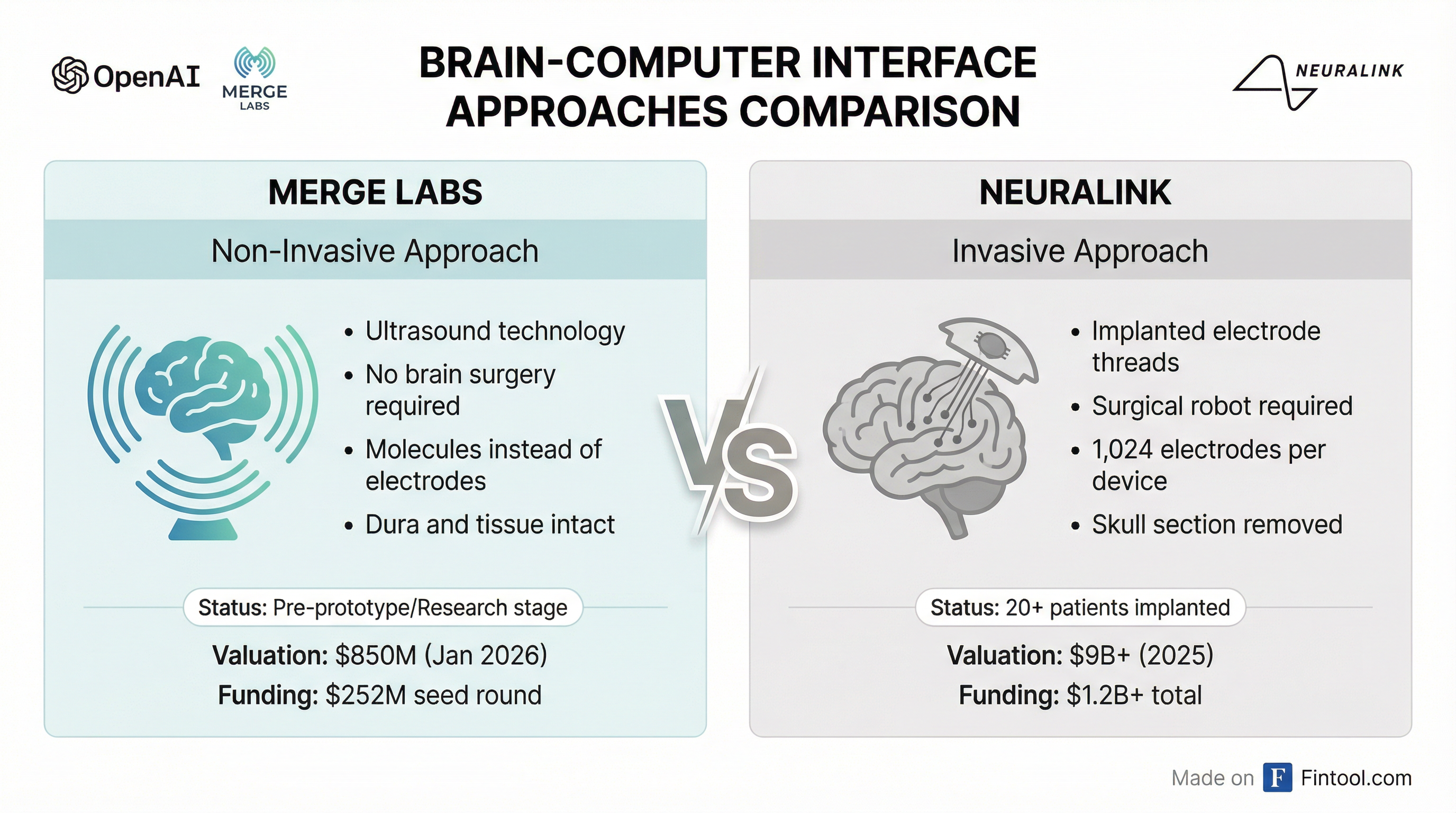
Where Neuralink implants electrode threads directly into brain tissue through surgery, Merge Labs plans to detect neural signals from outside the skull using ultrasound and engineered molecules. The company says it's "developing entirely new technologies that connect with neurons using molecules instead of electrodes, transmit and receive information using deep-reaching modalities like ultrasound, and avoid implants into brain tissue."
The approach builds on years of research at Caltech by co-founder Mikhail Shapiro, a professor of chemical engineering and Howard Hughes Medical Institute Investigator. In 2024, Shapiro's team published groundbreaking research showing that functional ultrasound imaging could record brain activity through a transparent cranial window—allowing a patient to be imaged while playing video games and guitar, not just lying in a hospital scanner.
"We believe this requires increasing the bandwidth and brain coverage of BCIs by several orders of magnitude while making them much less invasive," Merge Labs said in its announcement.
 Ask Fintool AI Agent
A Star-Studded Founding Team
The investor and co-founder roster reads like a who's who of Silicon Valley's most ambitious projects.
Beyond Shapiro, the scientific co-founders include Tyson Aflalo and Sumner Norman, both researchers at Caltech's Chen Brain-Machine Interface Center who have published pioneering work on decoding movement intentions from brain signals using ultrasound.
On the business side, Alex Blania—CEO of Tools for Humanity and co-founder of Worldcoin with Altman—joins as a technology entrepreneur co-founder alongside Sandro Herbig. Altman himself is listed as a co-founder "in a personal capacity."
Bain Capital Ventures participated in the round, as did Gabe Newell, the billionaire co-founder of Valve who operates Steam, the dominant PC gaming platform. Newell has his own interest in brain-computer interfaces through Starfish Neuroscience.
Taking on Neuralink
The investment pits OpenAI directly against Musk's Neuralink, adding another front to the increasingly personal rivalry between Altman and Musk. The two are already locked in a legal battle set for trial in March.
Neuralink holds a commanding lead in resources and clinical validation:
| Metric | Neuralink | Merge Labs |
|---|---|---|
| Valuation | $9B+ (June 2025) | $850M (Jan 2026) |
| Total Funding | $1.2B+ | $252M |
| Patients Implanted | 20+ | None (pre-clinical) |
| Approach | Invasive (surgical implant) | Non-invasive (ultrasound) |
| FDA Status | Approved for clinical trials | Pre-clinical research |
Neuralink announced plans to begin "high-volume production" of its brain implants in 2026, with Musk claiming the company will move to "streamlined, almost entirely automated surgical procedure" this year. The company has received FDA Breakthrough Device Designation for its speech restoration technology and expanded clinical trials to the UK, UAE, and Canada.
But invasive approaches carry inherent risks and limitations. Neuralink's first patient, Noland Arbaugh, experienced thread retraction after implantation and requires regular recalibration sessions of up to 45 minutes.
The $252 million for Merge Labs—while substantial for a seed round—essentially funds a research lab to prove that non-invasive approaches can achieve comparable signal quality to implanted electrodes. "The money raised appears to be for a pre-prototype outfit, not a product-ready company," noted Bloomberg.
Ask Fintool AI AgentThe AI Connection
OpenAI isn't just providing capital—it's positioning to shape how BCIs integrate with artificial intelligence.
"High-bandwidth interfaces will benefit from AI operating systems that can interpret intent, adapt to individuals, and operate reliably with limited and noisy signals," OpenAI said. "OpenAI will collaborate with Merge Labs on scientific foundation models and other frontier tools to accelerate progress."
The technical partnership could prove more valuable than the money. Decoding brain activity remains one of neuroscience's hardest computational problems—exactly the kind of challenge where large foundation models could accelerate progress.
Synchron, another BCI startup that has raised $345 million, is already working with Nvidia to develop foundation models for the brain.
Morgan Stanley estimates the BCI market at $400 billion in the U.S. alone, primarily for medical applications. But Merge Labs' stated mission extends beyond medicine: "If we can interface with these neurons at scale, we could restore lost abilities, support healthier brain states, deepen our connection with each other, and expand what we can imagine and create alongside advanced AI."
Governance Questions
The investment adds to a growing list of Altman-linked ventures that OpenAI has backed or entered commercial agreements with, including nuclear fusion startup Helion Energy, nuclear fission company Oklo, and startups Red Queen Bio, Rain AI, and Harvey.
OpenAI said the Merge Labs investment "underwent independent board review." But the optics are unavoidable: the company is betting a quarter-billion dollars on technology developed by its own CEO.
The circular nature of Silicon Valley dealmaking has become increasingly pronounced. Amazon is reportedly in talks to invest $10 billion in OpenAI itself. Altman's position at the center of multiple overlapping ventures—AI, nuclear energy, digital identity (Worldcoin), and now brain-computer interfaces—raises questions about where one company's interests end and another's begin.
Ask Fintool AI AgentWhat to Watch
Technical milestones: Can Merge Labs demonstrate that non-invasive ultrasound can achieve signal quality comparable to implanted electrodes? The Caltech team's published research showed proof-of-concept in one patient through a cranial window—scaling that to broader applications without any surgical intervention is the key challenge.
Competitive response: Neuralink's mass production push and clinical expansion will generate significant data and patient outcomes in 2026. If invasive approaches continue demonstrating strong results with acceptable risk profiles, the case for non-invasive alternatives becomes harder to make.
Foundation models for the brain: The race to develop AI systems that can decode neural signals is just beginning. OpenAI's collaboration with Merge Labs could give both companies an edge—or prove that brain-computer interfaces require specialized approaches that general-purpose AI labs struggle to develop.
Regulatory pathway: The FDA has granted Neuralink multiple breakthrough designations. Merge Labs' non-invasive approach could potentially face a shorter regulatory path, but the company first needs to prove its technology works.
For the millions of patients with paralysis, ALS, and severe neurological conditions, the competition between approaches may ultimately benefit everyone. But with $252 million now backing Altman's vision of merging human and artificial intelligence, the race to read—and write to—the human brain has entered a new phase.
Related