Ouster Acquires Stereolabs for $35M, Creating 'Physical AI' Sensing Powerhouse
February 09, 2026 · by Fintool Agent

Ouster shares surged 12% to $19.42 Monday after the digital LiDAR specialist announced it has closed its acquisition of Stereolabs, an AI vision and perception pioneer, for $35 million in cash and 1.8 million shares. The deal positions Ouster as the first company to offer a fully integrated sensing platform for Physical AI—combining LiDAR, cameras, AI compute, and perception software under a single roof.
"Today marks a pivotal moment for both companies as we join forces to create a world-leading sensing and perception company for Physical AI," CEO Angus Pacala said on a conference call held earlier this morning.
The transaction, which closed February 4, 2026, arrives at a critical inflection point for the robotics industry. With CES 2026 dominated by "Physical AI" announcements and humanoid robot prototypes advancing toward commercial deployment, demand for sophisticated perception systems is accelerating across industrial automation, smart infrastructure, and robotics markets.
Deal Structure and Strategic Rationale
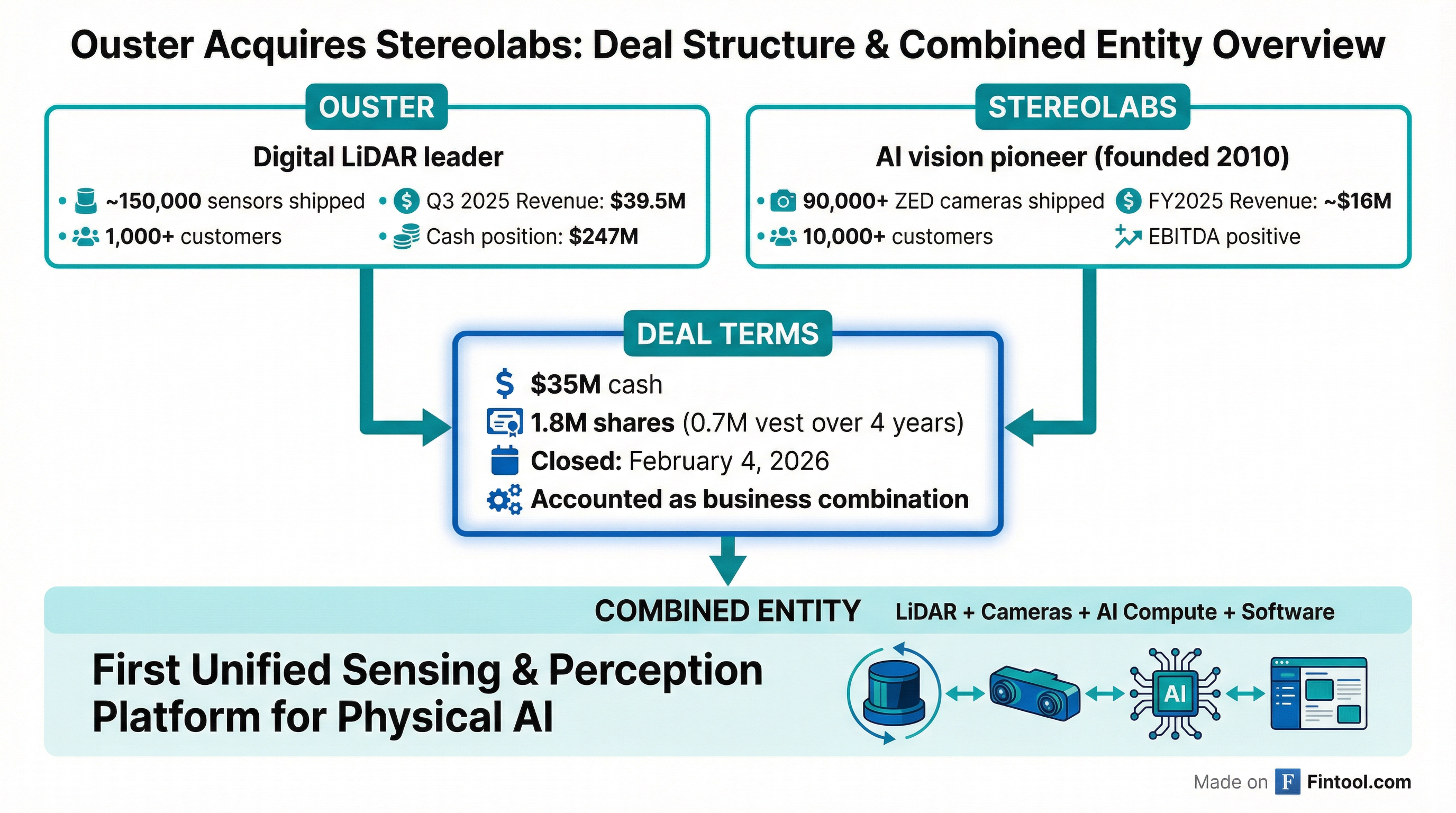
Ouster funded the acquisition using approximately $35 million in cash and 1.8 million shares, with 0.7 million shares released over a four-year period to retain key talent. Stereolabs will operate as a wholly-owned subsidiary, with co-founders Cecile Schmollgruber (CEO), Edwin Azzam, and Olivier Braun continuing to lead the entire Stereolabs team.
The deal brings compelling financial characteristics. Stereolabs generated approximately $16 million in unaudited revenue for fiscal 2025 while maintaining positive EBITDA—reinforcing Ouster's path to profitability. CFO Ken Gianella noted the acquisition is expected to be "not only accretive but create additional leverage as we execute our long-term model."
For context, Ouster entered the deal with a strong balance sheet. As of Q3 2025, the company held $247.2 million in cash, cash equivalents, restricted cash, and short-term investments. Q3 revenue reached $39.5 million, up 41% year-over-year, with gross margin expanding to 42% from 38% in the prior year period.
| Metric | Q3 2025 | Q3 2024 | Change |
|---|---|---|---|
| Revenue | $39.5M | $28.1M | +41% |
| Gross Profit | $16.7M | $10.8M | +55% |
| Gross Margin | 42% | 38% | +400bps |
| Net Loss | ($21.7M) | ($25.6M) | Improved |
 Ask Fintool AI Agent
The Physical AI Platform Play
The strategic logic centers on creating an end-to-end perception stack for autonomous systems. Historically, customers building robots, autonomous vehicles, or smart infrastructure had to source LiDAR sensors, cameras, and AI compute separately, then invest significant engineering resources integrating these disparate components.
"By combining industrial-grade hardware with proven in-house AI models, we are delivering seamless, synchronized, and calibrated data on day one," Pacala explained. "The result for customers is simplified and accelerated development with reduced engineering costs."
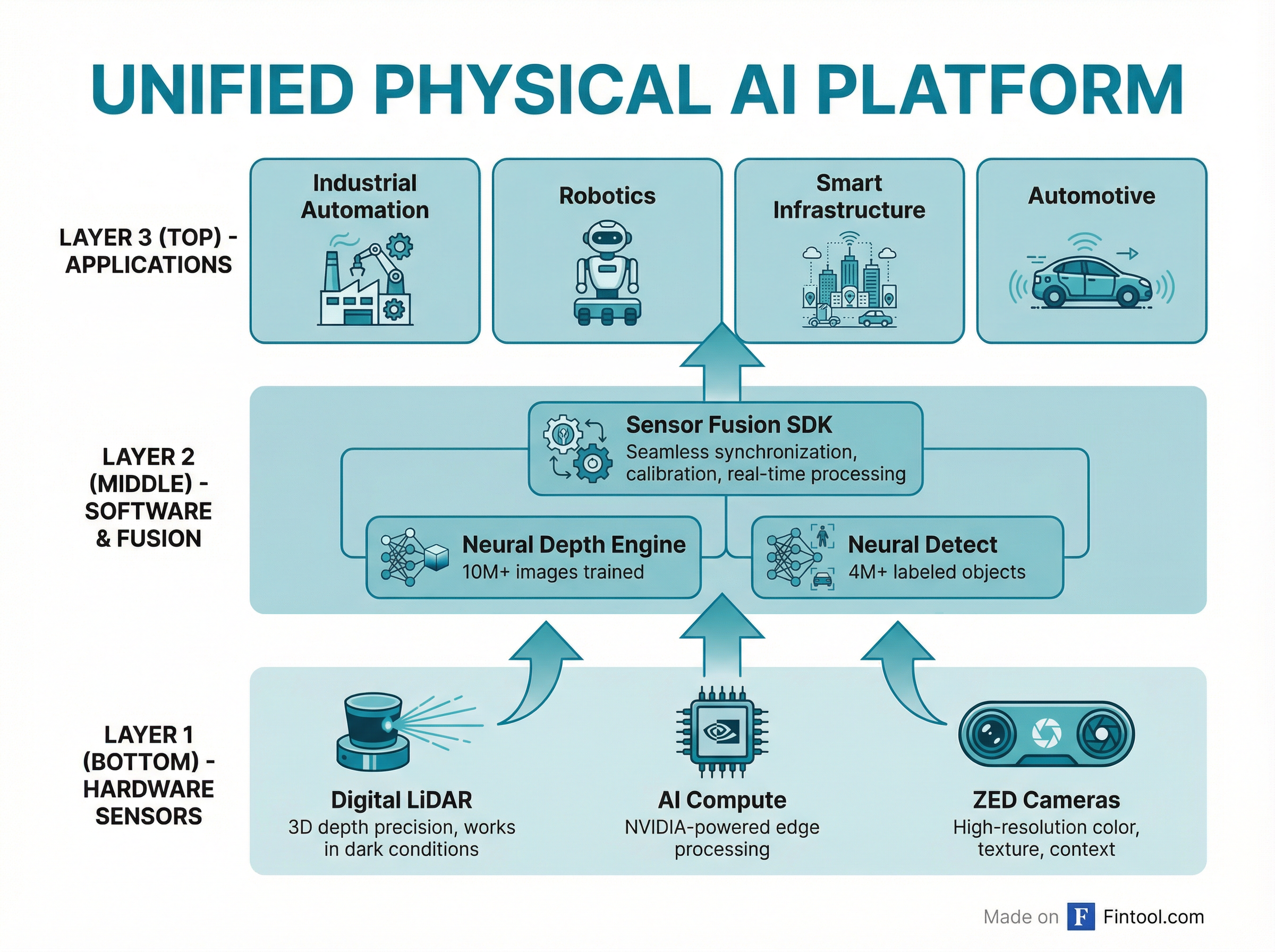
The combined platform brings together complementary sensing modalities:
LiDAR (Ouster): Provides exceptional depth accuracy and performs well in dark and obscured conditions. Ouster has shipped nearly 150,000 sensors to more than 1,000 customers worldwide across seven generations of its digital LiDAR technology.
AI Vision (Stereolabs): Delivers high-resolution context, color, and texture data through its ZED camera line. The company has shipped over 90,000 cameras to 10,000+ customers across 75 countries since its founding in 2010.
AI Compute & Software: Stereolabs' NVIDIA-powered edge compute hardware enables native real-time sensor fusion. Its Neural Depth Engine—trained on 10 million images of synthetic and real-world industrial environments—delivers up to 10x sensing price-to-performance advantage over traditional cameras.
Critically, the sensor fusion platform is already market-ready. "The sensor fusion platform is ready to go today, actually," Pacala confirmed during Q&A, noting that the ZED SDK already supports fusing four ZED X cameras with an Ouster OS1 LiDAR sensor.
Shared DNA in AI Model Development
Both companies have invested significantly in proprietary AI model training—a key differentiator versus competitors who rely on off-the-shelf algorithms.
Ouster's Neural Detect model powers its Gemini and Blue City smart infrastructure solutions, incorporating training data from over 4 million labeled objects validated at 800+ sites globally. Stereolabs' Neural Depth, meanwhile, was trained from scratch on GPU clusters using over 10 million images.
"This is our own training datasets, our own corpus of data that we have trained from scratch on GPU clusters," Pacala emphasized. "We're not post-training some model we took off the internet."
The acquisition also brings Stereolabs' substantial simulation capabilities in-house. The company has invested heavily in synthetic data generation—a methodology Ouster plans to leverage for LiDAR model development.
Ask Fintool AI AgentExpanded Customer Base and Market Reach
The deal significantly expands Ouster's addressable market. Stereolabs has penetrated emerging segments including data factory automation and humanoid robotics—areas where Ouster has limited presence.
"There are some major Tier 1 and OEM customers that are brand new to the Ouster fold," Pacala noted. "Stereolabs has pushed into the data factory world... and into the humanoid robotics world."
The combined customer base offers cross-selling opportunities. Management highlighted an existing relationship with "a leading global technology company" where Ouster already powers warehouse AMRs and logistics optimization, and is now supporting next-generation industrial automation platforms with Stereolabs' AI vision solutions.
The timing aligns with surging interest in Physical AI. Deloitte estimates annual humanoid robot shipments may reach 15,000 units in 2026, with the industrial AI humanoid market reaching $210-270 million this year. The 3D LiDAR sensor market continues to expand rapidly as well, with the International Federation of Robotics reporting a record 4.28 million industrial robots now operational globally.
Manufacturing Synergies and Operational Leverage
Management sees operational improvements ahead. Stereolabs, largely an engineer-driven company, has built its business with a lean operations team. Ouster plans to bring its manufacturing acumen—developed through high-volume sensor production—to bear on the camera business.
"I think it's important for this next stage of growth for them that they have the backing of a very considerable operations and manufacturing capability at Ouster," Pacala said. "Definitely going to bring some value into the product, into the scale that we can drive, and also into the quality and the cost reductions."
Competitive Positioning
When asked about competition, Pacala was direct: "I really think that we are pioneering the combination of seamless LiDAR, camera, and AI compute with all the algorithms to go with it. We're in a class of our own right now."
The combination differentiates Ouster from pure-play LiDAR competitors like Luminar and Innoviz, which focus primarily on automotive applications. Ouster's diversified strategy spanning industrial, robotics, smart infrastructure, and automotive—now enhanced with AI vision—positions it as a broader perception platform provider.
Analyst sentiment remains positive. Wall Street consensus is a Buy rating with an average 12-month price target of $32-41, implying significant upside from current levels. Oppenheimer recently reiterated its Outperform rating with a $39 target, noting that Ouster's sensor fusion capabilities are "underappreciated" for their contribution to customer retention.
Stock Performance
OUST shares closed at $19.42 Monday, up 12.3% on the session, with aftermarket trading pushing the stock to $19.96. The stock trades well below its 52-week high of $41.65, offering potential upside as the integration unfolds and the combined platform gains traction.
Ask Fintool AI AgentWhat to Watch
Q4 2025 Earnings (March 2, 2026): Results will exclude Stereolabs, but management commentary on integration progress and combined pipeline will be critical.
Q1 2026 Results: Will include approximately seven weeks of Stereolabs operations, providing the first look at combined financials.
Integration Execution: Retaining Stereolabs' technical leadership and developer community while extracting manufacturing synergies will be key to realizing the deal's potential.
Physical AI Adoption: The broader pace of robotics and autonomous system deployments will drive demand for Ouster's unified platform. CES 2026 signaled strong momentum, but commercial scale remains the test.
For investors, the Stereolabs deal represents a strategic bet that the future of autonomy lies in unified perception platforms—not point solutions. With a solid balance sheet, accelerating revenue growth, and now a complete hardware-software stack for Physical AI, Ouster has positioned itself at the center of one of technology's most promising frontiers.
Related: Ouster Inc.
Photo: Ouster