Panama Seizes Canal Ports from CK Hutchison in US-China Proxy War Escalation
February 23, 2026 · by Fintool Agent

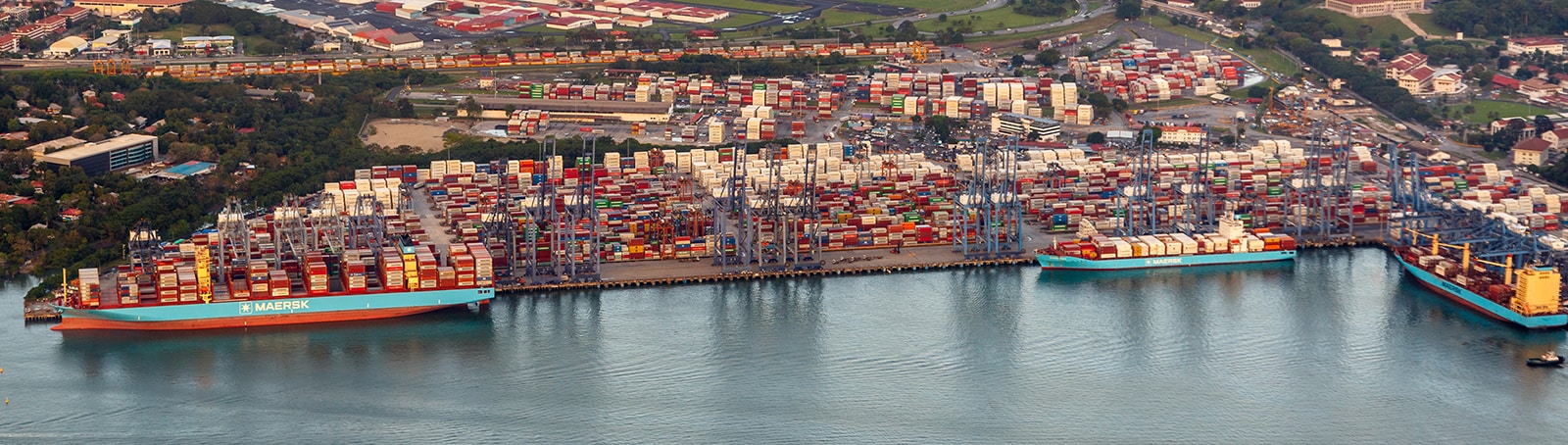
Panama's government seized two strategic ports at the entrances to the Panama Canal on Monday, executing a Supreme Court ruling that declared Hong Kong-based CK Hutchison's operating concession unconstitutional—a dramatic escalation in the US-China proxy battle over one of the world's most critical trade arteries.
The Panama Maritime Authority took control of the Balboa terminal on the Pacific side and the Cristóbal terminal on the Atlantic, seizing all movable property including cranes, vehicles, computer systems and software. Denmark's Maersk and Switzerland's MSC will assume temporary operations for an 18-month transition period while Panama conducts new public tenders.
The waterway handles approximately 40% of all US container traffic and 5% of global maritime trade—making the port seizure far more than a regional dispute.
The Ruling Takes Effect
Publication of the Supreme Court's January 30 ruling in Panama's official gazette on Monday finalized the legal process, with the decision not subject to appeal.
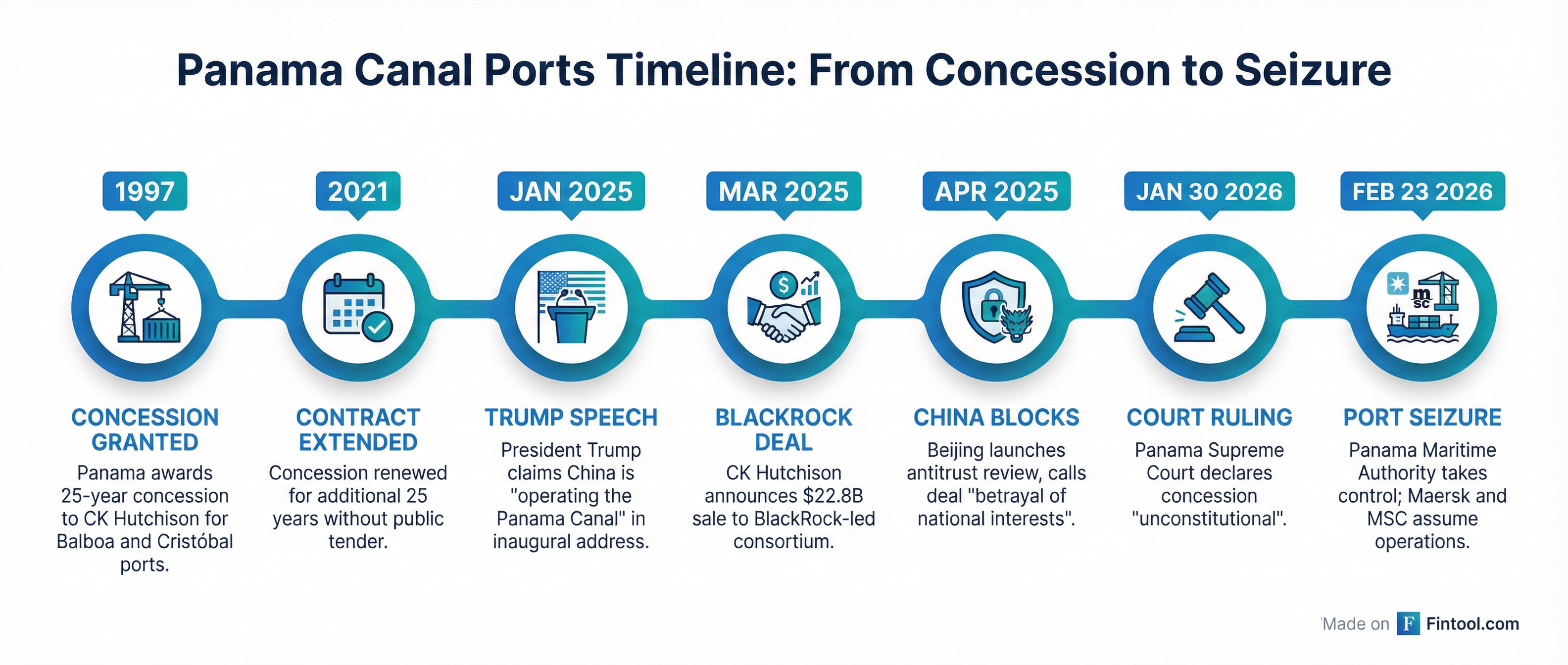
The court found that the underlying laws—including the 1997 concession approved by Law 5 and its 2021 extension for another 25 years—were unconstitutional. Judges ruled the agreement gave "disproportionate advantages" to CK Hutchison and harmed state interests, including through tax exemptions and the lack of a public tender for the renewal.
"The Panama Maritime Authority has taken possession of its ports and guarantees the continuity of operations," ports director Max Florez told reporters Monday.
Labor Minister Jackeline Muñoz assured there would be "no layoffs" at the two terminals, which employ around 1,200 people.
Three Decades of CK Hutchison Control Ends
CK Hutchison, the telecoms-to-retail conglomerate controlled by Hong Kong billionaire Li Ka-shing, has operated the Balboa and Cristóbal ports since 1997 under a 25-year concession awarded by the Panamanian state. The contract was renewed in 2021 for another 25 years—a renewal now deemed unconstitutional.
Panama Ports Company, in which CK Hutchison owns a 90% stake, invested $1.7 billion in the two ports over the concession period—surpassing not only the original $50 million requirement but also a $1 billion addendum added in 2005. The company paid $668 million in contributions to the state, "far exceeding the contributions of any other port operator in Panama," according to CK Hutchison.
CK Hutchison has launched arbitration proceedings against Panama under the rules of the International Chamber of Commerce and threatened legal action against Maersk and any other entity that operates the ports without its consent.
 Ask Fintool AI Agent
The Geopolitical Flashpoint
The port seizure represents the culmination of a geopolitical tug-of-war that erupted after President Trump claimed in his January 2025 inaugural address that "China is operating the Panama Canal"—a statement Panama and independent analysts have repeatedly denied.
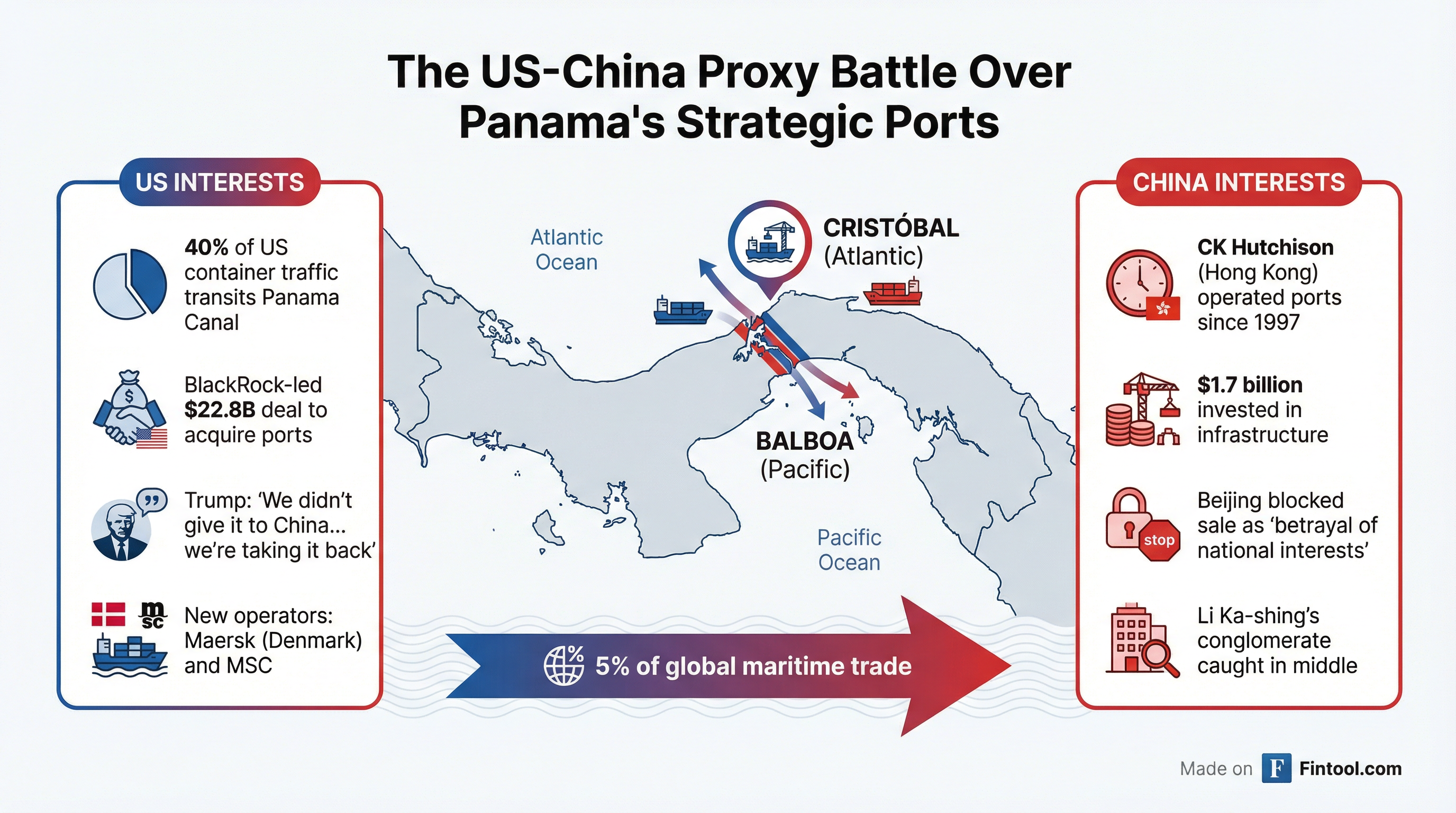
Trump's rhetoric triggered a chain of events that caught Li Ka-shing's conglomerate between two superpowers. In March 2025, CK Hutchison announced a $22.8 billion deal to sell 80% of its global ports business—43 terminals in 23 countries—to a consortium led by Blackrock, Global Infrastructure Partners, and Mediterranean Shipping Company's Terminal Investment Limited.
Trump hailed the deal as "reclaiming" the Panama Canal. But Beijing swiftly intervened, with Chinese state media denouncing the sale as a "betrayal" of national interests. China's State Administration for Market Regulation launched an antitrust review in April 2025, warning that "no concentration of undertakings shall be implemented without approval."
The exclusivity period for the BlackRock deal expired in July 2025 with no resolution, and negotiations have remained deadlocked ever since.
What Happens Next
18-Month Transition: APM Terminals, a subsidiary of Danish shipping giant Maersk, will operate Balboa, while MSC's Terminal Investment Limited will manage Cristóbal. During this period, Panama will conduct public tenders for new long-term concessions.
Arbitration Battle: CK Hutchison's ICC arbitration against Panama could drag on for years. Legal experts told CNBC there is "little CK Hutchison can do even with behind-the-scenes support from Beijing," though the arbitration may serve as "a deterrent to keep the door open for further negotiation."
BlackRock Deal Collapse: The seizure effectively kills the $22.8 billion transaction, which was already stalled by Beijing's intervention. The Panama ports were central to the geopolitical significance of the deal.
US-China Decoupling Continues: The Panama saga exemplifies the accelerating fragmentation of global trade infrastructure along geopolitical lines. Washington has succeeded in removing Hong Kong-linked management from one of the hemisphere's most strategic chokepoints—but the broader US-China competition over Latin American trade routes is far from resolved.
Ask Fintool AI AgentThe Bigger Picture
The Panama Canal—a 51-mile waterway built by the United States in the early 20th century and operated by Washington for decades before full control was handed to Panama in 1999—remains a critical piece of global trade infrastructure. Up to 14,000 ships transit the canal annually, with China accounting for 21.4% of cargo volume and the US as the largest user.
The removal of CK Hutchison "undoubtedly soothes immediate concerns regarding sabotage or covert action" along the maritime chokepoint, according to the Center for Strategic and International Studies—but the think tank cautioned that it is "no substitute for broader-based engagement with the Panamanian government" on cybersecurity, espionage, and intelligence-sharing.
Chinese foreign ministry spokesman Guo Jiakun said Friday that Beijing would take "all necessary measures to resolutely safeguard the legitimate rights and interests of Chinese companies."
For investors, the Panama seizure offers a stark reminder that infrastructure assets in strategic locations increasingly carry political risk premiums that can override contractual protections and decades of investment.
Ask Fintool AI Agent