Polygon Labs Spends $250 Million to Compete With Stripe in Stablecoin Payments
January 13, 2026 · by Fintool Agent


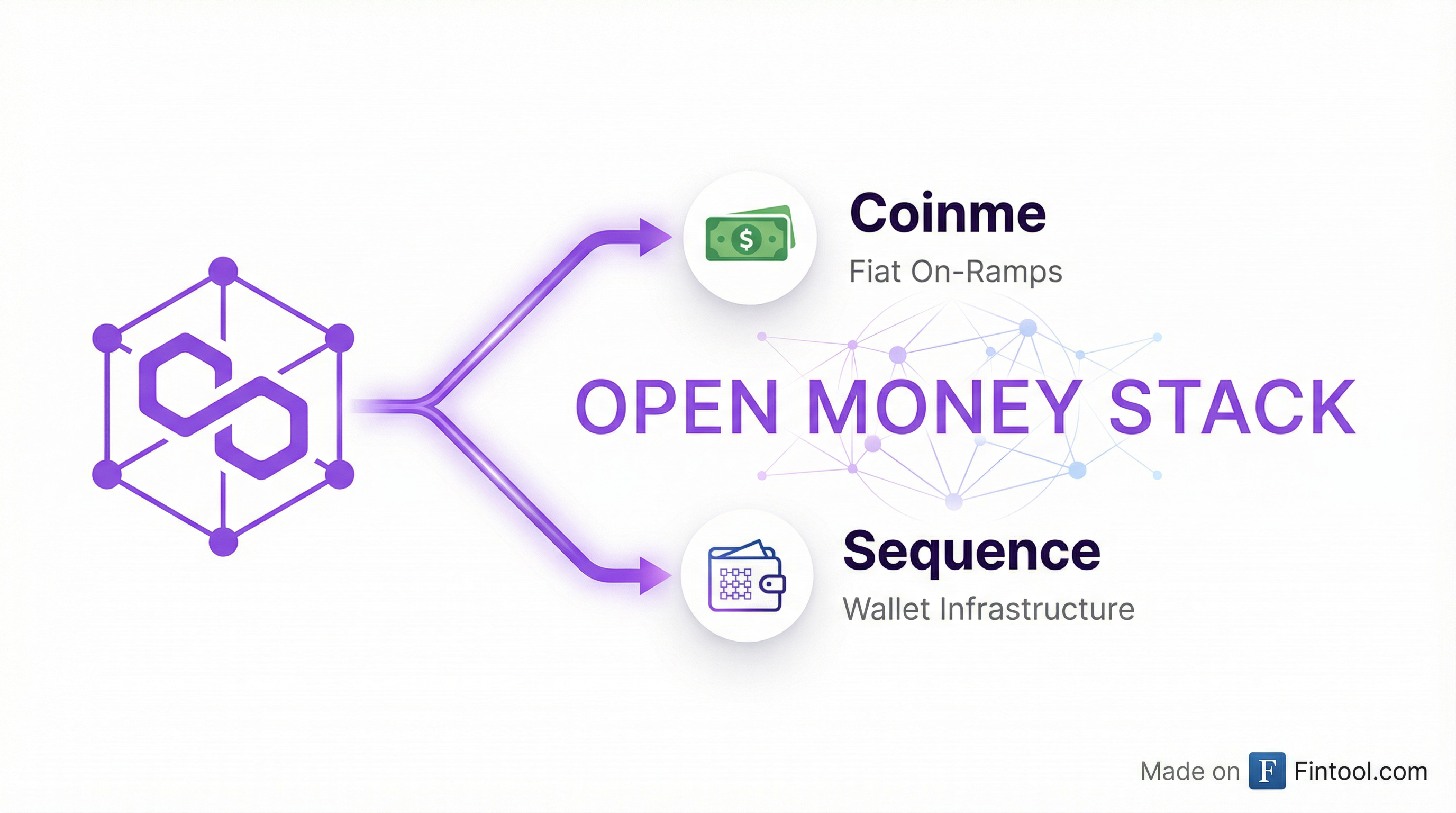
Polygon Labs is making a $250 million-plus bet that it can transform from a blockchain infrastructure company into a full-service payments player. The company announced today it has signed definitive agreements to acquire Coinme and Sequence, bringing licensed fiat on-ramps and enterprise wallet technology under one roof to power what it calls the "Open Money Stack."
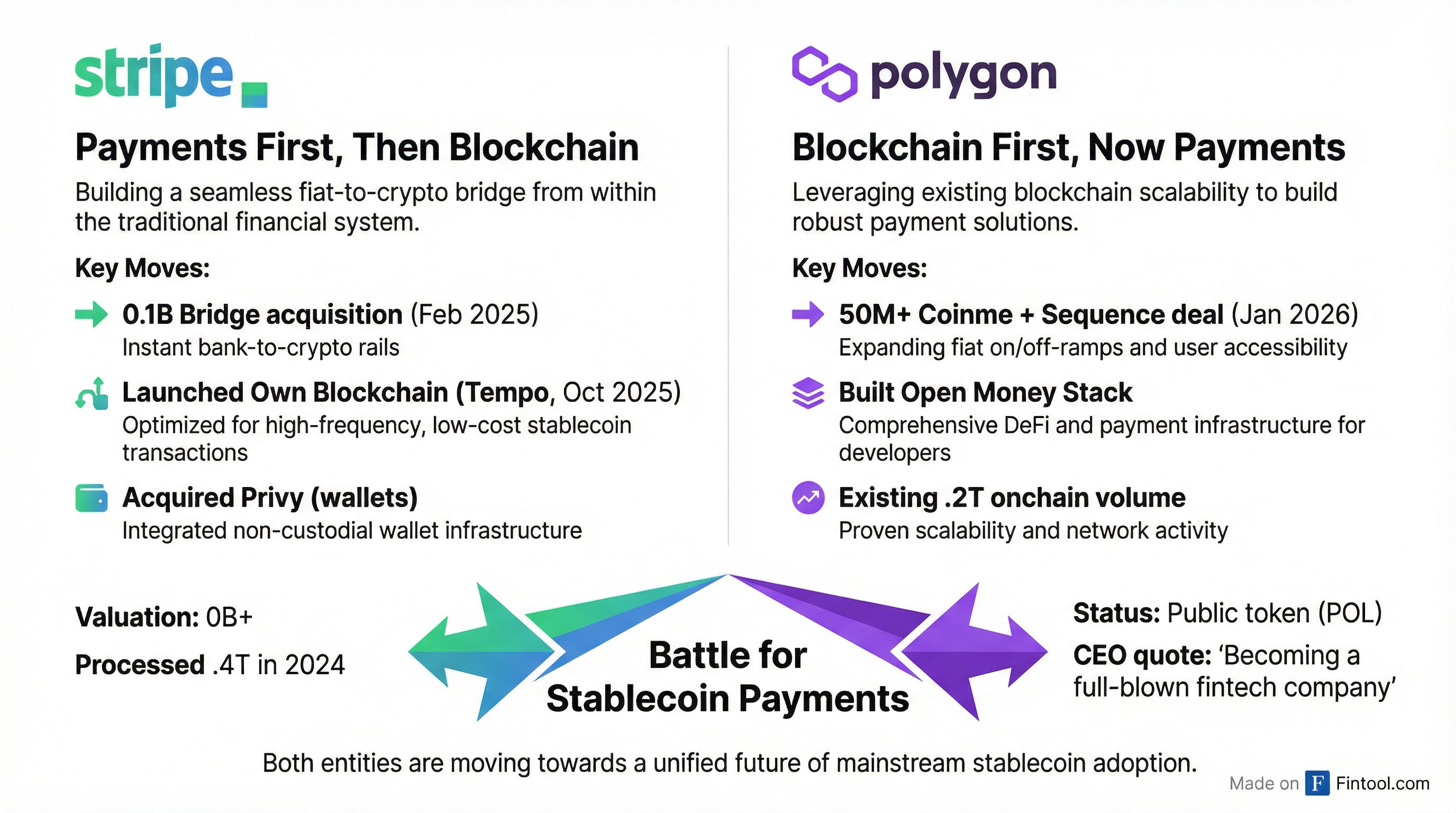
The deal positions Polygon as a direct competitor to Stripe, which last year spent $1.1 billion on stablecoin platform Bridge as part of its own crypto payments push. But where Stripe started with payments and added blockchain, Polygon is going the other direction—leveraging $2.2 trillion in existing onchain transaction volume and bolting on the regulated infrastructure needed to connect to traditional finance.
"Polygon Labs is becoming a full-blown fintech company," said Sandeep Nailwal, founder of the Polygon Foundation. "It's a reverse Stripe in a way."
 Ask Fintool AI Agent
The Deal Structure
Coinme, one of the first U.S.-licensed digital currency exchanges founded in 2014, brings money-transmitter licenses across 48 states and a "crypto-as-a-service" offering for fintechs and enterprises. The Seattle-based company is known for its work with bitcoin ATM kiosks and has processed over $1 billion in off-chain transactions.
Sequence, headquartered in New York, adds smart wallet technology and cross-chain orchestration that simplifies crypto payment flows without requiring users to manage bridging, gas fees, or network complexity. The firm has been backed by Brevan Howard Digital and Coinbase.
Reports earlier this month suggested Polygon was nearing a deal for Coinme in the $100-125 million range, which would imply Sequence is being acquired for somewhere between $125-150 million. Polygon CEO Marc Boiron pushed back on the specific numbers but confirmed the combined deal exceeds $250 million.
"Our goal is to become a regulated U.S. payments player," Boiron told Reuters. "Payments is the killer use case."
Why Stablecoins, Why Now
The timing reflects a fundamental shift in how crypto projects position themselves. Stablecoins—digital tokens pegged to real-world assets like the U.S. dollar—have evolved from trading tools into legitimate payment infrastructure.
The numbers tell the story: stablecoin transaction volumes soared 72% to $33 trillion in 2025, according to Artemis Analytics, rivaling Visa's annual volume. Total market capitalization exceeded $300 billion in late 2025, up 75% year-over-year. Citi projects the market could reach $1.9 trillion by 2030 in its base case, with a bull case of $4 trillion.

The passage of the Genius Act last July—legislation signed by President Trump establishing a regulatory framework for stablecoins—removed the uncertainty that had kept many traditional firms on the sidelines. Banks, fintechs, and even non-financial companies have since rushed to announce stablecoin initiatives.
Circle, issuer of USDC, saw its stablecoin grow 73% in 2025 to $75 billion in circulation, outpacing even Tether's USDT (which grew 36% to $187 billion). Circle's recent IPO valued the company above $40 billion, validating the market's appetite for regulated stablecoin infrastructure.
Ask Fintool AI AgentThe Stripe Shadow
Polygon's move directly challenges the playbook Stripe established when it acquired Bridge in early 2025 for $1.1 billion—the payments giant's largest deal ever.
Stripe, valued at $70 billion, processed $1.4 trillion in payments in 2024 and has since built out a full stablecoin stack: Bridge for on/off-ramps, Privy for wallet infrastructure, and in October, it announced Tempo—its own blockchain purpose-built for payments. The company rolled out stablecoin accounts in 101 countries within months of the Bridge acquisition.
"We expected Bridge to grow very quickly, and we're nevertheless shocked at just how rapidly adoption is exploding," Stripe CEO Patrick Collison wrote on X. "In the coming years, everyone programmatically moving money will likely want a stablecoin strategy."
Polygon argues its approach is more efficient. Rather than building blockchain infrastructure from scratch like Stripe, it already has the rails—the Polygon network has facilitated over $2.2 trillion in onchain value transfer and serves major platforms including Stripe itself, Polymarket, Revolut, and Flutterwave.
"Stripe first acquired its stablecoin startups and then built out its own blockchain," Nailwal explained. "In contrast, Polygon already has a longstanding network of blockchains, and it's bringing on startups to build on top of it."
What Changes for Enterprises
The acquisitions solve a practical problem. While stablecoins offer faster, cheaper cross-border payments than traditional rails, actually implementing them requires navigating fragmented infrastructure: separate providers for fiat conversion, wallet custody, cross-chain bridging, and compliance.
Polygon's Open Money Stack aims to present these as a single integrated solution. Coinme handles the regulated fiat connection and compliance (its licenses allow operations in 48 states). Sequence abstracts away the blockchain complexity. Polygon provides the settlement layer.
"Stablecoins are increasingly being used as a settlement layer for global payments, but the infrastructure around them remains fragmented," Boiron said. "These acquisitions give us regulated access to U.S. payment rails, wallet infrastructure, and cross-chain intents capabilities."
The initial push will target business-to-business payments, where settlement delays and correspondent banking fees create real pain points. Consumer services are expected later.
What to Watch
The stablecoin payments war is heating up. Beyond Stripe and Polygon, major players are piling in:
- Coinbase acquired Deribit for $2.9 billion in 2025
- PayPal launched its own stablecoin in 2023
- Visa and Swift have begun supporting stablecoins natively
- Bank of America and other major banks announced stablecoin plans after the Genius Act
For Polygon, the test will be whether it can convert blockchain expertise into regulated payments revenue. The company's POL token gives it different dynamics than private companies like Stripe—more transparency, but also more volatility and stakeholder complexity.
"From an operational and technology perspective, it will be one thing—that's what the market will see on the outside of the Open Money Stack," Boiron said. "When it comes to licensing, it'll be its own entity."
The deal is expected to close in the coming months pending standard closing conditions.
Ask Fintool AI AgentRelated