Prem Watsa Pours $188 Million Into Under Armour as Stock Sits 90% Off Peak
January 22, 2026 · by Fintool Agent


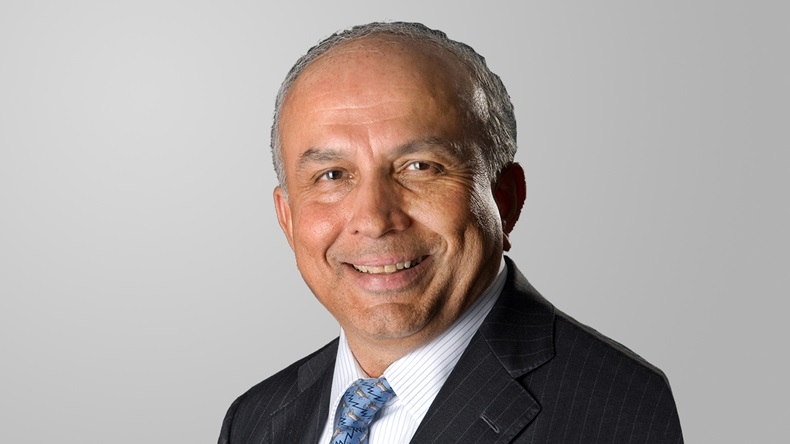
V. Prem Watsa, the billionaire founder of Fairfax Financial Holdings+1.04% often called "Canada's Warren Buffett," has poured $188 million into Under Armour+19.35% stock over the past month, according to SEC filings disclosed this week. The aggressive buying spree—including $49.7 million in the past week alone—makes Watsa's firm the largest institutional shareholder in the struggling sportswear brand.
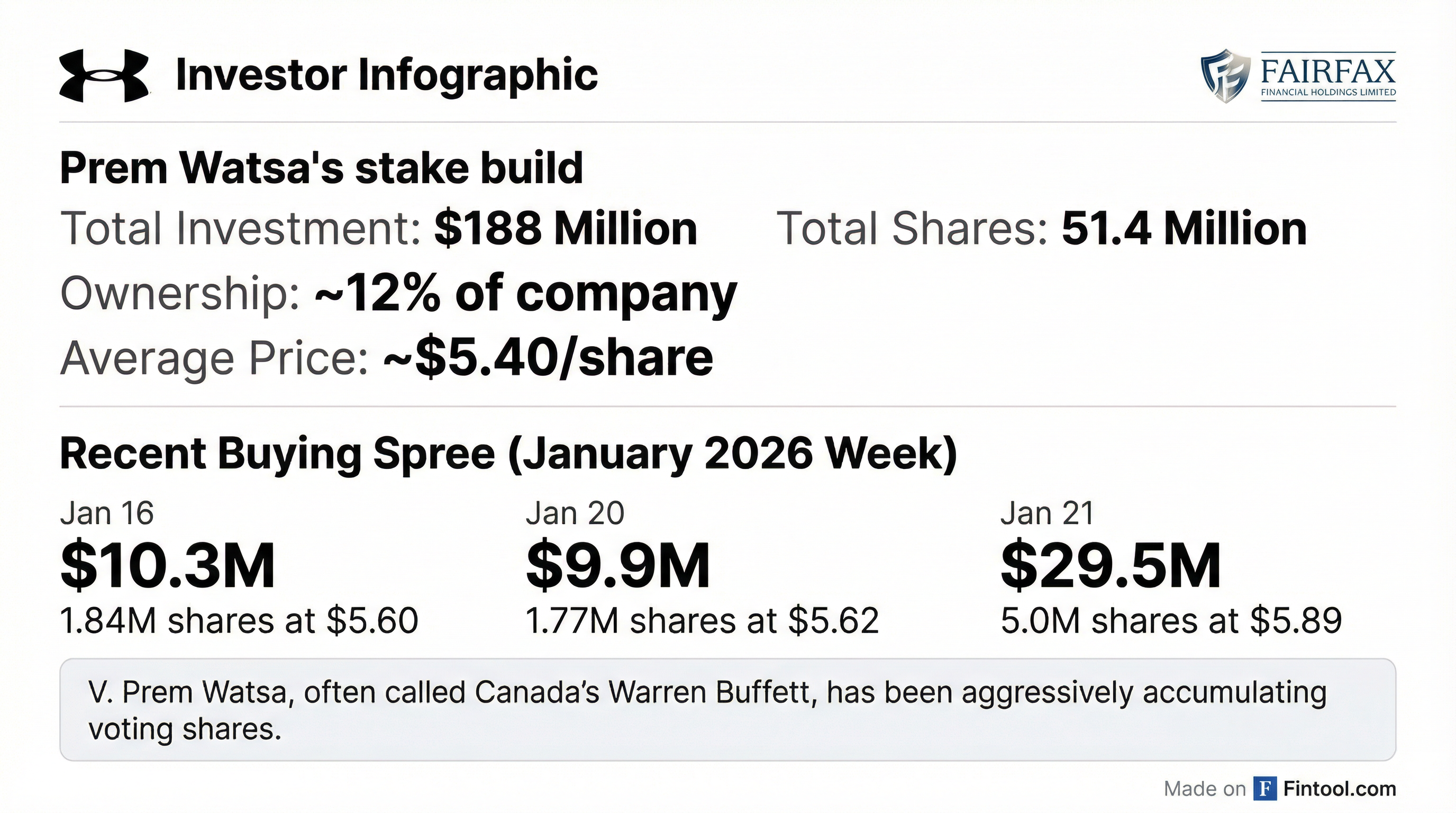
The Buying Spree
Filings submitted January 21 reveal Watsa acquired 8.6 million shares across three trading days last week :
| Date | Shares | Avg. Price | Total Value |
|---|---|---|---|
| Jan 16, 2026 | 1,837,686 | $5.60 | $10.3M |
| Jan 20, 2026 | 1,769,581 | $5.62 | $9.9M |
| Jan 21, 2026 | 5,000,000 | $5.89 | $29.5M |
This follows an even larger accumulation phase in late December, where Watsa purchased over 30 million shares. The combined stake now exceeds 51.4 million shares, representing approximately 12% of the company and valued at over $300 million at current prices .
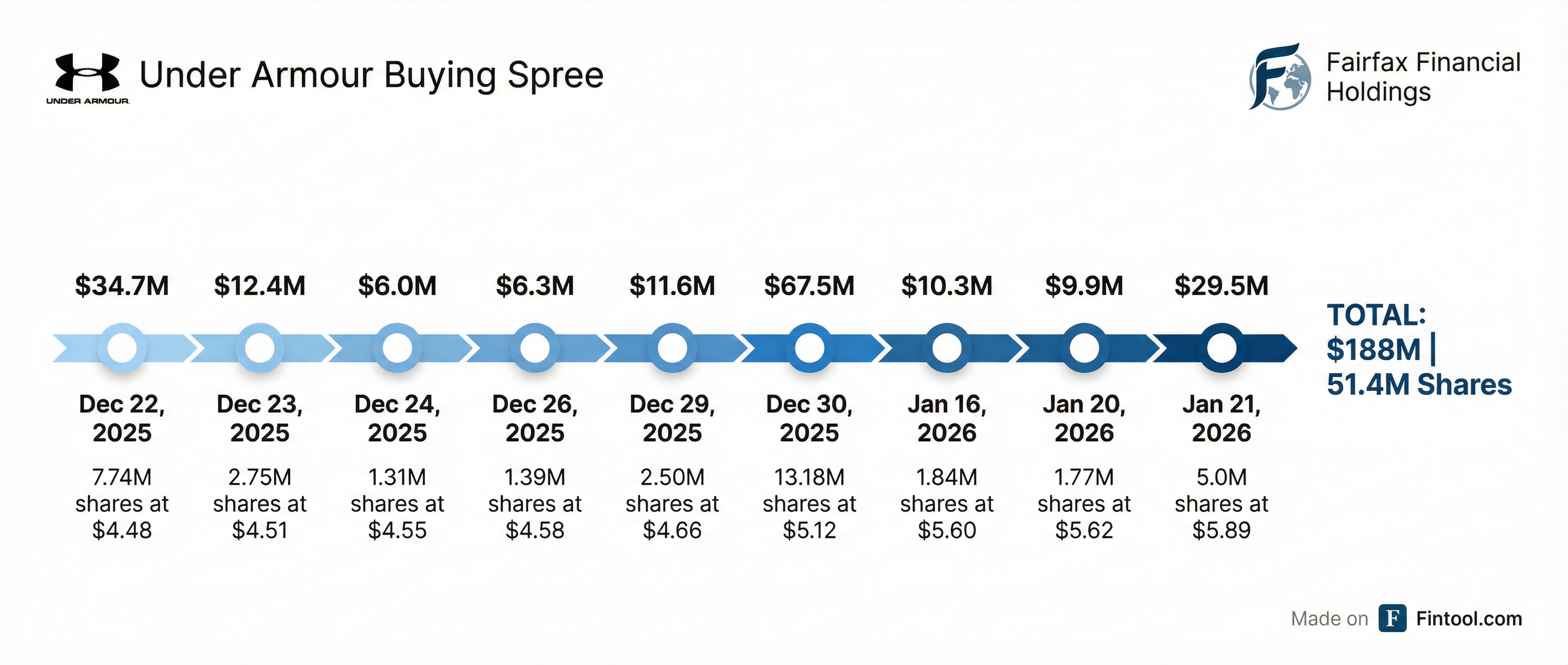
Notably, 11.5 million of Watsa's purchases were Class A voting shares (ticker: UAA), which trade at a premium due to their voting rights. This concentration in voting stock suggests potential activist intentions, though Watsa has not publicly announced any campaign .
 Ask Fintool AI Agent
Why Watsa Sees Value
Under Armour's stock tells a story of dramatic decline: the company commanded a $24 billion market cap at its 2018 peak, but now trades at just $2.5 billion—a 90% haircut . For Watsa, whose Fairfax Financial built its reputation by finding unloved assets, the setup is familiar territory.
The brand retains significant recognition despite operational struggles:
The Bear Case:
- Revenue declined 5% in Q2 FY2026 to $1.33 billion, with North America down 8%
- Gross margin contracted 250 basis points to 47.3% due to tariffs and channel mix
- The company ended its partnership with Stephen Curry, with the Curry Brand separation expected to cost $95 million in additional restructuring charges
- S&P Global placed Under Armour on CreditWatch negative, projecting lease-adjusted leverage around 4x
The Bull Case:
- Adjusted operating income guidance raised to $95-$110 million for FY2026
- CEO Kevin Plank (the founder, now back in charge) sees "signs of brand momentum in North America"
- Inventory declined 6% to $1.0 billion, suggesting improved discipline
- Trading at just 0.5x sales and 1.3x book value—deep value territory
The stock has rallied 37% from December lows around $4.50 to $6.18, coinciding almost perfectly with Watsa's accumulation. Whether this reflects Watsa's buying pressure or improving fundamentals remains an open question.
Ask Fintool AI AgentWho Is Prem Watsa?
Watsa, 75, founded Fairfax Financial in 1985 and built it into a $90 billion insurance and investment conglomerate. His investment style mirrors Warren Buffett's: patient capital, contrarian bets, and a willingness to buy businesses others have abandoned .
Past Watsa successes include:
- BlackBerry – Accumulated a major stake during the smartphone maker's collapse
- Eurobank – Bet on Greek banks during the debt crisis
- Thomas Cook India – Bought the travel company out of bankruptcy
His record isn't spotless—the BlackBerry bet took years to pay off, and some bets have failed outright. But Watsa's willingness to average down into unloved situations has generated long-term returns that rival Berkshire Hathaway's.
What to Watch
Analyst sentiment is lukewarm. Only 5 of 26 analysts recommend buying Under Armour, with a consensus Hold rating and $6.07 average price target—essentially flat from current levels. Price targets range from $4.00 (Evercore ISI) to $13.60, reflecting deep uncertainty about the turnaround's trajectory .
Near-term catalysts:
- Q3 FY2026 earnings (expected early February)
- Curry Brand separation execution
- Holiday season sell-through data
- Any activist moves from Watsa
For investors, the question is whether Under Armour can execute its turnaround before Watsa's patience runs out—or whether the legendary value investor has simply found another diamond in the rough.
Ask Fintool AI AgentRelated: