US Economy Grows Just 1.4% in Q4 as Shutdown Bites
February 20, 2026 · by Fintool Agent


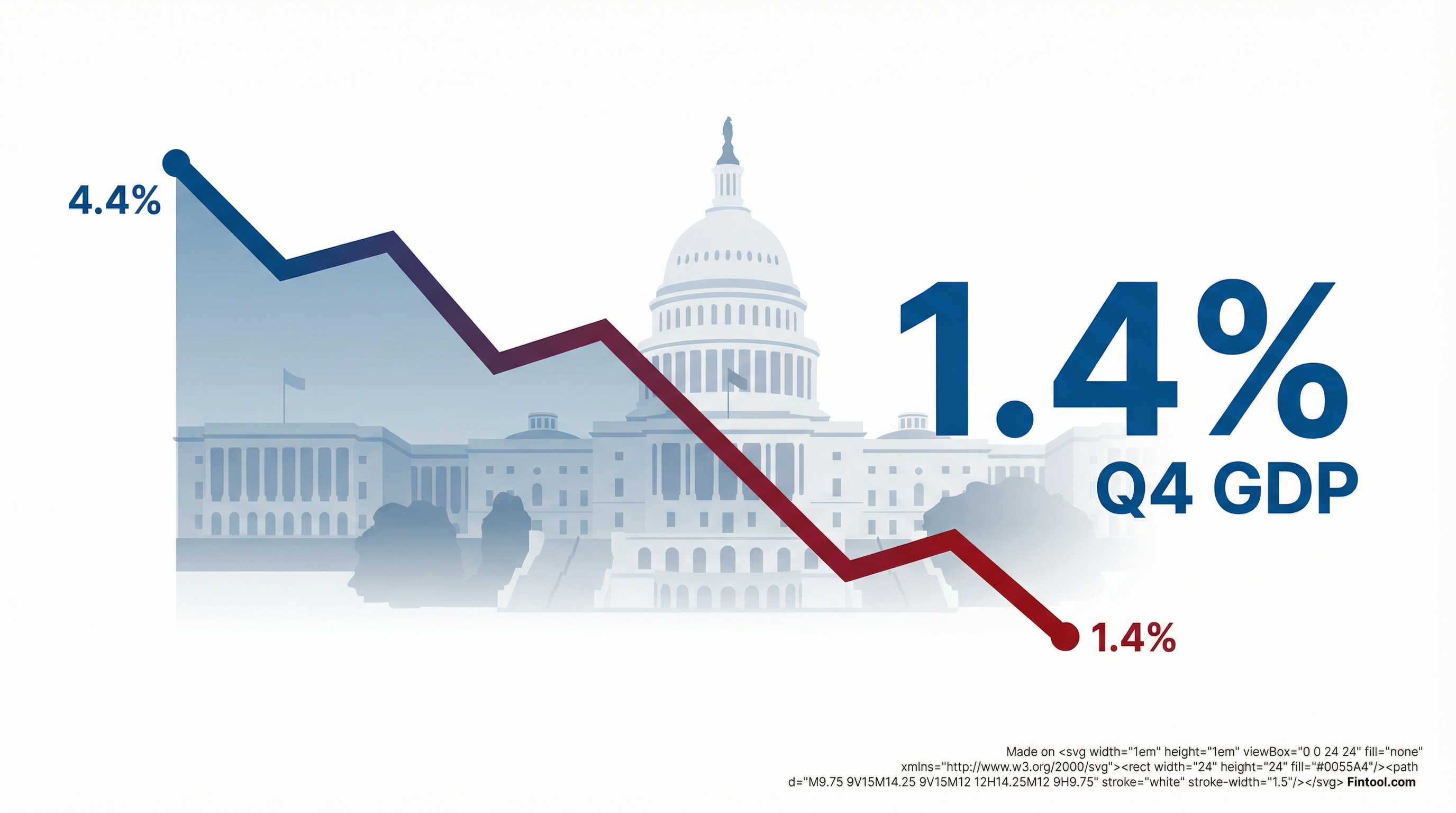
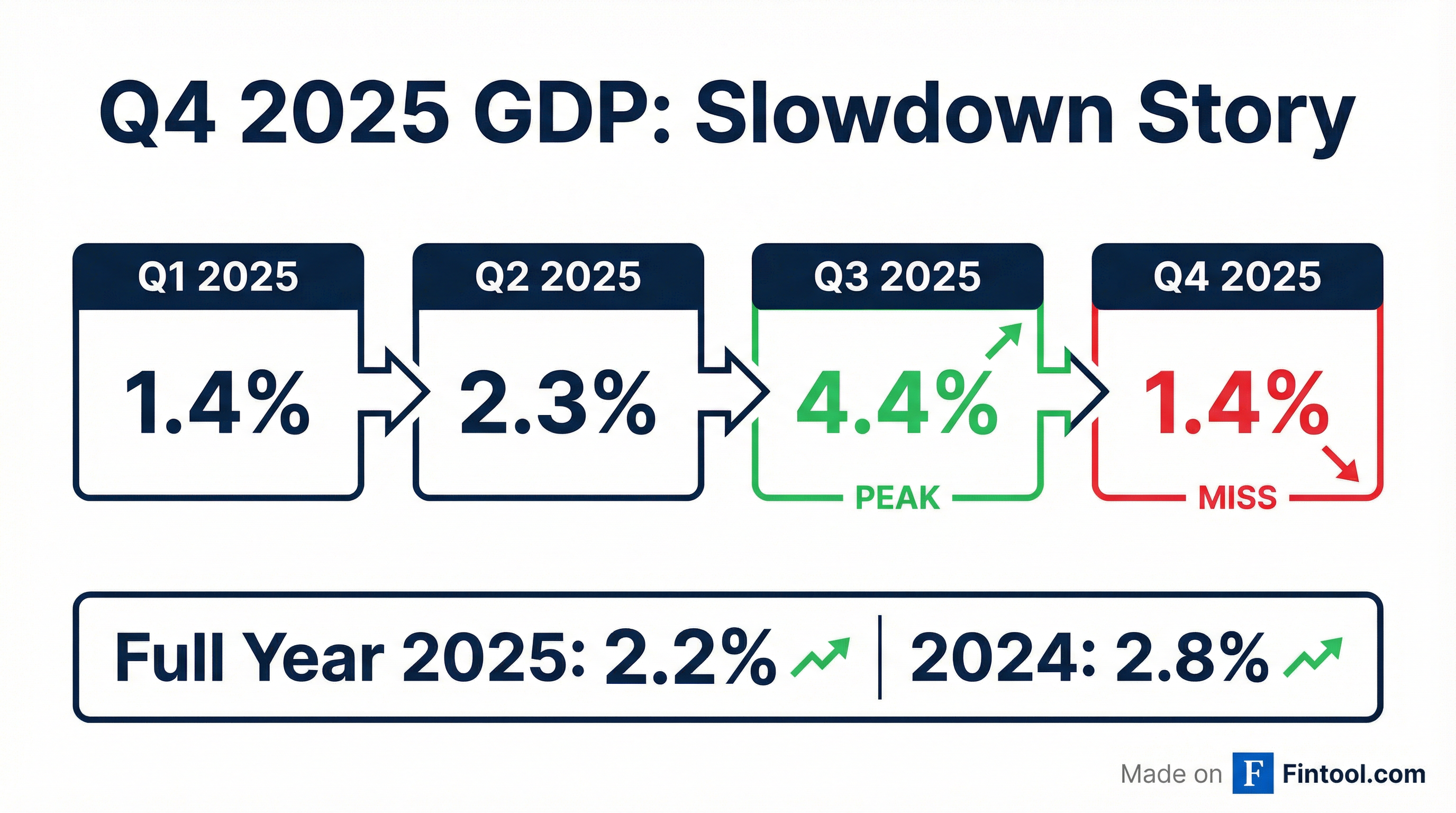
The US economy delivered its worst quarterly performance in over a year. Real GDP grew at an annualized rate of just 1.4% in Q4 2025, badly missing consensus expectations of 2.9% and marking a sharp deceleration from the 4.4% surge in Q3. The Bureau of Economic Analysis, releasing data delayed a month by the government shutdown, said the longest funding lapse in history knocked roughly 1.0 percentage point off growth.
To compound the macro complexity, the Fed's preferred inflation gauge heated up: core PCE rose to 3.0% year-over-year in December, exceeding the 2.9% forecast. The combination—weak growth, sticky inflation—creates a stagflation-lite scenario that complicates the central bank's path forward.
The Shutdown's Shadow
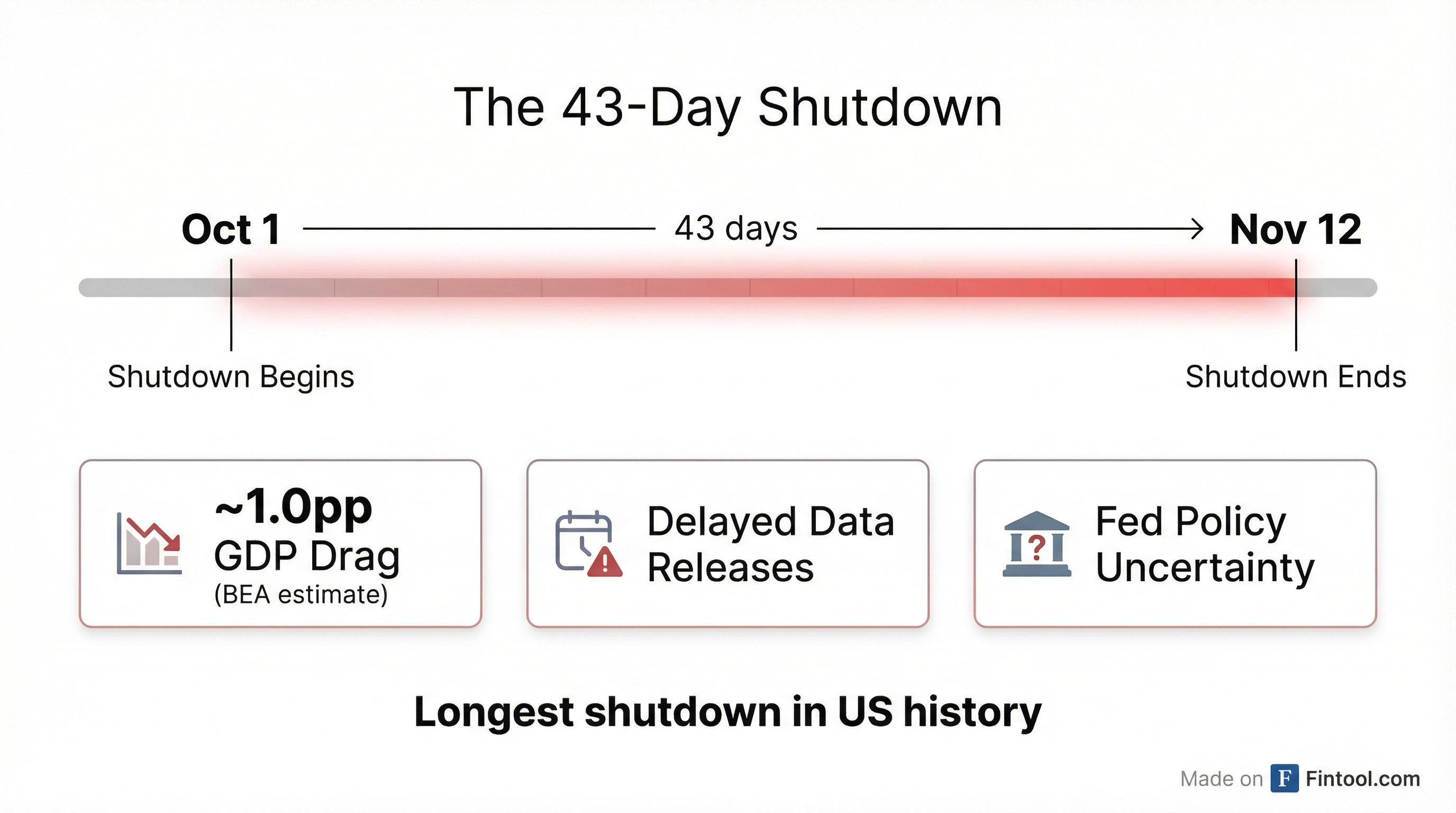
The 43-day government shutdown—running from October 1 through November 12, 2025—became the longest in US history, eclipsing the 35-day closure in 2018-2019. Its economic fingerprints are all over the Q4 data:
- Federal spending plunged: Both defense and nondefense consumption expenditures for employee compensation declined
- Data fog: The Bureau of Labor Statistics couldn't collect October CPI data, forcing the BEA to impute prices
- Report delay: This GDP release was originally scheduled for January 29 but pushed to February 20
The Congressional Budget Office had estimated a six-week shutdown would subtract 1.5 percentage points from Q4 growth—and that's almost exactly what materialized.
President Trump, posting on Truth Social ahead of the release, said the shutdown "cost at least two points in GDP" and renewed his calls for lower interest rates.
 Ask Fintool AI Agent
Under the Hood: Consumer Resilience, Government Drag
The headline misses a more nuanced story. Private domestic demand held up better than the topline suggests:
| Component | Q4 2025 | Q3 2025 | Change |
|---|---|---|---|
| Real GDP | 1.4% | 4.4% | -3.0pp |
| Real Final Sales to Private Domestic Purchasers | 2.4% | 2.9% | -0.5pp |
| Consumer Spending | Decelerated | Robust | — |
| Government Spending | Declined | Positive | — |
| Exports | Declined | Positive | — |
| Investment | Accelerated | Positive | + |
Real final sales to private domestic purchasers—the sum of consumer spending and gross private fixed investment—grew 2.4%, suggesting underlying demand remained solid despite the headline miss. Investment actually accelerated, partly offsetting the drag from government spending and exports.
For the full year, the economy grew 2.2% in 2025, down from 2.8% in 2024—still a respectable performance but clearly losing momentum into year-end.
Inflation Won't Quit
The December PCE data, released alongside GDP, showed inflation remains stubborn:
| Metric | December | November | Expectation |
|---|---|---|---|
| PCE YoY | 2.9% | 2.8% | 2.8% |
| Core PCE YoY | 3.0% | 2.8% | 2.9% |
| PCE MoM | 0.4% | 0.2% | 0.3% |
| Core PCE MoM | 0.4% | 0.2% | 0.3% |
Core PCE at 3.0%—a full percentage point above the Fed's 2% target—is the wrong direction. The Fed's January minutes, released earlier this week, showed several officials ready to consider rate hikes if inflation stays elevated. The hawkish lean, combined with today's data, suggests rate cuts are off the table for now.
Markets now price a 94% probability the Fed holds rates steady at the March meeting, with the next cut potentially pushed out to summer 2026.
Ask Fintool AI AgentMarket Reaction: Cautious Digestion
Stock futures dipped modestly following the data dump, with the S&P 500 down roughly 0.2% in early trading. The reaction was muted given the magnitude of the GDP miss—likely because:
- Shutdown impact was expected: Markets knew the shutdown would drag on Q4 numbers
- Rebound baked in: CBO and private economists expect GDP to rebound in Q1 2026 as government spending normalizes
- Private demand solid: The underlying 2.4% growth in private final sales provides some comfort
Treasury yields held steady, with the 10-year at 4.07% and the 2-year at 3.47%. The yield curve remains flat, reflecting uncertainty about both growth and the Fed's path.
Oil retreated toward $71/barrel after President Trump said he would decide within 10 days on military action against Iran—somewhat easing immediate escalation fears.
What to Watch
Near-term: Q1 2026 GDP should benefit from a normalization of government spending post-shutdown. The CBO estimated growth would be boosted by 2.2 percentage points in Q1 as the shutdown effect reverses. If realized, Q1 could print around 3.5-4.0%.
Fed trajectory: The March FOMC meeting (March 18-19) will be critical. With growth weak but inflation sticky, Powell faces a classic dilemma. Watch for any shift in the "higher for longer" language.
Earnings season implications: Consumer-facing companies will face questions about the "K-shaped" recovery—upper-income households doing well while lower-income consumers struggle with affordability pressures.
Tariff wildcard: The Supreme Court could rule as early as today on President Trump's "Liberation Day" tariffs. A decision either way will inject fresh uncertainty into the growth outlook.
Ask Fintool AI AgentSource: Bureau of Economic Analysis, Congressional Budget Office, Federal Reserve Bank of St. Louis (FRED)