Supreme Court Strikes Down Trump's Sweeping Tariffs in Landmark 6-3 Ruling
February 20, 2026 · by Fintool Agent


The Supreme Court delivered a stunning rebuke to President Donald Trump's economic agenda on Friday, ruling 6-3 that his sweeping global tariffs exceeded presidential authority and violated federal law. The decision invalidates over $175 billion in import duties and sets the stage for a massive refund battle that could reshape U.S. trade policy.
Markets rallied immediately on the news, with the S&P 500 jumping 0.45% and the Nasdaq rising 0.42% as investors cheered the removal of tariff uncertainty that has plagued businesses for over a year.
The Ruling: "IEEPA Does Not Authorize Tariffs"
Chief Justice John Roberts, writing for the majority, delivered an unambiguous verdict: the International Emergency Economic Powers Act of 1977 does not give the president authority to impose tariffs.
"The president asserts the extraordinary power to unilaterally impose tariffs of unlimited amount, duration, and scope," Roberts wrote. "But the Trump administration points to no statute in which Congress has previously said that the language in IEEPA could apply to tariffs."
Roberts emphasized the constitutional foundation of tariff authority: "The Framers gave 'Congress alone' the power to impose tariffs during peacetime. Accordingly, the President must 'point to clear congressional authorization' to justify his extraordinary assertion of that power. He cannot."
The ruling represents the first time the Supreme Court has issued a final opinion on the underlying legality of one of Trump's second-term policies—a stark contrast to the administration's string of victories on emergency appeals throughout 2025.
A Court Divided Across Unusual Lines
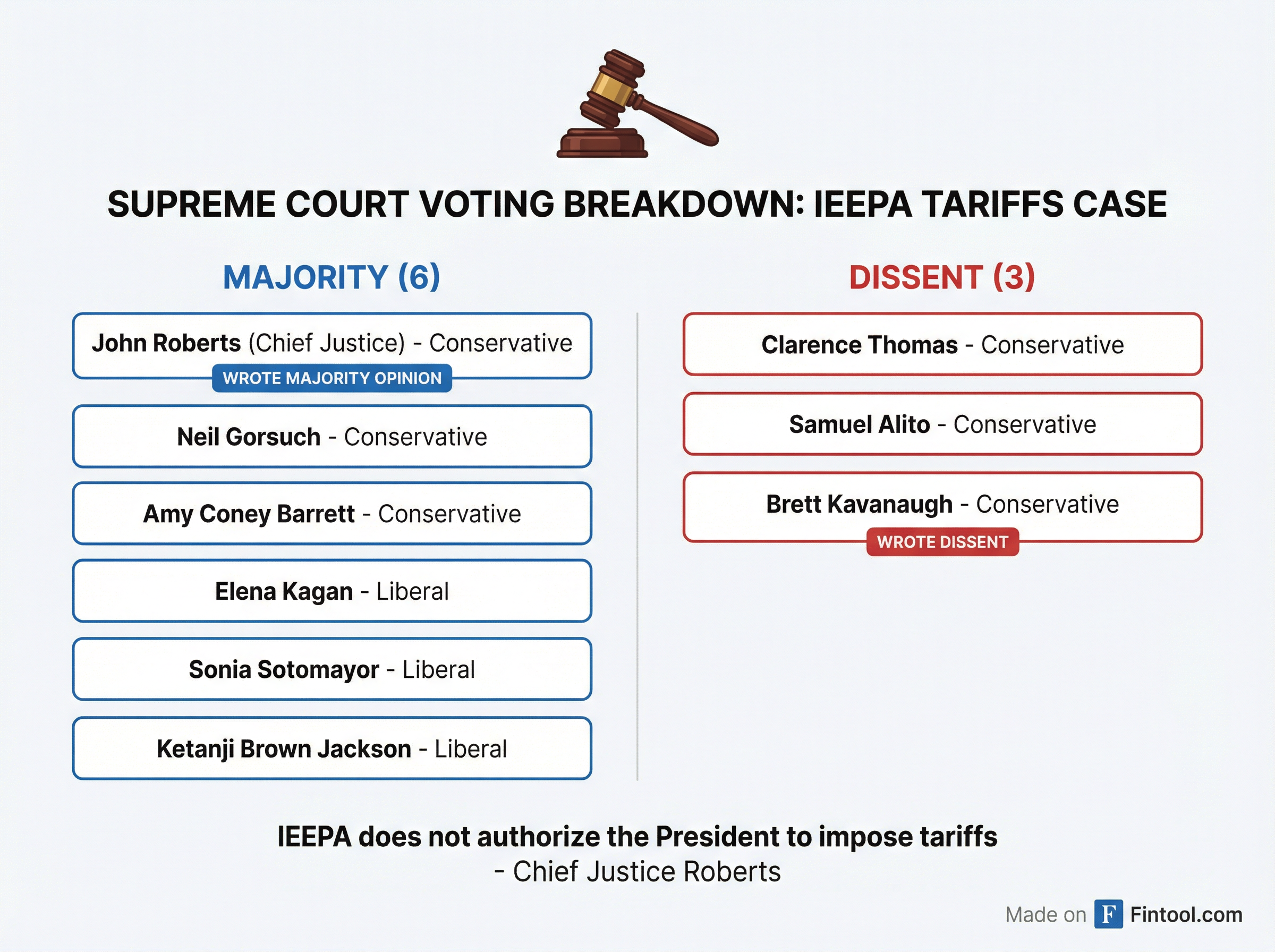
The decision split the conservative-majority court in unexpected ways. Roberts was joined by two Trump appointees—Justices Neil Gorsuch and Amy Coney Barrett—along with the three liberal justices: Elena Kagan, Sonia Sotomayor, and Ketanji Brown Jackson.
Justice Brett Kavanaugh authored the dissent, joined by Justices Clarence Thomas and Samuel Alito. Kavanaugh argued the court was wading into policy debates it should avoid: "Despite the vigorous policy debates spurred by Trump's tariffs, those debates are not for the courts to resolve."
Kavanaugh also warned about the financial consequences: "The Court says nothing today about whether, and if so how, the Government should go about returning the billions of dollars that it has collected from importers."
 Ask Fintool AI Agent
$175 Billion in Refunds at Stake
The financial implications are staggering. Penn-Wharton Budget Model economists estimate that more than $175 billion in IEEPA-based tariffs have been collected since Trump first invoked the law in February 2025—and that entire amount may need to be refunded.
| Metric | Value |
|---|---|
| IEEPA Tariffs Collected | $175+ billion |
| Number of Importers Affected | 301,000+ |
| Total Entries Subject to IEEPA | 34+ million |
| Refund Amount vs. Federal Agencies | Exceeds combined DOT + DOJ annual budgets |
For context, the potential refund amount exceeds the combined fiscal 2025 outlays from the Department of Transportation ($127.6 billion) and the Department of Justice ($44.9 billion).
Major corporations have already filed lawsuits seeking refunds, including Costco, BorgWarner, Goodyear Tire & Rubber, Yokohama Tire, and several Toyota subsidiaries. The U.S. Court of International Trade will now oversee the refund process administered by U.S. Customs and Border Protection.
Treasury Secretary Scott Bessent has previously stated that the Treasury can "easily cover" any tariff refunds, though he expressed confidence the Supreme Court would uphold the tariffs.
What's Struck Down vs. What Remains
The ruling invalidates two major categories of Trump's tariffs:
Struck Down:
- "Reciprocal" tariffs: Country-by-country duties ranging from 34% for China to a 10% baseline for most other nations
- Fentanyl-related tariffs: 25% duties on Canada, China, and Mexico imposed in February-March 2025
- Punitive tariffs: Including the 40% duty on Brazil over the prosecution of former President Jair Bolsonaro
Still in Effect:
- Steel and aluminum tariffs (imposed under Section 232)
- Sector-specific tariffs using other legal authorities
- These represent approximately one-third of Trump's total tariff revenue
Trump's Fallback Options
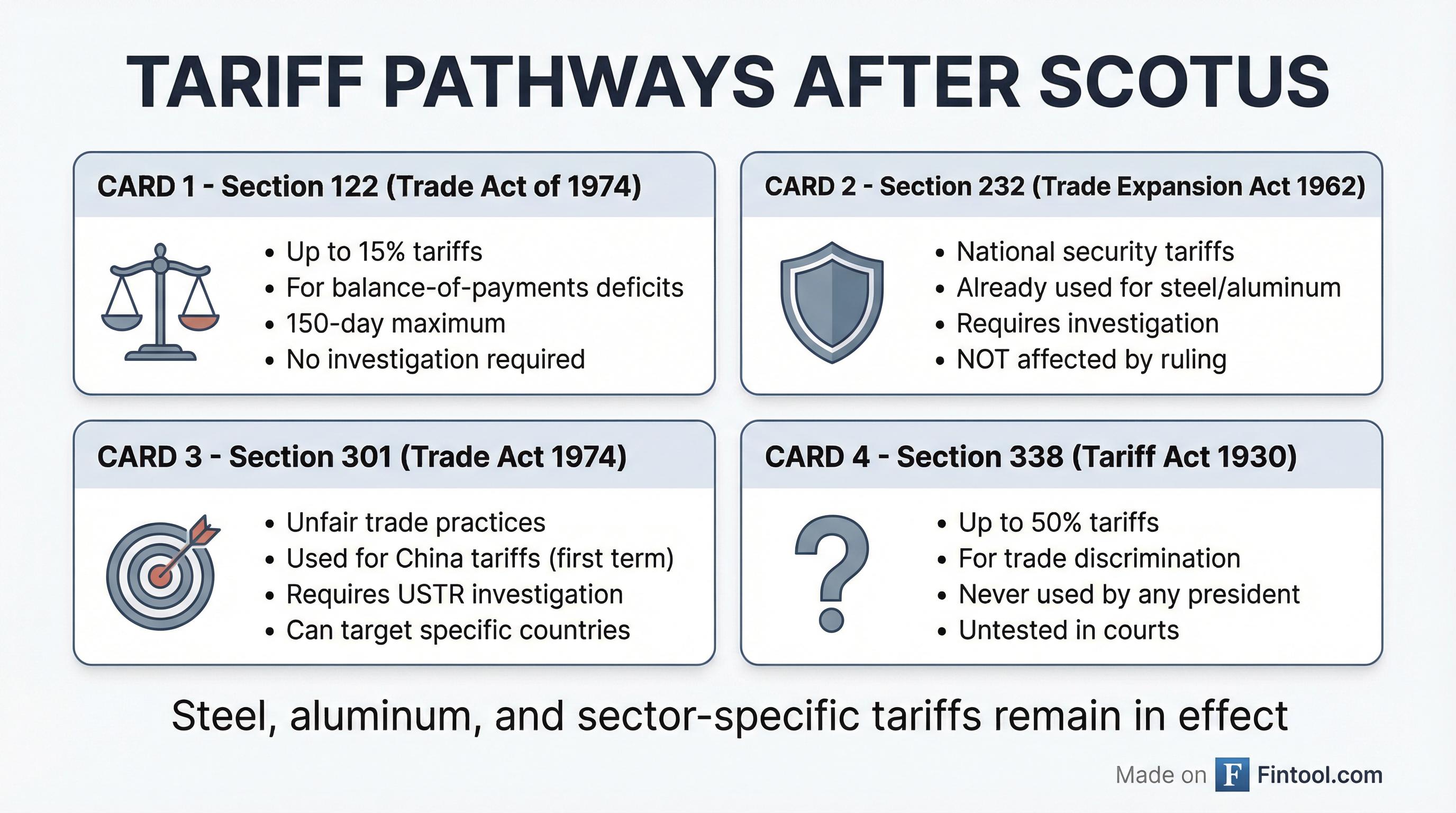
The administration has already signaled it will pursue alternative legal authorities to maintain its tariff agenda. Treasury Secretary Bessent previously identified several options:
| Law | Authority | Key Constraints |
|---|---|---|
| Section 122 (Trade Act 1974) | Up to 15% tariffs | Balance-of-payments only; 150-day max |
| Section 232 (Trade Expansion Act 1962) | National security | Requires investigation; already used for steel/aluminum |
| Section 301 (Trade Act 1974) | Unfair trade practices | Requires USTR investigation |
| Section 338 (Tariff Act 1930) | Trade discrimination | Up to 50%; never used by any president |
However, analysts note these alternatives impose more constraints than IEEPA, which allowed Trump to act instantaneously on any trading partner.
"I don't think we have heard the last from Trump and tariffs," wrote Neil Dutta, head of economics at Renaissance Macro. "There is a vast legal architecture that Trump can draw from to prosecute this... The issue is if he does not dial the tariff threat back on, he basically looks like a lame duck. The issue is more political than economic, at least right now."
Ask Fintool AI AgentMarket Reaction and Economic Impact
Markets responded positively but cautiously to the ruling. The immediate reaction suggests investors are relieved by reduced uncertainty, though questions remain about the administration's next moves.
The Tax Foundation estimates that the IEEPA tariffs increased taxes on American households by about $1,000 in 2025 and would have added another $1,300 in 2026.
California's Attorney General estimated the state alone faced $25 billion in costs and 64,000 lost jobs from the tariffs.
What to Watch Next
Immediate catalysts:
- Administration response and potential use of alternative tariff authorities
- Refund process mechanics from CBP and the Court of International Trade
- Tuesday's State of the Union address—an awkward moment for justices who typically attend
Longer-term implications:
- Congressional action on tariff authority
- Potential trade deal renegotiations with countries affected by the ruling
- Impact on the approximately $300 billion in annual tariff revenue the administration had projected over the next decade
The ruling represents the most significant check on presidential trade authority in decades—but whether it fundamentally reshapes Trump's tariff agenda depends on how aggressively the administration pursues alternatives.
Ask Fintool AI AgentRelated: