Joshua Easterly's Full Retirement Caps 16-Year Era at Sixth Street
February 23, 2026 · by Fintool Agent


Sixth Street Specialty Lending's co-founder Joshua Easterly is retiring completely from the firm he helped build, ending a 16-year tenure that transformed a middle-market lender into one of the largest publicly traded business development companies. The announcement came as TSLX shares touched a fresh 52-week low of $17.90, down 23% over the past year amid broader sector concerns about private credit's heavy exposure to enterprise software.
Easterly notified the board on February 19, 2026, that he will not seek re-election as Chairman at the May 21, 2026, annual meeting and will step down as Co-Chief Investment Officer of the adviser effective June 30, 2026 . He will also retire from Sixth Street Partners, the $75 billion alternative asset manager, on the same date .
The departure completes a transition that began in November 2025, when Easterly resigned as CEO and ceded the role to longtime partner Robert "Bo" Stanley . At that time, Easterly said he would remain as Chairman—a plan that has now changed.
A Bittersweet Farewell
In an internal letter to the Direct Lending team furnished with today's 8-K, CEO Bo Stanley struck an appreciative but forward-looking tone:
"This is a bittersweet moment. We want to thank Josh for the tremendous contributions he's made to our business, and for his tireless hustle and deep commitment to always creating the best possible outcomes for our investors."
Stanley emphasized continuity, noting that the investment team remains led by himself, Co-Head of Direct Lending Michael Griffin, and Sixth Street's Co-Founding Partner Alan Waxman . Investment decisions continue to be made by the Investment Review Committee, unchanged by Easterly's departure .
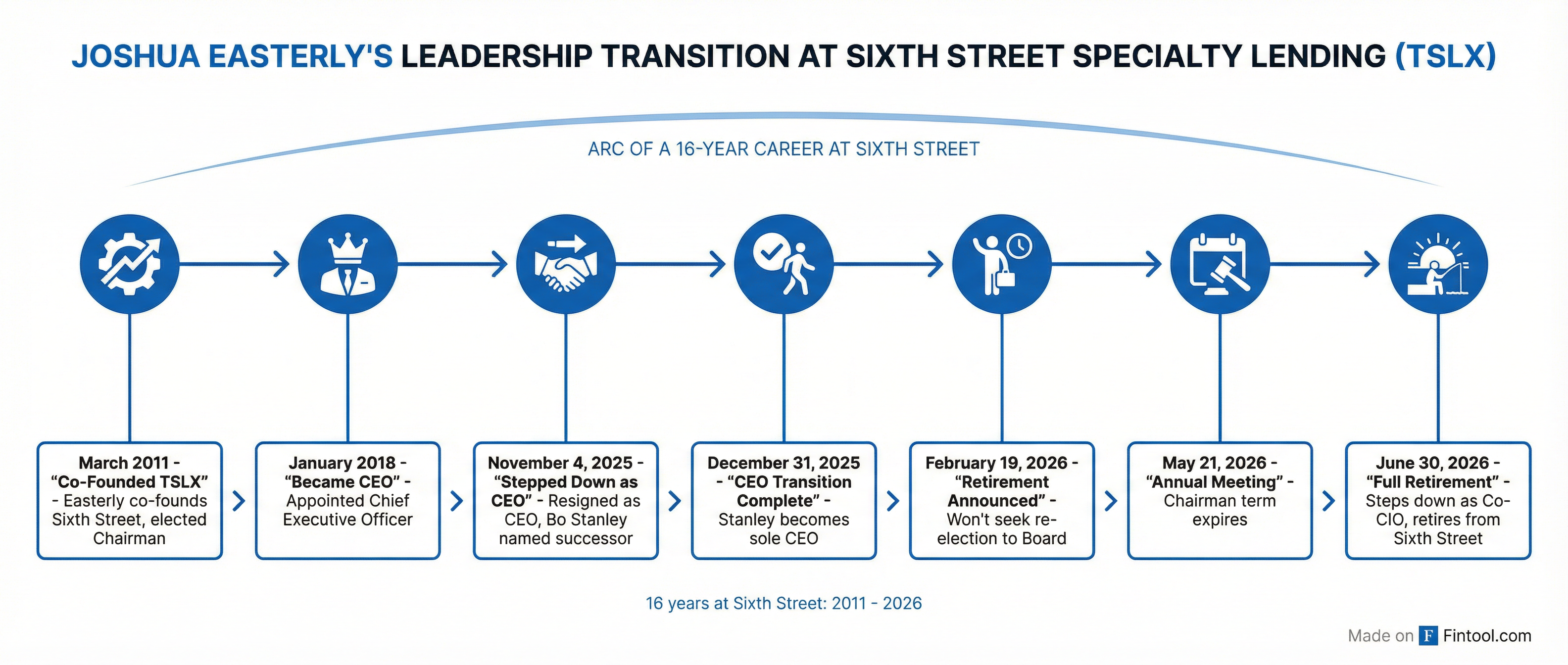
The filing stated that Easterly's decision "is not the result of any disagreement with the Company on any matter relating to the Company's operations, policies, or practices" —standard 8-K language, but notable given the timing.
 Ask Fintool AI Agent
The Easterly Record
Easterly's tenure at Sixth Street was marked by consistent outperformance. Under his leadership, TSLX delivered 10 consecutive years of double-digit economic returns through 2025 . Since the start of the interest rate hiking cycle in early 2022, TSLX's net asset value per share grew 1.9%—compared to an average 8.5% decline among public BDC peers .
The company reported adjusted net investment income of $2.18 per share for 2025, representing a 12.7% operating return on equity that exceeded the top end of guidance . Economic returns came in at 10.9%, above the estimated 9% cost of equity .
Before founding Sixth Street in 2011, Easterly spent time at Goldman Sachs as a Managing Director in the Americas Special Situations Group (2008-2010) and before that was Senior Vice President at Wells Fargo Capital Finance. The humble beginnings tell a remarkable story: one of five children, Easterly worked full-time while attending Fresno State, where he earned his B.S. in Business Administration magna cum laude before embarking on a Wall Street career.
| Metric | FY 2025 Performance |
|---|---|
| Adjusted NII per Share | $2.18 |
| Operating ROE | 12.7% |
| Economic Return | 10.9% |
| NAV per Share (Year-End) | $16.98 |
| Total Assets | $3.4B |
| Debt-to-Equity | 1.10x |
Timing and Market Context
The retirement announcement comes at a challenging moment for the BDC sector. TSLX shares have fallen 17% year-to-date, hitting a 52-week low of $17.90 on February 23—well below the $25.17 peak reached in July 2025.
The selloff reflects broader concerns about private credit's exposure to enterprise software, which accounts for approximately 40% of TSLX's portfolio by fair value . An ongoing correction in public software equities—driven by fears that AI will disrupt traditional SaaS business models—has spilled into the credit markets.
JPMorgan recently cut its TSLX price target from $23 to $21 with a neutral rating, part of a wave of analyst downgrades across the sector.
Management has been vocal in defending the portfolio. On the Q4 2025 earnings call, CEO Stanley emphasized that "AI levels the playing field on development costs that does not fundamentally change the intrinsic moat that protects a business" . He noted that TSLX's software portfolio companies maintain a 40% weighted average LTV and generated 9% revenue growth and 15% earnings growth in the latest period .
"We're not saying the tails might not be wider on the margin for ill-prepared business models and management teams, but generally, we think this is an equity valuation problem."
Ask Fintool AI AgentBo Stanley's Skin in the Game
If there's a vote of confidence in the transition, it came from Stanley himself. On November 18, 2025—just two weeks after being named Co-CEO—Stanley purchased 10,000 shares at $20.85, investing $208,500 of his own money. He now owns approximately 24,907 shares directly.
The purchase was notable timing: it came after the CEO transition announcement but before Q4 results revealed margin pressures and unrealized losses from portfolio markdowns.
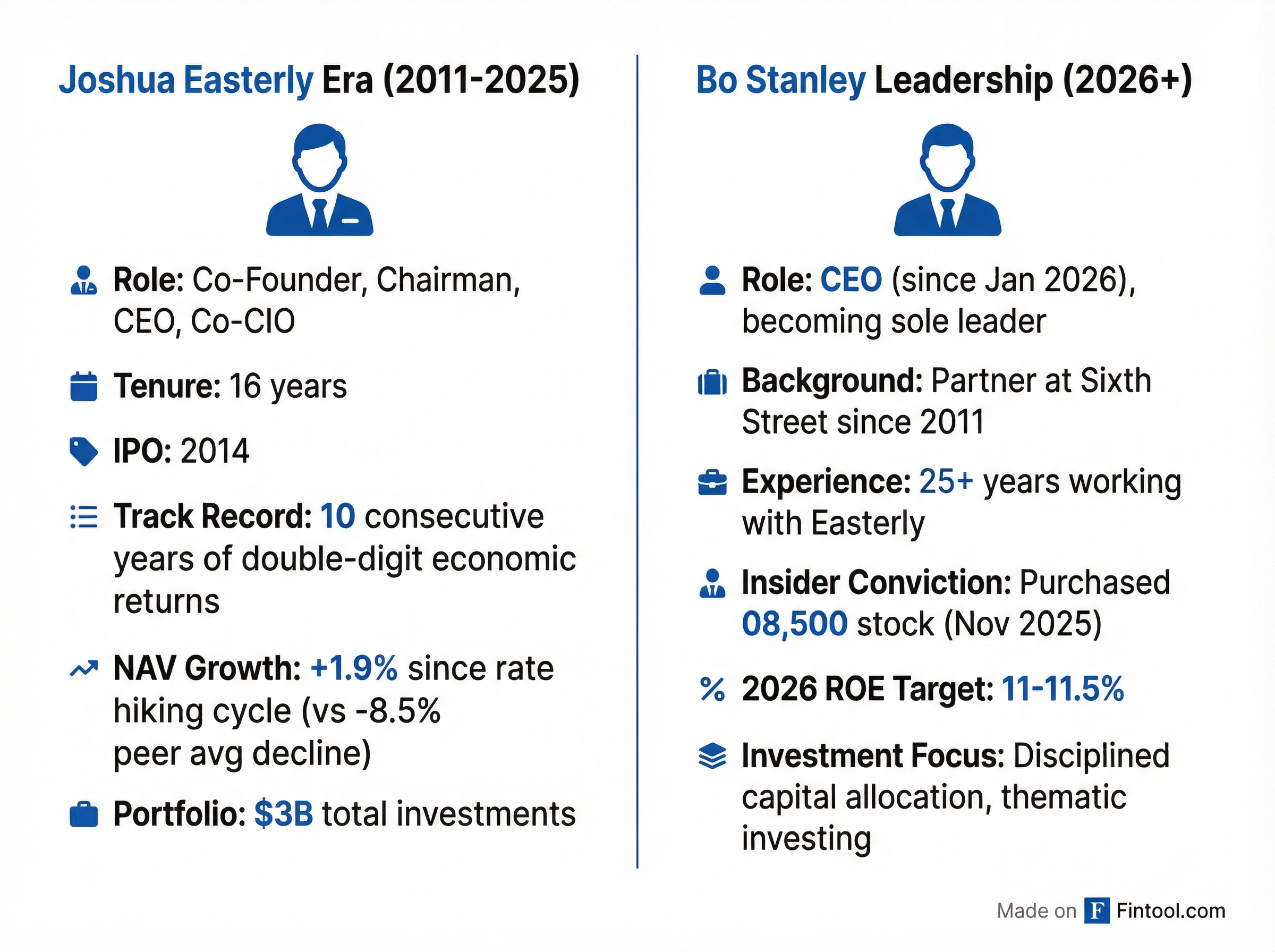
Stanley, 50, has worked alongside Easterly for 25 years, dating back to their time together at Wells Fargo Capital Finance. He joined Sixth Street in 2011 as one of the original team members and has served as Co-Head of Direct Lending and Co-Head of Sixth Street Growth.
On the Q3 2025 call, Easterly framed the transition as long-planned rather than reactive: "The framework for this transition has been in place for quite some time. As Josh mentioned, it started nine years ago" .
What to Watch
Board Succession: The company said it "intends to appoint a successor Chairman of the Board on or about the date of the Annual Meeting" . The identity of that successor—internal or external—will signal whether Sixth Street is truly comfortable with the depth of its bench.
Software Credit Performance: With 40% exposure and sector sentiment souring, investors will scrutinize quarterly NAV movements and non-accrual trends closely. Management's Q4 guidance calls for 11-11.5% operating ROE in 2026 .
Capital Reallocation: Management expects "a gradual market-correcting rebalancing" as capital migrates away from managers that cannot earn their cost of equity . TSLX ended 2025 with significant liquidity (33% of total assets) and leverage below target (1.10x vs. 1.22x peer median) .
New CLO Joint Venture: The recently announced Structured Credit Partners JV with Carlyle—to which TSLX committed $200 million—is expected to generate mid-teens returns and provide earnings support .
Ask Fintool AI AgentThe Bottom Line
Joshua Easterly built one of the most respected BDC platforms in the industry over 16 years, generating consistent returns while his peers stumbled through credit cycles. His departure is not acrimonious—the phased transition over nine months and lack of any stated disagreement suggest an orderly, long-planned exit.
But the timing is awkward. TSLX trades at a discount to NAV for the first time in years, the sector faces its first real stress test since COVID, and questions about private credit valuations are getting louder. Whether Bo Stanley and the remaining Sixth Street team can maintain the firm's track record of outperformance will determine if this is merely the end of an era—or the beginning of something different.