STAAR Shareholders Reject $1.6 Billion Alcon Bid in Major Activist Victory
January 06, 2026 · by Fintool Agent



Staar Surgical shareholders delivered a stunning rebuke to management Tuesday, voting down Alcon's sweetened $1.6 billion acquisition offer in one of the most significant activist victories in medtech M&A history. The rejection came despite a 74% premium to STAAR's 90-day volume-weighted average price—one of the richest premiums seen in the medical device sector this year.
STAA shares plunged 9% to $21.82 on the news, while ALC rose 1.3% to $81.77 as investors cheered the Swiss eyecare giant's escape from what activists called an overpriced deal.
The $150 Million Sweetener That Wasn't Sweet Enough
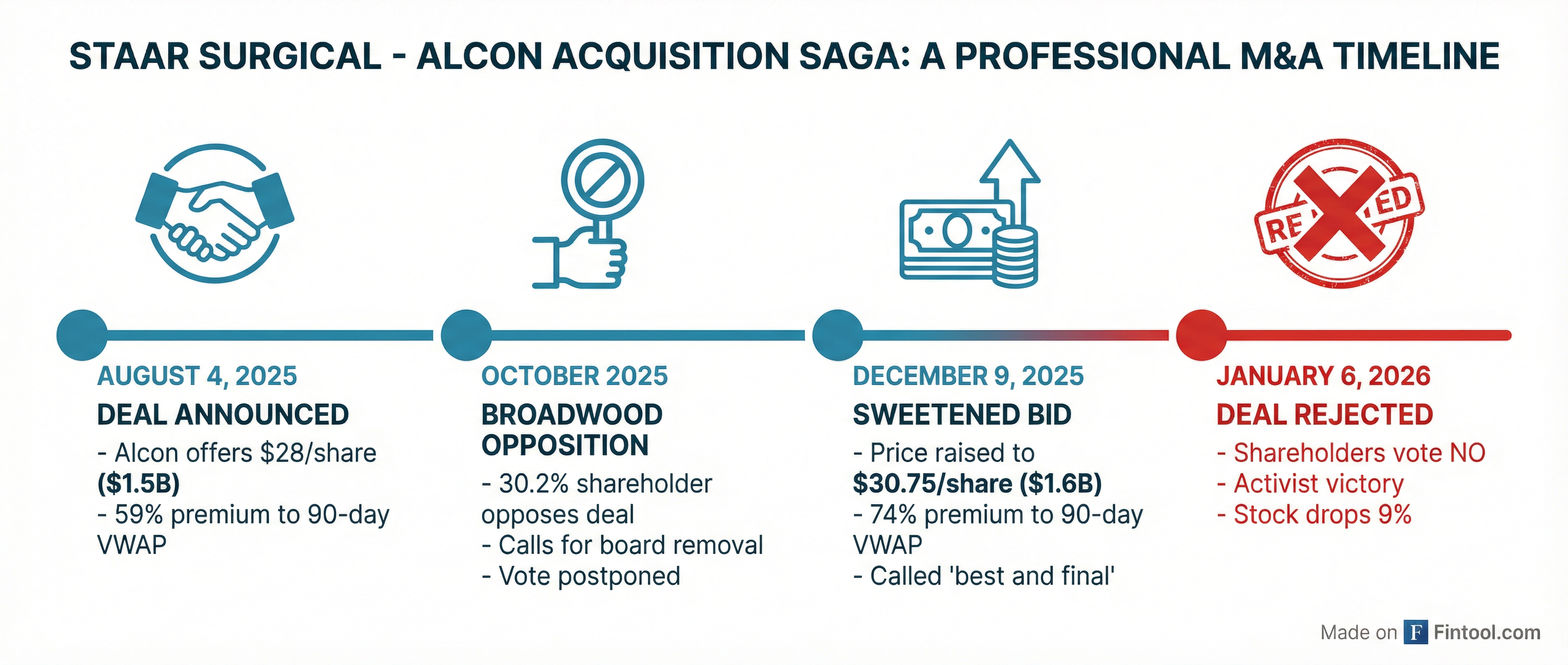
The deal's collapse caps a five-month proxy battle that saw Alcon raise its bid twice and STAAR postpone the shareholder vote four times. When Alcon first announced its $28-per-share offer on August 4, 2025, representing a 59% premium, the deal seemed straightforward.
But Broadwood Partners, a New York-based investment firm holding 30.2% of STAAR's outstanding shares, had other ideas. Led by founder and President Neal C. Bradsher, Broadwood launched an aggressive campaign arguing the deal massively undervalued STAAR's proprietary EVO Implantable Collamer Lens technology and its growth potential in the global refractive surgery market.
In December, facing mounting shareholder opposition, Alcon sweetened its offer to $30.75 per share—adding $150 million in equity value and pushing the premium to 74% over STAAR's 90-day VWAP. The company called it "best and final."
Shareholders weren't buying it.
 Ask Fintool AI Agent
Key Players in the Proxy Battle
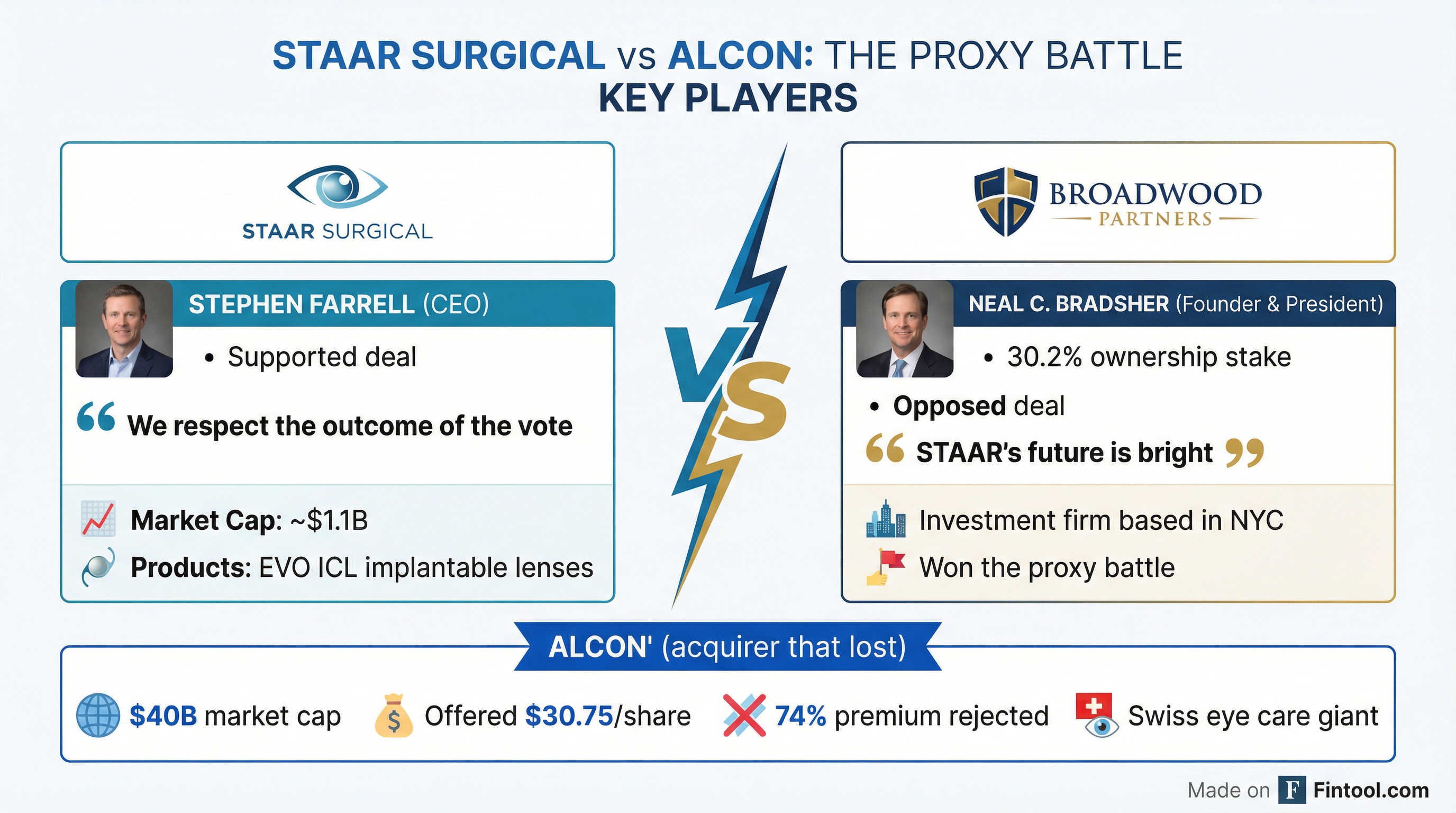
The battle lines were clearly drawn:
STAAR Management (Pro-Deal)
CEO Stephen Farrell and the board recommended the acquisition, arguing it provided "certain and immediate value" amid challenging market conditions—particularly in China, which had generated roughly half of STAAR's revenue before a dramatic collapse in sales.
"The Board approved the Alcon agreement because we determined that it was in the best interests of STAAR stockholders," Farrell said Tuesday. "We respect the outcome of the vote."
Broadwood Partners (Anti-Deal)
Bradsher's campaign was relentless. Broadwood not only opposed the merger but also called for the removal of three board directors, including Farrell himself. The activist argued STAAR's standalone prospects far exceeded what Alcon was willing to pay.
"STAAR's future is bright," Bradsher said following the vote. "As STAAR's largest shareholder, we are confident in the Company's standalone prospects and committed to helping STAAR realize its abundant potential."
Notably, even ISS, the influential proxy advisory firm, had recommended shareholders vote FOR the deal—making Broadwood's victory all the more remarkable.
The China Problem
Understanding the deal rejection requires understanding STAAR's China crisis—and how both sides framed it.
STAAR's revenue has been on a roller coaster. China accounted for approximately 51% of fiscal 2024 consolidated net sales, but macroeconomic headwinds and weak consumer spending crushed the business.
| Metric | Q4 2023 | Q1 2024 | Q2 2024 | Q3 2024 | Q4 2024 | Q1 2025 | Q2 2025 | Q3 2025 |
|---|---|---|---|---|---|---|---|---|
| Revenue ($M) | $76.3 | $77.4 | $99.0 | $88.6 | $49.0 | $42.6 | $44.3 | $94.7 |
| Net Income ($M) | $7.8 | $(3.3) | $7.4 | $10.0 | $(34.2) | $(54.2) | $(16.8) | $8.9 |
| Gross Margin (%) | 79.6% | 78.9% | 79.2% | 77.3% | 64.7% | 65.8% | 74.0% | 82.2% |
The numbers tell a stark story. Q1 2025 China sales collapsed to just $389,000—down from $38.5 million in the year-ago quarter—as distributors consumed existing inventory rather than placing new orders.
STAAR management used this crisis to justify the Alcon deal, warning of "volume-based procurement" risks in China that could devastate pricing and the ongoing challenges of operating as a single-product company with limited diversification.
Broadwood countered that the China weakness was transitory, pointing to improving procedure volumes and the resumption of more normalized sales in Q3 2025. The Q3 results showed $94.7 million in revenue—including a $25.9 million catch-up payment from a Chinese distributor—suggesting the business was stabilizing.
Ask Fintool AI AgentWhat Happens Now
With no termination fee payable by either party, STAAR exits the deal with its balance sheet intact—approximately $176 million in cash as of Q3 2025.
But the company faces significant challenges as a standalone entity:
Near-Term Headwinds
- Continued uncertainty in China amid tariff tensions and potential volume-based procurement
- Single-product dependency on EVO ICL technology
- Management credibility damaged after shareholders rejected the board's recommendation
Potential Catalysts
- Board reconstitution as Broadwood pushes for change
- Possible new strategic alternatives if fundamentals improve
- China recovery trajectory could justify higher standalone valuations
BTIG analyst Ryan Zimmerman struck a cautious tone: "Part of how STAAR emerges from this period depends on what existing or new management will want to do with the company. Shares are unlikely to see much, if any bid, as investors have limited reason to want to own STAAR until clarity on the company emerges."
Alcon, for its part, appears likely to move on. The Swiss company, with a market cap of $40 billion, has plenty of other growth avenues in its existing portfolio without needing to chase a reluctant target.
The Bigger Picture
The STAAR-Alcon saga offers lessons for both acquirers and activists:
For Acquirers: Even premium offers can fail when large shareholders have different views on intrinsic value. Alcon's mistake may have been announcing a deal without first securing support from Broadwood, whose 30% stake made it effectively a blocking position.
For Activists: Conviction matters. Broadwood held firm through four vote postponements, a sweetened bid, and ISS's recommendation to approve the deal. Their victory validates concentrated ownership as a lever for shareholder value—even when management and proxy advisors disagree.
For Shareholders: The market's initial reaction—STAA down 9% while Broadwood calls it a "bright future"—suggests investors aren't uniformly convinced the standalone path will outperform the $30.75 offer. The next 12 months will prove who was right.
Ask Fintool AI AgentMarket data as of market close January 6, 2026. STAA closed at $21.82 (-8.9%), ALC closed at $81.77 (+1.4%).