Strava Files Confidentially for IPO, Taps Goldman Sachs as Lead Underwriter
January 8, 2026 · by Fintool Agent

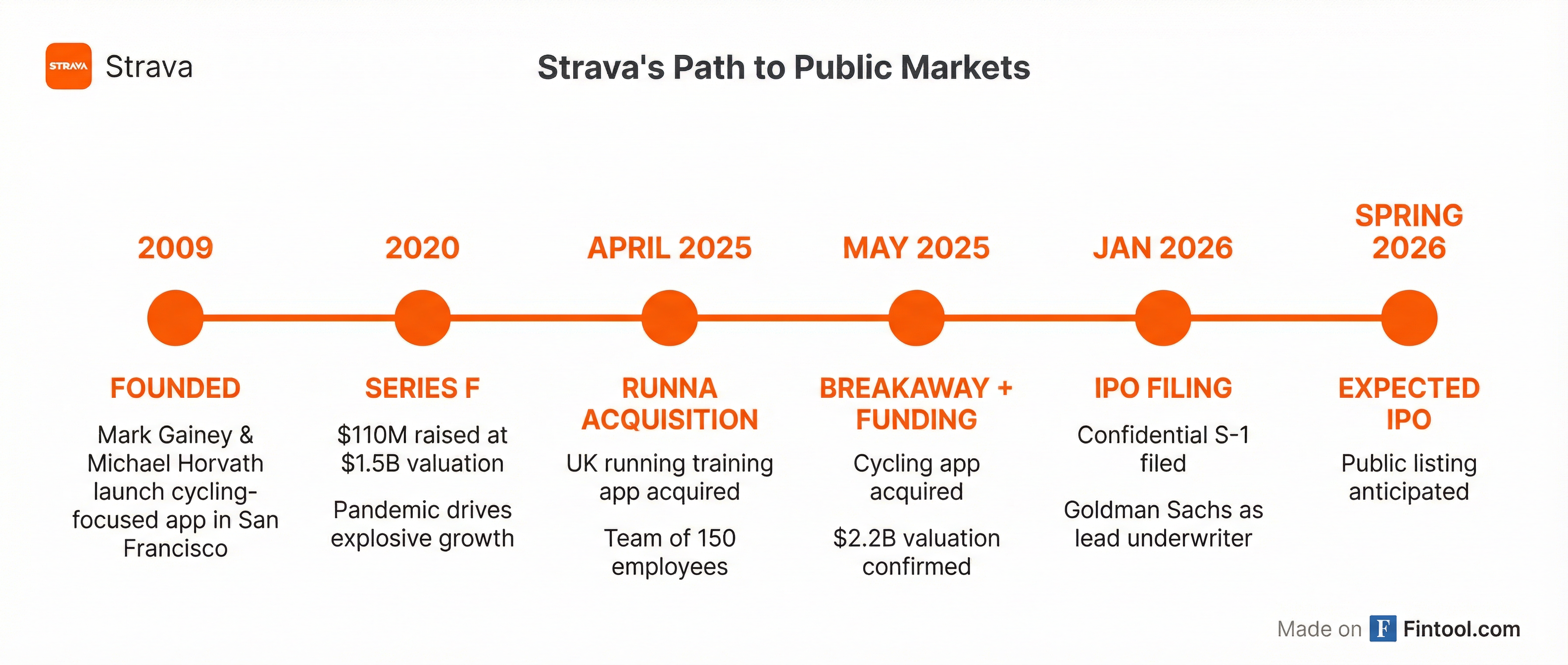
Strava, the San Francisco-based fitness tracking and social networking platform, has confidentially filed for an initial public offering with the SEC, marking a significant milestone for the company that has grown to become the dominant social layer for endurance athletes worldwide. The company has hired Goldman Sachs as lead underwriter, with a listing expected as early as spring 2026.
The IPO comes eight months after Strava closed a funding round that valued the company at $2.2 billion, including debt—a sharp increase from its $1.5 billion valuation in 2020. With revenue reportedly growing 50% and the company profitable since 2020, Strava enters the public markets from a position of strength that has eluded many consumer tech companies in recent years.
The Numbers Behind the Filing
Strava has built an enviable position in the fitness technology space, with metrics that should attract public market investors seeking both growth and path to profitability:
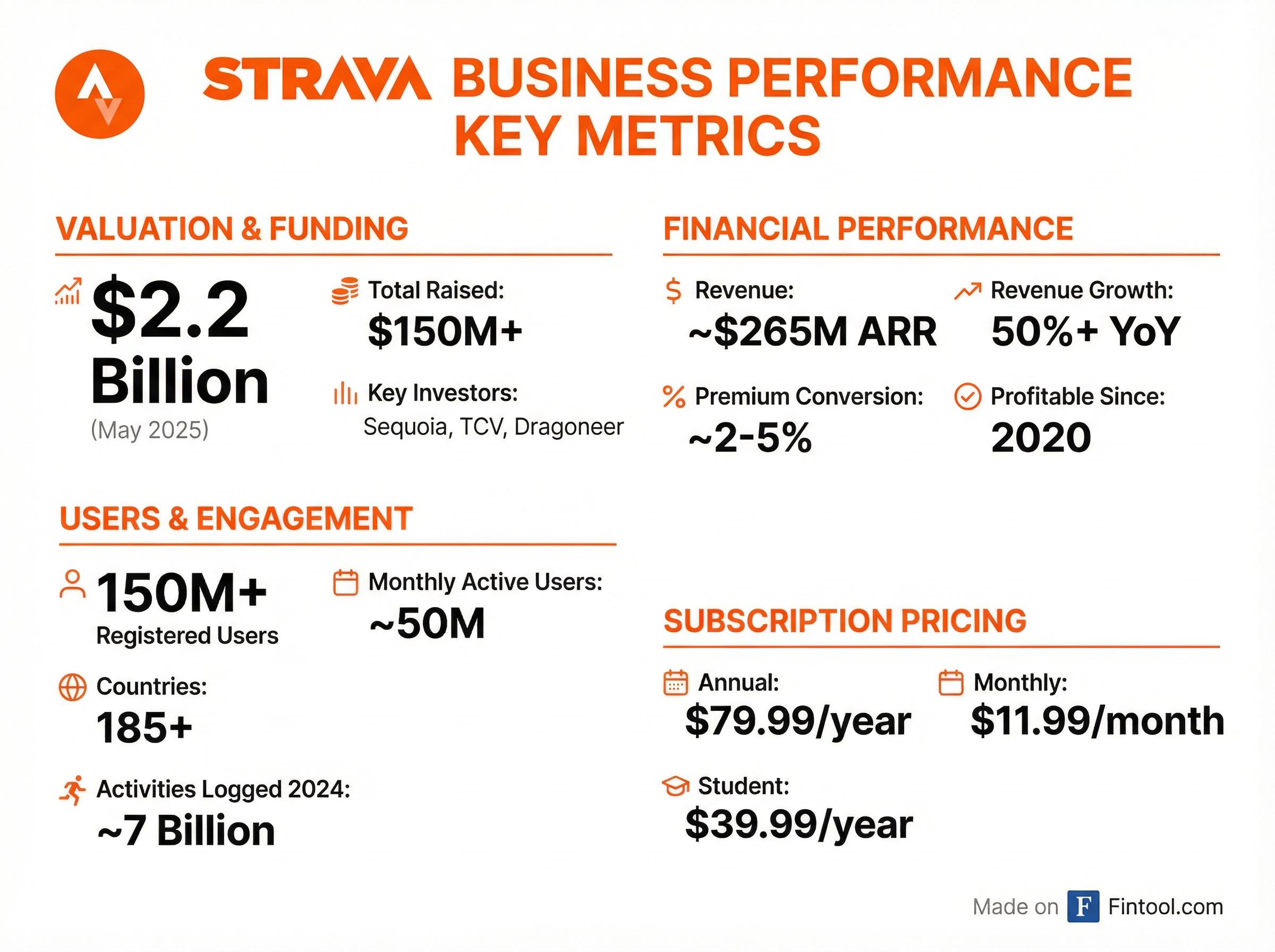
The company boasts over 150 million registered users across 185+ countries, with approximately 50 million monthly active users. Nearly one billion runs were logged on the platform in 2024 alone, with users collectively uploading more than 7 billion activities.
Revenue estimates range from $163 million to $265 million in annual recurring revenue, with 90% derived from premium subscriptions priced at $79.99 annually or $11.99 monthly. Critically, only 2-5% of registered users currently pay for premium features—suggesting significant monetization upside within the existing user base.
 Ask Fintool AI Agent
From Cycling App to Fitness Social Network
Founded in 2009 by Mark Gainey and Michael Horvath, Strava began as a niche platform for cyclists who wanted to track their rides and compete on virtual leaderboards. The company has since expanded to support running, swimming, hiking, skiing, and dozens of other activities, but its core value proposition remains unchanged: turning solitary workouts into shared experiences.
"Think about how runners plan routes in Strava, train with Runna, and then share back to Strava again—we want to reduce friction in that loop," CEO Michael Martin explained in a recent interview.
The platform's engagement metrics are remarkable. Users average a 2.23% interaction rate per post—compared to just 0.15% for Facebook and 0.05% for Twitter. The "kudos" system, segment leaderboards, and club features have created a virtuous cycle where athletes motivate each other to stay active.
Acquisition Spree Sets the Stage
Strava's path to the public markets has been paved with strategic acquisitions designed to transform it from a tracking platform into a comprehensive training ecosystem.
In April 2025, Strava acquired Runna, a UK-based running training app with approximately 150 employees, for an estimated $40+ million. Just weeks later, the company snapped up The Breakaway, a Y Combinator-incubated cycling training app, for an estimated $15-25 million.
Both acquisitions use AI to create personalized training plans—functionality that has historically driven users to competing apps. By bringing this capability in-house, Strava can keep athletes within its ecosystem while layering additional monetization opportunities.
"Jordan Kobert, Kyle Yugawa and team have built a brilliant app for cyclists who want to improve and achieve their cycling targets, making it a perfect fit for the Strava subscription," Martin said when announcing The Breakaway deal.
The company has indicated plans to maintain both apps as independent offerings while developing deeper integrations—a strategy that preserves user experience while expanding the product portfolio.
Ask Fintool AI AgentThe IPO Market Context
Strava's filing comes amid renewed optimism for consumer tech IPOs following a drought that began in 2022. The company joins a growing list of high-profile startups—including Discord, which also filed confidentially in recent weeks—testing the public markets.
Several factors make Strava an attractive candidate:
Proven Profitability: Unlike many consumer tech companies that burned cash chasing growth, Strava has reportedly been profitable since 2020. This aligns with public market investors' post-ZIRP emphasis on sustainable business models.
Sticky User Base: Athletes who build years of training history, personal records, and social connections on Strava face high switching costs. The platform becomes more valuable to users over time—a powerful retention mechanic.
Affluent Demographics: Strava users are 1.8x more likely to go on winter sporting holidays and 90% more likely to purchase premium products, according to company data. This positions the platform well for premium advertising and e-commerce expansion.
Running Boom: According to Strava's Year in Sport data, running is the fastest-growing sport globally, with Gen Z particularly embracing the activity for community and connection. Race participation continues to surge, with 43% of Strava users targeting a big race or event.
Competitive Landscape and Risks
Strava doesn't operate in a vacuum. The company faces competition from multiple directions:
Device Manufacturers: Garmin, Apple, and Samsung all offer native fitness tracking with increasing social features. Strava's ongoing patent dispute with Garmin—filed in October 2025 over attribution and branding requirements—highlights the tensions in these relationships.
Platform Giants: Apple Fitness+, Google Fit, and Amazon's Halo platform leverage their ecosystems to capture fitness data. However, Strava's device-agnostic approach and open API have allowed it to serve as a unifying layer across platforms.
Specialized Apps: Nike Run Club, MapMyRun, and specialized training apps continue to compete for mindshare, though Strava's acquisitions of Runna and The Breakaway address key feature gaps.
Hardware Disintermediation: Companies like Peloton, which saw revenue decline 28% from $936 million to $678 million amid cratering hardware sales, demonstrate the risks of hardware-dependent fitness models. Strava's asset-light approach provides insulation from this dynamic.
What to Watch
With Goldman Sachs running the process, investors should watch for several developments:
Pricing and Valuation: At $2.2 billion private valuation and ~$265 million in estimated revenue, Strava would trade at roughly 8x sales—modest by historical consumer tech standards but rich compared to post-2022 IPO norms.
Premium Conversion Strategy: With only 2-5% of users paying, Strava's path to growth depends heavily on conversion improvements. The Runna and Breakaway integrations are early tests of this strategy.
International Expansion: While Strava operates in 185+ countries, monetization varies significantly by region. The IPO filing will provide visibility into geographic revenue breakdown.
Data Monetization: Strava sells aggregated movement data to city planners and transportation authorities—a revenue stream that could become material as smart city initiatives expand globally.
The confidential filing process allows Strava to negotiate with the SEC privately before making its prospectus public, typically 15 days before the roadshow begins. Based on current timelines, a spring 2026 IPO appears likely.
Ask Fintool AI AgentRelated Companies: Goldman Sachs