StubHub's IPO Unravels: 143% Cash Flow Collapse Triggers Securities Lawsuit
December 25, 2025 · by Fintool Agent

Stubhub Holdings-2.27% is facing a securities class action lawsuit less than three months after its September IPO, after the company disclosed a 143% collapse in free cash flow that sent shares tumbling 56% below the $23.50 offering price. The lawsuit alleges the ticketing giant's registration statement failed to disclose "known trends" in vendor payments that were already adversely impacting liquidity when the company went public.
The Numbers Tell the Story
StubHub's first quarterly report as a public company revealed a liquidity picture that bore little resemblance to the one presented to IPO investors. The company disclosed free cash flow of negative $4.6 million for Q3 2025, compared to positive $10.6 million in the same quarter a year earlier—a stunning 143% decline.
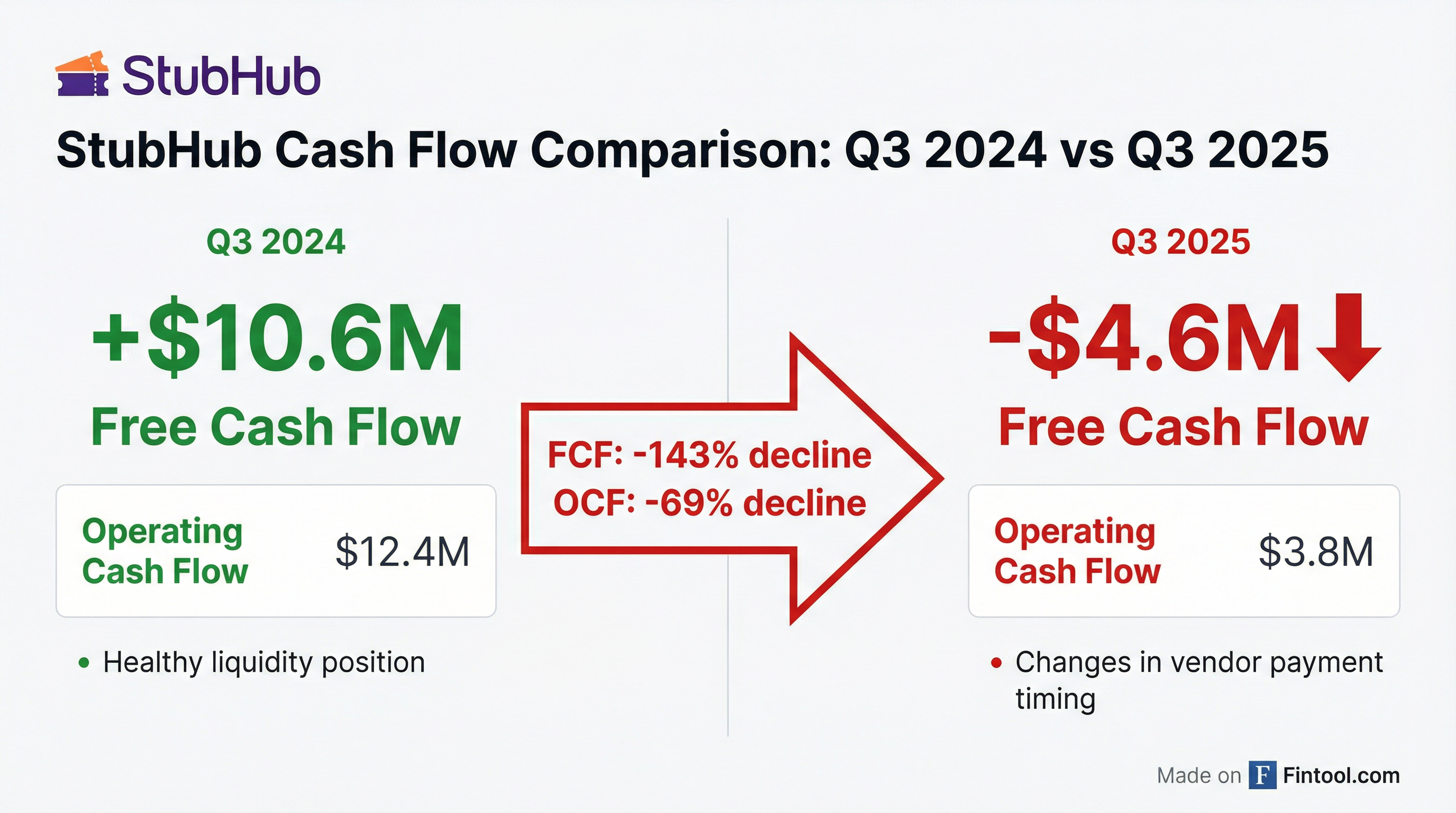
Net cash provided by operating activities fell to just $3.8 million, down 69% from $12.4 million in Q3 2024. The company attributed both declines to "changes in the timing of payments to vendors"—the same factor now at the heart of the class action.
| Metric | Q3 2024 | Q3 2025 | Change |
|---|---|---|---|
| Free Cash Flow | $10.6M | ($4.6M) | -143% |
| Operating Cash Flow | $12.4M | $3.8M | -69% |
| TTM Free Cash Flow | $501.5M | $5.6M | -99% |
 Ask Fintool AI Agent
IPO to Lawsuit in 68 Days
The speed of StubHub's post-IPO unraveling has been remarkable. The company priced its offering at $23.50 per share on September 17, 2025, raising approximately $758 million in net proceeds. Shares opened at $25.35 on the first day of trading but closed at $22.00—already below the IPO price.
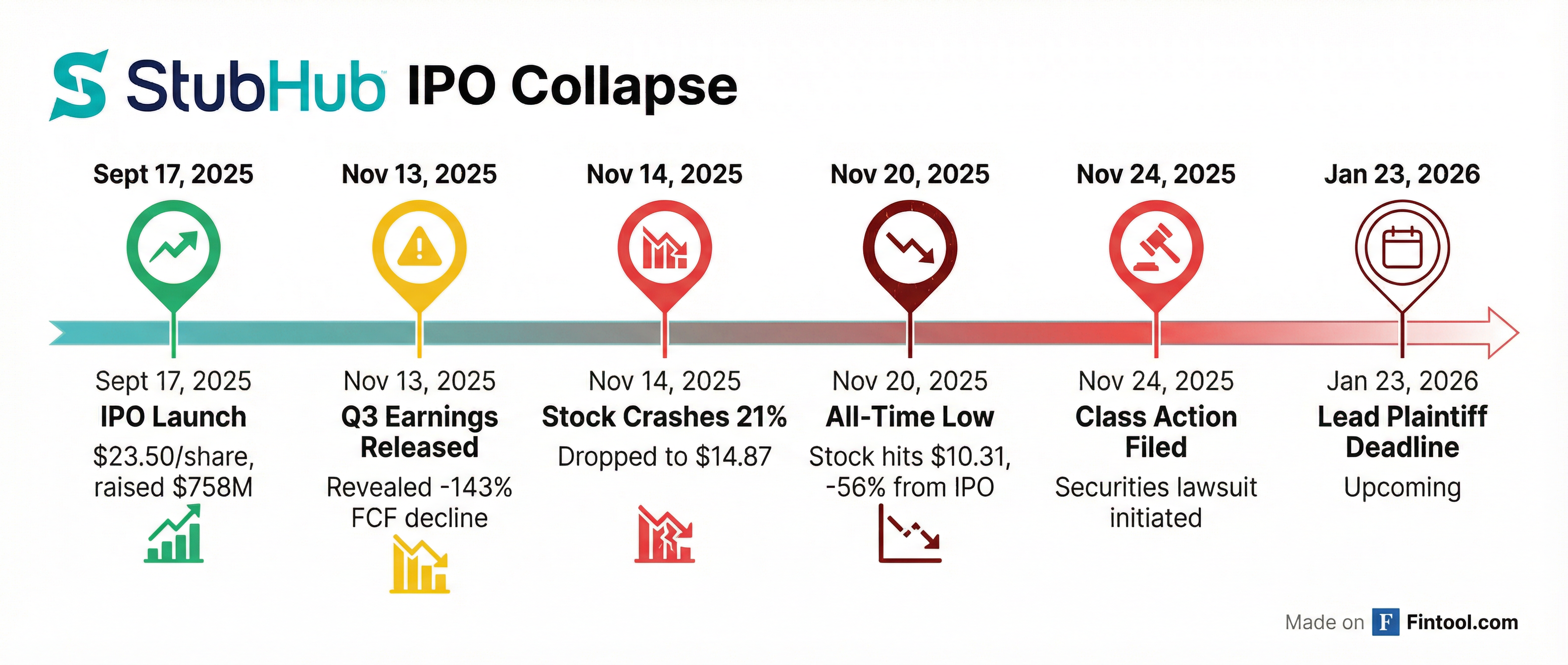
The real damage came on November 14, the day after StubHub released its Q3 results. Shares plunged nearly 21% to close at $14.87—more than 36% below the IPO price. By November 20, the stock had cratered to $10.31, erasing 56% of IPO value in just two months.
The class action lawsuit, Daniel Salabaj v. StubHub Holdings, Inc. et al., was filed on November 24, 2025 in the U.S. District Court for the Southern District of New York (Case No. 1:25-cv-09776).
Ask Fintool AI AgentThe Legal Case: What Was Hidden?
The lawsuit centers on a fundamental disconnect between StubHub's IPO materials and the reality revealed just weeks later. Plaintiffs allege the Registration Statement was "materially false and/or misleading" because it failed to disclose:
- StubHub was experiencing significant changes in the timing of payments to vendors
- Those changes were having a substantial adverse impact on free cash flow
- As a result, the company's free cash flow metrics presented to IPO investors were misleading
The complaint points to StubHub's own post-IPO disclosure as the corrective revelation. The Q3 2025 Form 10-Q explicitly stated: "During the three months ended September 30, 2025, the decrease in free cash flow, compared to the same periods in the prior year, primarily reflects changes in the timing of payments to vendors."
This language mirrors exactly what plaintiffs say should have been disclosed in the IPO prospectus—but wasn't.
"We're focused on whether StubHub's IPO materials may have misled investors about known trends in its business that, when disclosed in November, wiped out over $1 billion of market capitalization," said Reed Kathrein of Hagens Berman.
A Wall of Law Firms
The number of plaintiff's firms pursuing the case underscores the perceived strength of the legal claims. At least ten major securities litigation firms have announced investigations or filed suit, including:
- Robbins Geller Rudman & Dowd LLP
- Hagens Berman Sobol Shapiro LLP
- Kessler Topaz Meltzer & Check LLP
- Berger Montague PC
- DiCello Levitt LLP
- Glancy Prongay & Murray LLP
The lead plaintiff deadline is January 23, 2026. Investors who purchased StubHub shares through the IPO may seek appointment as lead plaintiff to direct the litigation on behalf of the class.
Ask Fintool AI AgentStubHub's Defense: Context Matters
To be fair, StubHub's Q3 results weren't uniformly negative. The company reported strong operational performance:
- Gross Merchandise Sales of $2.4 billion, up 11% year-over-year
- Revenue of $468 million, up 8% year-over-year
- Adjusted EBITDA of $67 million, up 21% year-over-year
- Successfully used IPO proceeds to repay $750 million in debt
CEO Eric Baker emphasized the company's strategic progress in the earnings release: "Our debut quarter as a public company underscores the strength and resilience of our global marketplace. We delivered double-digit GMS growth, expanded market share, and significantly strengthened our balance sheet."
The company also secured a multi-year partnership with Major League Baseball to distribute primary ticket inventory through its Direct Issuance technology.
StubHub has characterized the free cash flow decline as a timing issue rather than a fundamental business problem. The 10-Q notes that "seasonal trends in our GMS and the timing of major events throughout the year impact free cash flow for any given quarter and can vary year to year."
Ask Fintool AI AgentThe Vendor Payment Mystery
The core question for both investors and the courts: Why did vendor payment timing change so dramatically, and should StubHub have disclosed this before going public?
StubHub's business model involves collecting payment from ticket buyers at the time of transaction, then remitting payment to sellers at a later date. The company had $769.6 million in payments due to sellers as of September 30, 2025.
The lawsuit alleges that changes in when StubHub was paying its vendors—information the company had during the IPO process—materially impacted the cash flow metrics investors relied on. The nine-month free cash flow comparison is equally stark: $156.2 million in 2025 versus $405.7 million in 2024—a 61% decline.
The timing is critical. StubHub's IPO priced on September 17, 2025—just two weeks before the end of Q3. The company would have had visibility into how the quarter was tracking when it finalized its offering documents.
What to Watch
January 23, 2026: Lead plaintiff deadline. The investor or group appointed as lead plaintiff will shape litigation strategy and any potential settlement.
Q4 2025 Earnings: StubHub's next quarterly report will be crucial. Investors will scrutinize whether vendor payment timing issues persist or were truly temporary.
Settlement Prospects: Securities class actions frequently settle rather than go to trial. The speed and magnitude of StubHub's post-IPO decline—combined with the company's own attribution of the cash flow drop to a specific, identifiable factor—could strengthen plaintiffs' negotiating position.
Regulatory Scrutiny: The SEC has historically taken interest in IPO disclosure cases where companies allegedly omit known adverse trends from offering documents.
Ask Fintool AI AgentThe Bigger Picture
StubHub's travails highlight the risks of the current IPO market, where companies and their underwriters face pressure to present optimistic narratives to justify valuations. The company raised $758 million from investors who, according to the lawsuit, weren't given the full picture on liquidity trends.
For the secondary ticketing industry, the case is a reminder that marketplace businesses with significant timing mismatches between cash receipts and vendor payments require careful disclosure of working capital dynamics.
StubHub shares closed at $13.58 on December 24, 2025—still 42% below the IPO price. The company's market capitalization stands at approximately $4.76 billion, down from over $8 billion implied at the IPO price.
Whether investors can recover their losses will ultimately depend on what StubHub knew about vendor payment changes when it went public—and whether reasonable investors would have wanted to know.