Factor Bioscience Takes Control of Tempest Therapeutics, Installs CEO Matt Angel After 74% Stock Collapse
February 6, 2026 · by Fintool Agent

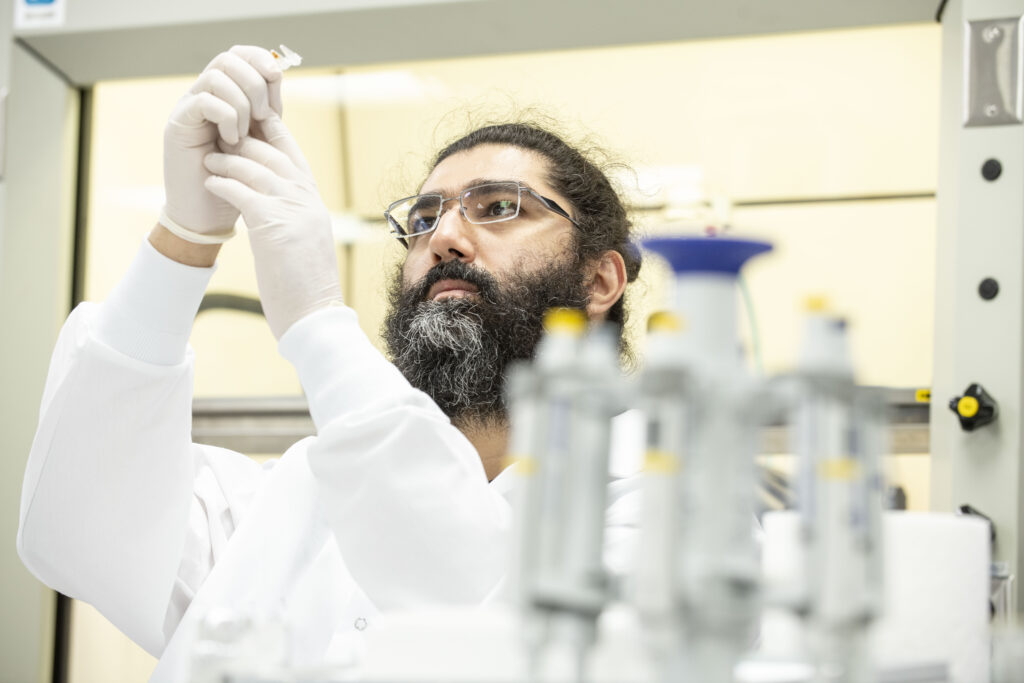
Tempest Therapeutics has completed a change-of-control transaction that hands majority ownership to Factor Bioscience and installs the latter's CEO at the helm—a deal that has vaporized nearly three-quarters of shareholder value since its announcement.
Matt Angel, Ph.D., Factor Bioscience's co-founder and CEO since 2011, officially became Tempest's President and Chief Executive Officer on February 3, 2026, replacing Stephen Brady, who now serves as Chairman of the Board. The transition caps a months-long saga of layoffs, failed fundraising, and strategic desperation at the Brisbane, California-based cancer biotech.
A Desperation Deal Dressed as Opportunity
The numbers tell the story of a company with no alternatives.
| Metric | Pre-Deal (Nov 2025) | Post-Deal (Feb 2026) | Change |
|---|---|---|---|
| Share Price | $9.24 | $2.40 | -74% |
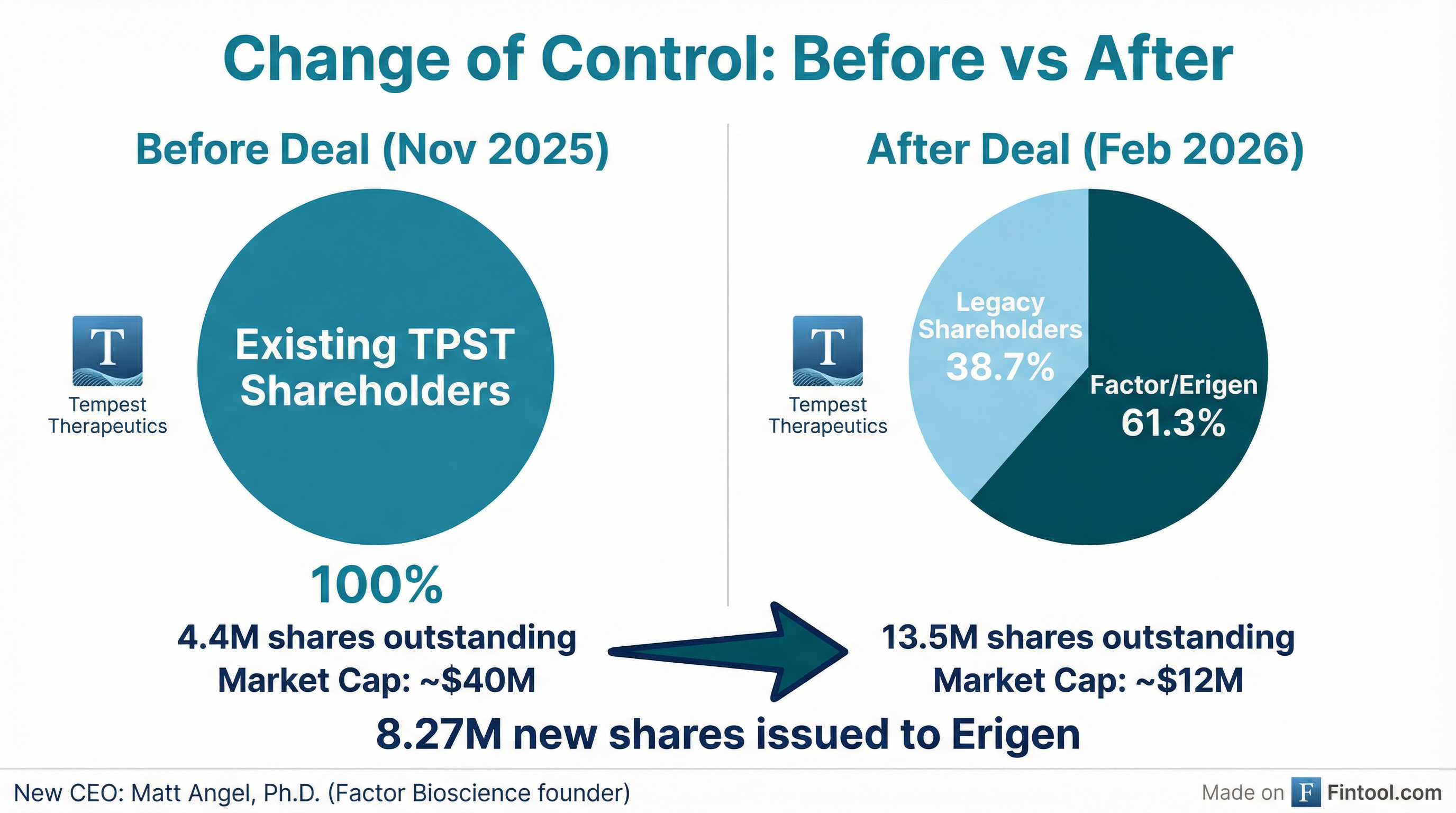
| Shares Outstanding | 4.4M | 13.5M | +207% |
| Market Cap | $41M | $12M | -71% |
| Cash Position | $7.5M | Extended to mid-2027* | — |
| Full-Time Employees | 5 | 5 | — |
*Per company statements; includes Factor investment commitment
Factor Bioscience, through its affiliate Erigen LLC, now owns 61.3% of Tempest's outstanding shares after the company issued 8,268,495 new shares as acquisition consideration. Legacy Tempest shareholders—who saw their stock drop 49% the day the deal was announced—now control just 38.7% of a company that bears little resemblance to what they originally invested in.
 Ask Fintool AI Agent
The Path to Surrender
The February 3 closing date marked the end of a painful journey that began nearly a year ago.
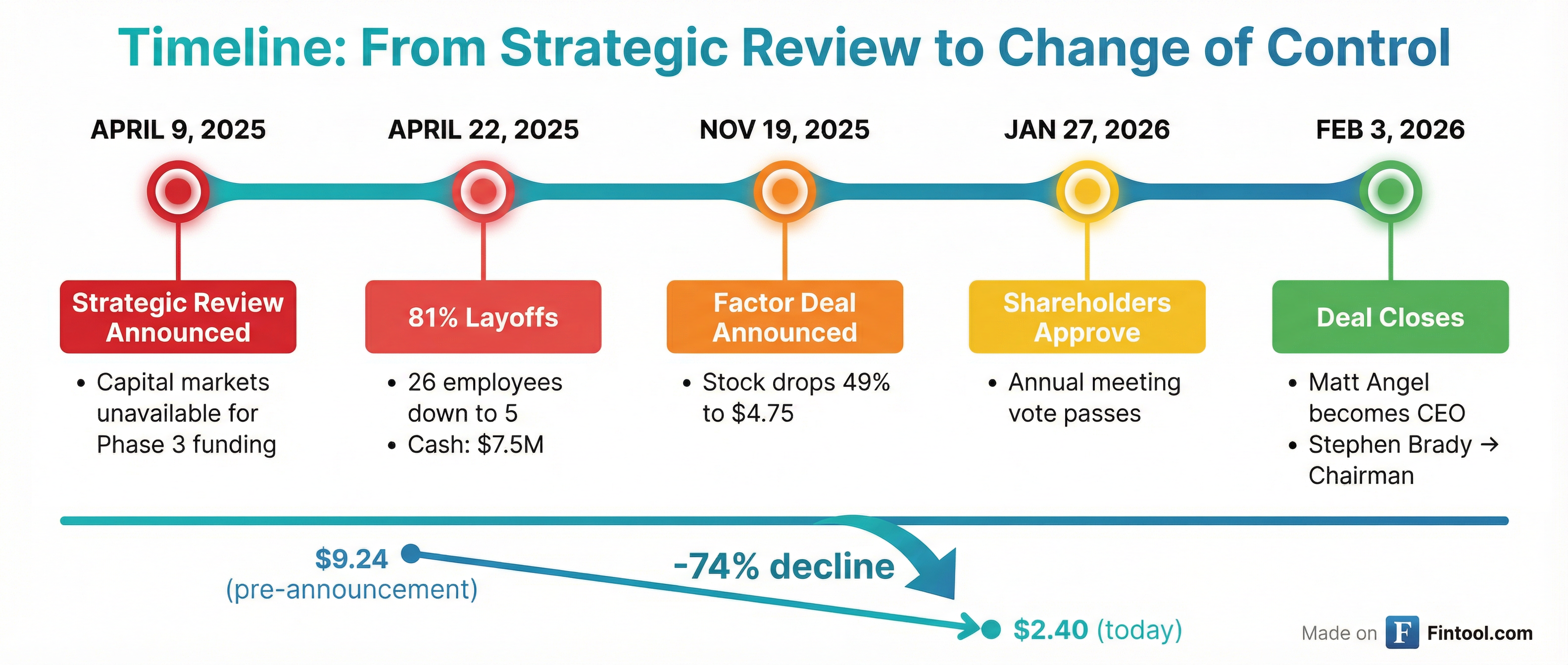
April 9, 2025: CEO Stephen Brady announced Tempest would explore "a full range of strategic alternatives" after capital markets proved "unavailable" to fund a Phase 3 trial of its lead candidate amezalpat, despite positive Phase 2 data showing a 35% improvement in overall survival for liver cancer patients.
April 22, 2025: Days later, Tempest laid off 21 of its 26 employees—an 81% workforce reduction. The company ended Q3 2025 with just $7.5 million in cash, down from $30.3 million at year-end 2024.
November 19, 2025: The Factor deal announcement sent shares plunging 49% in a single session, from $9.24 to $4.75, on volume of nearly 1 million shares—roughly 40x the average.
January 27, 2026: Shareholders approved the deal at the company's annual meeting.
February 3, 2026: The transaction closed. Geoff Nichol resigned from the board, and Michael Raab stepped down as Chairman (with Brady succeeding him).
Who Is Matt Angel?
The new CEO brings a mixed track record to Tempest. Angel, 45, founded Factor Bioscience in 2011 after earning his Ph.D. from MIT, where he pioneered early mRNA technology research. He holds more than 150 patents covering mRNA, gene editing, and cell reprogramming—credentials that position him well for Tempest's new CAR-T focus.
But his public company experience raises questions.
From May 2022 through December 2023, Angel served as CEO of Brooklyn Immunotherapeutics (Nasdaq: BTX), a company that later rebranded to Eterna Therapeutics. Tempest's press materials describe his tenure there as "successfully restructuring the company and extending the company's runway in a challenging market environment."
Factor's other exits paint a rosier picture: Novellus Therapeutics (founded 2014, sold to Brooklyn in 2021) and Exacis Biotherapeutics (founded 2020, sold 2023) both reached successful outcomes.
Matt Angel's Compensation at Tempest:
- Annual base salary: $650,000
- Target bonus: 50% of base ($325,000)
- Stock options: 269,621 shares vesting over four years
Ask Fintool AI AgentWhat Tempest Gets—and What It Loses
The transaction brings Tempest a portfolio of CAR-T cell therapy assets from Factor:
| Program | Target | Stage | Key Milestone |
|---|---|---|---|
| TPST-2003 | CD19/BCMA dual | Clinical (Phase 1 complete) | BLA filing in China planned for 2027 |
| TPST-2206 | CD70/CD70 dual | Preclinical | For renal cell carcinoma |
| TPST-3003 | CD19/BCMA dual (allogeneic) | Research | Gene-edited T cells |
| TPST-3206 | CD70/CD70 dual (allogeneic) | Research | Gene-edited T cells |
The lead asset TPST-2003 is a dual-targeting CAR-T designed for patients with extramedullary disease, an aggressive form of multiple myeloma. Phase 1 data is expected in 2026, with a potential U.S. registrational study starting in 2027.
But what about amezalpat?
Tempest's original lead candidate—a Phase 3-ready PPAR-alpha antagonist for liver cancer that showed positive Phase 2 results—remains in the portfolio but orphaned. The company says it will "continue to search for a partner or additional financing" for the program. Translation: the drug that investors bought TPST for is now a secondary priority to assets developed by the new controlling shareholders.
The Warrant Kicker
As a consolation prize, legacy shareholders received warrants to purchase additional shares at $18.48—roughly 8x the current stock price of $2.40. The company issued 6,784,989 warrants on February 3, 2026, expiring February 3, 2031.
For the warrants to have any value, TPST shares would need to appreciate 670% from current levels. Given the stock is trading near its 52-week low of $2.17, that outcome would require extraordinary clinical success.
What to Watch
Near-term catalysts:
- TPST-2003 Phase 1 data readout (2026)
- TPST-1495 Phase 2 enrollment for familial adenomatous polyposis (Q1 2026, NCI-funded)
- Any amezalpat partnership announcements
Key risks:
- Cash runway depends on Factor's investment commitment; details remain limited
- New CAR-T programs are early-stage with uncertain commercial prospects
- Legacy shareholders are now minority owners of a fundamentally different company
- Management's track record at prior public companies warrants scrutiny
The biotech funding drought that pushed Tempest into Factor's arms shows no signs of easing. For shareholders who held through the 74% decline, the question is whether Matt Angel can do more with this shell than he did at Brooklyn—and whether a $12 million market cap company can ever become the "lean cell therapy company" that Tempest's new owners envision.
Ask Fintool AI AgentRelated: