Tether Storms the U.S. Market With Federally Regulated USAT Stablecoin
January 27, 2026 · by Fintool Agent

The world's largest stablecoin company just fired a shot across the bow of America's digital dollar market. Tether, the $186 billion colossus that has dominated global crypto trading for a decade, announced Tuesday the launch of USAT—a federally regulated stablecoin designed specifically to compete in the United States.
It's a striking pivot for a company that has historically thrived outside the U.S. regulatory perimeter, operating offshore and accumulating both profits and controversy in equal measure. Now, armed with a federally chartered bank partnership and a former White House official at the helm, Tether is betting it can win in America's backyard.
"USAT offers institutions an additional option: a dollar-backed token made in America," said Paolo Ardoino, CEO of Tether. "USDT has proven for more than a decade that digital dollars can deliver trust, transparency, and utility at a global scale. USAT extends that mission by providing a federally regulated product designed for the American market."
The Architecture of American Ambition
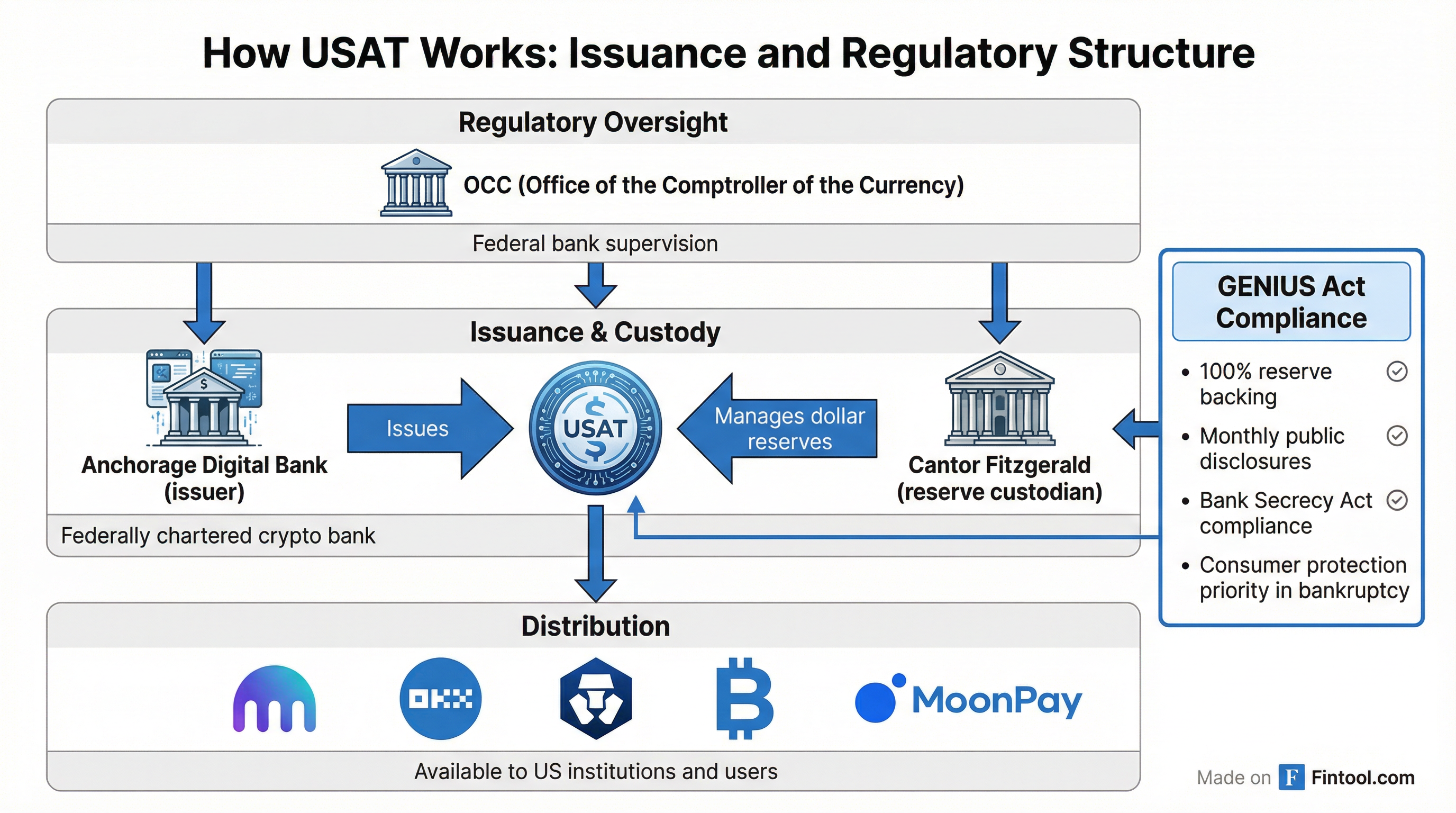
USAT is built to check every regulatory box. The token is issued by Anchorage Digital Bank, N.A.—America's first federally chartered crypto-native bank and the only digital asset institution with five years of continuous oversight from the Office of the Comptroller of the Currency.
The structure is deliberately institutional-grade:
| Component | Details |
|---|---|
| Issuer | Anchorage Digital Bank, N.A. (federally chartered) |
| Regulator | Office of the Comptroller of the Currency (OCC) |
| Reserve Custodian | Cantor Fitzgerald LP |
| Reserve Backing | 100% U.S. dollars and short-term Treasuries |
| Framework | GENIUS Act compliant |
| Initial Exchanges | Kraken, OKX, Bybit, Crypto.com, MoonPay |
"Stablecoins are fast becoming critical financial infrastructure, and infrastructure needs a trusted foundation," said Nathan McCauley, CEO of Anchorage Digital. "For five years, we've operated as a federally regulated bank, purpose-built for digital assets. USAT reflects what's possible when stablecoin issuance is done inside the U.S. banking system, under real supervision, with real accountability, at real scale."
 Ask Fintool AI Agent
The GENIUS Act Catalyst
The launch would have been impossible 18 months ago. The GENIUS Act, signed by President Trump in July 2025, created the first federal regulatory framework for payment stablecoins—legitimizing an industry that had operated in regulatory limbo for years.
Key provisions that enabled USAT:
- 100% reserve backing with liquid assets like U.S. dollars or short-term Treasuries
- Monthly public disclosures of reserve composition
- Bank Secrecy Act compliance for anti-money laundering
- Consumer protection in bankruptcy, with stablecoin holders prioritized over other creditors
- Federal or state licensing for all issuers, with OCC oversight for federally chartered entities
For Tether, the law presented both threat and opportunity. USDT, issued offshore, faced potential restrictions from U.S.-regulated exchanges, banks, and payment providers. USAT offers an elegant solution: a separate, compliant product for America while USDT continues its global dominance.
Circle's Monopoly Under Siege
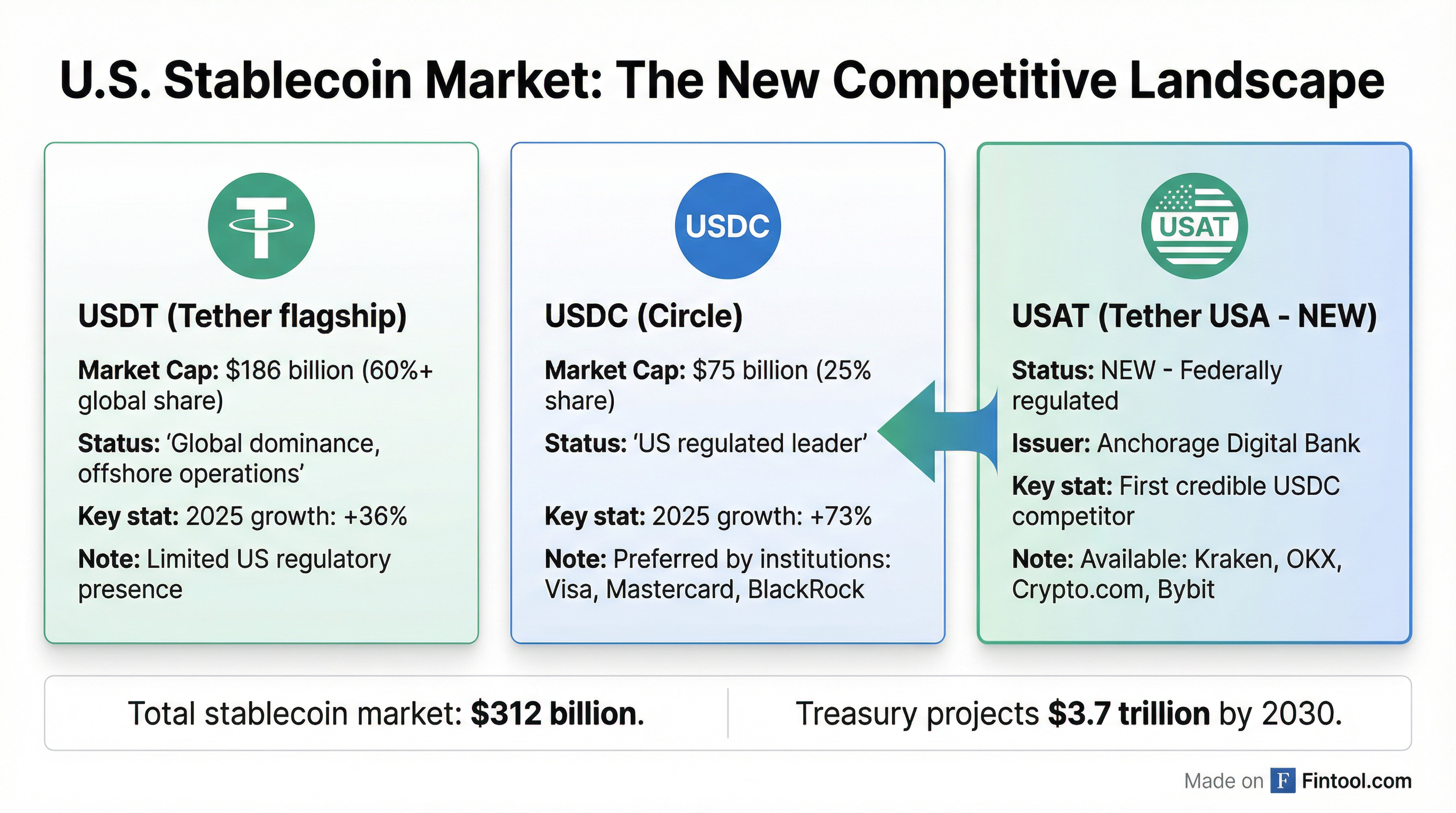
Until today, Circle had no credible domestic competitor. The company went public in June 2025 and has positioned USDC as the go-to stablecoin for regulated institutions. Its customer list reads like a who's who of traditional finance: Visa, Mastercard, BlackRock.
| Metric | USDT (Global) | USDC (Circle) | USAT (New) |
|---|---|---|---|
| Market Cap | $186 billion | $75 billion | Launch Day |
| 2025 Growth | +36% | +73% | — |
| Global Share | 60%+ | 25% | — |
| U.S. Regulatory Status | Offshore | Fully Compliant | Federally Chartered |
| Institutional Partners | Global exchanges | Visa, Mastercard, BlackRock | Cantor Fitzgerald |
"I believe USAT is a threat to USDC, even though the DNA of Tether and Circle is very different," said Noelle Acheson, author of the Crypto Is Macro Now newsletter. "USAT is designed to be institutional-grade, looking to attract clients that would otherwise be happy using USDC."
Acheson pointed to several potential USAT advantages: backing from Anchorage, partnerships with Cantor Fitzgerald (which already manages USDT's reserves), and the potential ability to tap into Tether's global network through USDT conversion.
Circle shares (CRCL) have already declined more than 70% from their 52-week high, trading around $71 as of late January. The company faces questions about margin sustainability—it pays Coinbase roughly half of USDC revenue in a distribution deal—while Tether prints $15 billion in annual profit.
Ask Fintool AI AgentThe Trump Connection
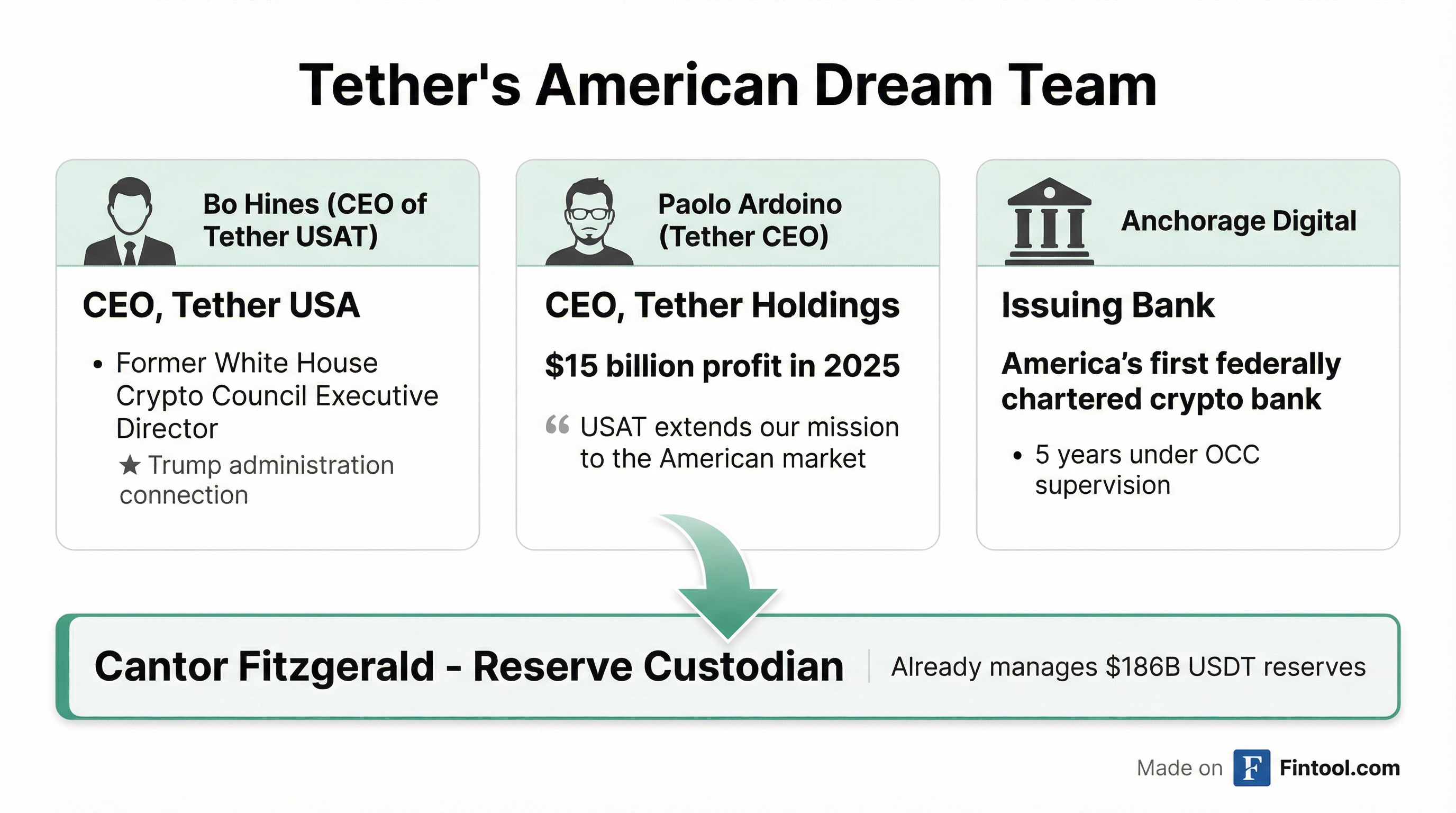
Tether has assembled a team with deep ties to the current administration. Leading USAT operations is Bo Hines, the former Executive Director of the White House Crypto Council under President Trump. Hines previously served as Trump's top crypto policy official before joining Tether.
"With the launch of USAT, we see a digital dollar that is designed to meet federal regulatory expectations," said Hines. "Our focus is stability, transparency, and responsible governance, ensuring that the United States continues to lead in dollar innovation."
The Cantor Fitzgerald relationship adds another layer of establishment credibility. The firm, whose CEO Howard Lutnick now serves as Commerce Secretary, already manages Tether's massive USDT reserves and will serve as USAT's reserve custodian and preferred primary dealer.
These connections may help overcome institutional reluctance about Tether's past regulatory troubles, including a 2021 settlement with the New York Attorney General and a reported DOJ investigation in 2024.
The $3.7 Trillion Prize
Treasury Secretary Scott Bessent has repeatedly stated that the stablecoin market could grow to $3.7 trillion by the end of the decade—more than 10x current levels.
Tether is positioning to capture that growth on both fronts: USDT for global dominance, USAT for American institutions. The company is already the 17th-largest holder of U.S. Treasuries globally—ahead of sovereign holders including Germany, South Korea, and Australia.
"The launch of USAT shows that demand for regulated dollar tokens among banks and fintechs is real," said Nicholas Roberts-Huntley, CEO of Blueprint Finance. "It also shows that the stablecoin market is shifting from size and utility to differential regulatory positioning and institutional trust."
What to Watch
Near-term catalysts:
- Institutional adoption announcements for USAT
- Circle's Q4 2025 earnings and competitive response
- Additional exchange listings and DeFi integrations
Key questions:
- Can USAT gain traction against USDC's entrenched institutional relationships?
- Will Tether's regulatory history create hesitation among conservative institutions?
- How will Circle respond—through pricing, partnerships, or product innovation?
One thing is clear: the era of stablecoins operating in regulatory gray zones is ending. Tether—the company that built a $186 billion empire outside the U.S. system—is now betting its future on playing inside the rules.
Ask Fintool AI Agent