Tidewater Pays $500M for Wilson Sons to Become Brazil's Offshore Vessel King
February 23, 2026 · by Fintool Agent

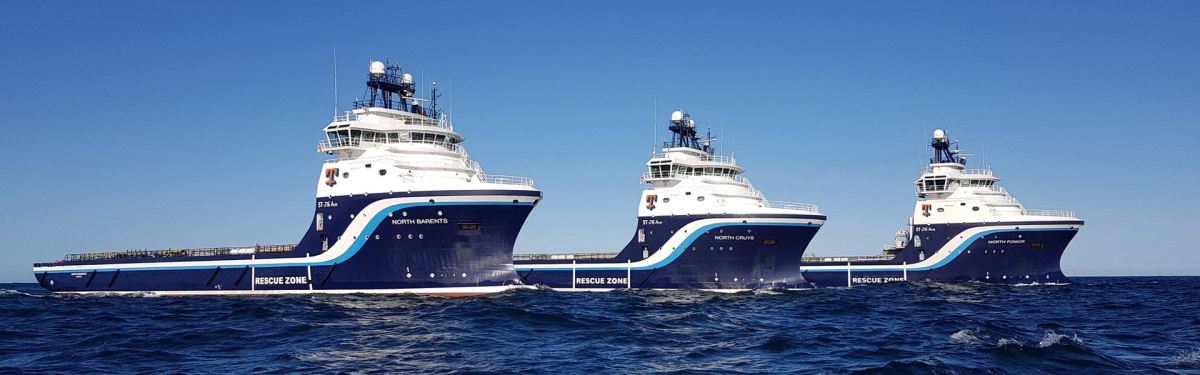
Tidewater (TDW) is betting big on Brazil. The world's largest offshore support vessel operator announced a $500 million all-cash acquisition of Wilson Sons Ultratug Offshore, instantly quintupling its presence in the planet's largest offshore supply vessel market and sending shares surging 9% to a 52-week high.
The deal adds 22 platform supply vessels to Tidewater's fleet—19 of which are Brazilian-built—unlocking preferential treatment in Petrobras tenders and the ability to import additional international vessels under Brazil's protective regulatory framework.
"Brazil stands out as perhaps the most attractive to Tidewater," CEO Quintin Kneen told analysts on a Monday morning call. "The scale of the offshore industry in Brazil, and in particular the offshore vessel industry, is one of the best in the world."
 Ask Fintool AI Agent
Deal Structure: Low-Cost Financing Sweetens the Acquisition
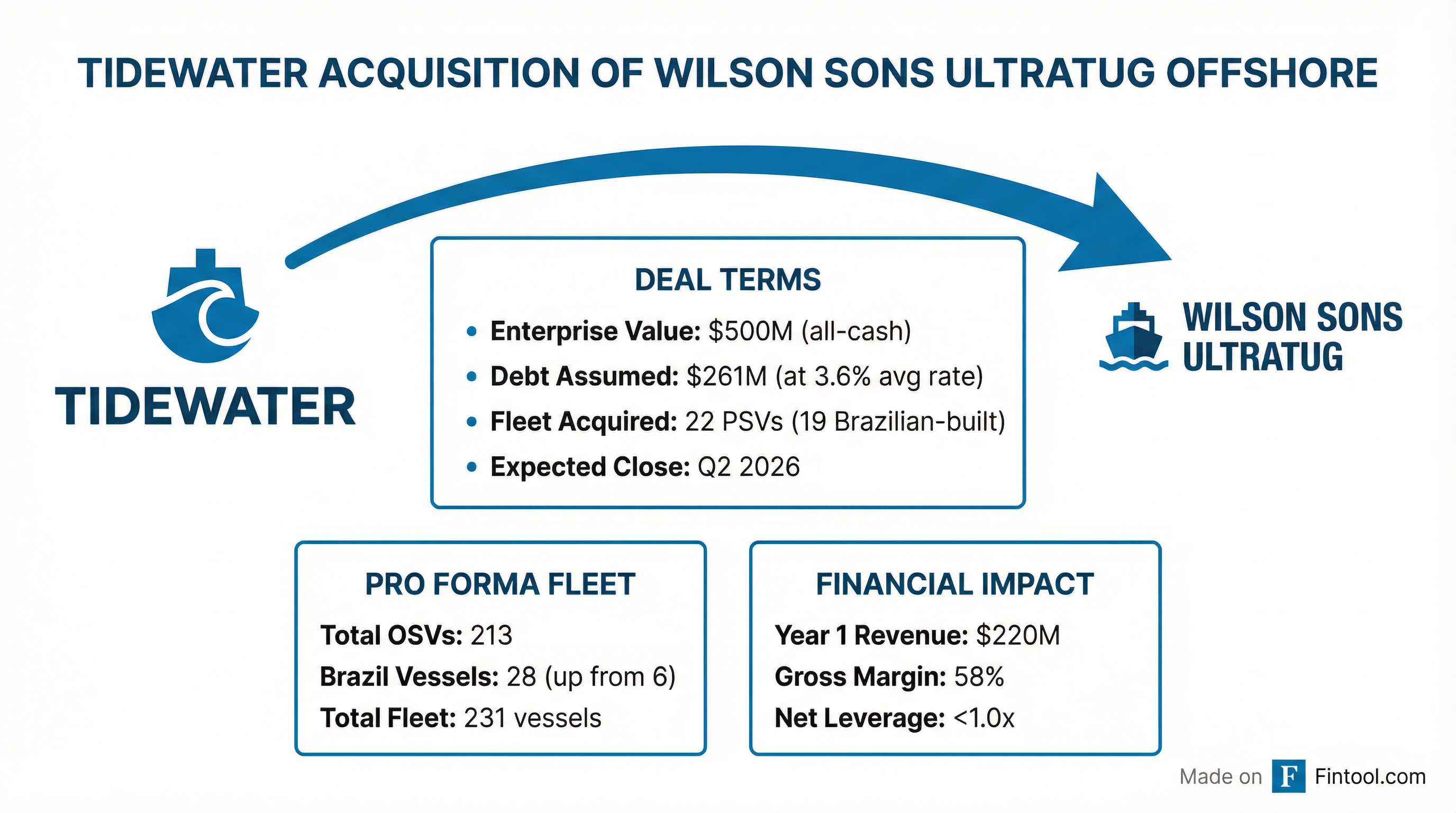
The transaction structure reveals a company playing offense from a position of strength. Tidewater will fund the purchase entirely from cash on hand—no revolving credit facility required—while assuming approximately $261 million of Wilson Sons' existing debt from BNDES and Banco do Brasil at a weighted average cost of just 3.6%.
"The Wilson Sons debt provides for a nice element of built-in financing," said West Gotcher, SVP of Strategy and Investor Relations. "The weighted average cost of debt is approximately 3.6%... stretching out to 2035, with no particular year adding significant maturities."
Post-transaction, Tidewater projects net leverage below 1.0x—remarkably conservative for a company completing its fourth major acquisition in four years.
| Metric | Value |
|---|---|
| Enterprise Value | $500M |
| Cash Payment | $239M |
| Debt Assumed | $261M |
| Debt Cost | 3.6% (avg) |
| Debt Maturity | Through 2035 |
| Pro Forma Net Leverage | <1.0x |
Brazil: The World's Best Offshore Market
Why pay a half-billion dollars to expand in Brazil? The answer lies in a unique combination of demand growth, regulatory protection, and structural vessel shortages.
Demand Tailwinds
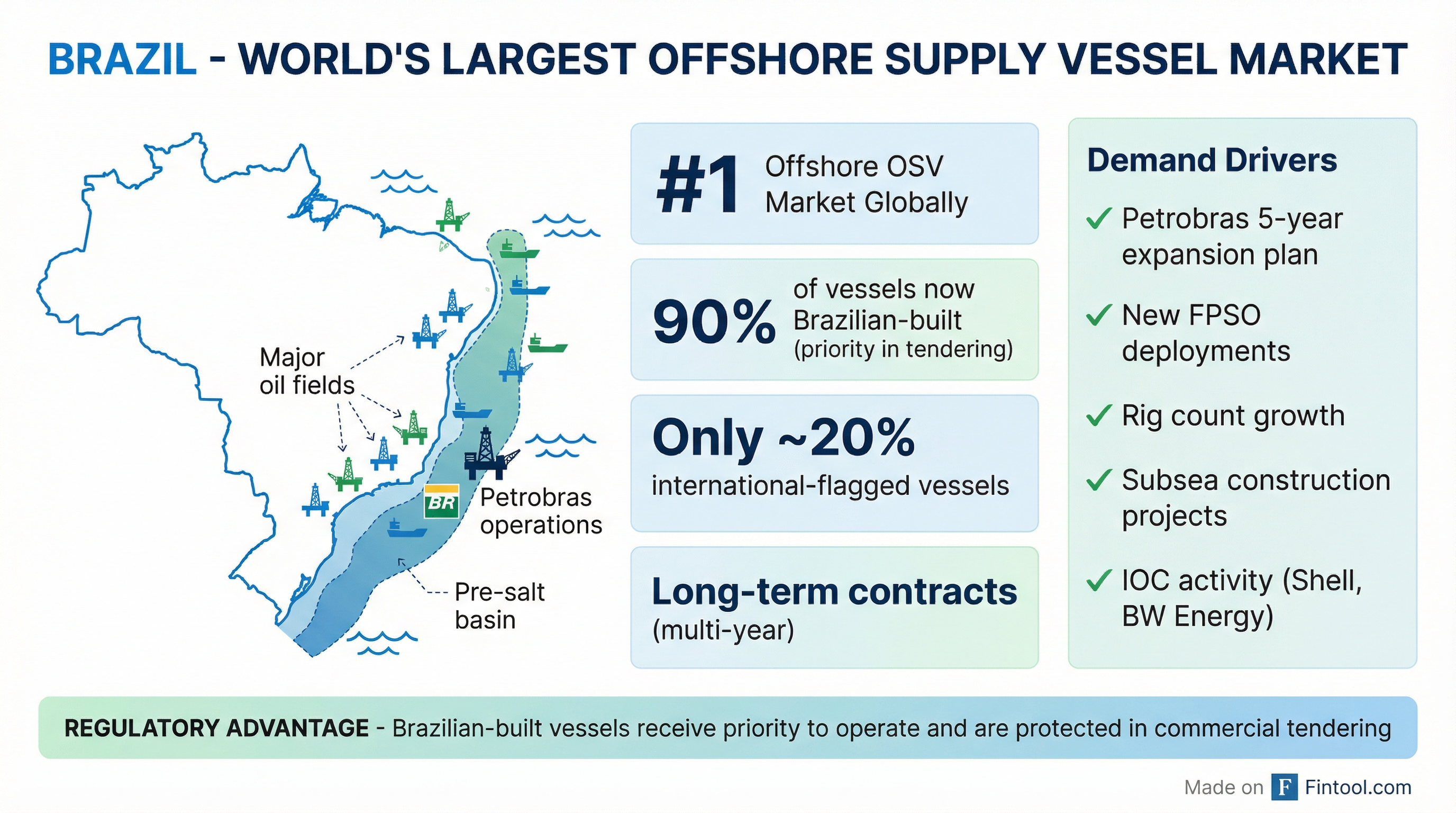
Brazil's offshore market is experiencing a multi-year expansion driven by Petrobras's recently published five-year plan, new FPSO deployments, and increased activity from international oil companies. Shell and BW Energy both sanctioned significant projects in 2025, while subsea construction activity continues to accelerate.
"We're seeing a lot of additional FPSOs. We're seeing extra rigs coming in as well, and then the subsea side as well," said COO Piers Middleton.
Regulatory Moat
Brazilian-built vessels receive priority in commercial tendering—a structural advantage that's nearly impossible to replicate. Currently, only about 20% of vessels operating in Brazil are international-flagged, creating a protected buffer for Brazilian tonnage.
The real kicker: Wilson Sons' Brazilian-built fleet comes with REB (Brazilian Special Registry) capacity—allowing Tidewater to import additional international-flagged vessels and temporarily flag them Brazilian, gaining the same commercial priority as locally built tonnage.
"This provides Tidewater two distinct benefits," Kneen explained. "First, the attractiveness of these vessels in local commercial tendering processes and, second, the opportunity to utilize the REB capacity with Tidewater's international tonnage."
Fleet Quality
Wilson Sons operates what management described as an "unmatched" fleet in terms of quality and professionalism. All 22 PSVs share a consistent Damen Shipyards design with Caterpillar engines and Kongsberg propulsion systems, simplifying maintenance and supply chain management.
Of the 22 vessels, 21 are currently active and working—suggesting minimal integration risk and immediate cash flow contribution.
Ask Fintool AI AgentFinancial Impact: Accretion from Day One
Management provided clear financial guidance for the first 12 months post-close:
| Metric | First 12 Months |
|---|---|
| Revenue | $220M |
| Gross Margin | 58% |
| Incremental G&A | $14M |
| Backlog | $441M |
The acquisition is expected to be accretive to 2026 and 2027 earnings and cash flow per share.
Crucially, many existing Wilson Sons contracts are priced at day rates "materially lower than current market day rates," according to the press release. As these contracts roll off over the next two years, Tidewater expects "significant earnings and free cash flow uplift."
"If you take that back in time a little bit, that would be reflective of a much lower day rate environment," Gotcher explained. "Our expectation is... there will be a nice uplift that we can realize from the rolling of these contracts over the coming years."
Tidewater's Consolidation Playbook Continues
This acquisition follows a well-established pattern. Tidewater has transformed from a regional player to the world's largest offshore vessel operator through disciplined, accretive M&A.
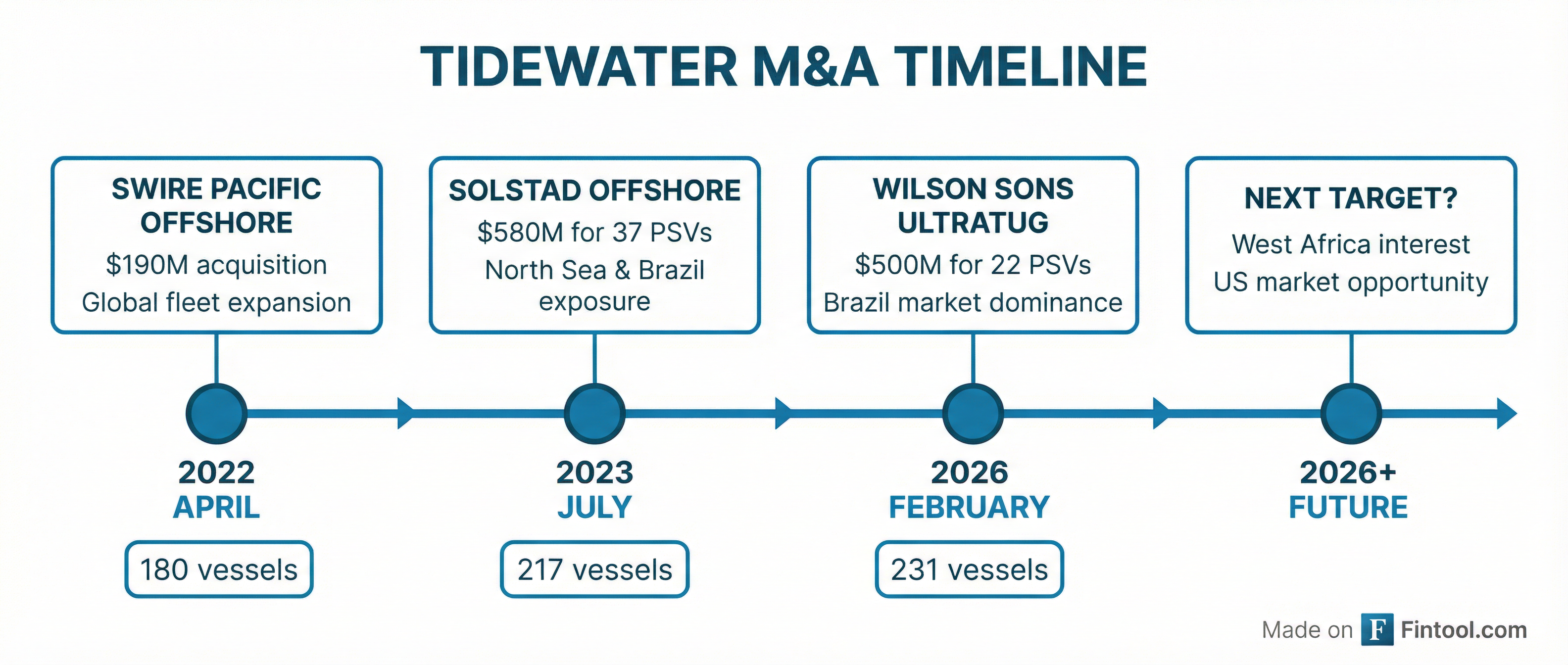
| Acquisition | Year | Value | Vessels | Geography |
|---|---|---|---|---|
| Swire Pacific Offshore | April 2022 | $190M | — | Global |
| Solstad Offshore | July 2023 | $580M | 37 PSVs | North Sea, Brazil |
| Wilson Sons Ultratug | Q2 2026 | $500M | 22 PSVs | Brazil |
The integration track record speaks for itself. Tidewater completed the Solstad integration within five months, transitioning all 37 vessels onto its administrative and technology infrastructure with G&A synergies exceeding initial expectations.
"We're highly confident in our ability to integrate the Wilson Sons organization onto the Tidewater platform," Kneen said. "We believe that we've shown this to be a core competency of the Tidewater management team."
Market Reaction: Shares Hit 52-Week High
TDW shares surged on the announcement, trading up 9.2% to $80.16 in Monday trading—a fresh 52-week high. The stock has more than doubled from its 52-week low of $31.17.
| Metric | Value |
|---|---|
| Current Price | $80.16 |
| Change | +$6.78 (+9.2%) |
| 52-Week Range | $31.17 - $81.99 |
| Market Cap | $4.0B |
| YTD Performance | +54% |
The rally reflects investor confidence in both the strategic rationale and Tidewater's execution capabilities. At current levels, TDW trades at approximately 22x trailing earnings—a premium to historical levels but arguably justified given the growth profile and margin expansion potential.
Ask Fintool AI AgentWhat's Next: West Africa in the Crosshairs
With Brazil secured, Kneen offered a glimpse at future capital allocation priorities.
"I have also been focused in the US market, but I just can't get anything done in the US market," Kneen admitted. "I'm actually getting very excited about West Africa again, so that could be the next move for us."
The company also signaled continued commitment to returning capital to shareholders if M&A opportunities don't materialize: "We still reserve the right to repurchase shares, and if I can't get anything done, I'm committed to doing that as well."
What to Watch
Near-term catalysts:
- Q4 2025 earnings release (expected within two weeks)
- Brazilian antitrust (CADE) approval timeline
- Contract rollovers at higher day rates through 2026-2027
Risks to monitor:
- Petrobras spending delays (some FRDs have already slipped into 2026)
- Brazilian real currency volatility
- Integration execution on the fourth major acquisition in four years
Key questions for management:
- What specific REB capacity utilization scenarios are being evaluated?
- Are there additional bolt-on opportunities in Brazil?
- What dry dock and maintenance CapEx should investors expect for the Wilson Sons fleet?
The Bottom Line
Tidewater's Wilson Sons acquisition represents a textbook strategic play: buying high-quality assets in the world's most attractive market with built-in regulatory protection, low-cost financing, and clear paths to earnings accretion through day rate uplift.
The company's track record of successful integrations—and the balance sheet firepower to continue pursuing opportunities—positions Tidewater as the consolidator of choice in an industry ripe for further rationalization. With Brazil locked up and West Africa in the crosshairs, the world's largest offshore vessel operator shows no signs of slowing down.
Related
- Tidewater Inc. (tdw) - Company Profile