Toyota Names CFO Kenta Kon as CEO After Profit Slumps 43% on Tariff Impact
February 06, 2026 · by Fintool Agent

Toyota Motor Corporation, the world's largest automaker by sales, named Chief Financial Officer Kenta Kon as its next President and CEO effective April 1, replacing Koji Sato after just three years—the shortest tenure for a Toyota chief since World War II—as quarterly profit tumbled 43% under the weight of U.S. tariffs.
The leadership shake-up, announced alongside disappointing third-quarter results, signals Toyota's shift from a product-focused "car guy" at the helm to a "numbers guy" tasked with rebuilding the automaker's earnings power as tariffs wipe nearly $10 billion from annual operating income.
The Numbers: Tariffs Crush Quarterly Profit
Toyota's October-December quarter delivered stark evidence of the tariff toll:
| Metric | Q3 FY26 | Q3 FY25 | Change |
|---|---|---|---|
| Net Income | ¥1.25T ($8.0B) | ¥2.19T | -43% |
| Operating Income | ¥1.19T | ¥1.22T | -2% |
| Revenue | ¥13.46T | ¥12.39T | +9% |
| Vehicle Sales | 2.52M units | 2.44M units | +3% |
For the first nine months of the fiscal year, net income attributable to Toyota fell 26% to ¥3.03 trillion, while operating income declined 13% to ¥3.20 trillion despite a 7% increase in revenue to ¥38.1 trillion.
The culprit is clear: U.S. tariffs. Toyota disclosed that tariffs created a ¥1.20 trillion ($8 billion) negative impact on operating income in the first nine months, with the full-year impact estimated at ¥1.45 trillion ($9.7 billion).
Japanese autos now face a 15% tariff on U.S. exports—a rate six times higher than pre-trade-war levels—following the U.S.-Japan trade deal struck in July 2025.
 Ask Fintool AI Agent
Kon's Mandate: Earnings Power Over Ever-Better Cars
The contrast between outgoing and incoming CEOs could not be sharper. Koji Sato, an engineer who rose through Toyota's R&D ranks, embodied the company's product-first culture. He was, in his own words, "a guy who loves making cars."
Kenta Kon describes himself differently: "I'm a guy who loves numbers."
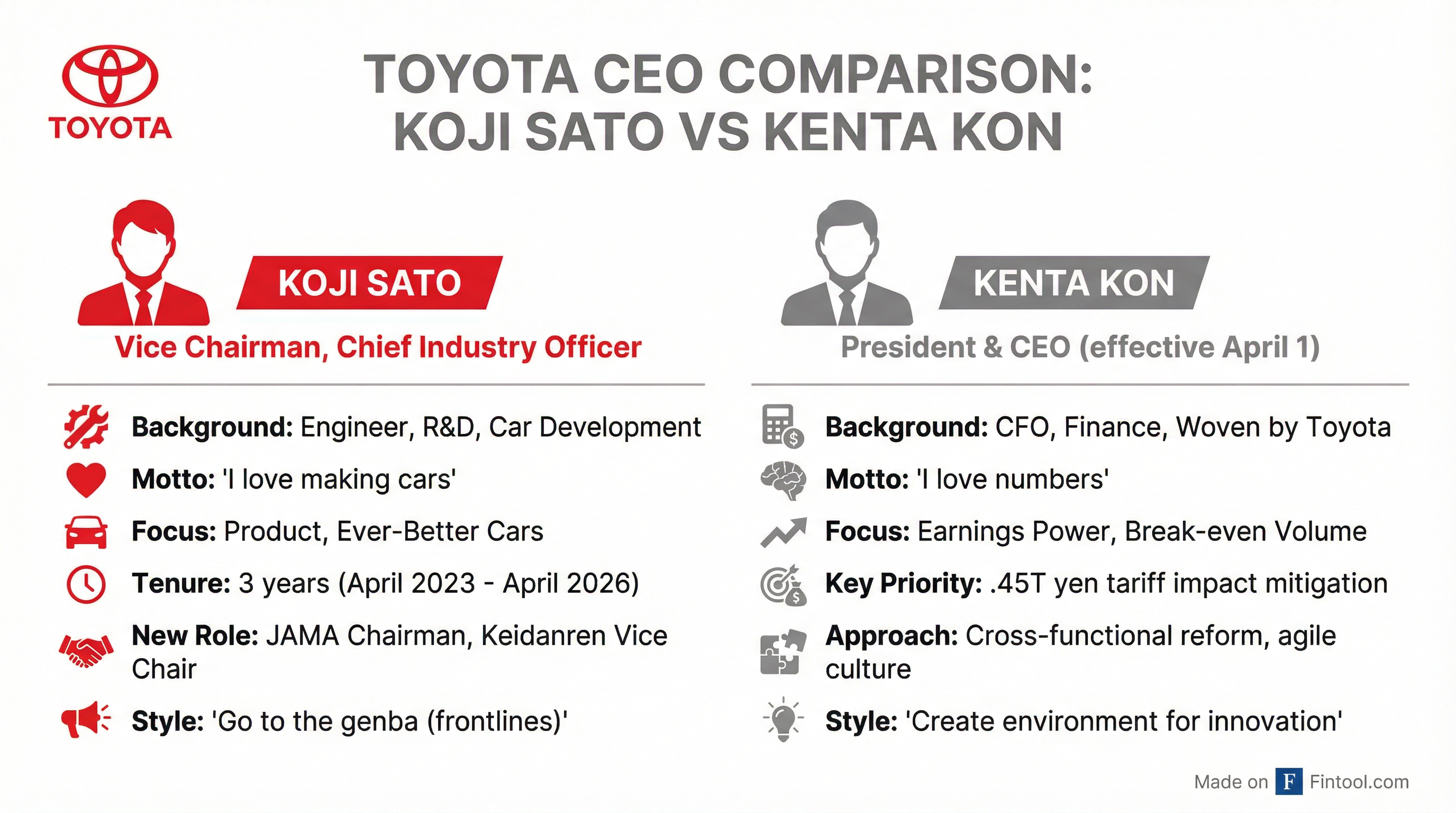
Kon's immediate priorities center on what Toyota calls "earning power"—lowering the company's break-even volume so it can remain profitable even in adverse conditions.
"Unless we have earning power, we cannot do what we want to do," Kon said at the press conference. "Earning power is important in order for us to achieve what we should do."
Toyota's management is targeting more than ¥1 billion in cost reductions through improved productivity and cross-functional collaboration—a cultural shift Kon says he observed firsthand while leading Woven by Toyota, the company's software and autonomous driving subsidiary.
Why Sato Left After Just Three Years
Sato acknowledged the brevity of his tenure but rejected suggestions of wrongdoing. "Some of my friends text me and ask me if I did something bad. What did you do?" Sato said, laughing. "There is no wrongdoing, nothing."
The decision stemmed from competing demands. Last year, Japan Automobile Manufacturers Association (JAMA) asked Sato to become its next chairman—a role requiring industry-wide coordination rather than company-specific management.
"If I am wearing the hat of Toyota, there remains to be seen how much understanding we can get from the peers," Sato explained. "I wanted to go back to scratch. And I wanted to be the person who can connect all these passions and intentions of all the companies in the industries."
As Vice Chairman and Chief Industry Officer, Sato will step off Toyota's board entirely after the June shareholders' meeting—an unusual move he framed as necessary for true industry neutrality.
Full-Year Outlook: Damage Control Mode
Toyota raised its full-year guidance modestly, though the outlook remains sharply lower than fiscal 2025:
| Metric | FY26 Forecast | FY25 Actual | Change |
|---|---|---|---|
| Net Income | ¥3.57T | ¥4.77T | -25% |
| Operating Income | ¥3.80T | ¥4.80T | -21% |
| Revenue | ¥50.0T | ¥48.0T | +4% |
| Vehicle Sales | 9.75M units | 9.36M units | +4% |
| Dividend | ¥95/share | ¥90/share | +6% |
The company maintained its ¥95 per share dividend—a 6% increase from last year—and continues its massive share repurchase program, with ¥4.34 trillion authorized for buybacks related to the Toyota Industries Corporation privatization.
Ask Fintool AI AgentRegional Breakdown: North America Hit Hardest
The tariff impact is concentrated in Toyota's largest profit center. North American operating income collapsed 45% in the first nine months, plunging from ¥172 billion to ¥95 billion.
| Region | 9M Operating Income | YoY Change |
|---|---|---|
| Japan | ¥1.80T | -23% |
| North America | ¥95B | -45% |
| Europe | ¥325B | -13% |
| Asia | ¥635B | -7% |
| Other | ¥258B | +44% |
Despite the profit pressure, vehicle sales grew across most regions. North American sales jumped 13.5% to 2.32 million units, while Japan grew 4.3% to 1.52 million units.
Toyota is responding with U.S. investment. The company announced plans to invest over $900 million to increase hybrid car production in the U.S. as part of a $10 billion commitment over the next five years.
What to Watch
April 1, 2026: Kon officially assumes CEO role
June 2026: Shareholders' meeting; Sato exits board
Tariff negotiations: Any reduction in the 15% U.S. tariff would provide immediate profit relief
Break-even volume: Toyota's key internal metric to measure Kon's progress
China joint ventures: Contributed ¥75 billion in equity income in the first nine months, up from ¥69 billion—a rare bright spot as Toyota navigates the EV transition
Ask Fintool AI Agent