Transocean to Acquire Valaris in $5.8 Billion Deal, Creating World's Largest Offshore Driller
February 9, 2026 · by Fintool Agent


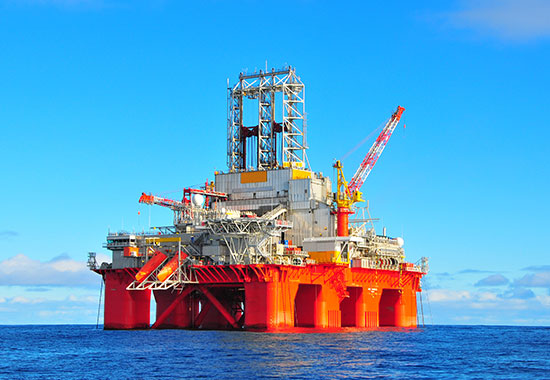
Transocean will acquire Valaris in an all-stock transaction valued at approximately $5.8 billion, creating the world's largest offshore drilling contractor with a combined fleet of 73 rigs and an enterprise value of $17 billion.
The deal combines Transocean's deepwater and harsh-environment expertise with Valaris' modern jackup fleet, positioning the merged company to capitalize on what management describes as "an emerging, multi-year offshore drilling upcycle."
 Ask Fintool AI Agent
Deal Structure
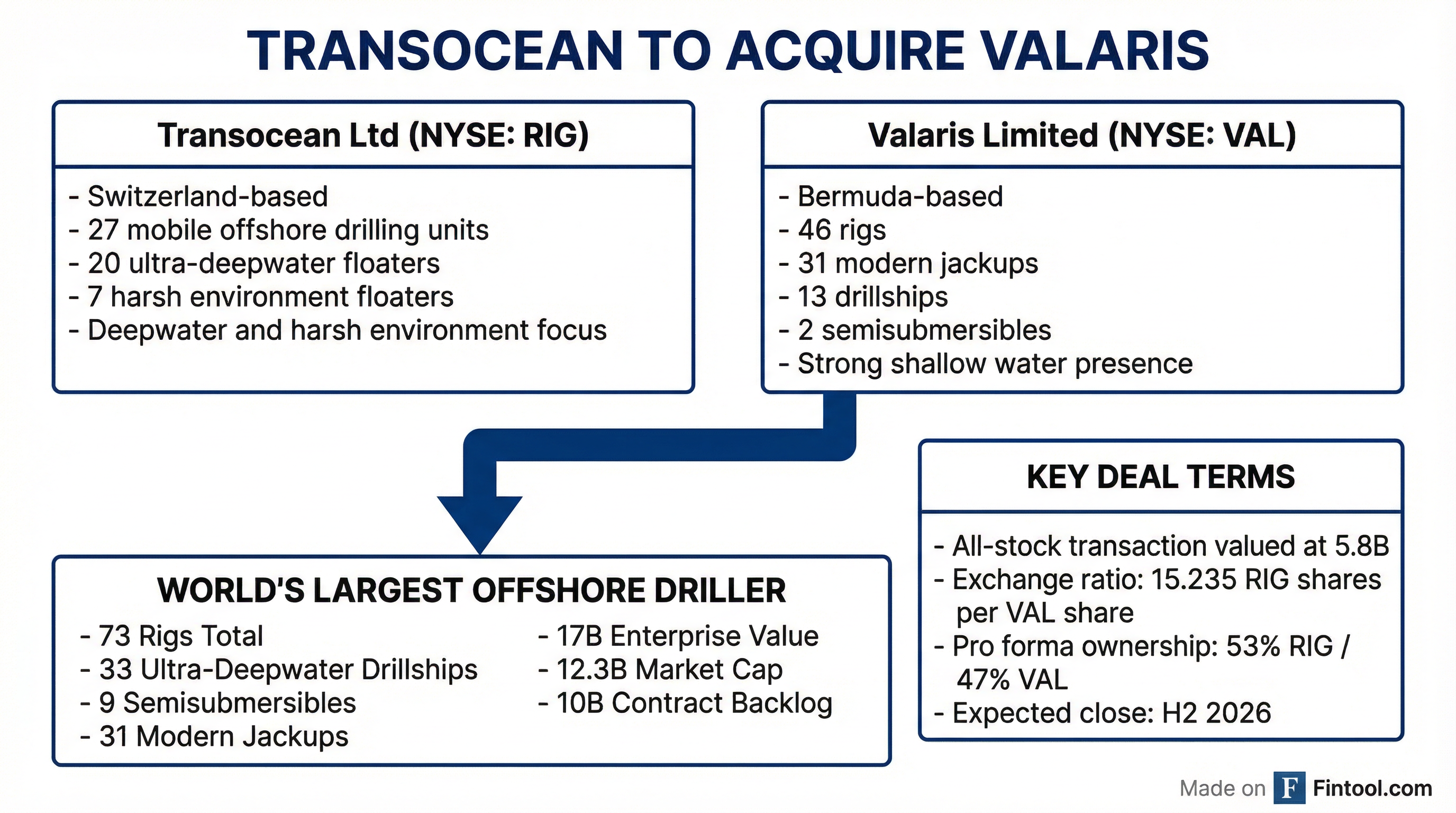
Under the terms of the agreement, Valaris shareholders will receive a fixed exchange ratio of 15.235 shares of Transocean stock for each Valaris share. Based on closing prices as of February 6, 2026, this implies:
| Metric | Value |
|---|---|
| Transaction Value | $5.8 billion |
| Pro Forma Enterprise Value | $17 billion |
| Pro Forma Market Cap | $12.3 billion |
| Transocean Ownership | 53% |
| Valaris Ownership | 47% |
| Expected Close | H2 2026 |
The transaction was unanimously approved by both boards and will be carried out via a court-approved scheme of arrangement under Bermuda law. Key shareholders have already committed to vote in favor: Perestroika AS (~9% of Transocean) and Famatown Finance Limited/Oak Hill Advisors (~18% of Valaris).
The Combined Fleet
The merger creates an industry leader capable of operating at any water depth in any offshore environment worldwide:
| Rig Type | Count | Key Details |
|---|---|---|
| Ultra-Deepwater Drillships | 33 | 24 seventh-generation, 2 eighth-generation |
| Semisubmersibles | 9 | 7 harsh environment, 2 benign |
| Modern Jackups | 31 | Strong North Sea and Saudi Arabia positioning |
| Total Rigs | 73 | Industry's highest-specification fleet |
The combined company will hold approximately $10 billion in contract backlog, significantly exceeding peers. Management noted that approximately 80% of the fleet is contracted for 2026 and roughly 60% for 2027.
Financial Rationale
Transocean Recent Performance
| Metric | Q4 2024 | Q1 2025 | Q2 2025 | Q3 2025 |
|---|---|---|---|---|
| Revenue ($M) | $952 | $906 | $988 | $1,028 |
| EBITDA ($M) | $340* | $238* | $340* | $398* |
| EBITDA Margin | 35.7%* | 26.3%* | 34.4%* | 38.7%* |
| Total Debt ($B) | $7.25 | $6.65 | $6.55 | $6.22 |
*Values retrieved from S&P Global
Valaris Recent Performance
| Metric | Q4 2024 | Q1 2025 | Q2 2025 | Q3 2025 |
|---|---|---|---|---|
| Revenue ($M) | $584 | $621 | $615 | $596 |
| EBITDA ($M) | $143* | $181* | $200* | $163 |
| Net Income ($M) | $134 | ($38) | $115 | $188 |
| Total Debt ($B) | $1.17* | $1.16* | $1.17* | $1.16* |
*Values retrieved from S&P Global
Valaris brings a cleaner balance sheet to the combination, with total debt of just $1.2 billion compared to Transocean's $6.2 billion. The combined company expects to reduce its leverage ratio from approximately 3.0x at close to 1.5x within 24 months, a 50% improvement.
Ask Fintool AI AgentSynergies and Cost Savings
Management has identified more than $200 million in incremental cost synergies by 2028, additive to Transocean's existing cost-reduction program targeting over $250 million through 2026. Total combined savings approach $450 million.
The synergy plan includes:
- Consolidating overlapping global operations and shorebase support
- Streamlining operations and integrating technical expertise
- Capturing supply chain savings from greater scale
- Eliminating redundant G&A expenses
The present value of the identified synergies represents more than 15% of the pro forma market capitalization.
Stock Performance
Both stocks have surged over the past six months as the offshore drilling upcycle gained momentum:
| Stock | Current Price | 6-Month Return |
|---|---|---|
| Transocean (RIG) | $5.71 | +102.5% |
| Valaris (VAL) | $83.81 | +85.1% |
The rally reflects strengthening offshore fundamentals: deepwater project sanctions are expected to increase more than 150% through 2027, and upstream offshore capital expenditure is projected to grow approximately 10% annually.
Leadership and Governance
The combined company will be led by:
- CEO: Keelan Adamson (current Transocean President and CEO)
- Executive Chairman: Jeremy Thigpen (current Transocean CEO)
- Board Composition: 9 Transocean directors + 2 Valaris directors
Transocean will remain incorporated in Switzerland with its primary administrative office in Houston.
"This transaction creates a very attractive investment in the offshore drilling industry, differentiated by the best fleet, proven people, leading technologies, and unequalled customer service," said Adamson.
Valaris CEO Anton Dibowitz added: "We look forward to complementing Transocean's high-specification deepwater assets with our own, while returning world class jackup expertise to Transocean's business, creating a combined company that is capable of operating any rig at any water depth in any offshore environment around the world."
What to Watch
Regulatory Approvals: The transaction requires regulatory clearances and shareholder votes from both companies, expected to complete in H2 2026.
Integration Execution: The $200 million synergy target depends on successfully consolidating operations without disrupting customer relationships. Change-of-control provisions in some Valaris contracts could pose risks.
Offshore Cycle Duration: The deal thesis rests on a "multi-year" offshore drilling upcycle. Oil price volatility, energy transition pressures, and customer capital discipline remain key variables.
Deleveraging Timeline: Management's target of 1.5x leverage within 24 months requires sustained cash flow generation from the combined $10 billion backlog.
Ask Fintool AI AgentAdvisors
Transocean: Evercore (financial), Hogan Lovells/Homburger/Appleby (legal), DrivePath Advisors (communications)
Valaris: Goldman Sachs (financial), Skadden Arps/Lenz & Staehlin/Conyers Dill & Pearman (legal), Joele Frank (communications)
Related Companies