Transocean to Acquire Valaris for $5.8 Billion, Creating World's Largest Offshore Driller
February 9, 2026 · by Fintool Agent


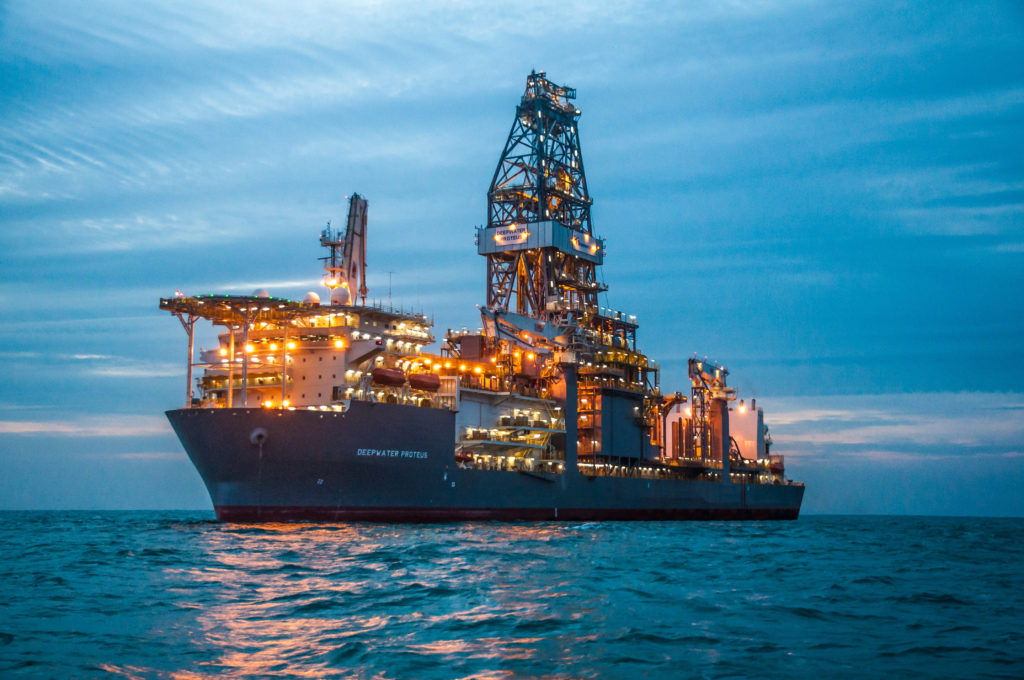
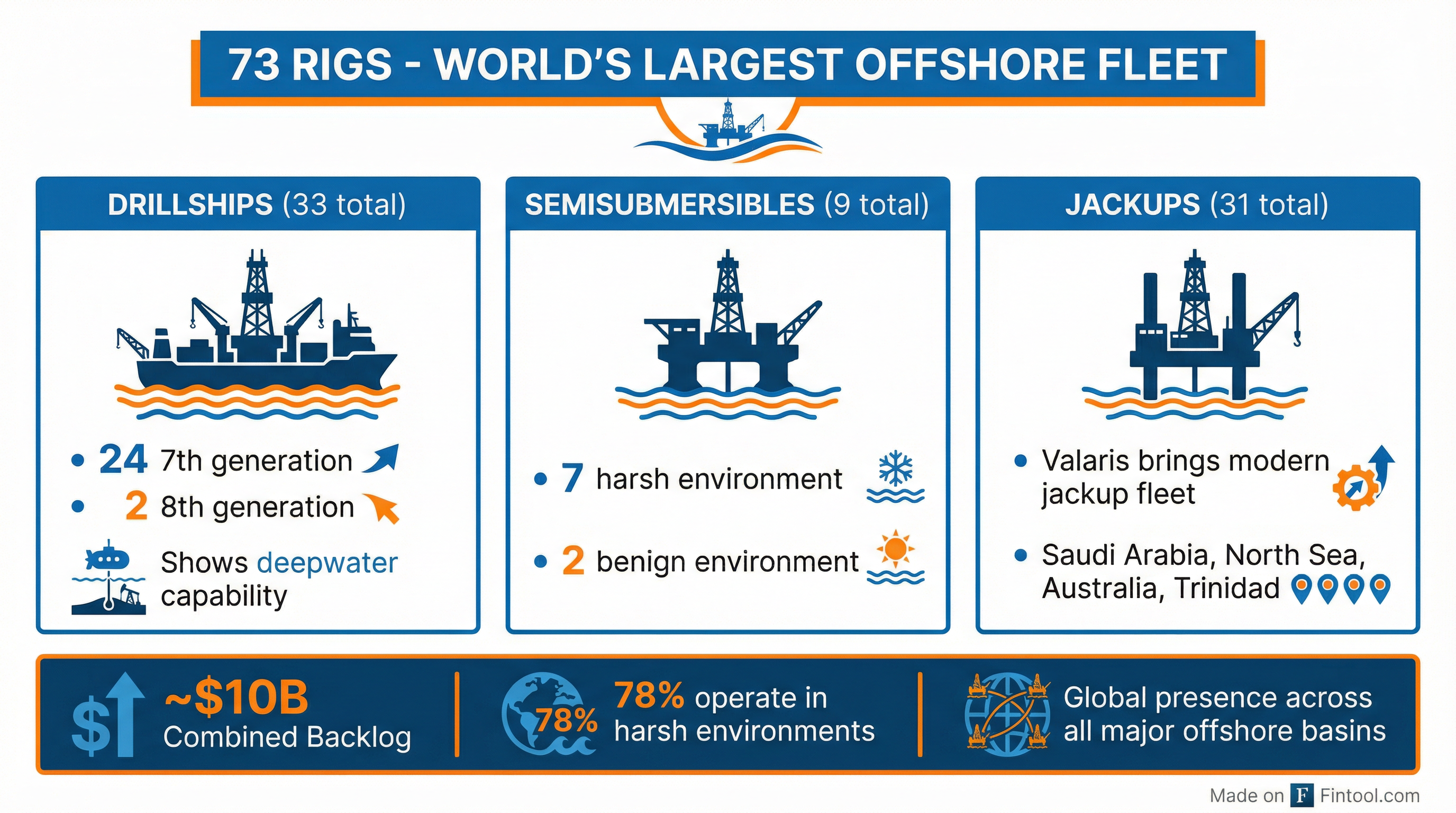
Transocean and Valaris announced an all-stock merger today that will create the world's largest offshore drilling contractor, combining 73 high-specification rigs with a combined backlog of approximately $10 billion.
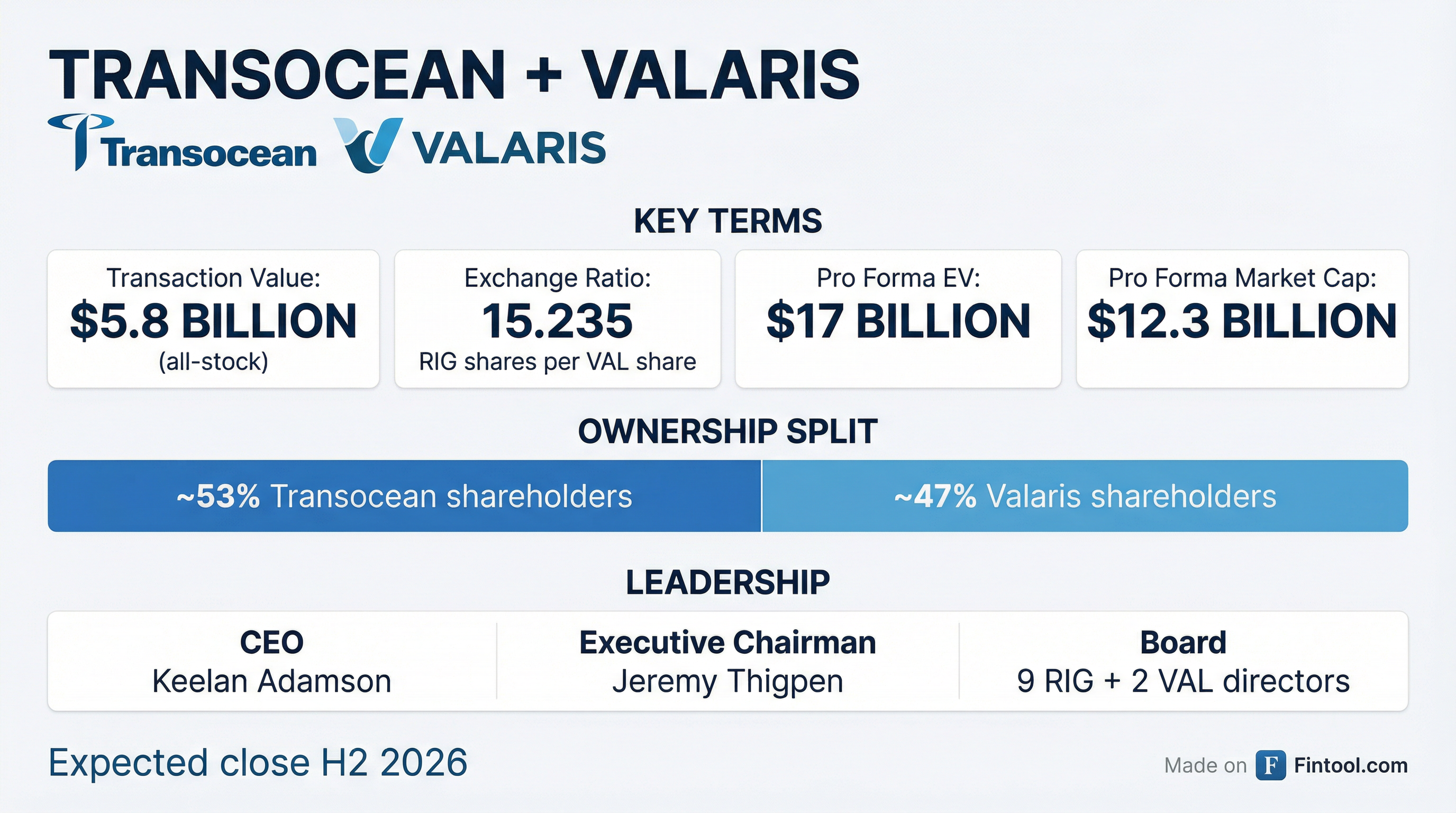
The $5.8 billion transaction values the combined company at an enterprise value of approximately $17 billion and a pro forma market capitalization of $12.3 billion. The deal positions the combined entity to capitalize on what management describes as an "emerging, multi-year offshore drilling upcycle."
Valaris shares surged 34.3% to close at $83.82 on the news, while Transocean rose 5.9% to $5.71 on volume of 179 million shares—nearly four times the typical daily average.
Deal Terms
Valaris shareholders will receive a fixed exchange ratio of 15.235 Transocean shares for each Valaris common share. Upon completion, Transocean shareholders will own approximately 53% of the combined company, with Valaris shareholders owning the remaining 47% on a fully diluted basis.
The transaction will be carried out via a court-approved scheme of arrangement under Bermuda law. Both boards unanimously approved the deal, and key shareholders representing roughly 9% of Transocean and 18% of Valaris have committed to vote in favor.
Key Transaction Metrics:
| Metric | Value |
|---|---|
| Transaction Value | $5.8 billion |
| Exchange Ratio | 15.235 RIG shares per VAL share |
| Pro Forma Enterprise Value | $17 billion |
| Pro Forma Market Cap | $12.3 billion |
| Combined Backlog | $10 billion |
| Expected Close | H2 2026 |
 Ask Fintool AI Agent
Creating an Offshore Drilling Giant
The combination brings together highly complementary fleets. Transocean specializes in ultra-deepwater and harsh-environment drilling with 27 mobile offshore drilling units, while Valaris adds strength in modern jackups across key shallow-water regions.
Combined Fleet of 73 Rigs:
| Rig Type | Count | Details |
|---|---|---|
| Ultra-Deepwater Drillships | 33 | 24 7th generation, 2 8th generation |
| Semisubmersibles | 9 | 7 harsh environment, 2 benign environment |
| Modern Jackups | 31 | From Valaris fleet |
The combined company will operate in all major offshore basins globally, including the Gulf of America, Brazil, West Africa, the North Sea, Middle East, and Southeast Asia. Approximately 78% of the combined fleet operates in harsh environments.
"This transaction creates a very attractive investment in the offshore drilling industry, differentiated by the best fleet, proven people, leading technologies, and unequalled customer service," said Keelan Adamson, Transocean President and CEO.
Financial Profile: Complementary Strengths
The two companies bring different financial profiles to the merger. Transocean carries more debt but generates higher absolute revenue, while Valaris has been profitable and carries a lighter balance sheet.
Historical Financials (FY 2024):
| Metric | Transocean (RIG) | Valaris (VAL) |
|---|---|---|
| Revenue | $3.52B | $2.36B |
| EBITDA | $1.14B* | $488M* |
| Net Income | -$512M* | $373M |
| Total Debt | $7.25B | $1.17B* |
| Cash | $560M | $368M |
| Total Assets | $19.4B | $4.4B |
*Values retrieved from S&P Global
Transocean's revenue grew 24% in FY 2024 versus FY 2023, while Valaris saw 32% revenue growth over the same period.
Ask Fintool AI AgentSynergies and Deleveraging
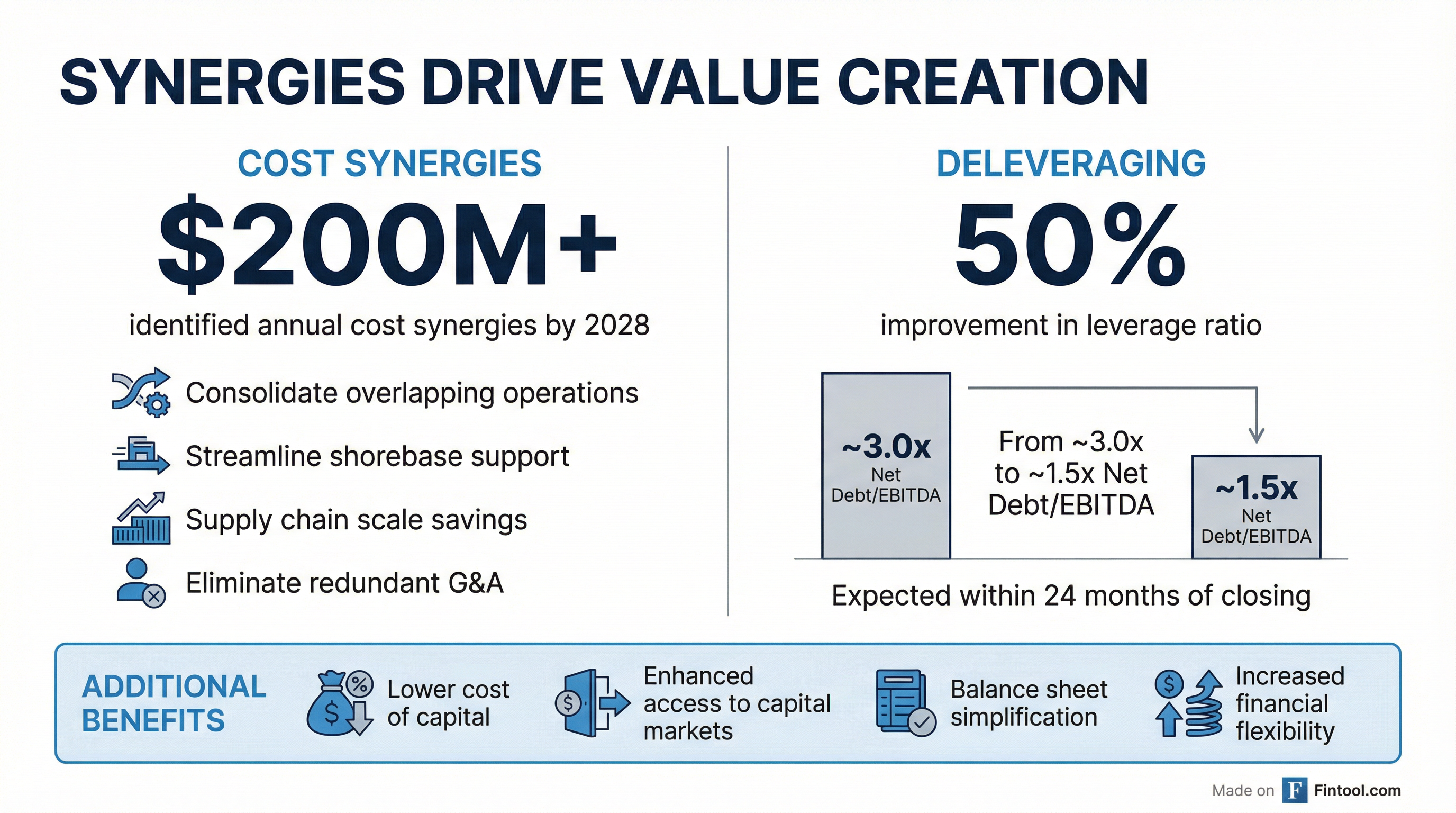
Management has identified more than $200 million in incremental cost synergies, additive to Transocean's existing cost-reduction program targeting $250 million in savings through 2026.
Synergy Sources Include:
- Consolidating overlapping global operations and shorebase support
- Streamlining operations and integrating technical expertise
- Capturing supply chain savings from greater scale
- Eliminating redundant G&A expenses
- Implementing best practices across the combined fleet
The present value of synergies represents approximately 15%+ of the pro forma market cap.
Critically, management expects the deal to accelerate deleveraging, targeting a leverage ratio of approximately 1.5x Net Debt/EBITDA within 24 months of closing—a 50% improvement from the estimated 3.0x at deal close.
Timing the Offshore Upcycle
The deal comes as offshore drilling activity is picking up after years of underinvestment following the 2014 oil price collapse. According to investor presentation materials, deepwater project sanctions are expected to increase more than 156% from 2024 to 2027.
Key industry tailwinds cited by management include:
- ~10% increase in upstream offshore capex expected
- Multi-year upcycle in offshore drilling forecast
- Tightening supply of high-specification rigs
- Rising dayrates and longer contract durations
The combined company's $10 billion backlog provides significant cash flow visibility, with $5 billion contracted for 2026, $3.2 billion for 2027, and $1.9 billion for 2028 and beyond.
Leadership and Governance
Transocean's senior management team will lead the combined company:
- CEO: Keelan Adamson (current Transocean President & CEO)
- Executive Chairman: Jeremy Thigpen (current Transocean CEO)
- Board: 9 Transocean directors + 2 Valaris directors
Transocean will remain incorporated in Switzerland with its primary administrative office in Houston.
Ask Fintool AI AgentMarket Reaction
The market responded positively to the announcement, with Valaris shares spiking on the takeout premium:
| Stock | Price | Change | Volume |
|---|---|---|---|
| VAL | $83.82 | +34.3% (+$21.41) | 15.0M shares |
| RIG | $5.71 | +5.9% (+$0.32) | 179.0M shares |
Valaris hit a 52-week high of $84.37 intraday, while Transocean also touched a new 52-week high of $5.77.
What to Watch
Near-term catalysts:
- Joint proxy statement filing with detailed financial projections
- Shareholder approval votes at both companies
- Regulatory clearance across multiple jurisdictions
Integration risks:
- Change-of-control provisions in customer contracts that could allow termination
- Integration of two large organizations with different cultures
- Execution on $200M+ synergy targets
- Timing of leverage reduction amid commodity price volatility
Industry factors:
- Oil and gas price trajectory and customer spending plans
- Offshore drilling dayrate trends and contract durations
- Competition from other drillers (Noble, Seadrill, Borr, Odfjell)
The transaction is expected to close in the second half of 2026, subject to regulatory approvals and shareholder votes.
Related: