Trump Maxes Out Tariff Authority at 15%, Vows 'Many More' Using Untested Laws
February 21, 2026 · by Fintool Agent


Less than 24 hours after the Supreme Court delivered a historic rebuke to his trade agenda, President Donald Trump escalated the tariff war to maximum legal intensity—raising global duties to 15% and vowing to pursue "many more" tariffs through never-before-tested statutes.
The move leaves markets facing a complicated Monday open: relief over the IEEPA invalidation has collided with immediate confirmation that Trump intends to max out every available alternative. The 15% rate represents the absolute ceiling of Section 122 authority, signaling the administration will push each legal tool to its limit.
The Saturday Escalation
In a Truth Social post Saturday morning, Trump announced he would raise the 10% global tariff he imposed Friday "to the fully allowed, and legally tested, 15% level," calling the Supreme Court's ruling "ridiculous, poorly written, and extraordinarily anti-American."
The timing is notable. Just 24 hours earlier, Trump had invoked Section 122 at 10%—preserving headroom for negotiation or further pressure. By immediately maxing out the rate, the president has signaled confrontation over compromise.
"Based on a thorough, detailed, and complete review of the ridiculous, poorly written, and extraordinarily anti-American decision on Tariffs issued yesterday... I, as President of the United States of America, will be, effective immediately, raising the 10% Worldwide Tariff on Countries, many of which have been 'ripping' the U.S. off for decades, without retribution (until I came along!), to the fully allowed, and legally tested, 15% level," Trump wrote.
First-Ever Use of Section 122
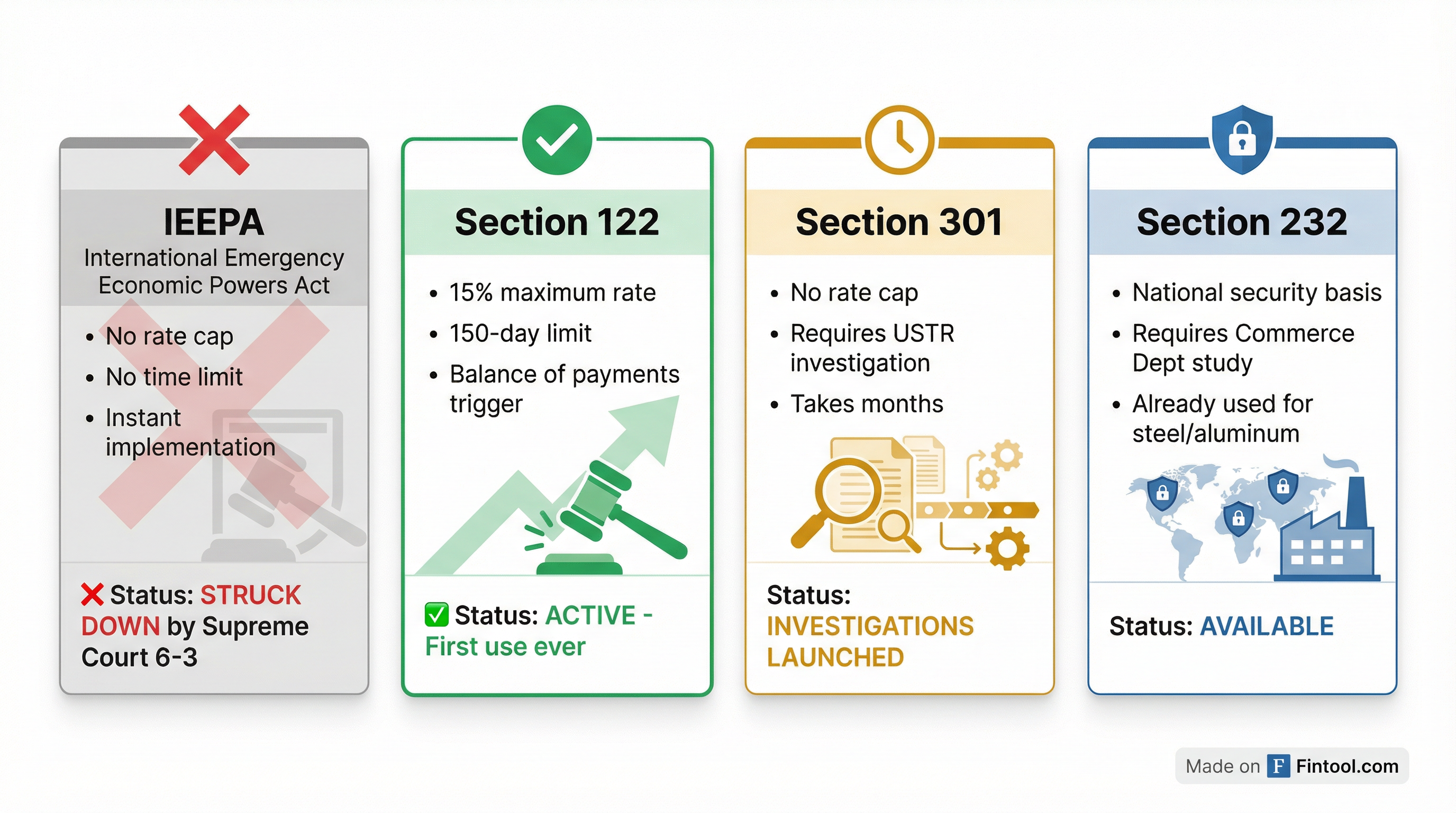
No president has ever invoked Section 122 of the Trade Act of 1974. The statute, designed to address short-term balance-of-payments emergencies, sat dormant for five decades until Friday's Supreme Court ruling forced Trump to seek alternatives.
Unlike IEEPA—which allowed unlimited tariff rates with no expiration—Section 122 imposes strict constraints:
| Constraint | Section 122 Limit |
|---|---|
| Maximum Rate | 15% |
| Maximum Duration | 150 days |
| Required Trigger | Balance-of-payments deficit |
| Extension | Requires Congressional approval |
The 150-day clock begins when the tariffs take effect February 24, meaning they will expire in mid-July unless Congress acts—an unlikely prospect given current political dynamics.
 Ask Fintool AI Agent
What's Exempt—And What Isn't
The White House fact sheet released Friday outlined exemptions that mirror the struck-down IEEPA tariffs, targeting goods where domestic alternatives are limited or strategic concerns prevail:
Exempt from 15% Tariff:
- Critical minerals, metals used in currency and bullion
- Energy and energy products
- Natural resources and fertilizers not producible domestically in sufficient quantities
- Certain agricultural products including beef, tomatoes, and oranges
- Pharmaceuticals and pharmaceutical ingredients
- Certain electronics
- Passenger vehicles, light trucks, and certain automotive parts
- Aerospace products
- USMCA-compliant goods from Canada and Mexico
- Steel and aluminum (already subject to Section 232 tariffs)
Subject to 15% Tariff:
- Consumer goods and apparel
- Metal products and electrical equipment
- Industrial machinery
- Most manufactured imports not otherwise exempted
The exemption structure suggests the administration is trying to insulate politically sensitive categories—autos, energy, food—while targeting the broader manufacturing base.
Economic Impact: The Numbers
The Yale Budget Lab updated its tariff analysis Saturday to reflect Trump's 15% escalation. The picture for consumers and businesses has deteriorated:
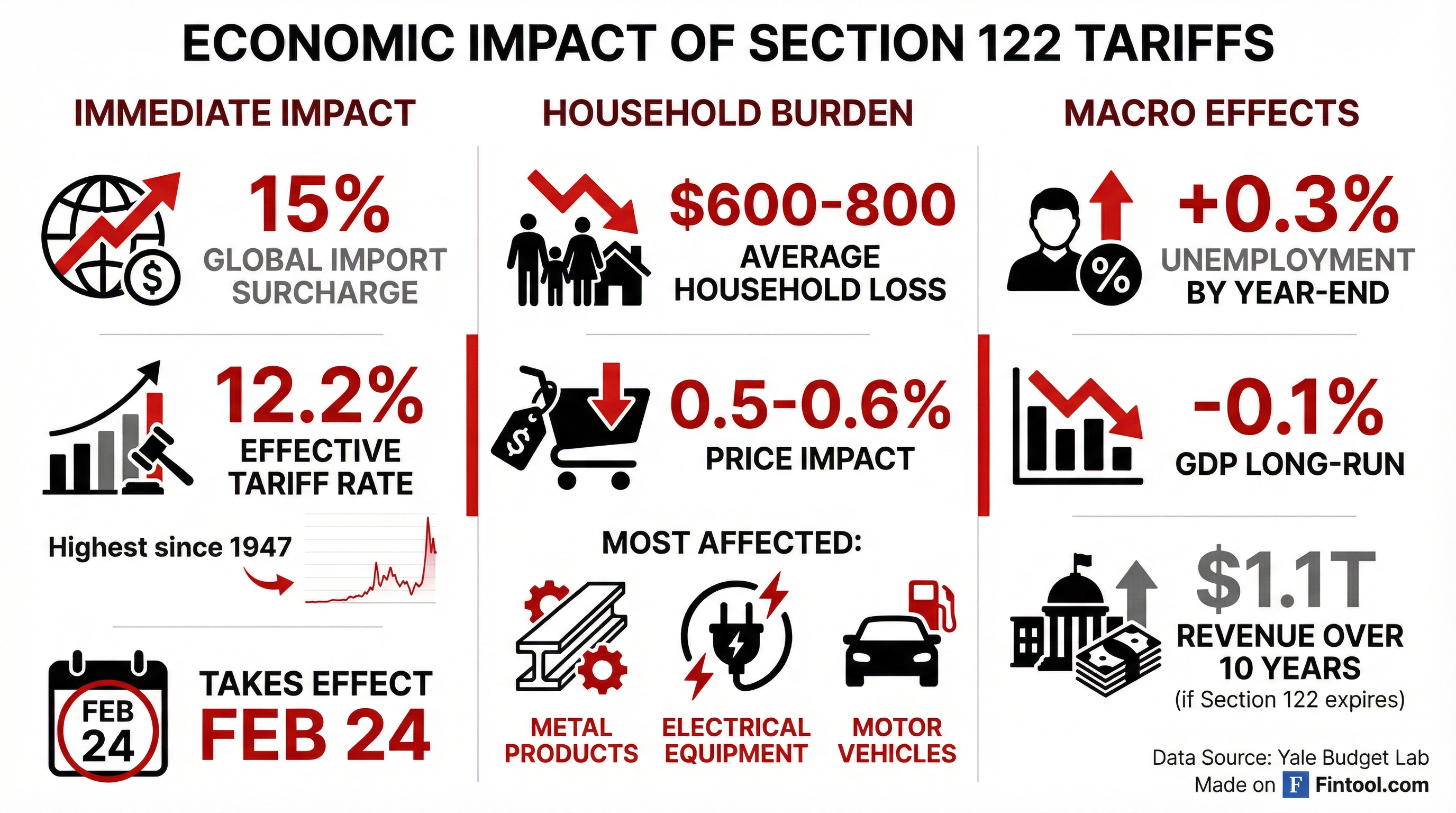
| Metric | If Section 122 Expires (July 2026) | If Extended Permanently |
|---|---|---|
| Effective Tariff Rate | 12.2% (highest since 1947) | Higher |
| Household Loss | $600-800 annually | $1,000-1,300 annually |
| Price Level Impact | 0.5-0.6% | 0.8-1.0% |
| Unemployment Impact | +0.3 percentage points by year-end | Higher |
| GDP Impact (long-run) | -0.1% ($30B annually) | -0.2% |
| 10-Year Revenue | $1.1 trillion (dynamic) | $1.9 trillion (dynamic) |
Notably, Yale estimates that any positive fiscal impulse from IEEPA refunds will approximately offset the negative growth impacts of the current tariff regime for 2026—though "substantial uncertainty" remains over how and when those refunds will be administered.
The commodities most affected are metal products, electrical equipment, and motor vehicles. If Section 122 is extended, apparel and related goods would join this list of most-impacted categories.
Ask Fintool AI AgentThe 150-Day Clock: What Happens Next
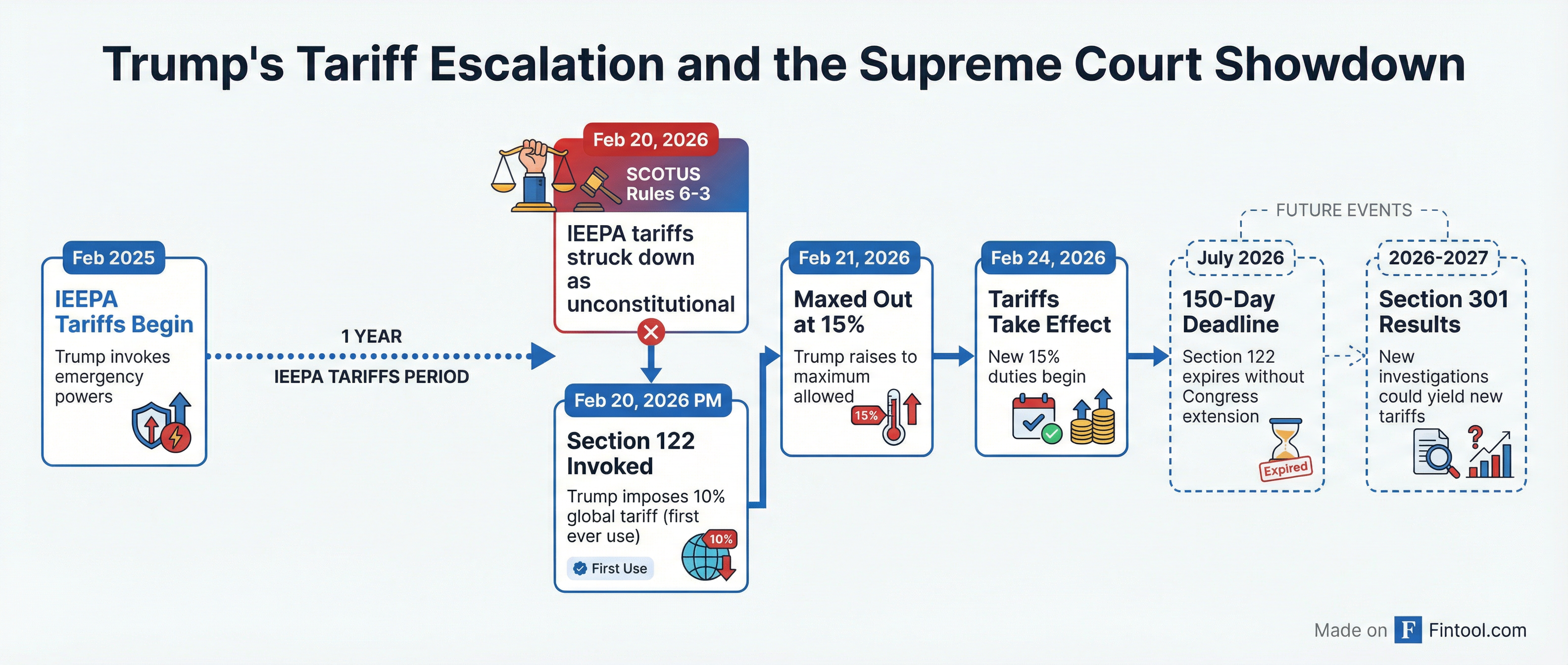
The Section 122 expiration in mid-July creates a hard deadline the administration must address. Trump has already telegraphed his playbook: use the 150-day window to launch investigations under Section 301 of the Trade Act of 1974, which could authorize indefinite tariffs at any rate—but only after completing a formal investigation process.
"I will be initiating several Section 301, and other investigations, to protect our country from unfair trading practices," Trump said Friday. These investigations typically take months, aligning with the Section 122 expiration timeline.
Key Dates for Investors:
| Date | Event |
|---|---|
| Feb 24, 2026 | Section 122 tariffs take effect at 15% |
| Feb 25, 2026 | State of the Union address |
| July 2026 | Section 122 expires (150 days) |
| Late 2026 | Section 301 investigation results expected |
| 2026-35 | $175B+ IEEPA refund process plays out |
The administration also retains Section 232 (national security) and Section 338 (trade discrimination, never before used) as additional tools. But each comes with constraints that IEEPA lacked—investigation requirements, duration limits, or rate caps.
Market Implications
Markets rallied Friday on the SCOTUS ruling, with the S&P 500 up 0.69% and the Nasdaq gaining 0.9%. But that was before Trump maxed out Section 122. Monday's open will be the first opportunity for investors to price in the 15% escalation and the administration's confrontational posture.
Key dynamics to watch:
For Bulls:
- The 150-day limit creates a natural endpoint—Section 122 cannot be a permanent solution
- Exemptions protect autos, energy, and other politically sensitive sectors
- $175B+ in IEEPA refunds could provide fiscal stimulus
For Bears:
- Trump has signaled maximum aggression, not compromise
- Section 301 investigations could yield permanent, higher tariffs by year-end
- The effective tariff rate at 12.2% is the highest since 1947
The industrial sector (Xli) and financial sector (XLF) may see the most volatility as companies assess supply chain exposure and import cost increases.
Ask Fintool AI AgentThe Bottom Line
Trump's immediate escalation to 15%—the maximum allowed under Section 122—leaves no room for doubt about the administration's intentions. What was billed Friday as a "temporary" measure to buy time has become, within hours, a maximum-pressure campaign.
For investors, the key question is no longer whether Trump will pursue tariffs, but which legal mechanisms he will use next. With Section 122 maxed out and set to expire in July, the administration has 150 days to build Section 301 cases that could extend tariff authority indefinitely.
The tariff war isn't over. It's entering a new phase.
Related: