Trump Threatens 25% Tariffs on NATO Allies Until Denmark Sells Greenland
January 19, 2026 · by Fintool Agent
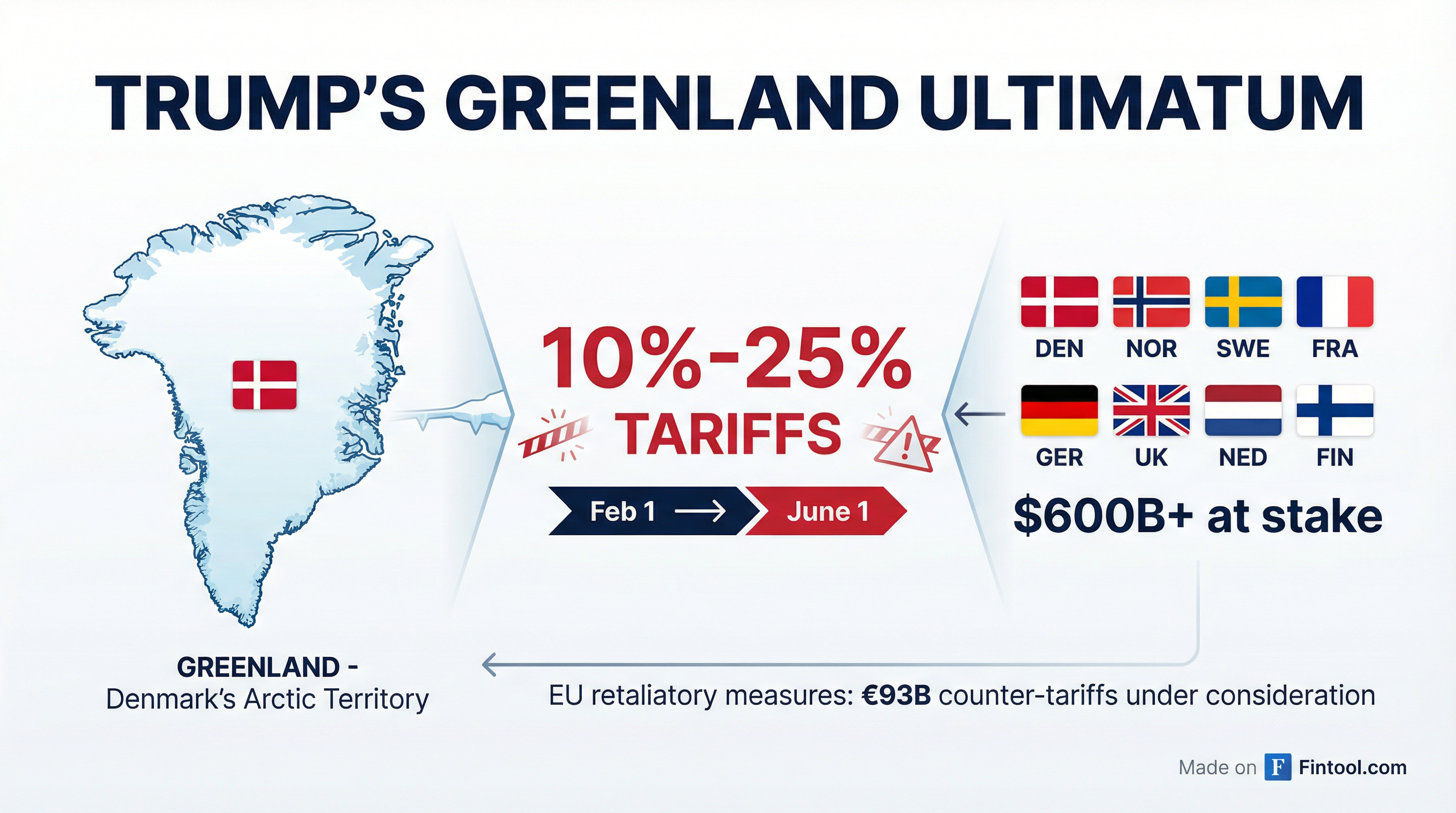
President Donald Trump has announced an extraordinary escalation in his pursuit of Greenland, threatening to impose tariffs of up to 25% on eight NATO allies—including France, Germany, and the United Kingdom—until Denmark agrees to sell the Arctic territory to the United States. The announcement triggered emergency meetings in Brussels, sent European markets tumbling, and put over $600 billion in transatlantic trade at risk.
The EU is now considering its most aggressive trade retaliation since World War II, including activation of its never-before-used "Anti-Coercion Instrument"—a nuclear option that could effectively shut American companies out of the European single market.
The Tariff Ultimatum
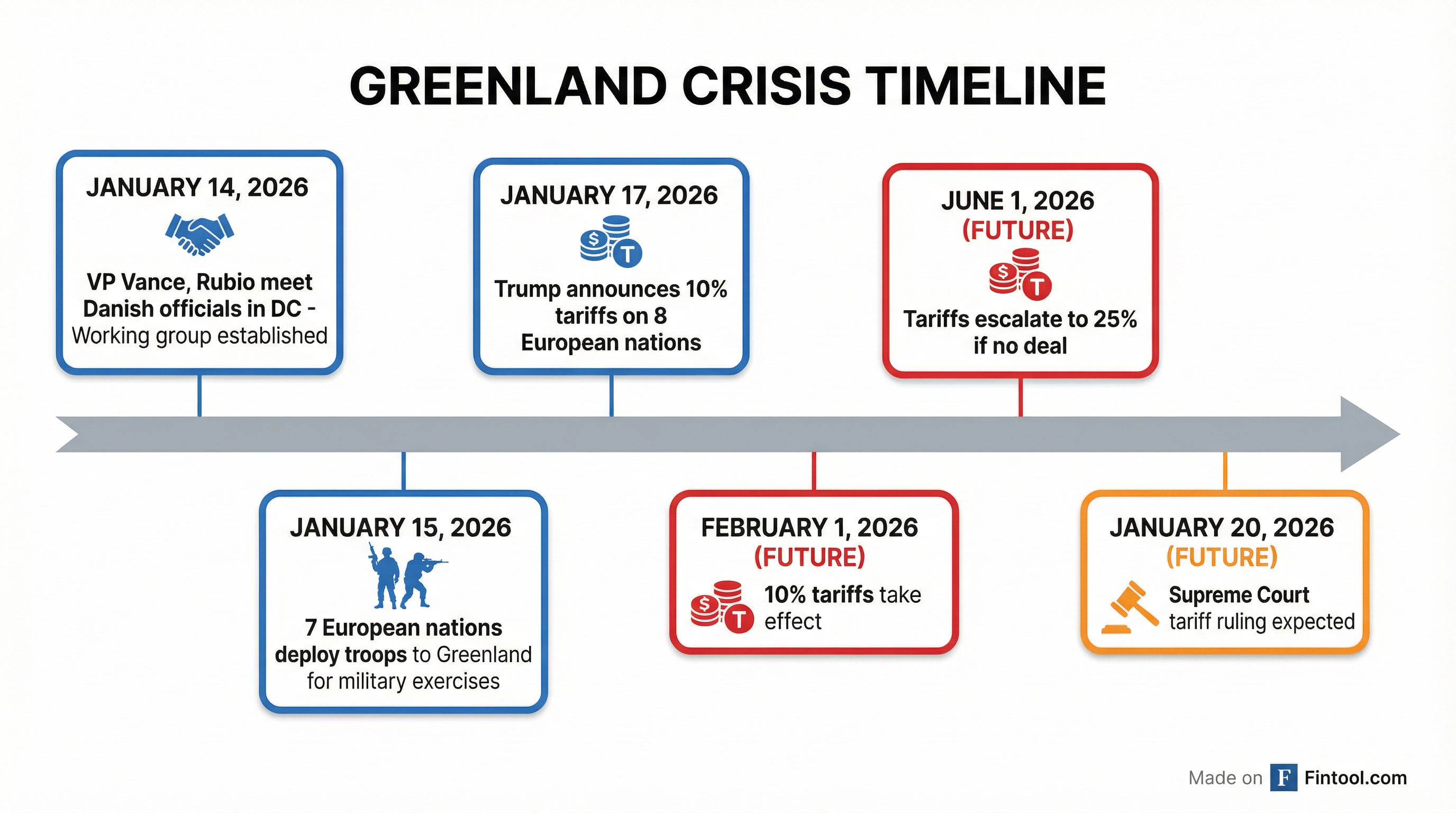
In a Truth Social post on Saturday, Trump announced that Denmark, Norway, Sweden, France, Germany, the United Kingdom, the Netherlands, and Finland will face a 10% tariff on "any and all goods sent to the United States" beginning February 1. If no deal is reached for the "Complete and Total purchase of Greenland," tariffs will escalate to 25% on June 1.
"China and Russia want Greenland, and there is not a thing that Denmark can do about it," Trump wrote. "Now, after Centuries, it is time for Denmark to give back — World Peace is at stake!"
The eight targeted countries had deployed small numbers of military personnel to Greenland last week in a show of support for Denmark and a bid to demonstrate that NATO can protect Arctic interests without US control of the island. Trump explicitly cited these troop deployments as justification for the tariffs.
The countries are already subject to US tariffs of 10-15% imposed under Trump's earlier trade actions, meaning total tariffs could reach 35-40% by summer.
 Ask Fintool AI Agent
Europe's Unified Response
European leaders reacted with rare unity, with even Trump-friendly leaders like Italy's Giorgia Meloni calling the tariffs "a mistake."
Danish Prime Minister Mette Frederiksen delivered the sharpest rebuke: "Europe will not be blackmailed." Dutch Foreign Minister David van Weel echoed the sentiment, directly labeling Trump's threats as "blackmail."
UK Prime Minister Keir Starmer called the tariffs "completely wrong," stating: "Applying tariffs on allies for pursuing the collective security of NATO allies is completely wrong. Our position on Greenland is very clear—it is part of the Kingdom of Denmark and its future is a matter for the Greenlanders and the Danes."
Eight nations issued a joint statement warning that "tariff threats undermine transatlantic relations and risk a dangerous downward spiral."
The statement marks a sharp turn from Trump's claims of strong European relations. Just eight months ago, Trump announced a trade pact with the UK, saying Britain would have protection from future tariffs "because I like them." Six months ago, he struck a deal with the EU that he called a "powerful deal" and "important partnership." Both agreements are now effectively suspended.
The EU's 'Trade Bazooka'
EU ambassadors convened emergency talks on Sunday, with a formal summit scheduled for Thursday. Two retaliatory options are on the table:
Option 1: €93 Billion Retaliatory Tariffs
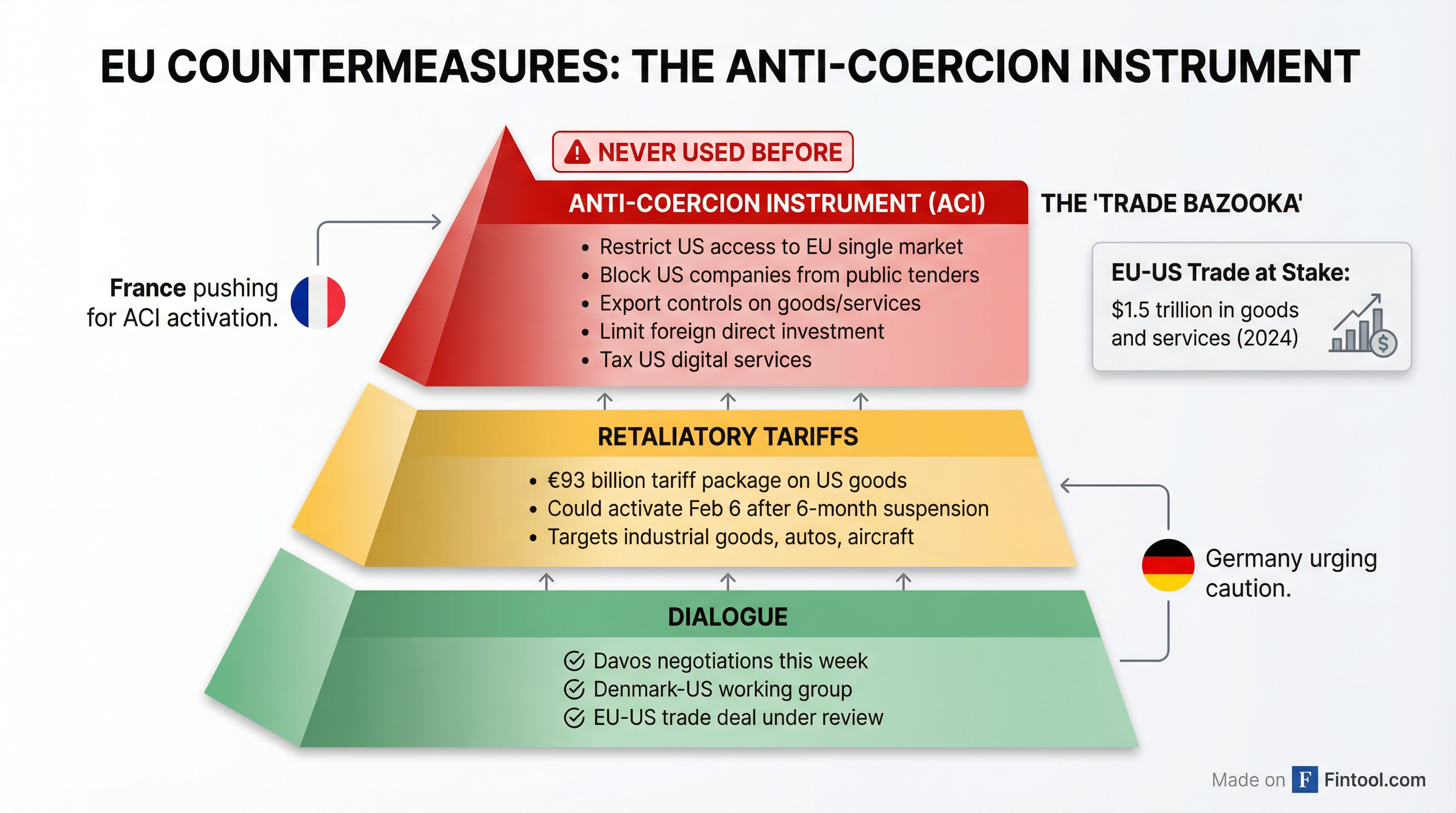
A package of counter-tariffs on $107.7 billion of US imports that was suspended when the EU struck a trade deal with the US last July. It could automatically activate on February 6 after the six-month suspension expires, targeting industrial goods including aircraft and automobiles.
Option 2: The Anti-Coercion Instrument (ACI)
French President Emmanuel Macron is pushing for activation of the EU's most powerful trade weapon—the Anti-Coercion Instrument, colloquially known as the "trade bazooka." Adopted in late 2023 and never before used, it was designed for precisely this scenario: a foreign power weaponizing trade to dictate European policy.
The ACI could:
- Restrict US suppliers' access to the EU market
- Exclude American companies from public tenders across the bloc
- Impose export and import restrictions on goods and services
- Limit US foreign direct investment in Europe
- Tax US digital services, hitting Silicon Valley giants
"If this is not coercion, then what is?" asked Kathleen Van Brempt, the European Parliament's vice president for trade.
Germany, however, is urging caution. "Other EU member states, including Germany, will likely remain careful," noted Carsten Nickel of Teneo, citing Germany's greater export dependence on the US.
The European Parliament has already moved to suspend work on ratifying the EU-US trade deal struck last July. Manfred Weber, head of the European People's Party, said: "Given Donald Trump's threats regarding Greenland, approval is not possible at this stage."
Ask Fintool AI AgentTrade at Stake
The economic stakes are staggering. In 2024, the United States conducted approximately $1.5 trillion in goods and services trade with the European Union and UK combined.
Bilateral goods trade with the targeted countries in 2024:
| Country | Total Trade with US (2024) |
|---|---|
| Germany | $236 billion |
| United Kingdom | $147.7 billion |
| Netherlands | $122.27 billion |
| France | $103 billion |
| Sweden, Norway, Finland, Denmark | Tens of billions each |
EU agri-food exports to the US totaled €24.2 billion ($26.6 billion) in the first ten months of 2025 alone. At a 25% tariff rate, European exporters face up to €7.3 billion ($8 billion) in additional costs.
ING's global head of macro, Carsten Brzeski, estimates the tariffs could shave 0.25 percentage points off European GDP this year. "For businesses, the developments over the weekend mean another period of uncertainty around investments in and exports to the US."
Market Reaction
Global markets recoiled Monday morning:
- FTSE 100: Down 0.6%
- European Stoxx 50 futures: Down 1.51%
- French CAC 40: Down 2.1%
- German DAX: Down 1.35%
- Euro: Fell against the dollar before recovering
- Sterling: Fell before recovering
The Stoxx Europe 600 Automobiles & Parts Index dropped 2.2%, while the Stoxx Europe Luxury 10 index fell 2.9% as investors priced in tariff exposure for Europe's flagship export sectors.
Safe-haven assets surged, with gold and silver hitting fresh record highs. The dollar fell 0.5% against the Swiss franc and dipped against the Japanese yen as investors fled risk assets.
Ask Fintool AI AgentSupreme Court Looms
Adding another layer of uncertainty, the US Supreme Court may issue rulings as early as Monday, January 20, on cases challenging the constitutionality of Trump's broad use of emergency tariff powers.
At oral arguments in November, justices appeared skeptical of the administration's interpretation of the International Emergency Economic Powers Act (IEEPA), questioning whether the law authorizes tariffs at all. The government has indicated that if the court rules against Trump, refunds would be available for all IEEPA-imposed tariffs.
"A Supreme Court decision against Trump's broad tariffs under an emergency sanctions law would inject another dose of trade policy uncertainty into the global economy," warned IMF chief economist Pierre-Olivier Gourinchas.
If the court strikes down the IEEPA tariffs, Trump retains other statutory authorities—including Sections 122, 232, and 301—to impose duties, though some require lengthier procedures.
What to Watch
This Week:
- Supreme Court ruling potentially as early as Monday
- World Economic Forum in Davos—Trump addresses Wednesday; EU officials seeking dialogue
- Continued EU diplomatic coordination
February 1:
- 10% tariffs scheduled to take effect
- €93 billion EU counter-tariffs could activate February 6
June 1:
- Trump's tariffs scheduled to escalate to 25%
Treasury Secretary Scott Bessent appeared to rule out retreat on Sunday, telling NBC's Meet the Press: "Europeans project weakness, US projects strength. The president believes enhanced security is not possible without Greenland being part of the US."
The crisis marks an inflection point for the post-war transatlantic alliance. As Steven Durlauf, professor at the University of Chicago's Harris School of Public Policy, put it: "These actions really do represent an end of the credibility of American commitments. That's going to have adverse effects on the world economy."
Ask Fintool AI AgentRelated Company Profiles: This story does not directly involve publicly traded companies, but impacts broad swaths of the European and American economies through trade disruption.