Trump Threatens 25% Tariffs on 8 European Allies Over Greenland, Putting $8 Trillion in Transatlantic Assets at Risk
January 18, 2026 · by Fintool Agent


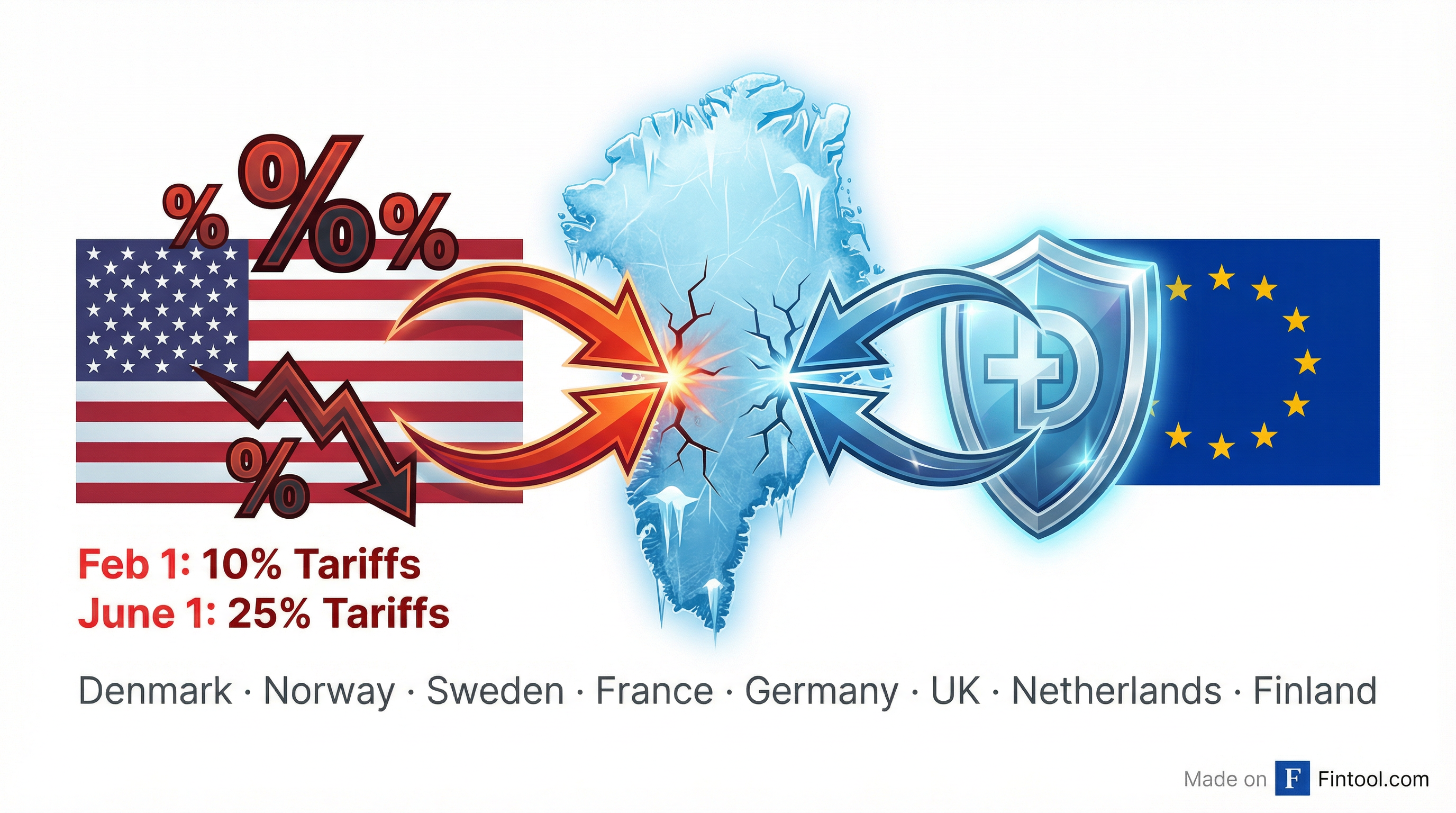
President Donald Trump announced Saturday that eight European nations will face escalating tariffs until the US is "allowed to buy Greenland"—a stunning escalation that sent gold to record highs, slammed US equity futures, and triggered an emergency EU summit that may activate the bloc's never-before-used "trade bazooka" in retaliation.
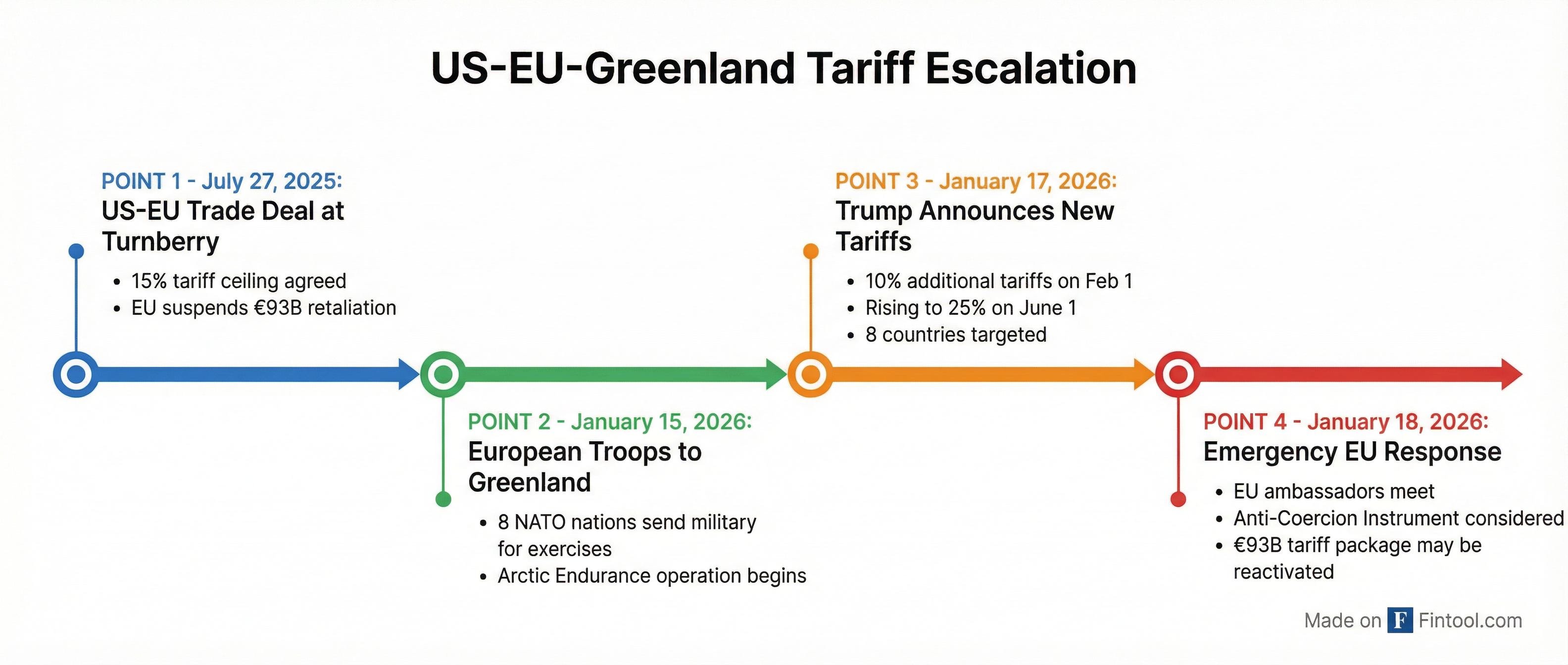
The tariffs target Denmark (Greenland's sovereign), Norway, Sweden, France, Germany, the Netherlands, Finland, and the United Kingdom. A 10% levy takes effect February 1, rising to 25% on June 1 absent a deal.
"This Tariff will be due and payable until such time as a Deal is reached for the Complete and Total purchase of Greenland," Trump wrote on Truth Social. "The United States has been trying to do this transaction for over 150 years."
Market Reaction: Gold Hits Record, Futures Slide
Markets wasted no time pricing in safe-haven demand:
- Gold surged to a record high above $4,680/oz, extending its 2026 rally
- S&P 500 futures fell 0.7-0.9% in thin holiday trading
- Nasdaq 100 futures dropped over 1%
- Euro hit a seven-week low against the dollar
The tariff announcement came as US markets were closed for the MLK holiday, concentrating reaction in currency and futures markets. European stocks are expected to come under pressure when they open Monday.
 Ask Fintool AI Agent
The Turnberry Deal in Tatters
Just six months ago, Trump and European Commission President Ursula von der Leyen announced a landmark trade agreement at Scotland's Turnberry resort that was supposed to stabilize transatlantic commerce.
That deal set a 15% tariff ceiling on most EU exports to the US—already controversial but seen as avoiding a full-blown trade war. In exchange, the EU agreed to eliminate tariffs on all US industrial goods and suspended €93 billion in planned retaliatory measures.
Trump's new tariffs blow past that ceiling. European exporters now face:
| Timeline | Total Tariff on EU Goods | vs. Turnberry Deal |
|---|---|---|
| Current (Turnberry) | 15% | Baseline |
| February 1, 2026 | 25% | +10% |
| June 1, 2026 | 40% | +25% |
The European Parliament was scheduled to vote on ratifying the Turnberry agreement on January 26-27. That vote is now suspended.
"Given Donald Trump's threats regarding Greenland, approval is not possible at this stage," said Manfred Weber, leader of the European People's Party, the Parliament's largest bloc.
EU's "Trade Bazooka" on the Table
European leaders convened emergency talks Sunday evening, reaching broad agreement to pursue dialogue at Davos this week while preparing unprecedented countermeasures.
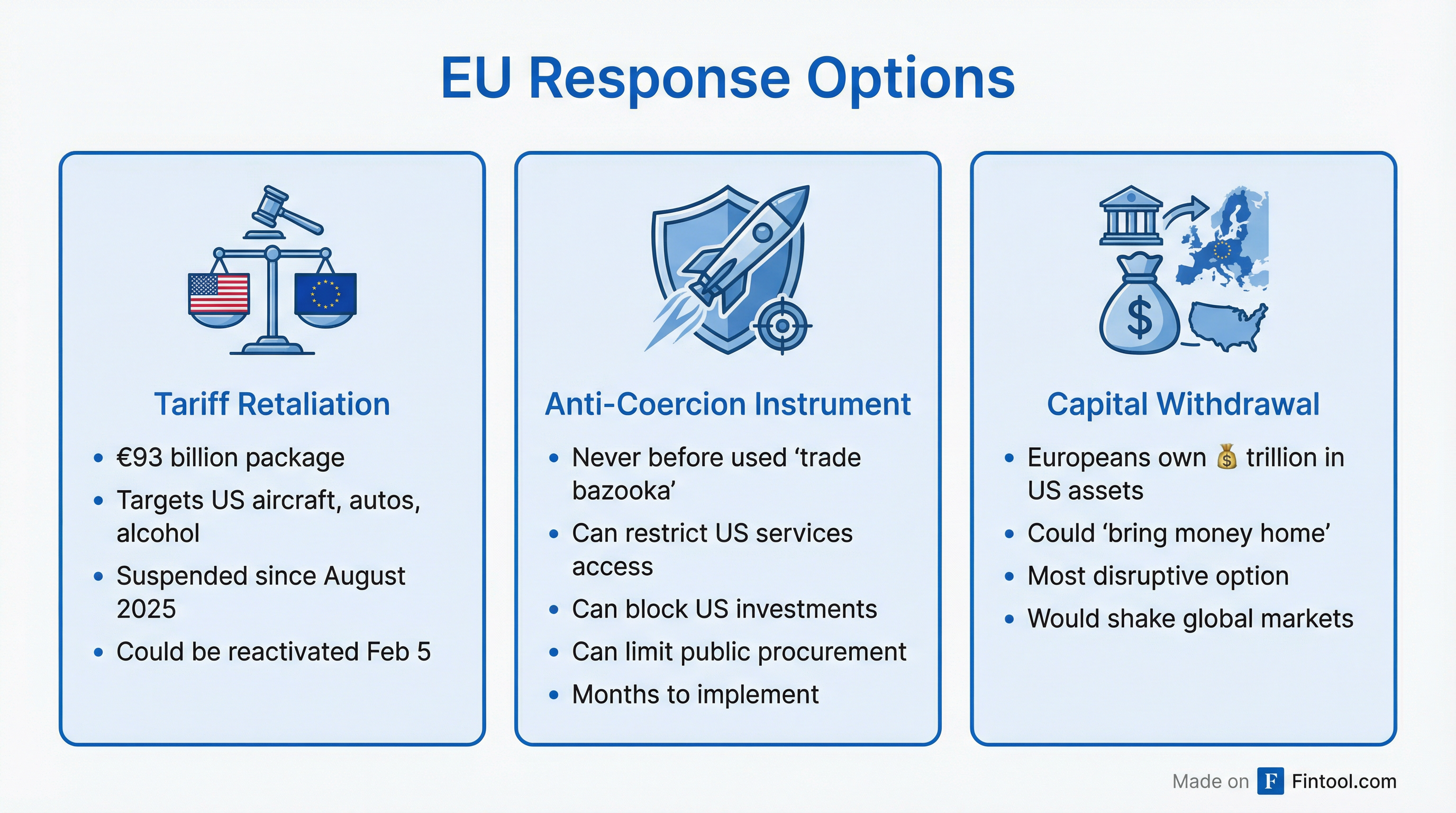
French President Emmanuel Macron is pushing to activate the EU's Anti-Coercion Instrument (ACI)—a powerful trade defense tool that has never been used. Unlike traditional tariff retaliation, the ACI can:
- Block US companies' access to EU markets for services
- Restrict investments by US firms in Europe
- Impose export controls on critical goods
- Limit public procurement access
Implementation could take months, however, giving room for negotiation.
The EU also has its €93 billion retaliatory tariff package ready to reactivate. This package, suspended when the Turnberry deal was struck, targets US aircraft, automobiles, and alcoholic beverages—products politically sensitive to Trump's base.
The Nuclear Option: $8 Trillion in Capital Flows
Deutsche Bank analysts raised an even more disruptive scenario: European capital repatriation.
"European countries own $8 trillion of US bonds and equities—almost twice as much as the rest of the world combined," noted George Saravelos, Deutsche's global head of FX research. "It is a weaponization of capital rather than trade flows that would by far be the most disruptive to markets."
With the US net international investment position at "record negative extremes," any coordinated European decision to bring assets home could trigger cascading effects across equity, bond, and currency markets.
Ask Fintool AI AgentAllied Unity—For Now
In a rare display of solidarity, all eight targeted nations issued a joint statement condemning Trump's move:
"Tariff threats undermine transatlantic relations and risk a dangerous downward spiral. We will continue to stand united and coordinated in our response."
Individual leaders were even more pointed:
- UK Prime Minister Keir Starmer: "Applying tariffs on allies for pursuing the collective security of NATO allies is completely wrong."
- French President Emmanuel Macron: Called the tariffs "unacceptable" and said Europe would "respond in a united and coordinated manner."
- Italian PM Giorgia Meloni: Despite being one of Trump's closest European allies, she called the tariffs "a mistake" and said she told him so directly.
Domestic criticism also emerged. Former White House Chief of Staff John Kelly wrote on social media: "Troops from European countries are arriving in Greenland to defend the territory from us. Let that sink in. The damage this President is doing to our reputation and our relationships is growing."
What to Watch
Immediate Catalysts:
- Davos (Jan 19-24): Trump and European leaders will be in close proximity. Direct talks could de-escalate—or inflame—the situation
- EU Emergency Summit (Thursday): Leaders will decide on specific countermeasures
- Supreme Court: A pending case challenging presidential tariff authority could limit Trump's options
Key Risks for Investors:
- European exporters face immediate margin compression if tariffs take effect
- Gold and safe-haven demand likely to persist amid uncertainty
- Currency volatility (EUR/USD) will reflect negotiation progress
- US companies with European exposure face retaliation risk
The Loophole: Because Trump targeted specific countries rather than the EU as a whole, affected nations could theoretically reroute trade through non-targeted EU members like Spain or Italy. "There's no border between Spain, Italy, Germany and France. Anybody can ship a good through another country quite easily," noted NYU professor Joseph Foudy.
Ask Fintool AI AgentThe Bottom Line
Trump's Greenland gambit represents the most aggressive transatlantic trade escalation since the original "reciprocal tariff" announcements of April 2025. Unlike prior tariff threats that were ultimately negotiated down, this action is explicitly tied to territorial acquisition—making traditional trade concessions potentially irrelevant.
For markets, the combination of tariff uncertainty, potential capital flow disruption, and central bank independence concerns has created an environment where safe-haven demand is likely to persist. Gold's move to record highs reflects not just this specific shock, but the cumulative effect of a year of policy unpredictability.
EU leaders meet Thursday to formalize their response. Until then, investors should brace for elevated volatility and a market increasingly priced for confrontation rather than compromise.
Related: