Tyson Foods Extends Dividend Streak to 14 Years as Protein Giant Posts Strongest Balance Sheet in Years
February 5, 2026 · by Fintool Agent

Tyson Foods raised its annual dividend to $2.04 per Class A share at its 63rd Annual Meeting of Shareholders in Springdale, Arkansas, extending its dividend growth streak to 14 consecutive years while delivering the strongest balance sheet in recent memory.
The meeting comes just three days after Tyson reported Q1 FY2026 earnings that beat consensus, with revenue of $14.3 billion and adjusted EPS of $0.97. Net leverage dropped to 2.0x—down approximately 2.5 turns from peak levels—as the company reduced gross debt by $1.4 billion over the past 12 months.
"We entered fiscal 2025 with a clear plan to improve our operational execution and drive better financial performance," CFO Curt Calaway told shareholders. "Through deliberate actions, we successfully executed this plan, resulting in a significant improvement in profitability over the prior year."
The Dividend Streak
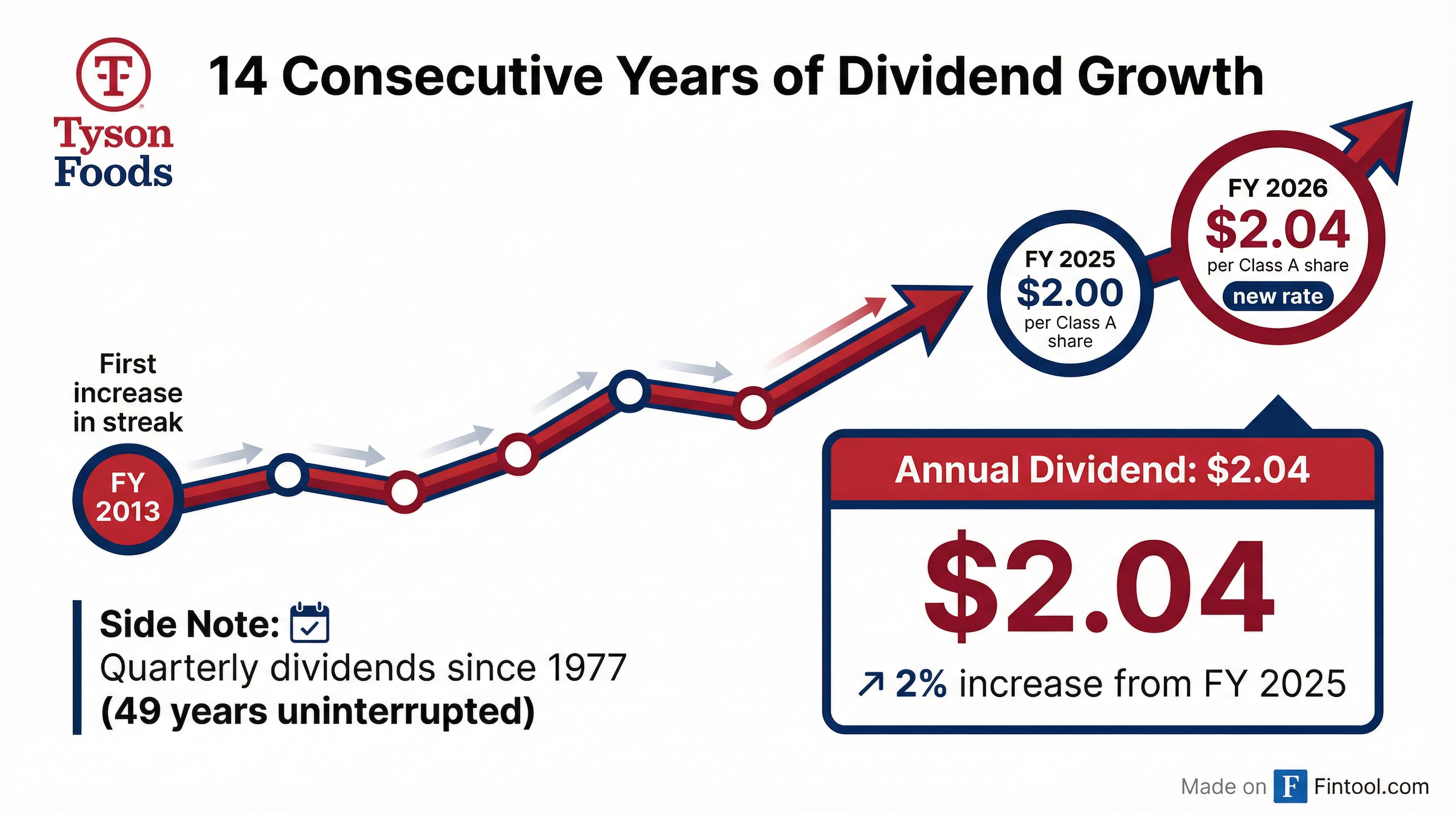
The 2% increase to $2.04 represents the 14th consecutive annual dividend raise since fiscal 2013—a period spanning commodity cycles, pandemics, and significant industry restructuring. Tyson has paid uninterrupted quarterly dividends since 1977, a 49-year streak.
"This increase in dividends reflects the confidence our management team and board have in our cash flows of the business," Calaway noted.
| Dividend Metric | Value |
|---|---|
| FY 2026 Annual Rate (Class A) | $2.04 |
| FY 2025 Annual Rate | $2.00 |
| Quarterly Dividend | $0.51 |
| Increase | 2% |
| Consecutive Years of Growth | 14 |
| Uninterrupted Dividends Since | 1977 |
The Board declared the most recent quarterly dividend on February 4, 2026, payable June 15, 2026 to shareholders of record June 1, 2026.
 Ask Fintool AI Agent
Balance Sheet Transformation
The capital allocation story at Tyson has shifted dramatically over the past two years. From a levered position that constrained strategic flexibility, the company has methodically strengthened its financial foundation.
| Balance Sheet Metric | Q1 FY2026 | FY 2025 | FY 2024 |
|---|---|---|---|
| Net Leverage | 2.0x | 2.1x | 2.6x* |
| Liquidity | $4.5B | $3.7B | - |
| Q1 Operating Cash Flow | $942M | - | - |
| Q1 Free Cash Flow | $690M | - | - |
| Gross Debt Reduction (12 mo.) | $1.4B | - | - |
*Values retrieved from S&P Global
In Q1, Tyson returned $224 million to shareholders through dividends and share repurchases, building on $893 million returned in FY 2025.
"With leverage continuing to decline and cash flows remaining strong, we continued share repurchases of $47 million during the quarter," Calaway said.
FY 2025: The Turnaround Year
Fiscal 2025 marked a turning point for Tyson. After posting a net loss in FY 2023, the company returned to sustained profitability while strengthening its balance sheet.
| Metric | FY 2025 | FY 2024 | FY 2023 | FY 2022 |
|---|---|---|---|---|
| Revenue | $54.4B | $53.3B | $52.9B | $53.3B |
| Net Income | $474M | $800M | ($648M) | $3.2B |
| Operating Cash Flow | $2.2B | $2.6B | $1.8B | $2.7B |
| CapEx | $978M | $1.1B | $1.9B | $1.9B |
The disciplined reduction in capital expenditures—from nearly $2 billion in FY 2022-2023 to under $1 billion in FY 2025—freed cash for debt reduction and shareholder returns.
Protein Powers Forward
CEO Donnie King struck an optimistic tone on protein demand, citing the new U.S. dietary guidelines as validation of Tyson's positioning.
"The updated guidelines and recommendations represent a historic validation of our core mission: providing high-quality, essential protein to millions," King said on the Q1 earnings call. "By advocating for increased animal protein consumption as a leading pillar of a healthy lifestyle, the administration has underscored what we have always known: animal protein is a foundational building block of a nutritious diet."
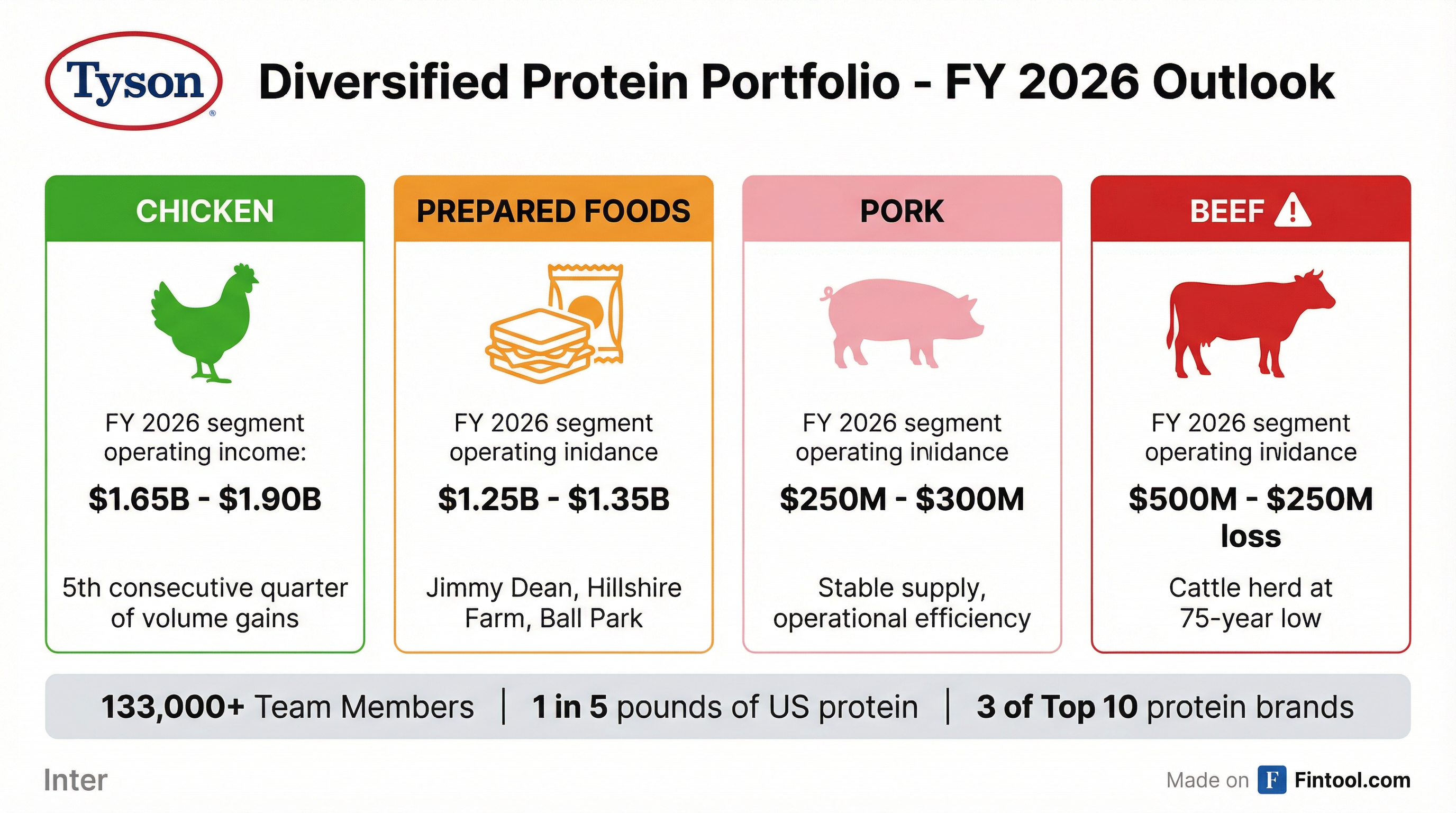
The company's branded portfolio—anchored by Tyson, Jimmy Dean, and Hillshire Farm, three of the top 10 protein brands in the U.S.—continues gaining share.
"Our retail branded products... grew by 2.5% in volume and 3.6% in dollars, significantly outperforming the broader sector," King noted. Specific highlights:
- Tyson Fresh Chicken: +10.7%
- Hillshire Farm Lunchmeats: +10.4%
- Hillshire Snacking: +12.5%
- Aidells Sausage: +7.2%
Ask Fintool AI AgentBeef: Strategic Restructuring
The elephant in the room remains beef. With the U.S. cattle herd at its smallest since 1951—9% below 2019 levels—Tyson has moved decisively to right-size operations.
In January, the company closed its Lexington, Nebraska facility and reduced Amarillo, Texas to single-shift operations. The moves weren't reflected in Q1 results but are expected to improve capacity utilization and reduce losses going forward.
"We expect cattle supplies to remain tight throughout 2026 and 2027," King acknowledged. "During this period, chicken is likely to continue to benefit most from the changing consumer preferences."
The FY 2026 outlook for beef remains challenging:
| Segment | FY 2026 Guidance |
|---|---|
| Chicken | $1.65B - $1.90B |
| Prepared Foods | $1.25B - $1.35B |
| Pork | $250M - $300M |
| Beef | ($500M) - ($250M) loss |
| International | $150M - $200M |
Despite beef headwinds, total company adjusted operating income guidance remains $2.1B - $2.3B.
Next Generation Takes the Board
In a moment of family continuity, Chairman John Tyson welcomed two fourth-generation family members to the board: his son John Randall Tyson and daughter Olivia Tyson.
"The next generation that will carry on the family values, and you can rest assured, they knew their grandfather well. They know me well. Occasionally, they'll challenge me, and that's okay. And I am thankful for their accountability," Tyson said.
Sarah Bond from Microsoft also joined the board, adding technology expertise.
The Tyson family and TLP collectively control approximately 71.94% of total voting power through their Class B shares, which carry 10 votes per share compared to one vote for Class A.
Shareholder Proposals: All Defeated
Three shareholder proposals faced defeat at the meeting:
-
Voting Disclosure by Class — The New York City Pension Funds' proposal seeking disclosure of voting results by share class was rejected. The proponent noted that similar proposals have historically received 55-88% support from independent shareholders.
-
Waste Lagoon Environmental Report — As You Sow's proposal requesting disclosure of environmental and health impacts from waste lagoons in Tyson's pork supply chain was defeated.
-
Immigration Impact Assessment — A proposal from the Sisters of St. Francis seeking assessment of immigration policy changes on operations was rejected.
The dual-class structure ensures family control over governance matters, a tension acknowledged but defended by Chairman Tyson: "We are committed, and I'm committed, and the leadership team is committed to creating value for our shareholders, our customers, our team members, and our communities."
Ask Fintool AI AgentWhat to Watch
Near-term catalysts:
- Q2 FY2026 earnings (typically seasonally weaker, particularly in beef)
- Impact of beef plant closures on segment profitability
- Chicken commodity pricing normalization vs. brand strength
Longer-term themes:
- U.S. cattle herd rebuild timing (early signs of heifer retention in some regions)
- Protein demand trajectory as dietary guidelines influence consumer behavior
- Balance sheet optionality for M&A or accelerated buybacks
Consensus estimates project EPS of $3.92 in FY 2026 rising to $4.44 in FY 2027, with revenue reaching $56.4B and $56.9B respectively.* The Street's average price target stands at $69.08.*
*Values retrieved from S&P Global
Related: