U.S. Bancorp Makes $1 Billion Bet on Wall Street With BTIG Acquisition
January 13, 2026 · by Fintool Agent

U.s. Bancorp is buying institutional broker BTIG for up to $1 billion, adding equity trading, investment banking, and prime brokerage capabilities to the nation's largest regional bank. The deal—announced Tuesday morning—marks USB's biggest bet yet on capital markets and ends years of building the business organically.
The acquisition fills the most glaring gap in USB's product lineup. The Minneapolis-based lender already ranks among the top players in investment-grade bonds and syndicated loans, with capital markets revenue of approximately $1.4 billion and a 21% compound annual growth rate from 2021 to 2024. But equity capabilities—the trades and advisory work that generate the fattest fees on Wall Street—were conspicuously absent.
"BTIG's top talent, capabilities and technology will position us for continued capital markets growth and deeper client relationships," said U.s. Bancorp CEO Gunjan Kedia.
The Deal
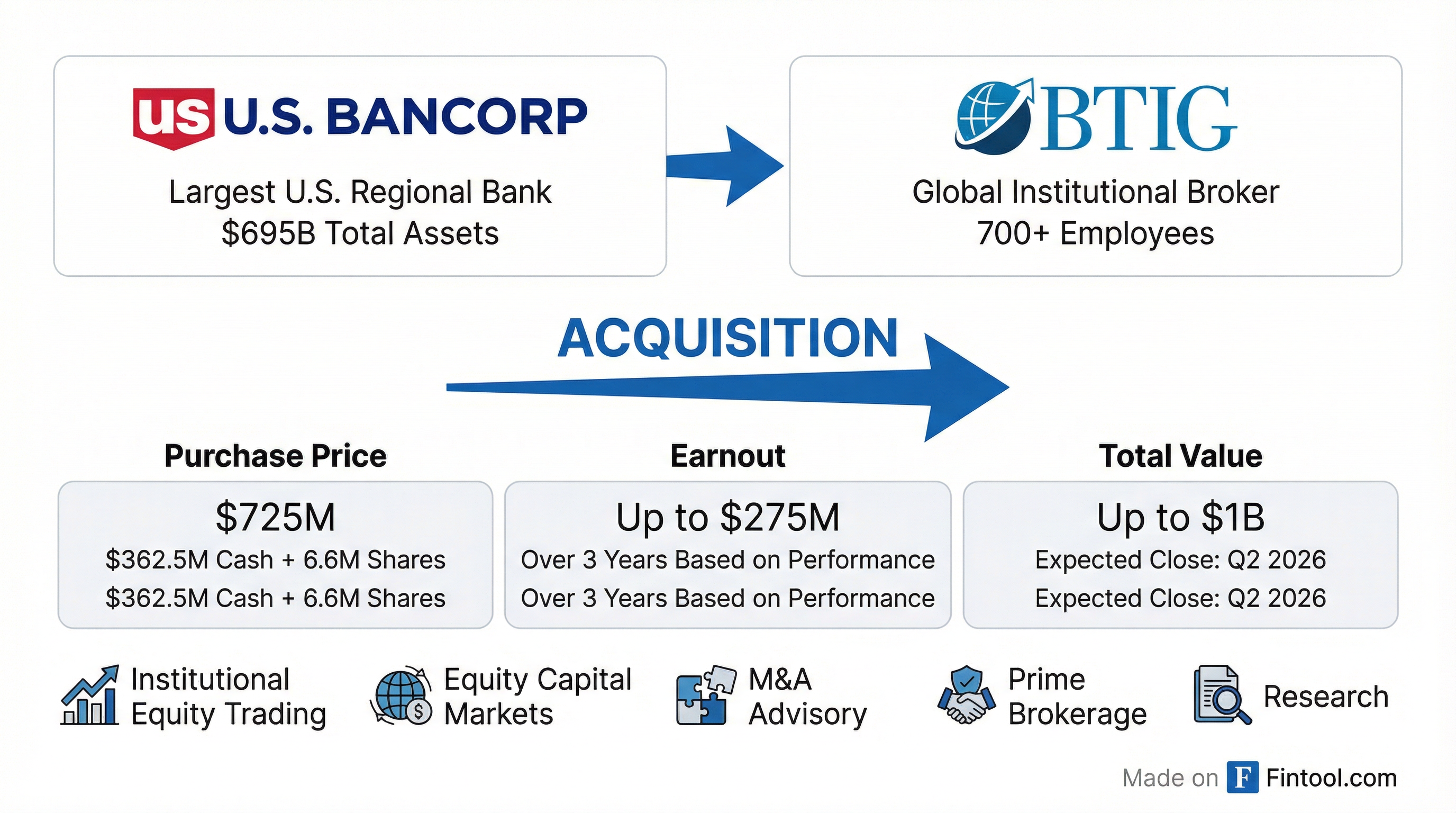
U.S. Bancorp will pay $725 million at closing—half in cash, half in stock—with up to $275 million in additional earnouts tied to performance over three years. The deal is expected to close in Q2 2026.
The financial impact appears manageable: USB expects negligible 2026 EPS effect and roughly 12 basis points of CET1 capital dilution at closing, with no change to near-term capital return plans.
| Metric | Value |
|---|---|
| Base Purchase Price | $725 million |
| Cash Component | $362.5 million |
| Stock Component | 6.6 million USB shares |
| Performance Earnout | Up to $275 million over 3 years |
| Maximum Deal Value | $1 billion |
| Expected Close | Q2 2026 |
| CET1 Impact | 12 bps reduction at close |
 Ask Fintool AI Agent
Filling the Product Gap
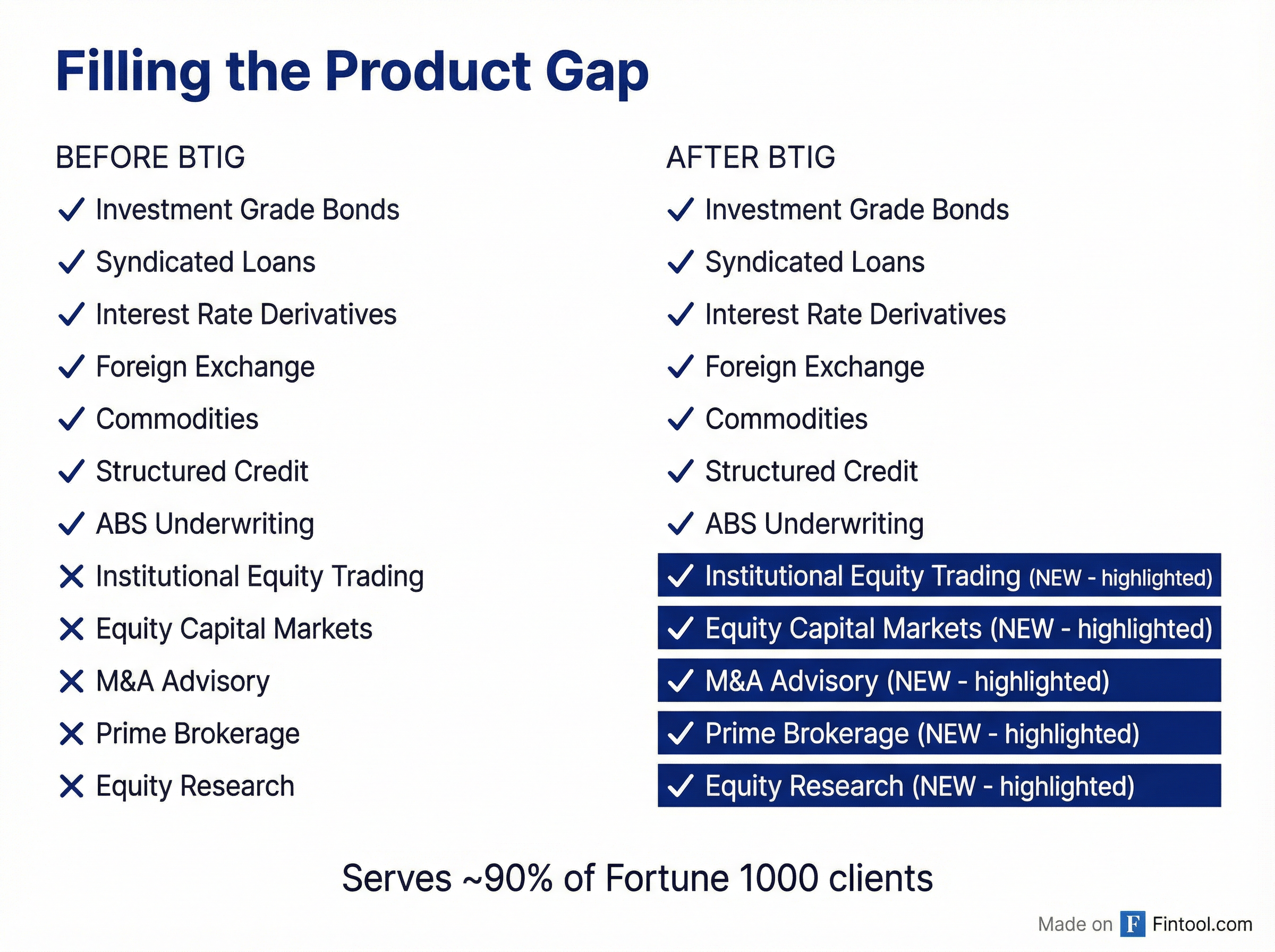
BTIG brings exactly what USB lacks: institutional equity sales and trading, equity capital markets, M&A advisory, prime brokerage, and equity research.
The acquisition makes strategic sense. USB management has been telegraphing this move for over a year. On the Q4 2024 earnings call, CEO Kedia said plainly: "We have a balance sheet that would support a much bigger capital markets business. So we are very focused on that. We're introducing new capabilities there at quite a good pace."
By Q2 2025, CFO John Stern was highlighting the organic build: "The capital markets business continues to show a lot of growth opportunities. We've been growing our client base both in terms of high grade as well as investment grade as well as high yield."
But organic growth has limits. USB's commercial products revenue—which includes capital markets—was "double digit growth last year" but had been "a little bit more subdued" in recent quarters as investment-grade and high-yield underwriting activity slowed.
BTIG accelerates the roadmap. The broker ranks among the top 10 U.S. firms for high-touch equity volume and has participated in more than 1,275 announced investment banking transactions since 2015.
A Partnership Turned Merger
The deal isn't a cold call—USB and BTIG have been partners for a decade. Since 2014, BTIG has served as USB's equity capital markets referral partner, and in 2023 the two launched an M&A advisory referral program.
The problem with referral arrangements: USB was sending clients to BTIG and watching the fees walk out the door. Nearly 90% of Fortune 1000 companies are USB clients. By bringing BTIG in-house, USB keeps those equity and advisory revenues.
BTIG's leadership will remain in place. CEO Anton LeRoy—who joined in 2008 and architected the firm's expansion—will continue leading the business under USB's wealth and institutional banking head Stephen Philipson. Co-founder Steven Starker, a Goldman Sachs alum who started the firm in 2005, will maintain his client-facing role.
Ask Fintool AI AgentUSB by the Numbers
U.S. Bancorp enters this deal from a position of strength. The bank has delivered four consecutive quarters of positive operating leverage, with fee income now representing 42% of total net revenue.
| Metric | Q4 2024 | Q1 2025 | Q2 2025 | Q3 2025 |
|---|---|---|---|---|
| Net Income ($B) | $1.66 | $1.71 | $1.82 | $2.00 |
| Total Assets ($B) | $678 | $676 | $686 | $695 |
| Return on Equity (%) | 11.3%* | 11.5% | 11.9% | 12.8% |
*Values retrieved from S&P Global
USB shares were down about 1.5% in Monday's session, trading around $54 after hours. The stock has risen roughly 55% over the past year from its 52-week low of $35.18.
What to Watch
Regulatory approval. The deal requires sign-off from banking regulators. While the current administration has signaled a friendlier M&A environment, large bank acquisitions still face scrutiny.
Integration execution. Combining a nimble institutional broker with a $695 billion bank is complex. Management's ability to retain BTIG talent while extracting synergies will determine whether the premium was worth it.
Earnout achievement. Up to $275 million of the purchase price depends on BTIG hitting revenue targets. If capital markets activity remains muted, USB pays less—but also gets less growth.
Competitive response. Regional bank peers will take note. USB's move raises the bar for capital markets ambitions across the sector.
Ask Fintool AI AgentRelated: U.s. Bancorp