US Weekly Jobless Claims Fall to 199,000, Beating All Estimates
December 31, 2025 · by Fintool Agent

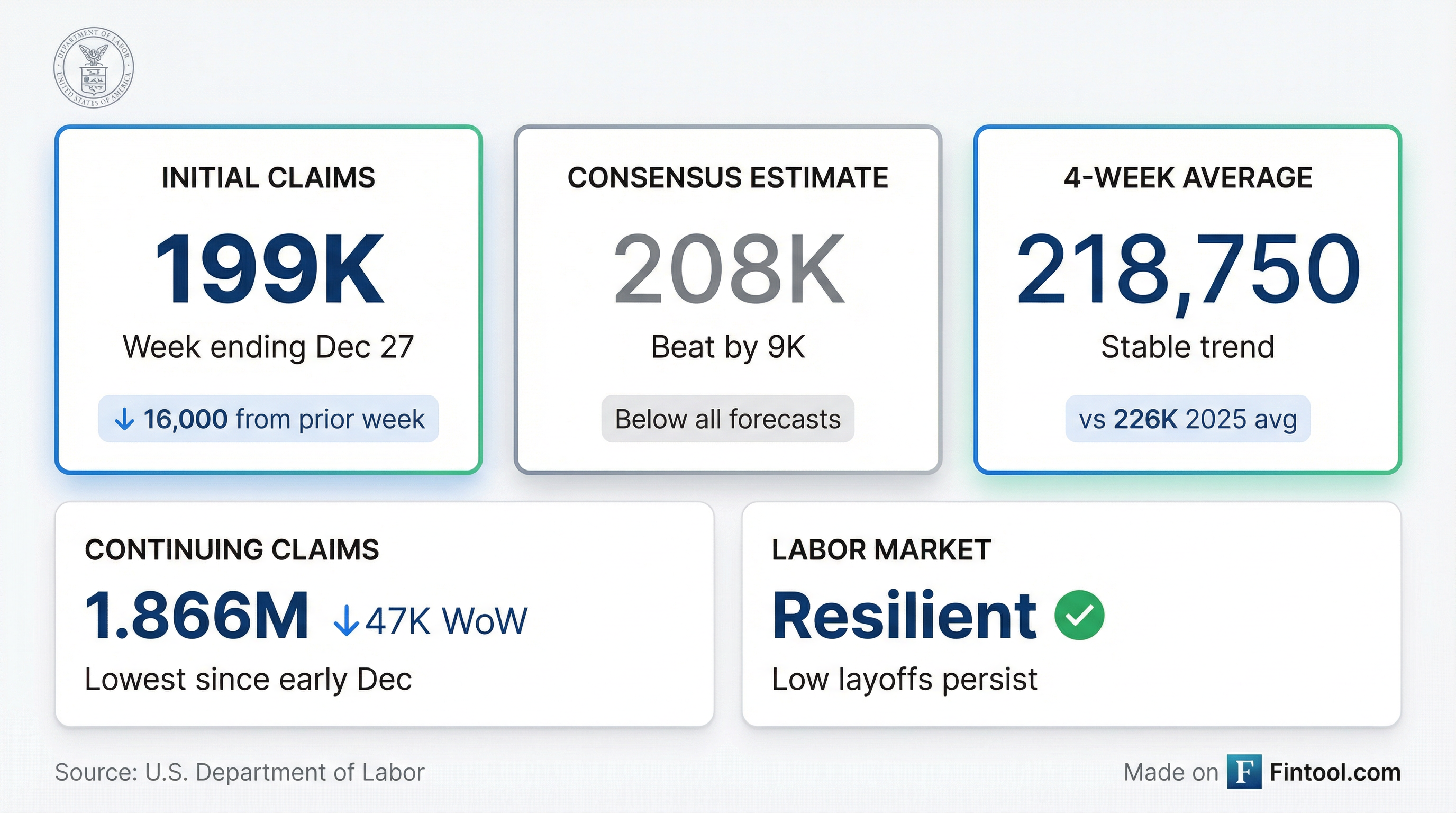
Initial unemployment claims unexpectedly dropped to 199,000 for the week ending December 27—dipping below the psychologically important 200,000 threshold and coming in well below the 208,000 consensus estimate. The 16,000 decline from the prior week's 215,000 marks just the fourth reading below 200,000 since the start of 2024, signaling that layoffs remain historically muted even as the broader labor market has cooled from its post-pandemic highs.
The Numbers
| Metric | This Week | Prior Week | Change |
|---|---|---|---|
| Initial Claims | 199,000 | 215,000 | -16,000 (-7.4%) |
| Continuing Claims | 1.866M | 1.913M | -47,000 |
| 4-Week Average | 218,750 | — | — |
| 2025 Average | 226,096 | — | — |
Source: U.S. Department of Labor
The week included the Christmas holiday plus the newly declared federal holidays of December 24 and 26, which typically introduces volatility into the data as some workers delay filing. The Labor Department released the report a day early due to New Year's Day.
Continuing claims—a proxy for how long the unemployed remain jobless—fell by 47,000 to 1.866 million for the week ending December 20, reaching their lowest level since early December.
 Ask Fintool AI Agent
The 200K Threshold
Economists generally view initial claims below 220,000 as consistent with a healthy, stable labor market. Readings below 200,000 are rare—there have been only four such weeks since January 2024:
| Date | Initial Claims |
|---|---|
| Nov 29, 2025 | 192,000 |
| Dec 27, 2025 | 199,000 |
| Jan 6, 2024 | 199,000 |
| Jan 13, 2024 | 193,000 |
The latest reading suggests employers remain reluctant to cut payrolls despite softer hiring momentum. This "no hire, no fire" dynamic has characterized much of 2025.
Labor Market Context
The claims data arrives against a backdrop of mixed signals:
Signs of Resilience:
- Initial claims consistently below 250,000 for most of 2025
- Continuing claims trending lower in recent weeks
- Layoff announcements remain below historical averages
Signs of Cooling:
- Unemployment rate rose to 4.6% in November, a four-year high
- Nonfarm payrolls added just 64,000 jobs in November after shedding 105,000 in October
- Hiring rates have slowed significantly from 2022-2023 levels
The December employment report, scheduled for release January 9, 2026, will provide a more comprehensive picture of labor market conditions heading into the new year.
Ask Fintool AI AgentFed Implications
The resilient claims data reinforces the Federal Reserve's recent messaging that the labor market is not a source of inflationary pressure. Following the December FOMC meeting, Fed Chair Powell maintained that the committee would proceed cautiously with additional rate cuts, noting that the labor market remains in "approximate balance."
Market pricing shows roughly 24% odds of a rate cut at the January 2026 FOMC meeting, unchanged from before the claims data. The Fed has signaled it wants to see more evidence of labor market conditions before adjusting its policy stance.
| Fed Funds Rate | Current | Dec 2024 | Peak (2023) |
|---|---|---|---|
| Target Range | 4.00-4.25% | 4.25-4.50% | 5.25-5.50% |
Source: Federal Reserve
Ask Fintool AI AgentWhat to Watch
January 9, 2026: December employment report (nonfarm payrolls, unemployment rate)
January 13, 2026: December CPI inflation data
January 28-29, 2026: Next FOMC meeting
The claims data will continue to be an important high-frequency indicator as investors assess whether the labor market can maintain its resilience amid slower economic growth. A sustained move above 250,000 would signal deterioration; continued readings near 200,000 would reinforce the soft-landing narrative.
Ask Fintool AI AgentMarket Reaction
Equity futures were little changed following the release, with the S&P 500 trading slightly lower amid typical year-end thin volumes. Treasury yields edged marginally higher as the labor market resilience suggested less urgency for Fed rate cuts.
| Index | Close | Change |
|---|---|---|
| S&P 500 | 6,845.49 | -0.77% |
| 10-Year Yield | — | +1bp |
Note: Markets closed early for New Year's Eve