VersaBank Expects Deposit Token Regulatory Approvals 'Within a Month' as US Business Outpaces Canada
January 27, 2026 · by Fintool Agent

Versabank founder and CEO David Taylor delivered an upbeat assessment of the company's digital asset strategy at the OTC Markets Digital Asset Virtual Investor Conference today, revealing that regulatory announcements on its deposit token technology could come "within about a month" in both the United States and Canada.
The Canadian digital bank, which trades on both NASDAQ and TSX under ticker VBNK, is positioning itself as a first-mover in bank-issued tokenized deposits—a blockchain-based technology that Taylor argues offers critical advantages over non-bank stablecoins that have dominated crypto headlines.
Shares of VersaBank closed at $15.77, up 0.6% on the day, trading near their 52-week high of $16.32. The stock has gained 85% over the past year as the bank's US expansion exceeded expectations and digital asset opportunities came into focus.
The Regulatory Path Forward
Speaking to investors at the OTC Markets conference, Taylor outlined VersaBank's progress on two simultaneous pilot programs—one in Canada and one in the United States—for its Real Bank Deposit Tokens (RBDTs).
"North of the border, we'd already run a pilot and acclimatized the various regulators about our deposit token, but we're refreshing it in Canada. And south of the border, we're well underway with socializing our deposit token with the US regulators," Taylor explained.
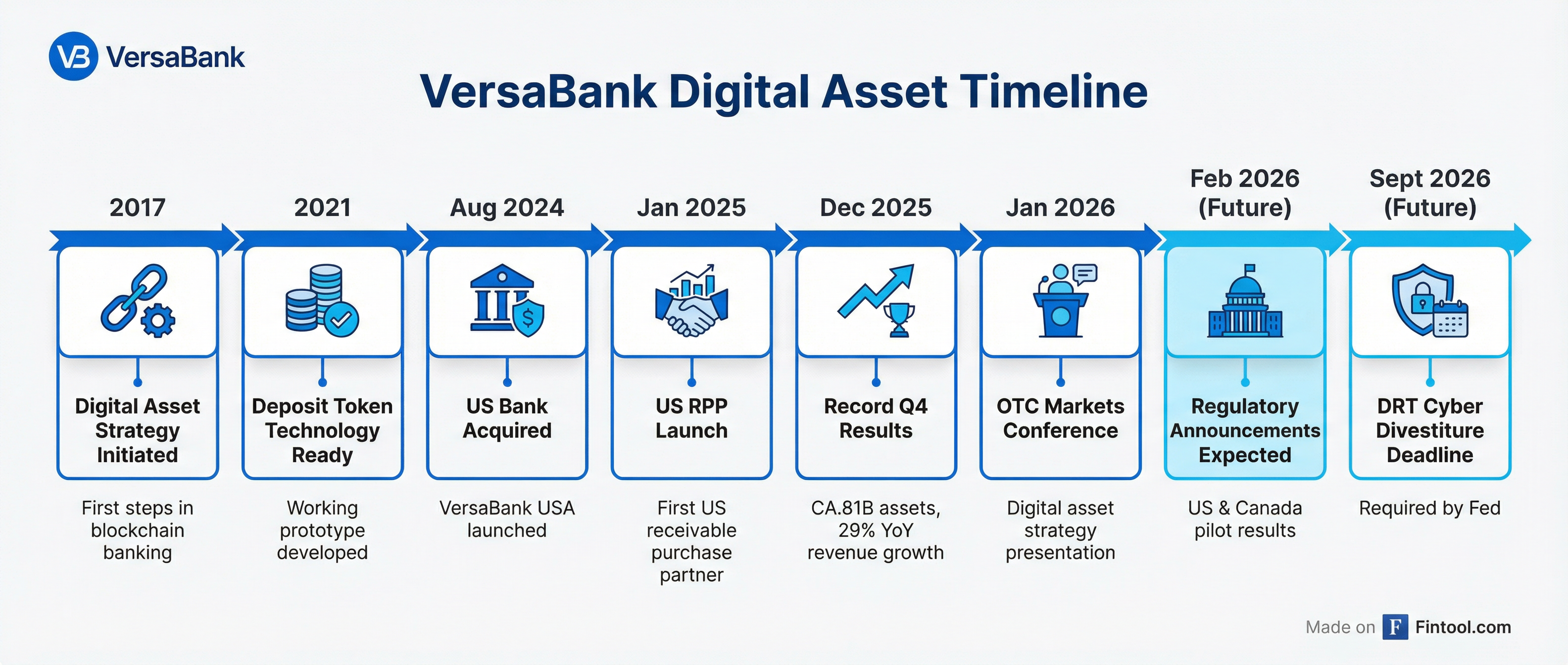
The timing appears deliberate. VersaBank had developed working deposit token technology as early as 2021 but was advised to shelf the initiative when applying for its US banking license. Now, with a "favorable regulatory environment" under the new US administration, the bank is accelerating commercialization.
 Ask Fintool AI Agent
Bank-Issued Tokens vs. Stablecoins: The Key Distinction
Taylor spent considerable time differentiating VersaBank's approach from the stablecoin issuers that have captured market attention. The stablecoin market has surpassed $300 billion in total value, up more than a third in the past 12 months, with transaction volumes "regularly reaching record levels."
But VersaBank is betting that regulated, bank-issued tokens will prove more attractive for institutional and enterprise applications.
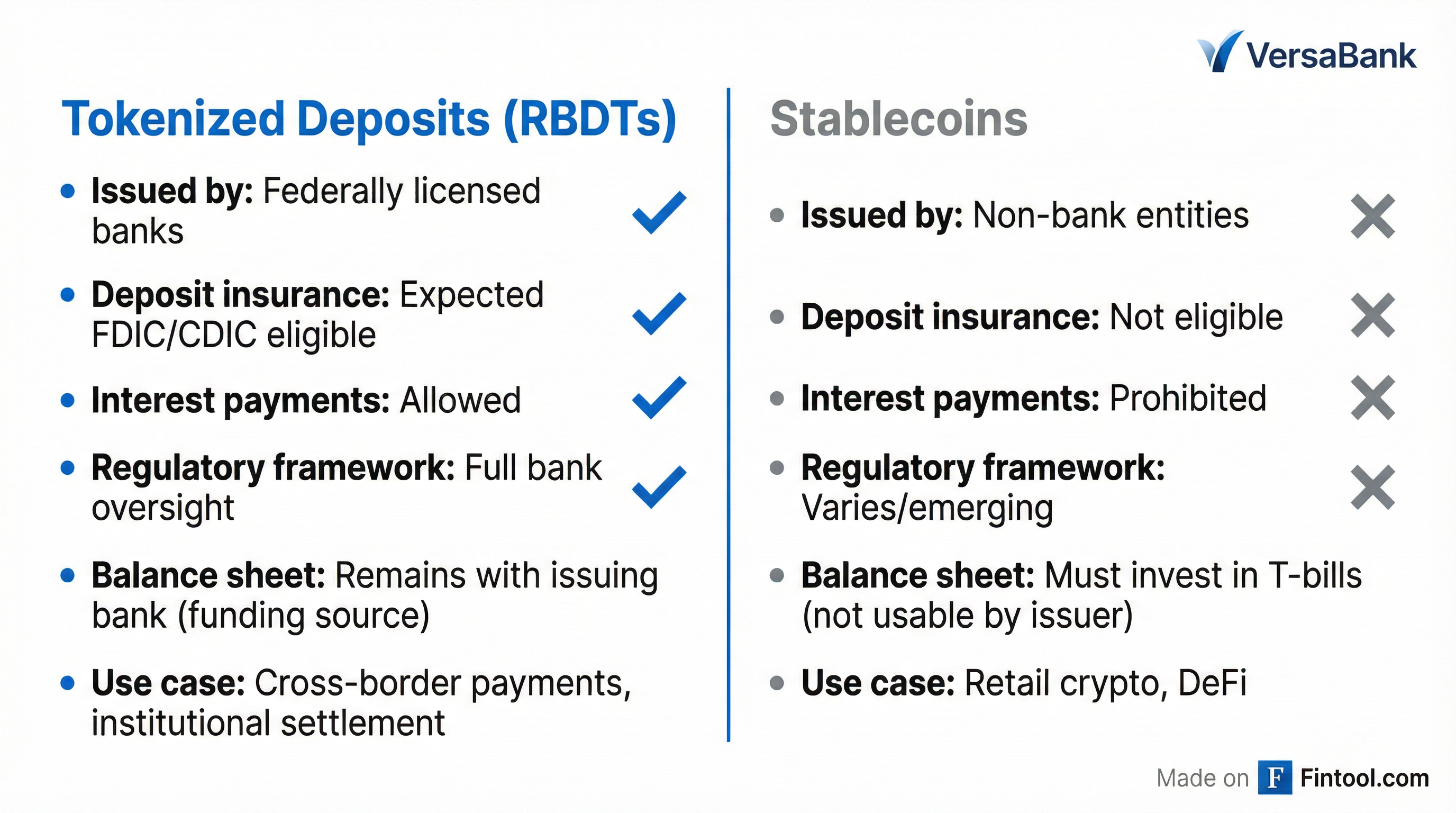
"Deposit tokens adhere to the most rigorous compliance standards, better suited for enterprise-grade applications where know-your-client and anti-money laundering compliance standards must be met," Taylor said. "And very importantly, they reside on the bank's balance sheet, meaning they are a source of low-cost, even no-cost deposits."
The funding advantage is significant. Unlike stablecoins—which must be backed by T-bills held with third parties and cannot be used by the issuer—bank deposit tokens provide actual funding for lending operations. For a bank like VersaBank, which earns its returns by deploying deposits into receivable financing, this represents a potential transformational source of capital.
Taylor was emphatic about deposit insurance eligibility: "We fully expect they will be, but until we receive official approval, I'll have to use the word expect. They are no different than any other deposit that our bank has actually maintained."
Cross-Border Opportunity: $1.3 Trillion at Stake
VersaBank holds a unique position as the only bank with deposit token technology deployed on both sides of the US-Canada border. Taylor framed this as a significant competitive moat, pointing to $1.3 trillion in annual trade activity between the two countries.
"This means billions of potential, tens of billions of very low or even no-cost deposits for our bank," Taylor said.
The vision extends beyond VersaBank's own operations. Taylor outlined plans to license the technology to US community banks facing an "existential crisis" from deposit flight as wealth transfers from older to younger generations increasingly flow to non-bank platforms.
"We've been told by a major banking service provider that approximately 70% of the wealth that is transferred generationally goes to non-bank, crypto, stablecoins, et cetera," Taylor said. "They must embrace new technology or suffer the consequences."
The white-label opportunity could prove substantial. VersaBank plans to host deposit tokens for other community banks and operate an exchange facility enabling dollar-for-dollar conversions between different banks' tokens.
Ask Fintool AI AgentUS Expansion: A Breakout First Year
Beyond digital assets, Taylor provided striking details about VersaBank's core business expansion into the United States. The Receivable Purchase Program (RPP)—a financing solution for point-of-sale lenders—generated more deal flow in its first full year of US operation than the Canadian program achieved after 18 years.
"Fantastic reception in the US market. We've been able to sign up some big players. We have a few more in the works presently," Taylor said.
The numbers confirm the momentum. VersaBank's US credit assets surged from $65.2 million at fiscal year-end 2024 to $441.8 million by October 31, 2025—a 578% increase. Management is targeting at least CAD $1 billion in US RPP funding during fiscal 2026.
| Metric | FY 2023 | FY 2024 | FY 2025 | YoY Change |
|---|---|---|---|---|
| Total Assets (CAD B) | $4.21 | $4.84 | $5.81 | +20% |
| Total Revenue (CAD M) | $100.9 | $111.6 | $124.6 | +12% |
| Net Interest Income (CAD M) | $91.5 | $102.7 | $116.2 | +13% |
| Adjusted Net Income (CAD M) | $39.0 | $39.7 | $36.9 | -7% |
| Adjusted EPS (CAD) | $1.55 | $1.49 | $1.17 | -21% |
Note: FY 2025 adjusted net income excludes $9.9M in one-time reorganization costs. Reported EPS was $0.90, impacted by reorganization expenses and a 25% increase in share count from the December 2024 equity offering.
VersaBank is also developing AI-driven instant purchase capabilities for receivables, which would allow partners to sell loans in real-time rather than batching them—reducing partner liquidity requirements to "theoretically, no liquidity."
Digital Asset Timeline and Catalysts
Cybersecurity Divestiture: Bids Expected Shortly
Under the Federal Reserve's approval of VersaBank's 2024 US bank acquisition, the company must divest its DRT Cyber cybersecurity subsidiary by September 2026. Taylor indicated the sale process is advancing.
"In the next month, you'll see we'll be receiving bids for the business," Taylor said. He described DRT Cyber as a penetration testing specialist serving "high-value targets" including railway lines, police departments, and energy companies.
Importantly, VersaBank's deposit token intellectual property—despite residing within DRTC—is not expected to be part of any divestiture. The digital asset technology will remain with the bank.
The sale could provide a meaningful capital boost. DRT Cyber currently generates approximately CAD $7.2 million in annual revenue but operates at a small loss. Management has suggested the divestiture could free up regulatory capital and remove roughly CAD $10 million in annual non-interest expenses.
Ask Fintool AI AgentWhat to Watch
Several near-term catalysts could drive the stock:
-
Regulatory announcements on deposit token pilots in the US and Canada—expected within approximately one month
-
DRT Cyber sale bids anticipated in the coming weeks, with potential for proceeds to boost capital ratios
-
Shareholder vote on corporate reorganization to a US bank framework at the April annual meeting
-
US RPP scaling toward the CAD $1 billion funding target, with management guiding for flat non-interest expenses and stable-to-improving net interest margins in fiscal 2026
-
Stablecoin custody revenue as VersaBank positions its VersaVault technology to serve third-party stablecoin issuers
The digital asset opportunity represents potential upside to what Taylor characterized as an already "established, consistently profitable, high-growth North American bank." With tokenized deposits projected to become mainstream—major banking names including JPMorgan and Citi have announced various initiatives—VersaBank's early-mover position could prove valuable.
"The digital asset revolution is upon us and is transforming financial industry that includes banking," Taylor concluded. "There are two main functional areas that are relevant to us as a bank: deposits and payments. We're pursuing both."
Related