Zepto Files for $1.3 Billion IPO as India's Gen-Z Founders Bet on Quick Commerce
December 27, 2025 · by Fintool Agent
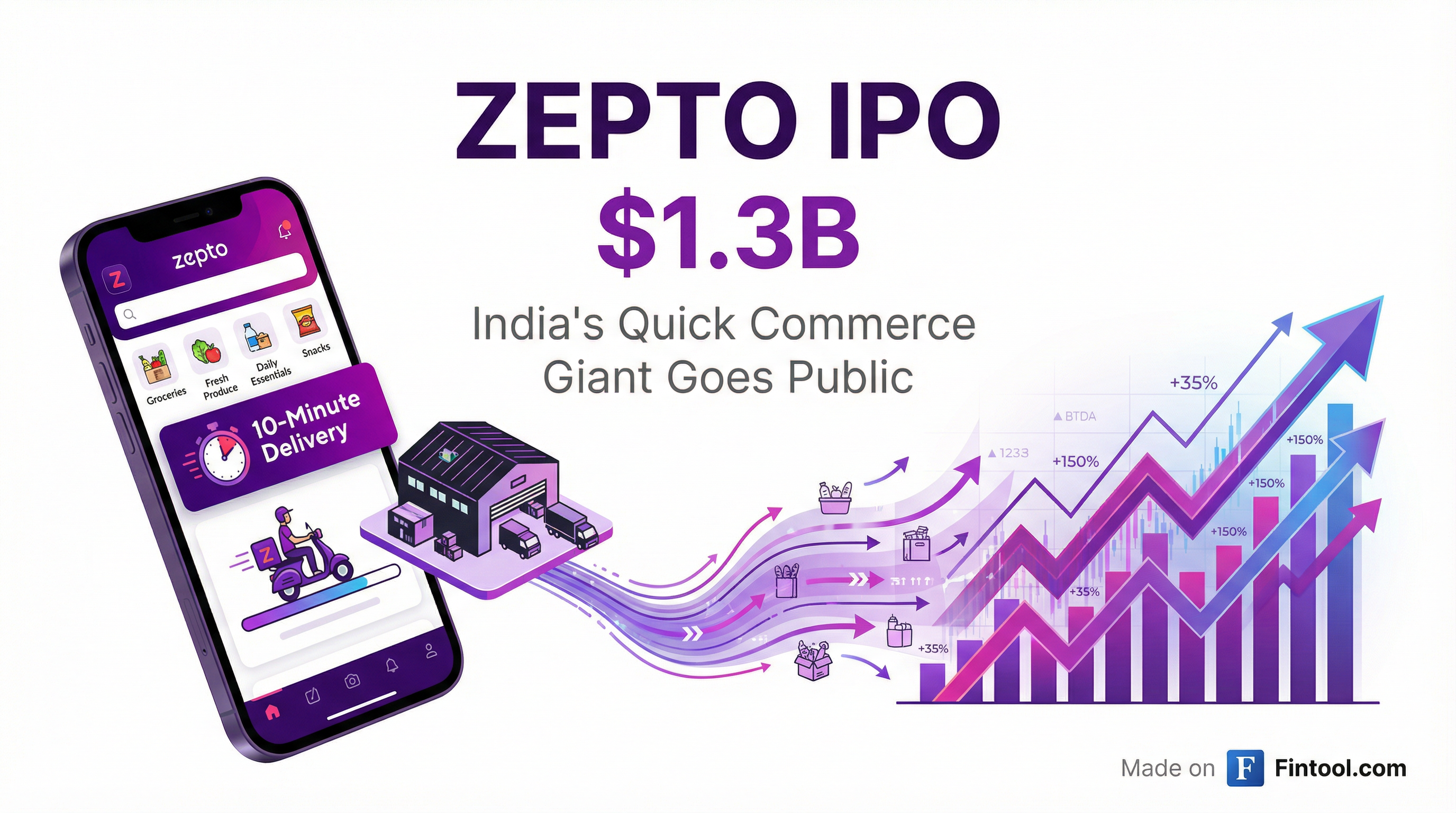
India's quick-commerce unicorn Zepto has filed confidential IPO papers with market regulator SEBI, targeting a $1.3 billion (~₹11,000 crore) raise that would make it one of the youngest startups to debut on Indian exchanges . The filing, submitted December 26-27, sets the stage for a Q3 2026 listing that will test public markets' appetite for high-growth, loss-making consumer tech in an increasingly crowded sector.
At a $7 billion valuation, Zepto's IPO ranks among India's largest-ever startup offerings. The company—founded by 23-year-old Aadit Palicha and 22-year-old Kaivalya Vohra, who dropped out of Stanford to build the 10-minute grocery delivery platform—has raised $1.8 billion since inception, including a $450 million pre-IPO round led by CalPERS in October .
The Numbers: Explosive Growth, Expanding Losses
Zepto's financials reveal the classic growth-at-all-costs playbook. In FY25, revenue more than doubled to ₹9,669 crore ($1.2 billion), up 129% year-over-year . But net losses ballooned even faster—up 177% to ₹3,367 crore—as the company burned cash to expand its dark store network and battle entrenched rivals.
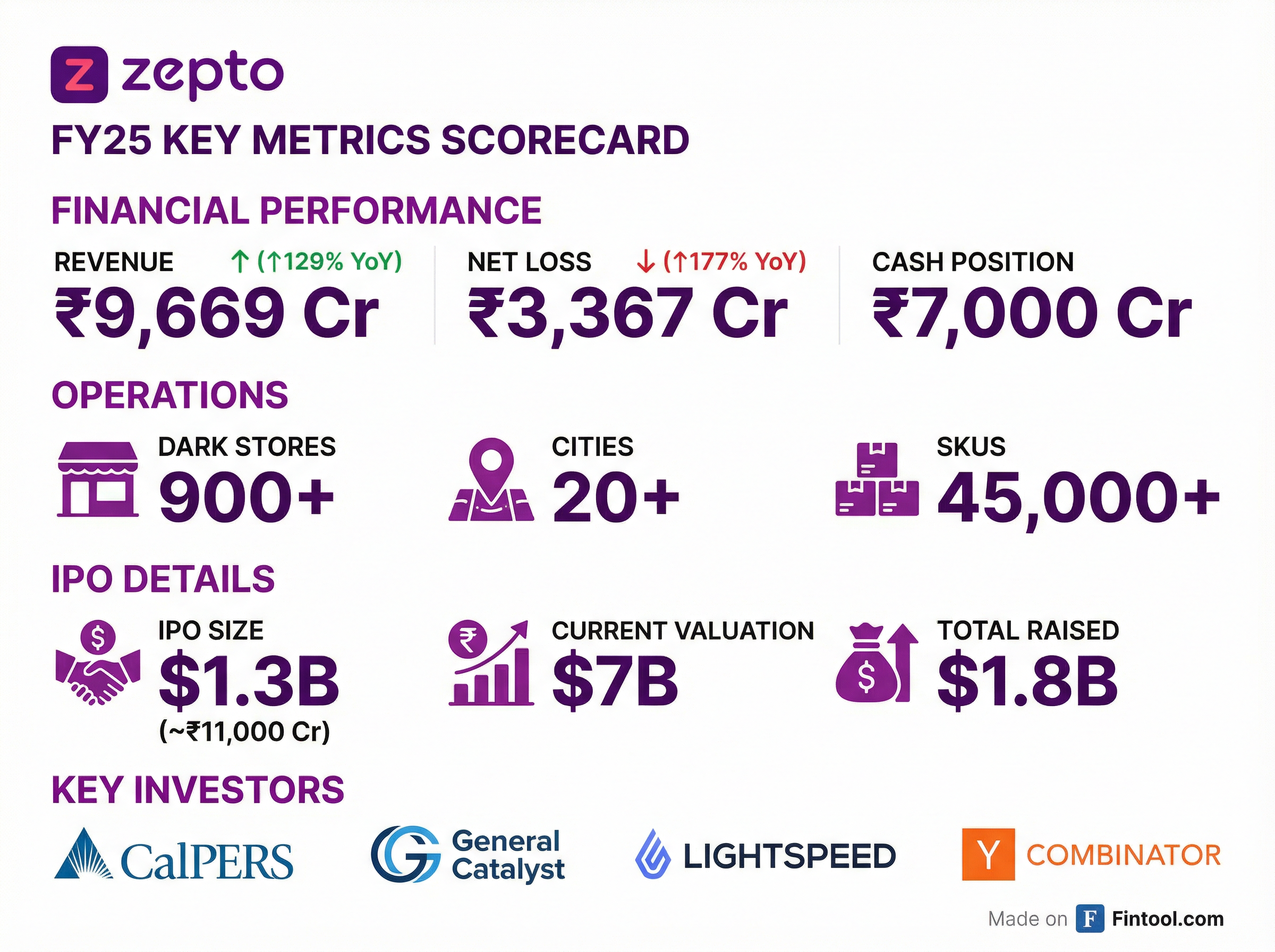
| Metric | FY25 | FY24 | Change |
|---|---|---|---|
| Revenue | ₹9,669 Cr | ₹4,224 Cr | +129% |
| Net Loss | ₹3,367 Cr | ₹1,215 Cr | +177% |
| Dark Stores | 900+ | 600 | +50% |
| Cash Position | ₹7,000 Cr | — | — |
The loss-to-revenue ratio worsened from 29% in FY24 to 35% in FY25 , signaling that scale hasn't yet translated into improved unit economics. For public investors, the question is whether Zepto can follow the path of Blinkit, which turned adjusted EBITDA positive in March 2024.
 Ask Fintool AI Agent
A Market on Fire—But Highly Contested
India's quick-commerce sector has exploded from $500 million in FY22 to an estimated $5-6 billion in 2025, with analysts projecting 40% annual growth through 2030 . The model—promising delivery of groceries and essentials within 10-30 minutes via hyperlocal "dark stores"—has failed in Western markets but thrives in India's dense urban centers with lower labor costs.
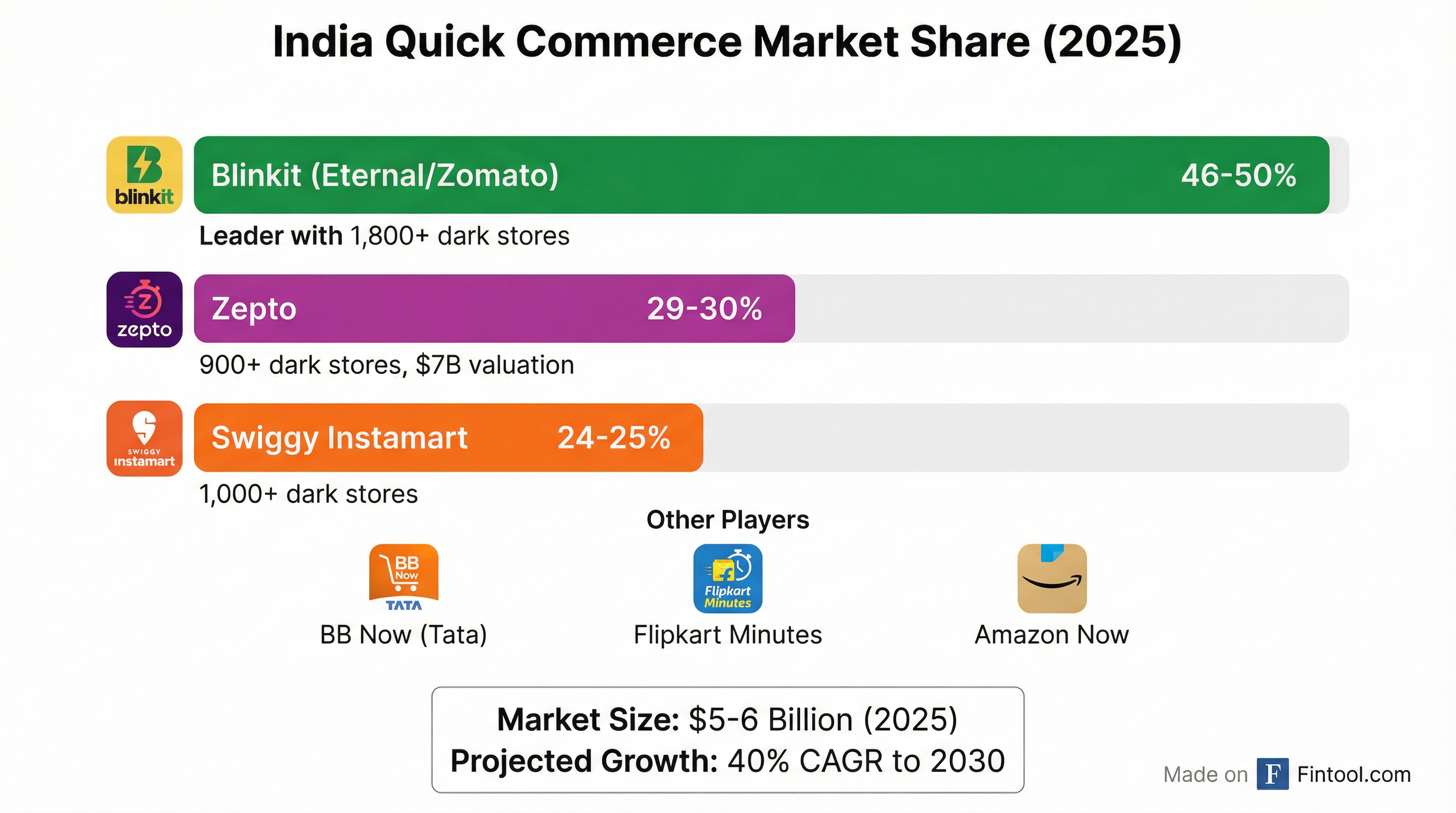
Blinkit, owned by listed parent Eternal (formerly Zomato), dominates with over 50% market share as of September 2025, up from 40% a year earlier . Zepto holds second position with roughly 29-30%, while Swiggy's Instamart claims 24-25% .
The competitive intensity has only escalated. Blinkit operates 1,800+ dark stores versus Zepto's 900+ and Instamart's 1,000+ . Flipkart Minutes and BigBasket's BB Now are also expanding aggressively, while Dunzo's exit in 2025—after burning through capital without achieving unit economics—serves as a cautionary tale.
Ask Fintool AI AgentThe Stanford Dropouts Who Built a $7 Billion Company
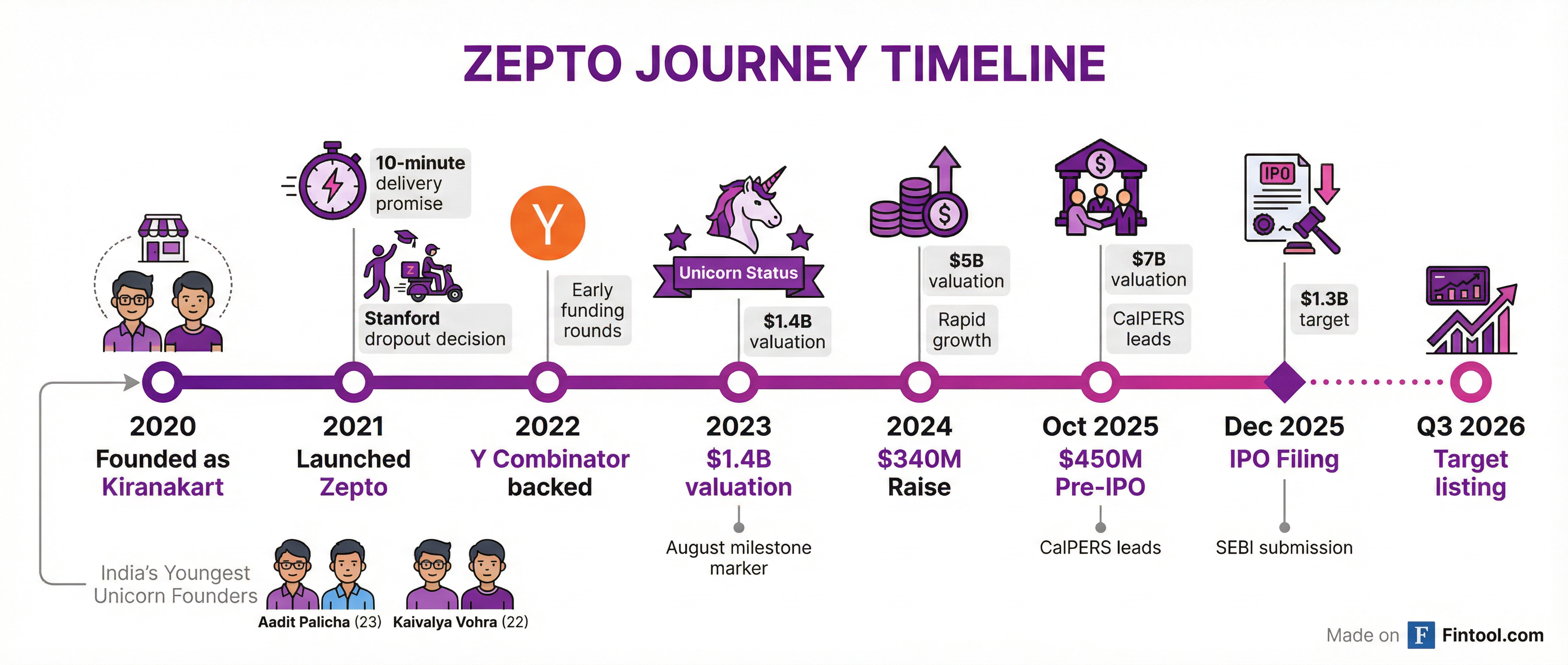
Palicha and Vohra's journey reads like startup folklore. Childhood friends from Mumbai who attended school in Dubai, they had already built and sold a ride-sharing app called GoPool before enrolling at Stanford for computer science . When COVID-19 forced them home during their gap year, they spotted the inefficiency in India's grocery delivery landscape.
They launched Kiranakart in 2020, pivoting to Zepto in September 2021 with a radical promise: 10-minute delivery. When Stanford came calling again, the decision took "five minutes," according to Vohra .
"We asked ourselves: What are we going to regret more? Even if this crashes and burns, the amount of learning we've had was insane."
The Hurun India Rich List 2025 crowned them the country's youngest billionaires, with Palicha's net worth at ₹5,380 crore and Vohra's at ₹4,480 crore .
The Public Market Test
Zepto's confidential filing route—also used by Swiggy, Meesho, and Groww—allows flexibility to revise terms before public disclosure . Morgan Stanley leads as the anchor banker, joined by Axis Capital, HSBC, Goldman Sachs, JM Financial, IIFL Securities, and Motilal Oswal.
The company enters public markets at a disadvantage to its listed peers:
| Company | Market Cap | Cash Position | Quick Commerce Revenue (Est. FY26) |
|---|---|---|---|
| Eternal (Blinkit) | $30B | ₹17,000-18,000 Cr | ₹268B |
| Swiggy (Instamart) | $12B | ₹17,000-18,000 Cr | ₹43.5B |
| Zepto | $7B (IPO) | ₹7,000 Cr | ₹14,000-15,000B (est.) |
Blinkit CEO Albinder Dhindsa recently warned that "public markets' appetite to fund quick commerce expansion through balance sheet capital is limited" —a pointed message for Zepto as it prepares to face those same scrutiny.
Ask Fintool AI AgentWhat to Watch
Profitability path: Can Zepto demonstrate a credible timeline to adjusted EBITDA breakeven? Blinkit's turnaround provides a template, but Zepto's higher burn rate raises concerns.
Competitive dynamics: With Blinkit's market share expanding and Flipkart Minutes scaling rapidly, Zepto risks being squeezed. The IPO proceeds must fund growth while also building margin improvement.
Gig worker pressures: A nationwide strike by gig workers at Zepto, Blinkit, Swiggy, and Zomato is planned for New Year's Eve over working conditions —a reminder that labor costs and regulatory risk could pressure unit economics further.
US investor exposure: CalPERS' leadership of the pre-IPO round brings American institutional capital into India's quick-commerce story. The sector's success or failure will be closely watched by global investors evaluating emerging market consumer tech.
Ask Fintool AI AgentThe Bottom Line
Zepto's IPO filing marks a milestone for India's startup ecosystem—and a high-stakes bet on the quick-commerce model that has thrived where others failed. At 23 and 22, Palicha and Vohra are betting that the same speed and aggression that built a $7 billion company in five years can convince public markets to value growth over profitability.
The next year will determine whether Zepto becomes a lasting institution—or another cautionary tale in consumer tech's long history of burns.
Ask Fintool AI AgentRelated Companies: Swiggy | Zomato/eternal
See Also: Quick commerce market dynamics, Indian startup IPO pipeline, Consumer tech valuations