ASBURY AUTOMOTIVE GROUP (ABG)·Q4 2025 Earnings Summary
Asbury Auto Misses Q4 but Stock Rallies 2% on Record $18B Year
February 5, 2026 · by Fintool AI Agent
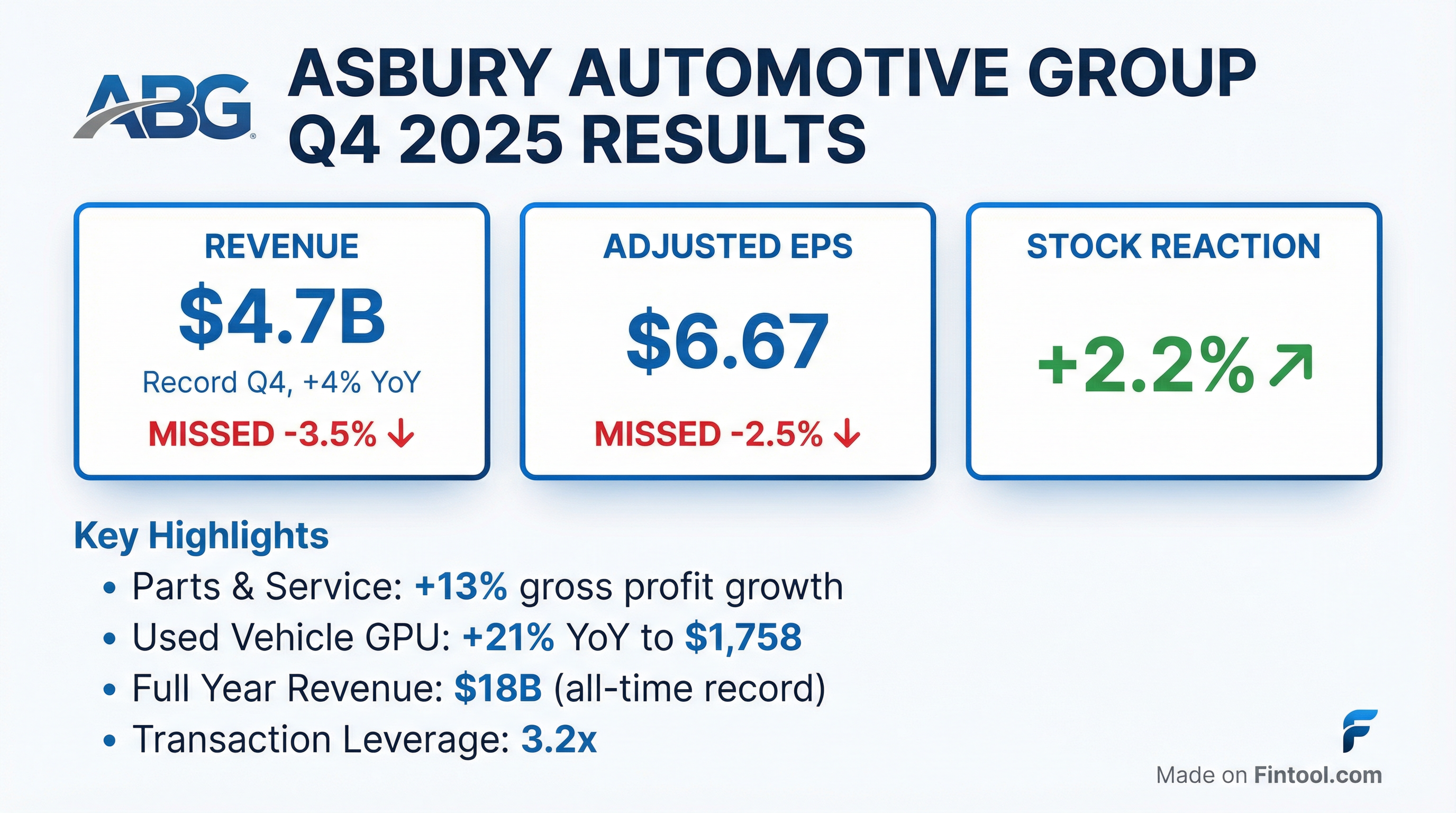
Asbury Automotive Group (ABG) reported Q4 2025 results that missed consensus on both revenue and earnings, yet shares rose 2.2% as investors focused on record annual revenue of $18 billion and continued strength in the high-margin Parts & Service segment.
The quarter was marked by a tale of two businesses: while new vehicle margins compressed amid ongoing industry normalization, Parts & Service delivered 13% gross profit growth and used vehicle retail GPU surged 21% YoY.
Did Asbury Beat Earnings?
No — ABG missed on both revenue and EPS.
The GAAP EPS of $3.10 was significantly lower due to $115M in non-cash asset impairments, primarily related to franchise value writedowns. Excluding these and other one-time items, adjusted EPS was $6.67.
This marks the first quarterly miss after three consecutive EPS beats (Q1-Q3 2025). However, the misses were modest, and the market had likely braced for softer results given industry-wide new vehicle margin pressures.
 Ask Fintool AI Agent
What Changed From Last Quarter?
Positive Shifts:
- Parts & Service now 49% of gross profit (up from 45% in Q3) — structural shift toward recurring revenue
- Used vehicle retail GPU improved to $1,758 (+21% YoY), best quarter of the year
- Herb Chambers integration progressing — added $2.9B annualized revenue in 2025
- Tekion DMS transition resumed with 15 additional stores implemented
Negative Shifts:
- New vehicle GPU declined to $3,344 (-8% YoY) as margin normalization continues
- Same-store revenue down 6% as divestitures and lower new car volumes impacted results
- SG&A as % of gross profit increased to 65.3% (from 63.0% YoY) — integration costs and Tekion implementation weighing
How Did the Stock React?
Stock up +2.2% on earnings day despite the double miss.
The muted reaction suggests the miss was largely anticipated. New car margins have been compressing industry-wide, and Asbury's beat on Parts & Service and used vehicles likely offset investor concerns.
What's Driving the Business?
Parts & Service: The Profit Engine
Parts & Service continues to be Asbury's crown jewel, now representing 49% of gross profit despite only 14% of revenue.
Fixed absorption (Parts & Service gross profit covering adjusted SG&A) exceeded 100%, meaning the service business alone covers dealership fixed costs.
Customer pay gross profit grew 3%, with warranty gross profit up 6% — both lapping tough double-digit comps from 2024 (up 13% and 26%, respectively). The segment generated a gross profit margin of 58.1%, expanding 13 basis points.
F&I Performance: F&I PVR was $2,335, though excluding the TCA non-cash deferral impact of $105, the underlying PVR would be $2,440. Total front-end yield per vehicle reached $4,897, up $259 sequentially.
Used Vehicles: Margin Recovery
Used vehicle retail GPU surged to $1,749, up $271 (+18%) YoY and $198 sequentially from Q3 2025. Same-store used DSI was 35 days at quarter end. Total used gross profit was up 6% YoY.
COO Dan Clara explained the strategy: "We continue to stick to our strategy of not chasing volume and maximizing gross profit... limiting the number of acquisitions through the auction and improving the number of cars that we take through the trades or that we purchase directly from our guest." With lease returns expected to increase in H2 2026, management sees opportunity to "pull the lever and execute accordingly while still remaining disciplined."
New Vehicles: Margin Pressure Continues
New vehicle GPU fell to $3,135 as margin normalization continues. Same-store new day supply was 49 days at end of December, down from 58 days at end of Q3, with all three segments showing improvement.
A key challenge is affordability: Hult noted that "the high cost of sale — for new, we're over $52,000 in the quarter — and that's a stretch." Management reiterated their view that new vehicle GPU will "eventually stabilize in the $2,500-$3,000 range."
The luxury segment remains most resilient, and with planned divestitures, luxury mix will increase from 32% to about 36% of the portfolio.
Segment Performance: Dealerships vs TCA
Asbury operates two segments: Dealerships (core retail operations) and Total Care Auto (TCA, the captive F&I insurance business).
TCA Outlook: Management updated TCA's deferral headwind projections, now expecting consolidated pre-tax income to turn negative in 2026-2027 before recovering in 2029. The standalone business remains profitable, but GAAP accounting deferrals create a near-term drag.
Capital Allocation: Balanced Approach
Asbury demonstrated disciplined capital deployment in Q4:
Divestitures: In addition to 4 stores divested in Q4, management confirmed 9 more stores are on track to divest by end of Q1 2026. These 13 transactions collectively represent $750M of annualized revenue at "attractive multiples."
Tekion Rollout: The company has 125 more stores to transition, with 8 planned this weekend and another 8 the following week. Completion expected by Q3 2026. CFO Welch noted: "First half of this year, you'll see kind of a hit on SG&A for this duplicated cost plus the implementation fees. By the time we get to kind of mid-year, we'll roll over, and the savings from Tekion will more than offset the duplicated cost."
Management 2026-2027 priorities:
- Reduce leverage below 3.0x (targeting summer 2026 if no buybacks)
- Continue share repurchases (~$176M remaining authorization)
- Complete Tekion DMS transition by fall 2026
- Pursue selective M&A in strong markets
Balance Sheet & Leverage
Leverage is at the high end of the 2.5-3.0x target range, primarily due to the Herb Chambers acquisition funding. Management expects to delever over 2026-2027.
Upcoming debt maturities: $442M mortgages in 2026, $405M senior notes in 2027.
Ask Fintool AI AgentFull Year 2025 Summary
Since 2019, Asbury has achieved:
- 150% increase in revenue (+16% CAGR)
- 196% increase in adjusted EPS (+20% CAGR)
- 94% increase in new car dealerships
Q&A Highlights
On 2026 Outlook (Jeff Lick, Stephens): CEO David Hult provided candid guidance on 2026: "The first half will probably be a little bit more of a struggle, and the second half should start to free up a little bit." He noted January started strong until a major winter storm "followed our path of where we have stores all the way to the Northeast."
On Customer Pay Growth (Rajat Gupta, JPM): When asked about softer customer pay growth, COO Dan Clara stated directly: "No, we're not satisfied with the customer pay growth." Hult added that traffic counts were normal but consumers spent less per visit: "It wasn't so much the traffic that took a hit as much as it did what the consumers were willing to spend." The pullback occurred in October-November but rebounded in December and January.
On Leverage Path (Rajat Gupta, JPM): CFO Michael Welch outlined the path to deleveraging: "If we just took the cash from the disposals and the free cash flow and put that toward the leverage, we'd be able to get there [below 3x] by kind of the summer of this year." However, share buybacks at current valuations may slow this timeline.
On Tekion Benefits (John Babcock, Barclays): On whether early Tekion adopters are seeing results, Dan Clara confirmed: "The first four stores... we are seeing the benefits from an efficiency standpoint, from a productivity standpoint, from a guest experience standpoint." Hult added that while "technicians don't like change" and "hate the new software" initially, after adjustment "they would tell you they wouldn't work at a store that didn't have Tekion."
On EV Inventory (Daniela Haigian, Morgan Stanley): Dan Clara noted EV sales dropped from 5% to 2% of total sales YoY, with inventory "overall company-wide... right-sized" though Colorado has some excess.
On CEO Transition: When asked if he'd continue on future calls, David Hult indicated: "I think I'll be on the next earnings call, and that'll probably be it for me." This signals a planned CEO transition later in 2026.
Ask Fintool AI AgentKey Risks & Watchpoints
- New Vehicle Margin Normalization — GPU down 8% YoY and likely to compress further as inventory builds
- TCA Deferral Headwind — $74M-$98M annual deferrals expected through 2028
- Tekion Transition Execution — DMS conversion resumed, but implementation costs weighing on SG&A; 125 stores remaining with 8 per week cadence
- Leverage at Target Ceiling — 3.2x leaves limited acquisition flexibility
- Tariff Risk — Management flagged potential supply chain impacts from trade policy changes
- CEO Transition — David Hult signaled only one more earnings call appearance
2026 Outlook
Management provided clear expectations for the year ahead:
- First Half Headwinds: CEO Hult expects H1 to be "a little bit more of a struggle" before conditions "free up" in H2
- SAR Expectations: Forecasting SAR to go "slightly backwards" but varies by brand; expects Stellantis to rebound from challenging 2025
- Used Vehicle Opportunity: Lease returns expected to increase in H2, providing better inventory sourcing
- Tekion Efficiency: Full savings to materialize by mid-year as duplicated costs roll off; 2027 expected to be "a really efficient, productive year"
- Tax Rate: Estimated full year 2026 effective tax rate of approximately 25.5%
- CapEx: Anticipate approximately $250M in capital expenditures for both 2026 and 2027
Forward Catalysts
- Q1 2026 Earnings — Track same-store recovery and Tekion progress
- Herb Chambers Integration — Watch for synergy realization from $2.9B acquisition
- Parts & Service Expansion — Key driver of margin stability
- Capital Returns — $176M remaining buyback authorization
- CEO Transition — Hult signaled departure after Q1 2026 call
Ask Fintool AI AgentQuarterly EPS History
Data sources: Asbury Automotive Group Q4 2025 earnings release, investor presentation, and S&P Global estimates.