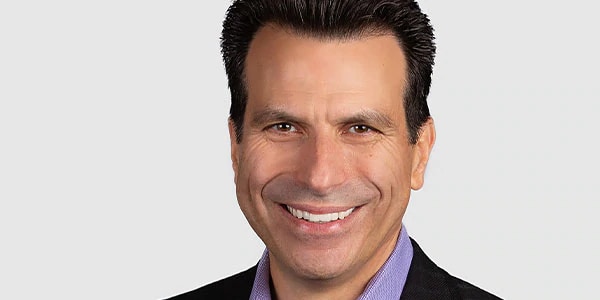
Andrew Anagnost
 Autodesk
About Andrew Anagnost
Andrew Anagnost, 60, has served as Autodesk’s President and Chief Executive Officer since 2017 and as a director since 2017. He holds a B.S. in Mechanical Engineering (CSU Northridge) and M.S./Ph.D. in Engineering Science/Aeronautical Engineering & Computer Science (Stanford). Under his leadership, Autodesk executed a multi‑year transformation to a resilient subscription model and a new transaction model with platform/AI focus. FY2025 performance: revenue $6.1B (+12% YoY), GAAP operating income $1.4B (+19% YoY), free cash flow $1.6B (+23% YoY). Cumulative TSR indexed to 158.16 in FY2025; FY2025 relative TSR modifiers were 105% (3‑yr), 96% (2‑yr), 109% (1‑yr). Pay design ties annual bonuses to revenue and non‑GAAP operating income, and PSUs to revenue, free cash flow, and relative TSR.
Past Roles
| Organization | Role | Years | Strategic impact |
|---|---|---|---|
| Autodesk, Inc. | President & CEO | 2017–Present | Architected subscription and new transaction model; refocused investment in cloud/platform/AI |
| Autodesk, Inc. | Senior leadership roles (incl. Co‑CEO, CMO; SVP Business Strategy & Marketing; VP Product Suites & Web Services) | 1997–2017 | Led product/platform and business model evolution |
| Lockheed Aeronautical Systems, EXA Corporation; NASA Ames (NRC Post‑doc) | Engineering/sales/marketing/product mgmt; NRC post‑doctoral fellow | 1986–1997 | Grounded technical and product leadership credentials |
External Roles
| Organization | Role | Years | Notes |
|---|---|---|---|
| HubSpot, Inc. | Director (U.S.-listed) | 2023–Present | External public board experience |
Fixed Compensation
- CEO pay mix: 95% variable/at‑risk; 88% long‑term equity (FY2025) .
- Base salary held flat at $1,040,000 for FY2025; target annual bonus set at 150% of base; actual bonus paid $1,516,320 (97.2% of target).
| Component | FY2025 |
|---|---|
| Base Salary ($) | 1,040,000 |
| Target Bonus (% Base) | 150% |
| Target Bonus ($) | 1,560,000 |
| Actual Bonus Paid ($) | 1,516,320 (97.2% of target) |
Multi‑year summary (total compensation):
| Year | Total Compensation ($) |
|---|---|
| 2025 | 25,192,846 |
| 2024 | 20,649,951 |
| 2023 | 17,600,752 |
Performance Compensation
Annual EIP (bonus) design and FY2025 outcome:
| Metric | Weight | Actual ($mm) | Target ($mm) | Attainment % | Funding | Weighted Funding |
|---|---|---|---|---|---|---|
| Total Revenue | 60% | 6,131 | 6,224 | 98.5% | 95.0% | 57.0% |
| Non‑GAAP Income from Operations | 40% | 2,231 | 2,222 | 100.4% | 100.6% | 40.2% |
| Total | 100% | — | — | — | — | 97.2% |
FY2025 equity awards and structure:
- Granted mix: 60% PSUs, 40% RSUs; RSUs vest in three equal annual installments; PSUs earned based on annual financials (revenue, FCF) and relative TSR (1‑, 2‑, 3‑year measurement windows), 0–200% payout.
- Andrew Anagnost FY2025 awards: Target value $23,000,000; PSU target 53,914 shares; RSU 35,943 shares.
| Equity Award (FY2025) | Target Value ($) | Target Shares |
|---|---|---|
| PSUs (aggregate of 3 tranches) | Included in total | 53,914 |
| RSUs | — | 35,943 |
| Total LTI Target Value | 23,000,000 | — |
PSU vesting results certified in FY2025:
| Award/Tranche | Financial Goal Funding | TSR Modifier | Payout (% Target) |
|---|---|---|---|
| Apr 2022 (3rd tranche) | 98.8% | 105% (3‑yr TSR, 54th pct) | 104% |
| Apr 2023 (2nd tranche) | 98.8% | 96% (2‑yr TSR, 47th pct) | 95% |
| Jul 2024 (1st tranche) | 98.8% | 109% (1‑yr TSR, 57th pct) | 108% |
PSUs earned (Andrew Anagnost):
| Award/Tranche | Target PSUs | Actual PSUs Earned |
|---|---|---|
| Apr 2022 (3rd tranche) | 17,046 | 17,727 |
| Apr 2023 (2nd tranche) | 20,376 | 19,357 |
| Jul 2024 (1st tranche) | 17,972 | 19,409 |
Forward-looking design changes (FY2026): replaced PSU FCF metric with “Non‑GAAP Income from Operations less SBC expense”; moved TSR to single 3‑year period; PSUs move to 3‑year cliff vesting (RSUs temporarily 2‑year vesting 50%/50% in FY2026–2027 during transition).
Equity Ownership & Alignment
- Beneficial ownership: 94,636 shares; Autodesk shares outstanding 214,297,198 as of 3/31/2025 (≈0.04% ownership; derived).
- Stock ownership guidelines: CEO required to hold 6x base salary; NEOs in compliance as of latest review.
- Hedging/pledging prohibited for directors/executives; no holding in margin accounts permitted.
- Clawback: Board‑adopted policy compliant with SEC/Nasdaq for recovery of excess incentive pay upon restatement (fault not required); prior misconduct‑based clawback also remains.
Outstanding unvested equity at FY2025 year‑end (market value at $311.34):
| Grant Date | Type | Unvested Shares | Value ($) |
|---|---|---|---|
| 4/10/2022 | PSU tranche | 17,728 | 5,519,436 |
| 4/10/2022 | RSU | 11,364 | 3,538,068 |
| 4/10/2023 | PSU tranches | 39,733 | 12,370,472 |
| 4/10/2023 | RSU | 27,168 | 8,458,485 |
| 7/10/2024 | PSU tranches | 55,352 | 17,233,292 |
| 4/10/2024 | RSU | 35,943 | 11,190,494 |
Vesting cadence and selling pressure indicators:
- RSUs granted 4/10/2024 vest in three equal annual installments beginning March 27, 2025 (typical annual vest near late March); PSU tranches earned for FY2025 were scheduled to vest March 27, 2025—these dates often coincide with concentrated Form 4 activity.
Options:
- No options exercised by NEOs in FY2025; Autodesk has not granted options since 2019; option repricing prohibited.
Employment Terms
Key provisions (CEO employment agreement, amended April 2022):
- Termination without cause / resignation for good reason (non‑CIC): 200% of base salary; pro‑rata bonus (subject to plan funding); time‑based equity vests fully; performance‑based equity vests pro‑rata based on actual performance; up to 12 months health benefits; 12‑month non‑compete/non‑solicit.
- CIC + qualifying termination (double‑trigger): 200% of base salary + target bonus; pro‑rata target bonus; full acceleration of all unvested equity (incl. performance awards at target); up to 18 months health benefits.
- Company‑wide severance and CIC programs apply to NEOs (CEO has bespoke agreement for severance/CIC as noted). No excise tax gross‑up; cutback applies if beneficial.
Potential payouts (as of 1/31/2025, illustrative):
| Scenario | Total Estimated ($) |
|---|---|
| Involuntary not‑for‑cause (non‑CIC) | 44,412,183 |
| CIC + qualifying termination | 64,787,048 |
| Disability | 61,447,672 |
| Death | 61,967,461 |
Other benefits/perquisites:
- FY2025 “All Other Compensation” included authorized executive/spouse travel and related tax gross‑ups ($128,658 travel; $63,789 tax gross‑ups). No excise tax gross‑ups for CIC benefits.
Board Governance
- Role: Director since 2017; not independent under Nasdaq standards (as CEO).
- Board leadership: Separate, independent Chair (Stacy J. Smith); 9 of 10 nominees independent; regular executive sessions.
- Committees: CEO is not a committee member; all three standing committees (Audit; Compensation & Human Resources; Corporate Governance & Nominating) composed entirely of independent directors.
- Attendance: FY2025—Board held 9 meetings; committees held 39 meetings; each director attended 100% of their meetings.
- Nomination: Company agreed to nominate Anagnost to the Board while he serves as CEO.
- Director pay: Employee‑directors (incl. CEO) receive no additional director compensation.
Compensation Governance, Peer Group, and Say‑on‑Pay
- Governance practices: No option repricing; no hedging/pledging; robust stock ownership; clawbacks; majority performance‑based LTI; independent comp consultant (Exequity LLP).
- Benchmarking peer group (FY2025): Adobe, Akamai, ANSYS, Block, Cadence, DocuSign, EA, Fortinet, Gen Digital, Intuit, NetApp, Palo Alto Networks, PTC, Salesforce, ServiceNow, Splunk (acquired), Synopsys, Workday; Autodesk (for reference).
- Say‑on‑Pay result: 82.1% support at 2024 Annual Meeting; FY2026 PSU changes (3‑yr TSR; SBC metric) respond to investor feedback.
Performance & Track Record
- Strategic achievements: Led subscription and transaction model transformations; expanded TAM through connected solutions; prioritized cloud/platform/AI investments.
- FY2025 business performance: revenue $6.1B (+12% YoY); GAAP operating income $1.4B (+19% YoY); free cash flow $1.6B (+23% YoY). Net income $1,112M.
- Capital returns: ~$3.8B repurchased over last 4 years; authorization remained under 2022/2024 programs as of FY2025.
- PSU relative TSR outcomes (FY2025 certification): 3‑yr 54th percentile (105% multiplier), 2‑yr 47th (96%), 1‑yr 57th (109%).
Risk Indicators & Red Flags
- Positive: No hedging/pledging; robust clawback; independent chair; double‑trigger CIC; no excise tax gross‑ups; no option repricing; strong ownership guidelines; high director/committee attendance.
- Watch items: Use of perquisite tax gross‑ups (e.g., travel‑related) for CEO in FY2025; continued share usage/overhang managed via buybacks and plan limits (share increase to 43.75M authorized under amended 2022 EIP proposed for approval).
Equity Ownership & Alignment (Beneficial Ownership Snapshot)
| Holder | Shares Beneficially Owned | % Outstanding |
|---|---|---|
| Andrew Anagnost | 94,636 | ≈0.04% (derived from 214,297,198 shares outstanding) |
Compensation Structure Analysis
- Mix and risk: 95% of CEO pay is variable, with 60% of LTI in PSUs tied to revenue/FCF and relative TSR, reinforcing pay‑for‑performance; RSUs provide retention ballast.
- Metric evolution: FY2026 PSU redesign tightens alignment to investor focus on profitability and SBC; longer TSR horizon mitigates short‑termism and increases difficulty.
- Cash vs equity: Base salary flat; majority of value from multi‑year equity subject to performance/vesting—limiting guaranteed pay escalations.
Investment Implications
- Alignment and incentives: Strong pay‑for‑performance design (high PSU mix, TSR modifier, rigorous revenue/profit metrics), robust governance (clawback, anti‑hedging/pledging, independent chair) and stock ownership guidelines suggest high alignment with shareholders.
- Retention and selling pressure: Significant unvested RSU/PSU over multi‑year schedules supports retention; expect recurring vest‑related selling windows around late March (e.g., March 27 cadence) and fiscal year‑end PSU certifications. Monitor Form 4s accordingly.
- Change‑in‑control protection: CEO’s CIC benefits are substantial (illustrative total ~$64.8M) with double‑trigger equity acceleration—standard for large‑cap software, but a consideration in strategic scenarios.
- Governance risk: Limited—no excise gross‑ups, no option repricing, high attendance, and responsive metric changes following investor feedback; modest perquisite tax gross‑ups warrant monitoring.

