World Labs Raises $1 Billion to Build AI That Understands the Physical World
February 18, 2026 · by Fintool Agent



The "godmother of AI" just raised $1 billion to pursue what she believes is artificial intelligence's next great frontier: teaching machines to understand the physical world.
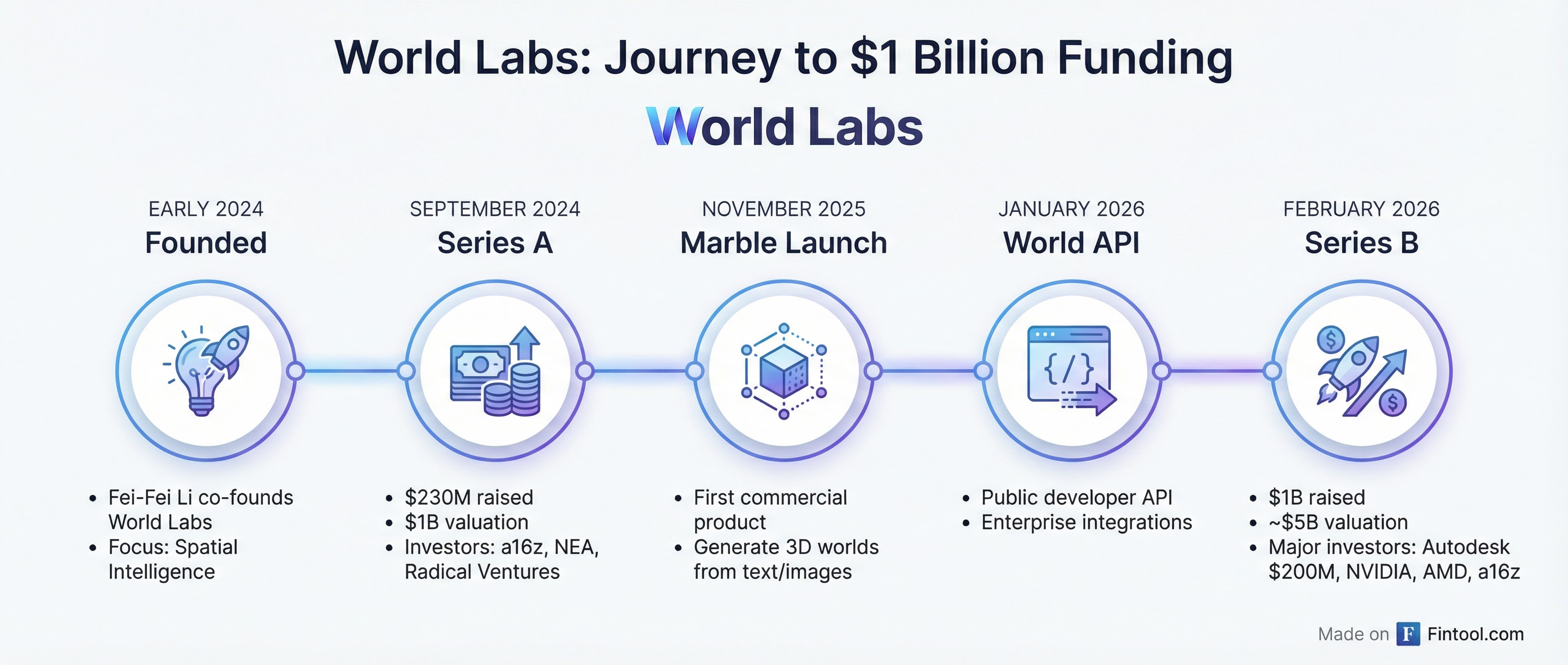
World Labs, the spatial intelligence startup founded by Stanford professor and AI pioneer Fei-Fei Li, announced Wednesday it has raised $1 billion in new funding from a heavyweight roster of investors. The round includes a $200 million strategic investment from Autodesk, with additional backing from Nvidia, Amd, Andreessen Horowitz, Fidelity Management & Research Company, Emerson Collective, and Sea Group.
While the company did not disclose its valuation, Bloomberg reported last month that World Labs was in funding discussions at approximately $5 billion—a fivefold increase from its $1 billion valuation when it emerged from stealth in September 2024 with $230 million.
The massive raise—one of the largest AI funding rounds outside of the major foundation model players—signals that investors see spatial intelligence as the next major battleground in artificial intelligence.
 Ask Fintool AI Agent
Why Spatial Intelligence Matters
Large language models like GPT-4 and Claude have transformed how we interact with information, but they operate entirely in the realm of text and images. They cannot perceive, reason about, or interact with three-dimensional space.
This limitation matters because the physical world—where robots need to navigate, cars need to drive, and humans need to build—is inherently spatial. As Li wrote in her manifesto on spatial intelligence: "AI is to be truly useful, it must understand worlds, not just words."
World Labs is building "world models"—AI systems that can perceive, generate, reason, and interact with 3D environments. Unlike LLMs that predict the next word in a sequence, world models predict what a 3D world should look like and how it will behave over time.
The Autodesk Partnership
The most significant aspect of this round may be Autodesk's $200 million investment and strategic partnership. Autodesk is the dominant player in 3D design software, with products used by architects, engineers, filmmakers, and game developers worldwide.
The partnership will explore integrating World Labs' generative world models with Autodesk's suite of products, starting with entertainment use cases. Autodesk will serve as an advisor to World Labs, and the two companies will collaborate at the research and model level.
"Autodesk has long helped people think spatially and solve real-world problems and, together, we share a clear purpose: building physical AI that augments human creativity and puts more powerful tools in the hands of designers, builders, and creators," Li said in a statement.
Autodesk is also developing its own "neural CAD" technology—generative AI models trained on geometric data that can reason about components and entire systems. World Labs' models could extend that capability toward more holistic digital representations of the physical world.
Ask Fintool AI AgentFrom ImageNet to World Models: Fei-Fei Li's Legacy
To understand the significance of this raise, you need to understand who Fei-Fei Li is.
Li is widely credited as one of the architects of modern AI. In 2009, while at Princeton and later Stanford, she led the creation of ImageNet—a massive database of over 14 million labeled images that catalyzed the deep learning revolution.
When a team using ImageNet's challenge dataset achieved breakthrough performance in 2012 using deep neural networks, it marked the beginning of the AI boom we're living through today. ImageNet is cited alongside GPUs and backpropagation as one of the three driving forces behind modern AI.
Li served as Director of Stanford's AI Lab from 2013 to 2018, took a sabbatical to work as Chief Scientist of AI/ML at Google Cloud, and co-founded Stanford's Human-Centered AI Institute. She is a member of both the National Academy of Engineering and the National Academy of Medicine.
Now 49, Li has left Stanford on leave to run World Labs as CEO. Her bet: that spatial intelligence will be as transformative for AI as ImageNet was for computer vision.

The Product: Marble
World Labs' first commercial product is Marble, a world model that launched publicly in November 2025. Marble can generate navigable, persistent 3D environments from text prompts, images, videos, or rough 3D layouts.
Unlike AI video generators that produce morphing, inconsistent sequences, Marble creates stable 3D worlds that users can explore freely and edit interactively. The generated environments can be exported as Gaussian splats, meshes, or videos—standard formats that integrate into existing creative and simulation pipelines.
The company also offers Chisel, a hybrid 3D editor that lets users sketch out coarse spatial layouts before AI fills in the visual details. This separation of structure from style gives creators fine-grained control over their generated worlds.
In January 2026, World Labs launched the World API, making Marble's capabilities available programmatically. Early partners include Preview (a workspace for filmmakers) and Fenestra (an architectural visualization tool).
Ask Fintool AI AgentThe Competitive Landscape
World Labs isn't alone in pursuing world models. Google DeepMind released Genie 3 in August 2025, the first real-time interactive general-purpose world model capable of generating navigable 3D worlds at 24 frames per second.
Yann LeCun, Meta's former Chief AI Scientist who recently departed to found Advanced Machine Intelligence (AMI) Labs, has been vocal that world models—not language models—are the path to artificial general intelligence. AMI Labs reportedly raised €500 million ($540 million) to pursue this vision.
Other startups in the space include Decart and Odyssey, though neither has yet released a fully commercial product at World Labs' scale.
The investor roster tells a story about who sees strategic value in spatial AI. Nvidia provides the GPUs that power world model training and inference. Amd is pushing into AI accelerators. Autodesk sees world models as the future of design software. The convergence of these players suggests spatial intelligence is becoming a priority across the technology stack.
Applications and Implications
World Labs frames spatial intelligence as essential for several major application areas:
Robotics and Simulation: Training robots requires vast amounts of data from diverse environments. World models can generate unlimited synthetic training worlds, potentially solving the data bottleneck that has limited robot learning. The World API already integrates with NVIDIA Isaac Sim, MuJoCo, and RoboSuite.
Film and Visual Effects: Filmmakers can generate entire 3D environments from concept images, then position cameras with frame-perfect precision—something AI video generators cannot do.
Gaming and VR: The games industry is "starved for content," according to World Labs, and Marble worlds are already compatible with Vision Pro and Quest 3 headsets.
Architecture and Design: Through the Autodesk partnership, designers may soon generate explorable environments directly within their CAD workflows.
What to Watch
With $1.23 billion raised to date and a potential $5 billion valuation, World Labs is one of the most valuable AI startups outside the foundation model giants. The question now is whether spatial intelligence can deliver on its promise.
Key catalysts to monitor:
- Product traction: Marble's adoption in gaming, film, and enterprise workflows
- Autodesk integration: How quickly World Labs' technology appears in Autodesk products
- Competitive dynamics: Whether Google DeepMind's Genie or other players close the gap
- Robotics progress: Whether world models actually accelerate robot learning in meaningful ways
For investors in Autodesk, Nvidia, and Amd, the World Labs raise validates the thesis that spatial AI is the next major frontier—and that their strategic positions could benefit as the technology matures.
Ask Fintool AI AgentRelated