AVALONBAY COMMUNITIES (AVB)·Q4 2025 Earnings Summary
AvalonBay Beats Q4 FFO, Guides for Flat 2026 as Supply Normalizes
February 5, 2026 · by Fintool AI Agent
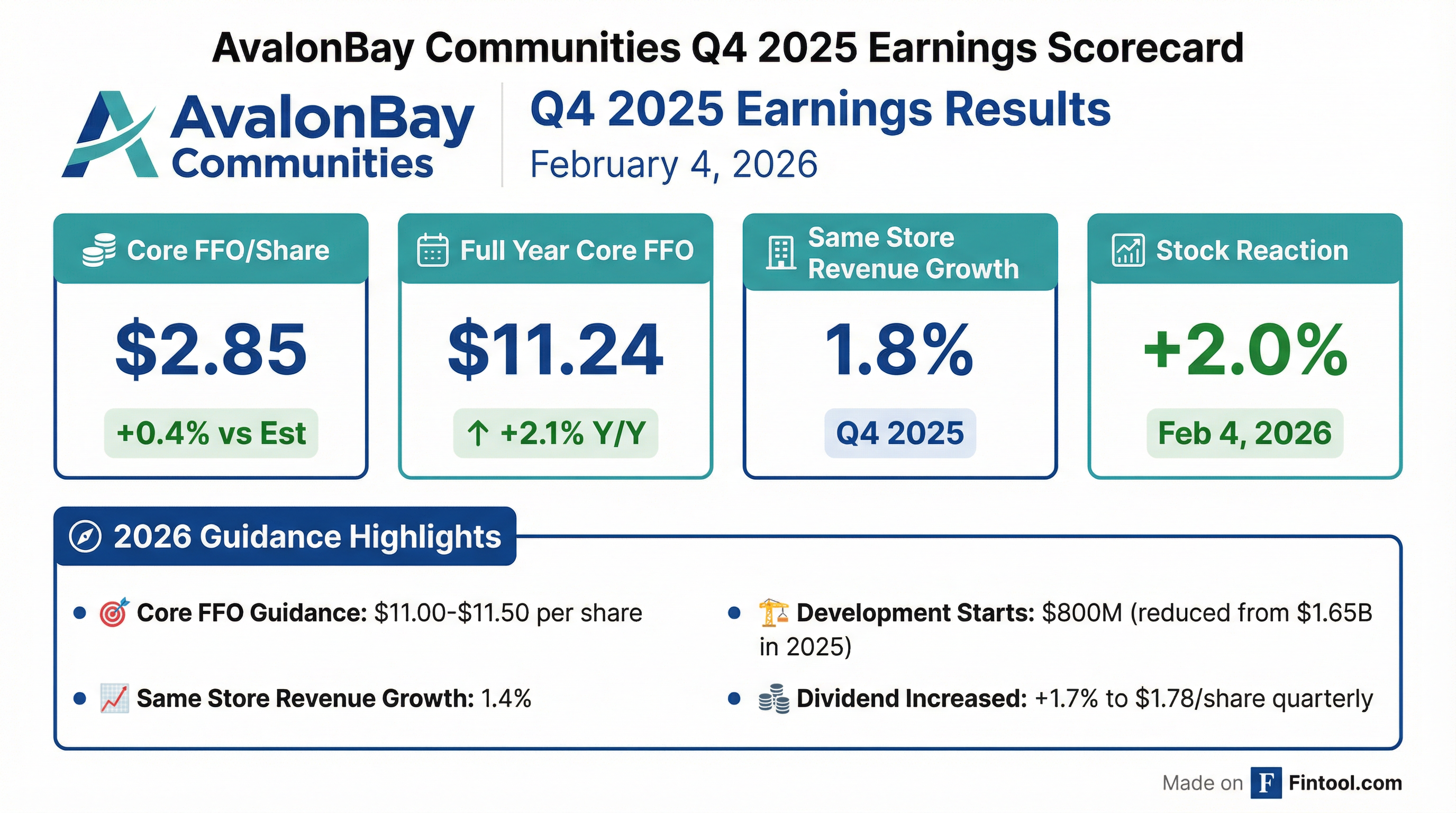
AvalonBay Communities (NYSE: AVB) delivered a modest Q4 2025 beat with Core FFO of $2.85 per share versus the $2.84 consensus, capping a year of 2.1% earnings growth despite softening rental demand. The stock rose ~2% as investors focused on favorable supply dynamics in the company's core Established Regions, where new apartment deliveries are at the lowest level since 2012.
Management guided for essentially flat Core FFO in 2026 ($11.25 midpoint), with tailwinds from development NOI being offset by refinancing headwinds and reduced transaction activity. The company is pulling back on new development starts, reducing the 2026 target to $800M from $1.65B in 2025. The balance sheet remains healthy with Net Debt-to-Core EBITDAre at 4.7x and 95% Unencumbered NOI.
Did AvalonBay Beat Earnings?
AvalonBay slightly exceeded expectations on the key metric for REITs—Core FFO per share:
For the full year 2025, AvalonBay delivered:
- Core FFO per share: $11.24 (+2.1% Y/Y)
- FFO per share: $11.40 (+3.8% Y/Y)
- Same Store Residential Revenue Growth: +2.5%
The company has beaten or met FFO estimates in 5 of the last 8 quarters:
How Did the Stock React?
AVB shares gained +2.0% following the release, closing at $177.81 on February 4. The positive reaction reflects relief that results came in-line despite the softer rental demand flagged in Q3, plus investor optimism about the favorable supply outlook in Established Regions.
Context on valuation:
- Current price: $177.81 (down 23% from 52-week high of $230.21)
- Dividend yield: ~4.0% ($7.12 annualized)
- Analyst price target: $203.50 consensus (Hold rating)
- Trading at 15.8x 2026 Core FFO guidance midpoint
 Ask Fintool AI Agent
What Did Management Guide?
2026 Core FFO guidance of $11.00-$11.50 per share (midpoint $11.25) implies essentially flat growth of just 0.1% year-over-year. The modest outlook reflects several offsetting factors:
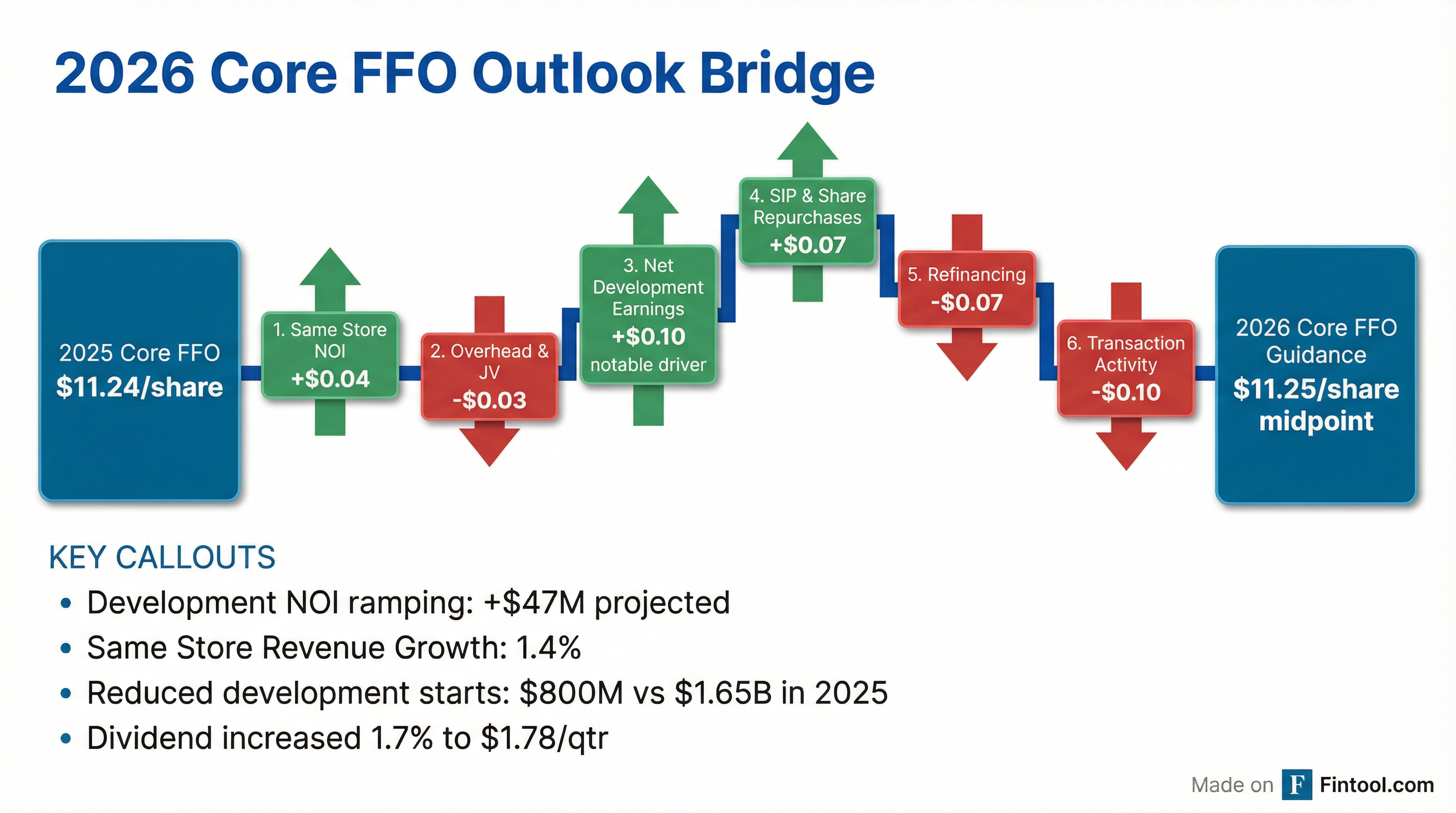
Key guidance callouts:
- Fundamentals expected to improve as 2026 progresses with same-store like-term effective rent change projected at ~1.25% in 1H and ~2.5% in 2H
- Operating initiatives projected to drive $7M of incremental NOI in 2026, bringing the total run-rate to $55M from the 2021 baseline
- Dividend increased 1.7% to $1.78 per share quarterly ($7.12 annualized)
What Changed From Last Quarter?
The Q3 2025 call raised concerns about softening rental demand and elevated operating costs. Here's what's different now:
Rent growth bifurcation is notable: Q4 like-term effective rent change was -0.3% overall, but this masks significant divergence: renewals at +3.0% vs. new move-ins at -4.2%. January 2026 showed similar trends with -0.5% overall (renewals +2.5%, new move-ins -3.7%). This indicates pricing power on existing residents but concession pressure on new leases.
Geographic divergence is notable: Northern California leads 2026 same-store revenue growth expectations, while Expansion Regions (Texas, North Carolina) are projected to post negative 0.6% revenue growth as supply remains elevated.
Q4 2025 Same Store NOI by Region (Y/Y change):
The Supply Story: Biggest Tailwind in a Decade?
The most bullish element of the quarter is the supply outlook. Projected 2026 new apartment deliveries in Established Regions are just 1.4% of existing inventory—the lowest level since 2012 coming out of the Global Financial Crisis.
Management emphasized that zoning and entitlement barriers should keep supply constrained in Established Regions "for the foreseeable future." This structural advantage positions AvalonBay for rent growth acceleration once demand normalizes.
Rental affordability is also improving: The rent-to-income ratio in Established Regions has declined from 100 (indexed to Q1 2020) to 93 by year-end 2025. Meanwhile, the median mortgage payment is now $2,100/month more expensive than median apartment rent, supporting the "rent vs. buy" thesis.
Ask Fintool AI AgentDevelopment Pipeline: Quality Over Quantity
AvalonBay is deliberately scaling back development to improve returns. 2026 projected starts of $800M are less than half the $1.65B started in 2025.
Development NOI is ramping: The company expects ~$47M of Development NOI in 2026, with over 90% of projected occupancies concentrated at 11 communities. Development occupancies should accelerate to ~4,150 in 2027, driving projected Development NOI above $120M.
January 2026 lease-up velocity (from earnings call Q&A):
Management noted January's 26 average monthly leases across the portfolio was a pickup from Q4's 20 average—strong performance for a seasonally slow month. New Jersey lease-ups tracking at or above pro forma.
Balance sheet remains healthy: The $3.6B development pipeline is 91% match-funded with cash, unsettled forward equity ($808M), and operating cash flow.
Capital Allocation: Dividends Up, Buybacks Continue
The company bought back 2.7M shares in 2025 at an average price of $182, well above the current $178 stock price—a sign of management confidence in intrinsic value. The dividend increase marks the 12th consecutive annual increase.
Key Risks and Concerns
-
Flat earnings growth in 2026: Core FFO guidance of +0.1% is below the sector average; investors looking for growth may look elsewhere
-
Expansion Region weakness: Texas and North Carolina markets face 4.2% supply growth and are projected to post negative same-store revenue growth. Denver remains particularly challenged with zero net job growth in 2025 and another 9,000 units delivering in 2026—rents projected to continue declining.
-
Operating expense pressure: 3.8% expense growth is elevated, driven by property tax abatement phase-outs (+70bps) and a Q4 2025 tax appeal settlement creating a 50bps headwind. Management indicated abatement headwinds will continue for "the next few years."
-
Refinancing headwind: The company faces -$0.07/share headwind from refinancing ~$1.6B of unsecured debt at higher rates (3.4% maturing → 4.6% new)
-
Legislative/regulatory risk: Colorado legislation limits fee recovery and caps utility passthrough (15bps OpEx headwind). California AB 1414 allows bulk internet opt-outs. Massachusetts rent control ballot initiative pending—though management believes it's "set up to be a little bit easier to defeat" than past initiatives.
-
D.C. job losses: The Mid-Atlantic lost ~60,000 jobs in 2H 2025. Management noted need for business confidence and federal government stabilization before meaningful recovery.
Forward Catalysts to Watch
- Q1 2026 earnings (May 2026): First look at whether 2H26 acceleration is on track
- Lease rate trends: Management expects like-term effective rent change to double from ~1.25% in 1H to ~2.5% in 2H26
- Supply absorption: Watch for supply-demand normalization in Expansion Regions
- Interest rate trajectory: Lower rates would reduce refinancing headwind and improve acquisition economics
- Development yields: 6.5-7.0% target yields on new starts offer 150-200bp spreads to cost of capital
Ask Fintool AI AgentQ&A Highlights: What Analysts Asked
The earnings call Q&A surfaced several key themes:
On renewal rates and the 2H ramp (Eric Wolfe, Citi): Management confirmed February/March renewal offers are going out at 4%-4.5%, up from January's 2.5% achieved rate. COO Sean Breslin noted historical dilution of 100-125bps from offer to settlement. The company expects renewals to average mid-3% for 2026 (flat with 2025) while move-ins improve 70-80bps to approximately flat.
On guidance confidence (Steve Sakwa, Evercore): CEO Ben Schall emphasized development earnings are "in the concrete category"—projects already under construction with leasing underway provide good visibility. The main variable is demand, with upside if job growth accelerates and downside if the environment weakens significantly.
On development yield sustainability (John Pawlowski, Green Street): CIO Matt Birenbaum acknowledged the 6.5-7% yields are "more select" deals with unique characteristics—affordable components, long-term pilots, entitlement advantages built over years. He doesn't expect a "flood of supply" as these deals are difficult for competitors to replicate.
On D.C. and DOGE impact (Rich Hightower, Barclays): The Mid-Atlantic lost ~60,000 jobs in 2H 2025. Breslin noted 60% fewer deliveries in 2026 should help, but warned the first half of 2026 will "look a lot like the second half of last year." Business confidence and stabilization from federal government needed for upside.
On transaction market (Rich Hightower): Birenbaum cited surprisingly deep bid for quality assets despite higher rates. Debt markets have become "very competitive, very deep and liquid" with tighter spreads. Investors are "underwriting through another year or so of operating softness" to an expected recovery. High-quality assets trading at 4.7-4.8% cap rates.
On legislative risks (Jamie Feldman, Wells Fargo): Colorado legislation limits certain fees and caps utility recovery (15bps OpEx headwind). California AB 1414 allows residents to opt out of bulk internet programs. The Massachusetts rent control ballot initiative is "onerous enough" that political leaders have already opposed it—management believes it's easier to defeat than past California initiatives.
On stock buybacks vs. development (Alex Goldfarb, Piper Sandler): CFO Kevin O'Shea noted shares are "terrifically attractively priced" at an implied low-6% cap rate, but 2026 development starts offer higher yields at 6.5-7%. The decision isn't binary—AvalonBay can do both, and has ~$1B/year of leveraged funding capacity for investments without accessing equity markets.
Ask Fintool AI AgentKey Management Quotes
"Our turnover rate of 41% in 2025 was the lowest in our company's history." — Ben Schall, CEO
"We are forecasting sequential improvement quarterly until we get to Q4." — Sean Breslin, COO
"The development earnings, I put that very much in the concrete category. These are projects that are under construction. A lot of them are already in their initial phases of lease-up." — Ben Schall, CEO
"There is a lot of equity that's on the sidelines that's anxious to get in... buyers are optimistic enough that they will underwrite through another year or so of operating softness to what they expect to be a pretty robust recovery." — Matt Birenbaum, CIO
Bottom Line
AvalonBay delivered a modest Q4 beat and maintained credibility after flagging demand weakness last quarter. The 2026 outlook is uninspiring on the surface (flat FFO growth), but the underlying setup is constructive: historically low supply in Established Regions, improving rental affordability, and a development pipeline with widening yield spreads.
The stock's +2% reaction suggests investors are looking past the near-term noise and positioning for the 2H26 acceleration management is projecting. At a ~4% dividend yield and 16x forward FFO, AvalonBay offers a defensive play on the "delay-to-buy" housing theme with optionality on development returns.
Related: AVB Company Profile | Q3 2025 Earnings | Q4 2025 Earnings Call Transcript